
Judge, 1921-12-10 · page 20 of 36
Judge — December 10, 1921 — page 20: what you’re looking at
What you’re looking at
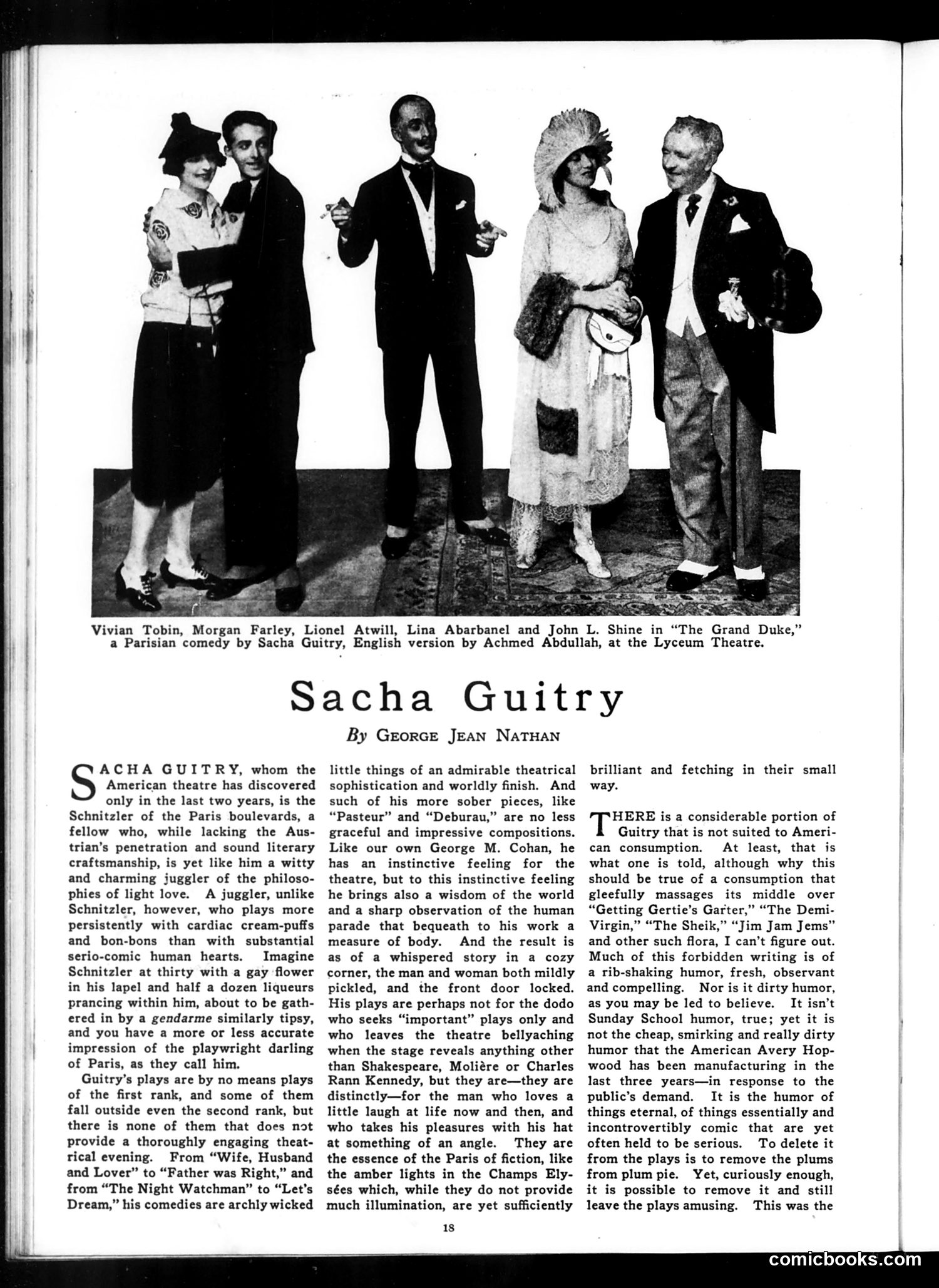
This is not a political cartoon but rather a theatrical feature article and photograph from Judge magazine profiling French playwright Sacha Guitry. The image shows five actors from his play "The Grand Duke" at the Lyceum Theatre. Critic George Jean Nathan argues that Guitry—whom American theatre has recently discovered—is a witty, charming writer of light comedies about romance and human nature, comparable to Austrian playwright Schnitzler. Nathan praises Guitry's theatrical instinct and worldly sophistication, though acknowledges his plays aren't of the "first rank." Nathan notes that some of Guitry's "forbidden" French humor—dealing with adultery and sexual situations—was considered unsuitable for American audiences, though he finds it fresher and less genuinely vulgar than American playwright Avery Hopwood's work. The article suggests that even with risqué content removed, Guitry's plays remain amusing.
📄 Transcribed text from this page (OCR, searchable)
Machine-transcribed from the original scan — historical spelling and the odd misread are preserved.
Vivian Tobin, Morgan Farley, Lionel Atwill, Lina Abarbanel and John L. Shine i a Parisian comedy by Sacha Guitry, English version by Achmed Abdullah, at the Lyceum Theatre. a = n “The Grand Duke,” Sacha Guitry American theatre has discovered only in the last two years, is the Schnitzler of the Paris boulevards, a fellow who, while lacking the Aus- trian’s penetration and sound literary craftsmanship, is yet like him a witty and charming juggler of the philoso- phies of light love. A juggler, unlike Schnitzler, however, who plays more persistently with cardiac cream-puffs and bon-bons than with substantial serio-comic human hearts. Imagine Schnitzler at thirty with a gay flower in his lapel and half a dozen liqueurs prancing within him, about to be gath- ered in by a gendarme similarly tipsy, and you have a more or less accurate impression of the playwright darling of Paris, as they call him. Guitry’s plays are by no means plays of the first rank, and some of them fall outside even the second rank, but there is none of them that does not provide a thoroughly engaging theat- tical evening. From “Wife, Husband and Lover” to “Father was Right,” and from “The Night Watchman” to “Let's Dream,” his comedies are archly wicked G “anerie GUITRY, whom the By Grorce JEAN NATHAN little things of an admirable theatrical sophistication and worldly finish. And such of his more sober pieces, like “Pasteur” and “Deburau,” are no less graceful and impressive compositions. Like our own George M. Cohan, he has an instinctive feeling for the theatre, but to this instinctive feeling he brings also a wisdom of the world and a sharp observation of the human parade that bequeath to his work a measure of body. And the result is as of a whispered story in a cozy corner, the man and woman both mildly pickled, and the front door locked. His plays are perhaps not for the dodo who seeks “important” plays only and who leaves the theatre bellyaching when the stage reveals anything other than Shakespeare, Moliére or Charles Rann Kennedy, but they are—they are distinctly—for the man who loves a little laugh at life now and then, and who takes his pleasures with his hat at something of an angle. They are the essence of the Paris of fiction, like the amber lights in the Champs Ely- sées which, while they do not provide much illumination, are yet sufficiently brilliant and fetching in their small way. HERE is a considerable portion of Guitry that is not suited to Ameri- can consumption. At least, that is what one is told, although why this should be true of a consumption that gleefully massages its middle over “Getting Gertie’s Garter,” “The Demi- Virgin,” “The Sheik,” “Jim Jam Jems” and other such flora, I can’t figure out. Much of this forbidden writing is of a rib-shaking humor, fresh, observant and compelling. Nor is it dirty humor, as you may be led to believe. It isn’t Sunday School humor, true; yet it is not the cheap, smirking and really dirty humor that the American Avery Hop- wood has been manufacturing in the last three years—in response to the public’s demand. It is the humor of things eternal, of things essentially and incontrovertibly comic that are yet often held to be serious. To delete it from the plays is to remove the plums from plum pie. Yet, curiously enough, it is possible to remove it and still leave the plays amusing. This was the comicbooks.com