
Judge, 1921-12-10 · page 27 of 36
Judge — December 10, 1921 — page 27: what you’re looking at
What you’re looking at
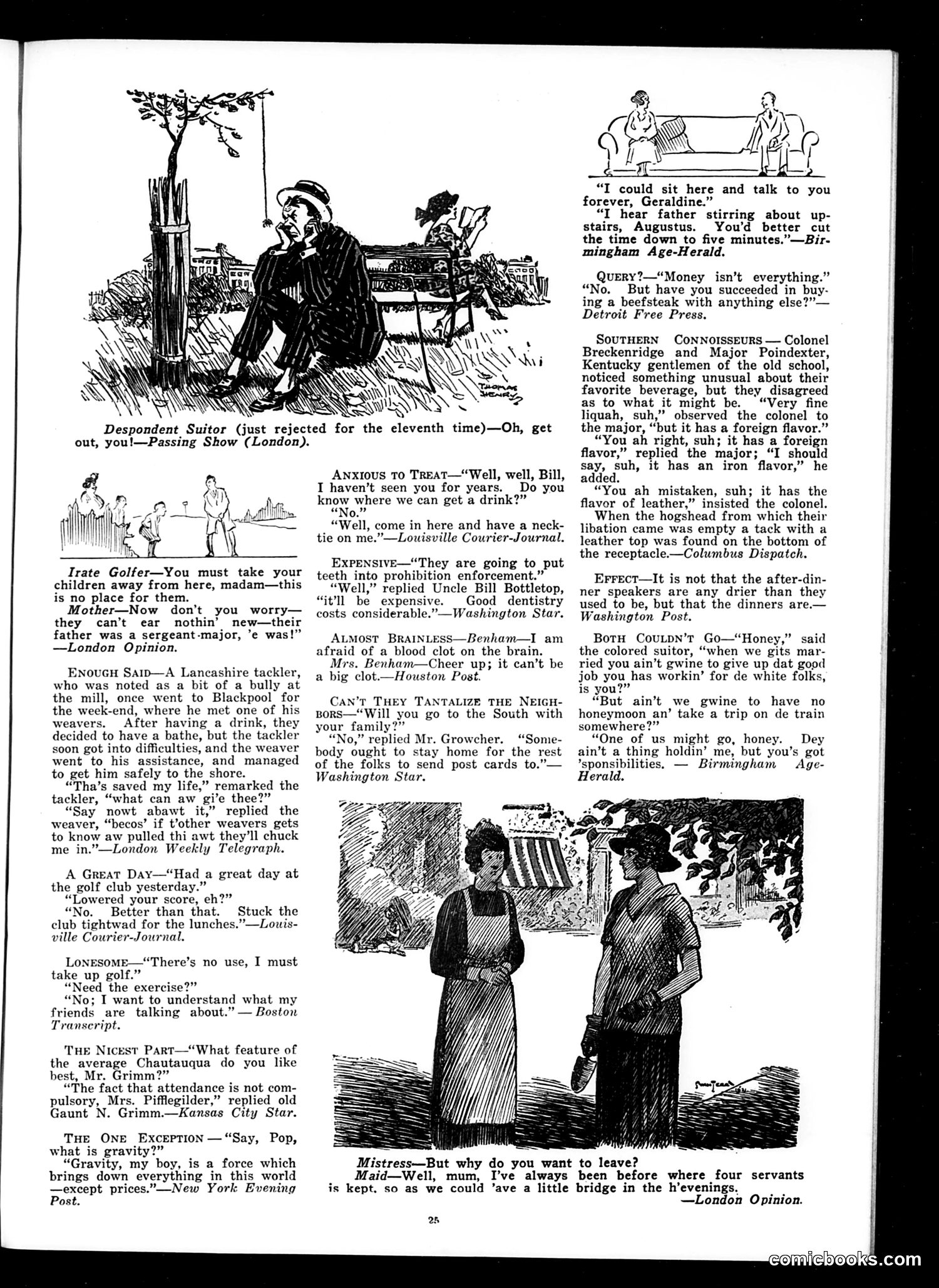
This page from *Judge* magazine contains multiple brief humorous anecdotes mocking various social situations and contemporary issues. **Key satirical themes:** 1. **Class and labor dynamics**: The Lancashire mill story mocks working-class pride—a weaver who saves his boss refuses credit to avoid ridicule from peers. 2. **Prohibition enforcement**: A joke about putting "teeth into prohibition enforcement" plays on dental costs, mocking the difficulty of enforcing Prohibition laws (likely early 1920s context). 3. **Regional stereotypes**: The "Southern Connoisseurs" section uses exaggerated Kentucky dialect to ridicule wealthy Southern gentlemen debating their liquor's "flavor" while unknowingly drinking from a tack-contaminated barrel—satire of both Southern pretension and Prohibition-era bootlegging. 4. **Marital dynamics**: Multiple items mock romance cooling after marriage and romantic inconvenience. 5. **General human folly**: Various jokes target golf obsession, social climbing, and self-deception. The cartoons illustrate social awkwardness and class tensions typical of early 20th-century American humor.
📄 Transcribed text from this page (OCR, searchable)
Machine-transcribed from the original scan — historical spelling and the odd misread are preserved.
Irate Golfer—You must take your children away from here, madam—this is no place for them. Mother—Now don’t you worry— they can’t ear nothin’ new—their father was a sergeant-major, ’e was!” —London Opinion. EnouGH Saip—A Lancashire tackler, who was noted as a bit of a bully at the mill, once went to Blackpool for the week-end, where he met one of his weavers. After having a drink, they decided to have a bathe, but the tackler soon got into difficulties, and the weaver went to his assistance, and managed to get him safely to the shore. “Tha’s saved my life,” remarked the tackler, “what can aw gi’e thee?” “Say nowt abawt it,” replied the weaver, “becos’ if t’other weavers gets to know aw pulled thi awt they’ll chuck me in.”—London Weekly Telegraph. A Great Day—“Had a great day at the golf club yesterday.” “Lowered your score, eh?” “No. Better than that. Stuck the club tightwad for the lunches.”—Louis- ville Courier-Journal. LonEsoME—“There’s no use, I must take up golf.” “Need the exercise?” “No; I want to understand what my friends are talking about.” — Boston Transcript. THE Nicest Part—“What feature of the average Chautauqua do you like best, Mr. Grimm?” “The fact that attendance is not com- pulsory, Mrs. Pifflegilder,” replied old Gaunt N. Grimm.—Kansas City Star. THE ONE ExcEePTION — “Say, Pop, what is gravity?” “Gravity, my boy, is a force which brings down everything in this world powent prices.".—New York Evening ost. ANXIOUS TO TREAT—“Well, well, Bill, I haven’t seen you for years. Do you know where we can get a drink?” “No.” “Well, come in here and have a neck- tie on me.”—Louisville Courier-Journal. EXPENSIVE—“They are going to put teeth into prohibition enforcement.” “Well,” replied Uncle Bill Bottletop, “it'll be expensive. Good dentistry costs considerable.”—Washington Star. ALMOST BRAINLESS—Benham—I am afraid of a blood clot on the brain. Mrs. Benham—Cheer up; it can’t be a big clot—Houston Post. Can’? THEY TANTALIZE THE NEIGH- Bors—“Will you go to the South with your family?” “No,” replied Mr. Growcher. “Some- body ought to stay home for the rest of the folks to send post cards to.”— Washington Star. Mistress—But why do you want to leave? $ a \ 33) \— ive “I could sit here and talk to you forever, Geraldine.” “I hear father stirring about up- stairs, Augustus. You’d better cut the time down to five minutes.”—Bir- mingham Age-Herald. QuERY?—“Money isn’t everything.” “No. But have you succeeded in buy- ing a beefsteak with anything else?”— Detroit Free Press. SouTHERN CONNOISSEURS — Colonel Breckenridge and Major Poindexter, Kentucky gentlemen of the old school, noticed something unusual about their favorite beverage, but they disagreed as to what it might be. “Very fine liquah, suh,” observed the colonel to the major, “but it has a foreign flavor.” “You ah right, suh; it has a foreign flavor,” replied the major; “I should say, suh, it has an iron flavor,” he added. “You ah mistaken, suh; it has the flavor of leather,” insisted the colonel. When the hogshead from which their libation came was empty a tack with a leather top was found on the bottom of the receptacle-—Columbus Dispatch. Errect—It is not that the after-din- ner speakers are any drier than they used to be, but that the dinners are.— Washington Post. BotH CouLpn’t Go—‘Honey,” said the colored suitor, “when we gits mar- ried you ain’t gwine to give up dat good job you has workin’ for de white folks, is you?” “But ain’t we gwine to have no honeymoon an’ take a trip on de train somewhere?” “One of us might go, honey. Dey ain’t a thing holdin’ me, but you’s got *sponsibilities. — Birmingham Herald. Age- Maid—Well, mum, I’ve always been before where four servants is kept. so as we could ’ave a little bridge in the h’evenings. 25 —London Opinion.