
Judge, 1921-12-10 · page 28 of 36
Judge — December 10, 1921 — page 28: what you’re looking at
What you’re looking at
This page from *Judge* contains several brief humorous anecdotes typical of early 20th-century American satirical magazines: **Key Content:** The most historically significant piece is "Re-hearsing His Funeral," a racist joke about two Black soldiers returning from WWI France. One describes dressing in all white clothing to walk with white people in Richmond, Virginia; the other responds he'll dress in black and follow behind as the first man's "hearse"—implying the first man will be killed for such behavior. This darkly satirizes Jim Crow segregation and the violence Black Americans faced, particularly veterans returning from fighting for their country. Other anecdotes mock rural life, small-town newspapers, and include wordplay (a surgeon operating on a dead "motor"/car). One features a "negress" character referencing the Bluebeard folklore. **Context:** These pieces reflect *Judge's* reliance on ethnic/racial humor and small-town Americana stereotypes common in early 20th-century American publications—content that would be considered deeply offensive today.
📄 Transcribed text from this page (OCR, searchable)
Machine-transcribed from the original scan — historical spelling and the odd misread are preserved.
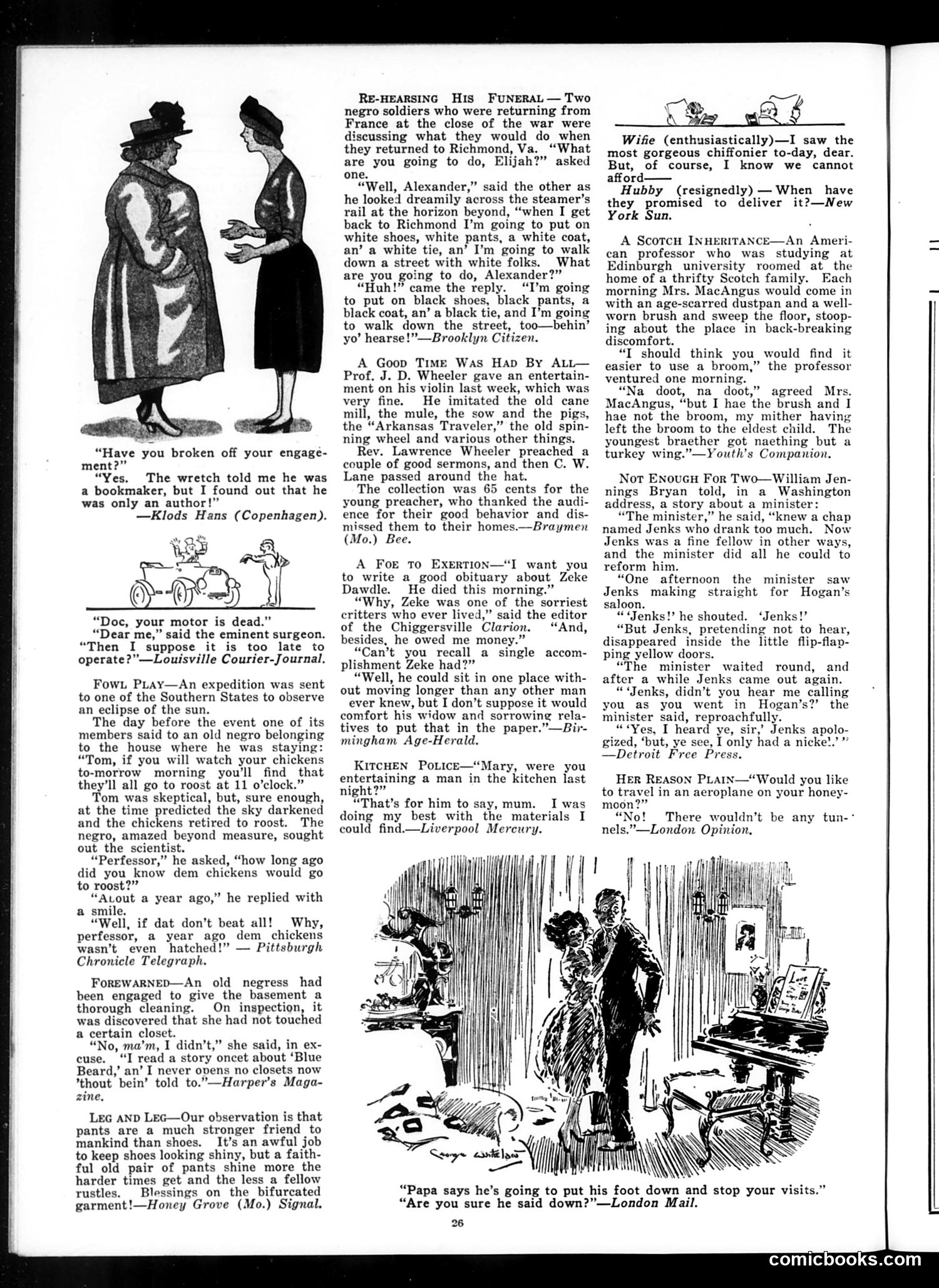
“Have you broken off your engage- ment?” “Yes. The wretch told me he was a bookmaker, but I found out that he was only an author!” —Klods Hans (Copenhagen). “Doc, your motor is dead.” “Dear me,” said the eminent surgeon. “Then I suppose it is too late to operate?”—Louisville Courier-Journal. Fow. PLay—An expedition was sent to one of the Southern States to observe an eclipse of the sun. The day before the event one of its members said to an old negro belonging to the house where he was staying: “Tom, if you will watch your chickens to-morrow morning you'll find that they’ll all go to roost at 11 o’clock.” Tom was skeptical, but, sure enough, at the time predicted the sky darkened and the chickens retired to roost. The negro, amazed beyond measure, sought out the scientist. “Perfessor,” he asked, “how long ago did you know dem chickens would go to roost?” “Avout a year ago,” he replied with a smile. “Well, if dat don’t beat all! Why, perfessor, a year ago dem chickens wasn’t even hatched!” — Pittsburgh Chronicle Telegraph. FoREWARNED—An old negress had been engaged to give the basement a thorough cleaning. On inspection, it was discovered that she had not touched a certain closet. “No, ma’m, I didn’t,” she said, in ex- cuse. “I read a story oncet about ‘Blue Beard,’ an’ I never ovens no closets now *thout bein’ told to.”—Harper’s Maga- zine, Lec AND LeEc—Our observation is that pants are a much stronger friend to mankind than shoes. It’s an awful job to keep shoes looking shiny, but a faith- ful old pair of pants shine more the harder times get and the less a fellow rustles. Blessings on the bifurcated garment!—Honey Grove (Mo.) Signal. RE-HEARSING HIS FUNERAL — Two negro soldiers who were returning from France at the close of the war were discussing what they would do when they returned to Richmond, Va. “What are you going to do, Elijah?” asked one. “Well, Alexander,” said the other as he looked dreamily across the steamer’s rail at the horizon beyond, “when I get back to Richmond I’m going to put on white shoes, white pants, a white coat, an’ a white tie, an’ I’m going to walk down a street with white folks. What are you going to do, Alexander?” “Huh!” came the reply. “I’m going to put on black shoes, black pants, a black coat, an’ a black tie, and I’m going to walk down the street, too—behin’ yo’ hearse!”—Brooklyn Citizen. A Goon Time Was Hap By ALL— Prof. J. D. Wheeler gave an entertain- ment on his violin last week, which was very fine. He imitated the old cane mill, the mule, the sow and the pigs, the “Arkansas Traveler,” the old spin- ning wheel and various other things. Rev. Lawrence Wheeler preached a couple of good sermons, and then C. W. Lane passed around the hat. The collection was 65 cents for the young preacher, who thanked the audi- ence for their good behavior and dis- missed them to their homes.—Braymen (Mo.) Bee. A Foe To ExerTion—“I want you to write a good obituary about Zeke Dawdle. He died this morning.” “Why, Zeke was one of the sorriest critters who ever lived,” said the editor of the Chiggersville Clarion. “And, besides, he owed me money.” “Can’t you recall a single accom- plishment Zeke had?” “Well, he could sit in one place with- out moving longer than any other man ever knew, but I don’t suppose it would comfort his widow and sorrowing rela- tives to put that in the paper.”—Bir- mingham Age-Herald. KitcHEN PoLice—‘Mary, were you entertaining a man in the kitchen last night?” “That’s for him to say, mum. I was doing my best with the materials I could find.—Liverpool Mercury. Wifie (enthusiastically)—I saw the most gorgeous chiffonier to-day, dear. But, of course, I know we cannot afford. Hubby (resignedly) — When have they promised to deliver it?—New York Sun. A ScotcH INHERITANCE—An Ameri- can professor who was studying at Edinburgh university roomed at the home of a thrifty Scotch family. Each morning Mrs. MacAngus would come in with an age-scarred dustpan and a well- worn brush and sweep the floor, stoop- ing about the place in back-breaking discomfort. “I should think you would find it easier to use a broom,” the professor ventured one morning. “Na doot, na_doot,” agreed Mrs. MacAngus, “but I hae the brush and I hae not the broom, my mither having left the broom to the eldest child. The youngest braether got naething but a turkey wing.”—Youth’s Companion. Not ENnouGH For Two—William Jen- nings Bryan told, in a Washington address, a story about a minister: “The minister,” he said, “knew a chap named Jenks who drank too much. Now Jenks was a fine fellow in other ways, and the minister did all he could to reform him. “One afternoon the minister saw Jenks making straight for Hogan’s saloon. “ ‘Jenks!’ he shouted. ‘Jenks!’ “But Jenks, pretending not to hear, disappeared inside the little flip-flap- ping yellow doors. “The minister waited round, and after a while Jenks came out again. “‘Jenks, didn’t you hear me calling you as you went in Hogan’s?’ the minister said, reproachfully. “Yes, I heard ye, sir,’ Jenks apolo- gized, ‘but, ye see, I only had a nicke!.’” —Detroit Free Press. HeR REASON PLAIN—“Would you like to travel in an aeroplane on your honey- moon?” “No! There wouldn’t be any tun-* nels.”—London Opinion, “Papa says he’s going to put his foot down and stop your visits.” “Are you sure he said down?”—London Mail. 26 comicbooks.com