
Judge, 1921-12-10 · page 8 of 36
Judge — December 10, 1921 — page 8: what you’re looking at
What you’re looking at
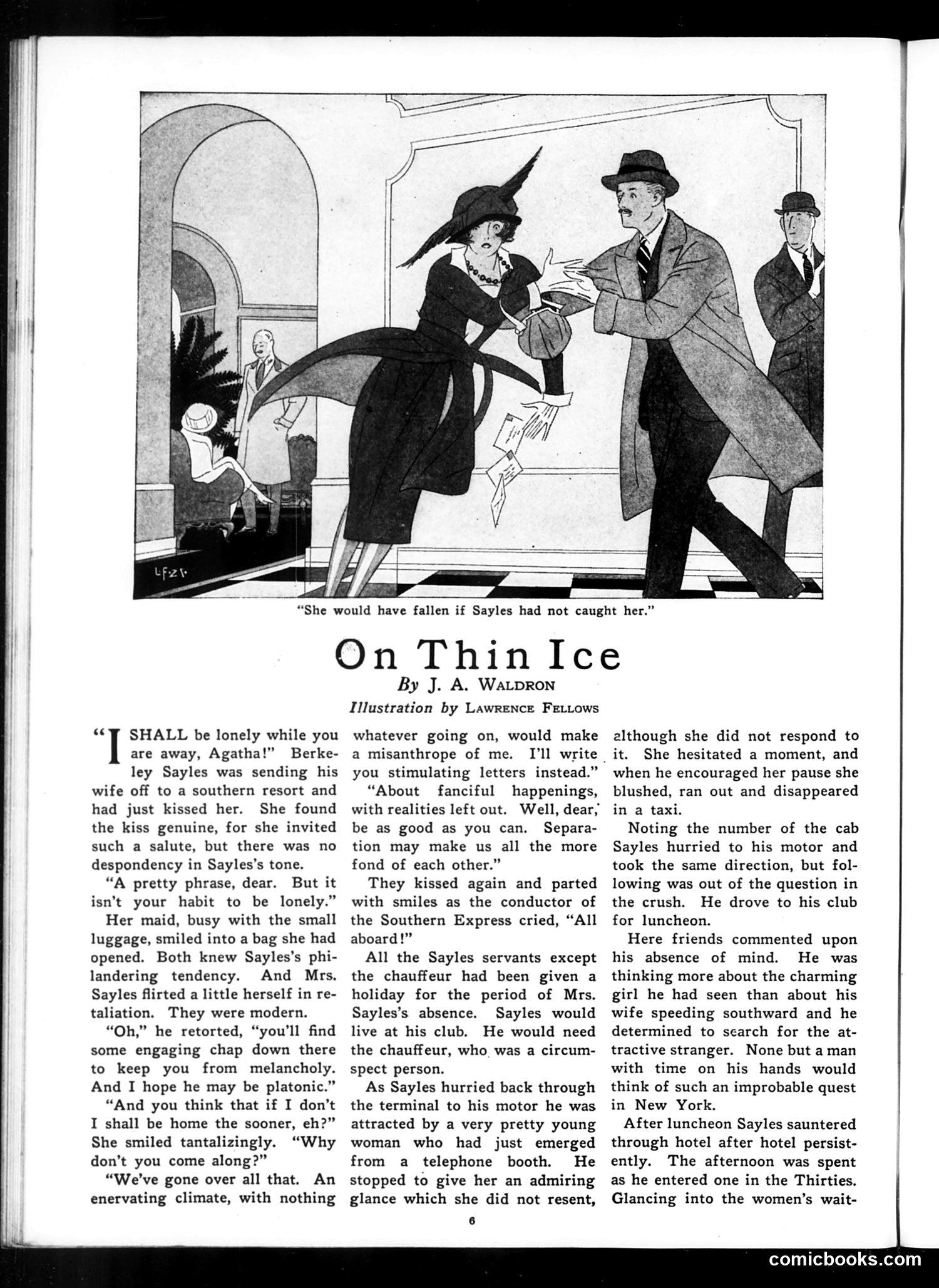
This is a short story illustration satirizing 1920s marital infidelity among the wealthy. Berkeley Sayles sends his wife away to a southern resort while pretending devotion, though both openly acknowledge his philandering tendency. The couple practices modern, cynical tolerance of each other's affairs. The satire targets Sayles specifically: despite his wife's departure, he immediately pursues an attractive stranger at the train station, obsessively tracking her taxi and spending his afternoon hotel-hopping to find her. The irony is sharp—his promise of "stimulating letters" and claims about separation strengthening their bond are instantly betrayed by his compulsive womanizing. The illustration captures the moment where Sayles "catches" the woman, suggesting the predatory nature of his behavior. The story mocks upper-class moral hypocrisy: marriage has become a transactional arrangement where infidelity is accepted as long as it's discreet. The title "On Thin Ice" foreshadows complications ahead.
📄 Transcribed text from this page (OCR, searchable)
Machine-transcribed from the original scan — historical spelling and the odd misread are preserved.
“She would have fallen if Sayles had not caught her.’ On Thin Ice “SW SHALL be lonely while you are away, Agatha!” Berke- ley Sayles was sending his wife off to a southern resort and had just kissed her. She found the kiss genuine, for she invited such a salute, but there was no despondency in Sayles’s tone. “A pretty phrase, dear. But it isn’t your habit to be lonely.” Her maid, busy with the small luggage, smiled into a bag she had opened. Both knew Sayles’s phi- landering tendency. And Mrs. Sayles flirted a little herself in re- taliation. They were modern. “Oh,” he retorted, “you'll find some engaging chap down there to keep you from melancholy. And I hope he may be platonic.” “And you think that if I don’t I shall be home the sooner, eh?” She smiled tantalizingly. “Why don’t you come along?” “We've gone over all that. An enervating climate, with nothing By J. A. WatprRon Illustration by Lawrence FEettows whatever going on, would make a misanthrope of me. you stimulating letters instead.” “About fanciful happenings, with realities left out. Well, dear, be as good as you can. Separa- tion may make us all the more fond of each other.” They kissed again and parted with smiles as the conductor of the Southern Express cried, “All aboard!” All the Sayles servants except the chauffeur had been given a holiday for the period of Mrs. Sayles’s absence. Sayles would live at his club. He would need the chauffeur, who was a circum- spect person. As Sayles hurried back through the terminal to his motor he was attracted by a very pretty young woman who had just emerged from a telephone booth. He stopped to give her an admiring glance which she did not resent, 6 I'll write | although she did not respond to it. She hesitated a moment, and when he encouraged her pause she blushed, ran out and disappeared in a taxi. Noting the number of the cab Sayles hurried to his motor and took the same direction, but fol- lowing was out of the question in the crush. He drove to his club for luncheon. Here friends commented upon his absence of mind. He was thinking more about the charming girl he had seen than about his wife speeding southward and he determined to search for the at- tractive stranger. None but aman with time on his hands would think of such an improbable quest in New York. After luncheon Sayles sauntered through hotel after hotel persist- ently. The afternoon was spent as he entered one in the Thirties. Glancing into the women’s wait- comicbooks.com