
Judge, 1921-12-10 · page 12 of 36
Judge — December 10, 1921 — page 12: what you’re looking at
What you’re looking at
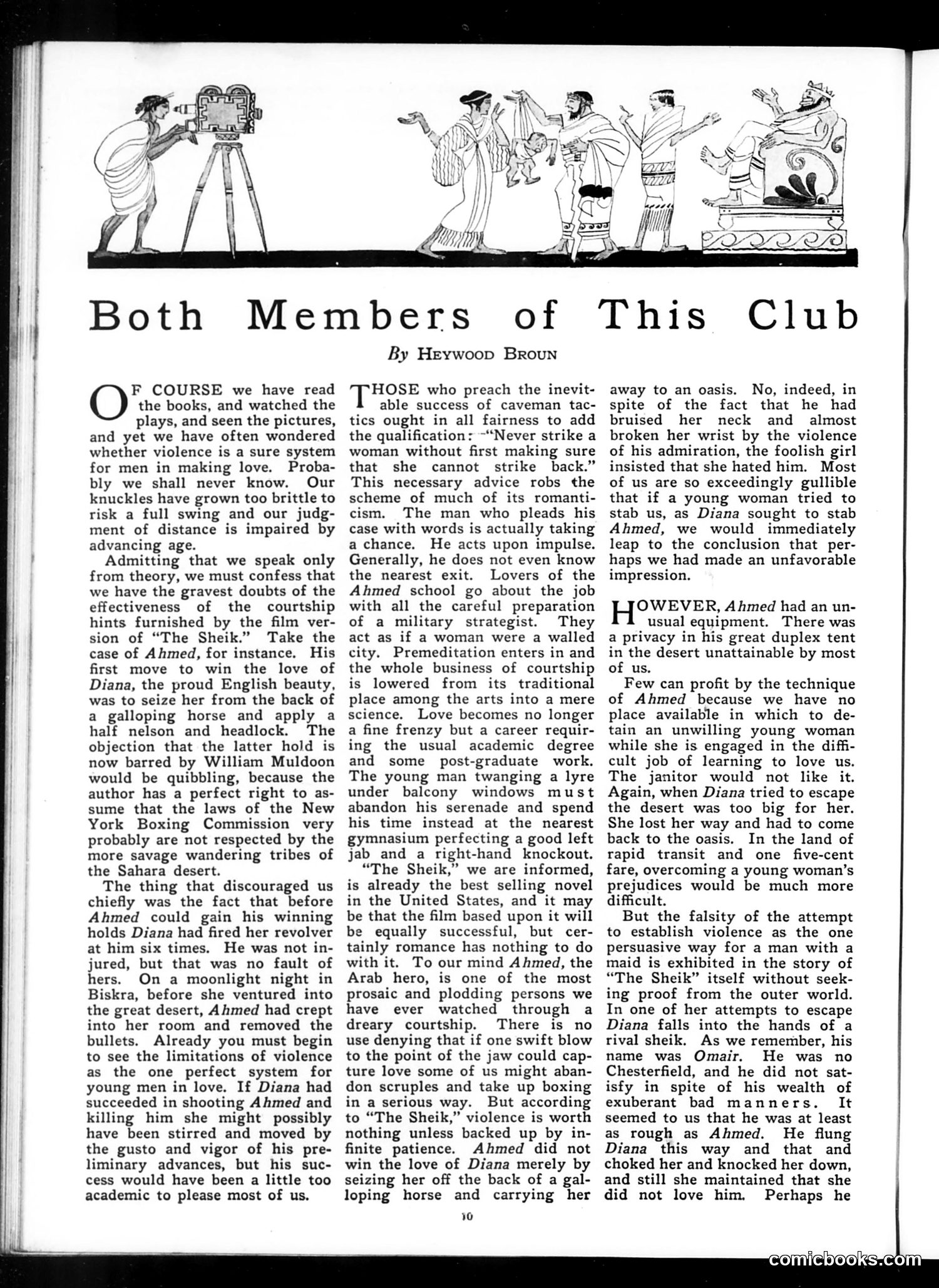
This piece by Heywood Broun satirizes *The Sheik*, a wildly popular 1921 novel (and film adaptation) about an Arab man named Ahmed who forcibly abducts an English woman named Diana into the desert. The cartoon's header depicts a film production scene, establishing the context of cinema's influence on romance narratives. Broun's essay mocks the book's endorsement of violent courtship tactics. He argues that Ahmed's method—kidnapping Diana by seizing her from a horse, applying wrestling holds—is presented as romantic but is actually impractical and counterproductive. He notes that Diana initially shoots at Ahmed six times (foiled only because he'd removed her bullets), highlighting the absurdity of promoting physical force. The satire targets both the novel's logic and society's uncritical consumption of it. Broun points out that successful romance in *The Sheik* requires not spontaneous passion but calculated military strategy—reducing love to a "science" requiring "academic degree and post-graduate work." The critique is fundamentally about how popular media romanticizes male aggression and female submission.
📄 Transcribed text from this page (OCR, searchable)
Machine-transcribed from the original scan — historical spelling and the odd misread are preserved.
——— Both Members F COURSE we have read O the books, and watched the plays, and seen the pictures, and yet we have often wondered whether violence is a sure system for men in making love. Proba- bly we shall never know. Our knuckles have grown too brittle to risk a full swing and our judg- ment of distance is impaired by advancing age. Admitting that we speak only from theory, we must confess that we have the gravest doubts of the effectiveness of the courtship hints furnished by the film ver- sion of “The Sheik.” Take the case of Ahmed, for instance. His first move to win the love of Diana, the proud English beauty, was to seize her from the back of a galloping horse and apply a half nelson and headlock. The objection that the latter hold is now barred by William Muldoon would be quibbling, because the author has a perfect right to as- sume that the laws of the New York Boxing Commission very probably are not respected by the more savage wandering tribes of the Sahara desert. The thing that discouraged us chiefly was the fact that before Ahmed could gain his winning holds Diana had fired her revolver at him six times. He was not in- jured, but that was no fault of hers. On a moonlight night in Biskra, before she ventured into the great desert, Ahmed had crept into her room and removed the bullets. Already you must begin to see the limitations of violence as the one perfect system for young men in love. If Diana had succeeded in shooting Ahmed and killing him she might possibly have been stirred and moved by the gusto and vigor of his pre- liminary advances, but his suc- cess would have been a little too academic to please most of us. & THOS who preach the inevit- able success of caveman tac- tics ought in all fairness to add the qualification: “Never strike a woman without first making sure that she cannot strike back.” This necessary advice robs the scheme of much of its romanti- cism. The man who pleads his case with words is actually taking achance. He acts upon impulse. Generally, he does not even know the nearest exit. Lovers of the Ahmed school go about the job with all the careful preparation of a military strategist. They act as if a woman were a walled city. Premeditation enters in and the whole business of courtship is lowered from its traditional place among the arts into a mere science. Love becomes no longer a fine frenzy but a career requir- ing the usual academic degree and some post-graduate work. The young man twanging a lyre under balcony windows must abandon his serenade and spend his time instead at the nearest gymnasium perfecting a good left jab and a right-hand knockout. “The Sheik,” we are informed, is already the best selling novel in the United States, and it may be that the film based upon it will be equally successful, but cer- tainly romance has nothing to do with it. To our mind Ahmed, the Arab hero, is one of the most prosaic and plodding persons we have ever watched through a dreary courtship. There is no use denying that if one swift blow to the point of the jaw could cap- ture love some of us might aban- don scruples and take up boxing in a serious way. But according to “The Sheik,” violence is worth nothing unless backed up by in- finite patience. Ahmed did not win the love of Diana merely by seizing her off the back of a gal- loping horse and carrying her 10 of This Club By Heywoop Broun away to an oasis. No, indeed, in spite of the fact that he had bruised her neck and almost broken her wrist by the violence of his admiration, the foolish girl insisted that she hated him. Most of us are so exceedingly gullible that if a young woman tried to stab us, as Diana sought to stab Ahmed, we would immediately leap to the conclusion that per- haps we had made an unfavorable impression. OWEVER, Ahmed had an un- usual equipment. There was a privacy in his great duplex tent in the desert unattainable by most of us. Few can profit by the technique of Ahmed because we have no place available in which to de- tain an unwilling young woman while she is engaged in the diffi- cult job of learning to love us. The janitor would not like it. Again, when Diana tried to escape the desert was too big for her. She lost her way and had to come back to the oasis. In the land of rapid transit and one five-cent fare, overcoming a young woman’s prejudices would be much more difficult. But the falsity of the attempt to establish violence as the one persuasive way for a man with a maid is exhibited in the story of “The Sheik” itself without seek- ing proof from the outer world. In one of her attempts to escape Diana falls into the hands of a rival sheik. As we remember, his name was Omair. He was no Chesterfield, and he did not sat- isfy in spite of his wealth of exuberant bad manners. It seemed to us that he was at least as rough as Ahmed. He flung Diana this way and that and choked her and knocked her down, and still she maintained that she did not love him. Perhaps he Comicbooks-com