
Judge, 1921-12-10 · page 16 of 36
Judge — December 10, 1921 — page 16: what you’re looking at
What you’re looking at
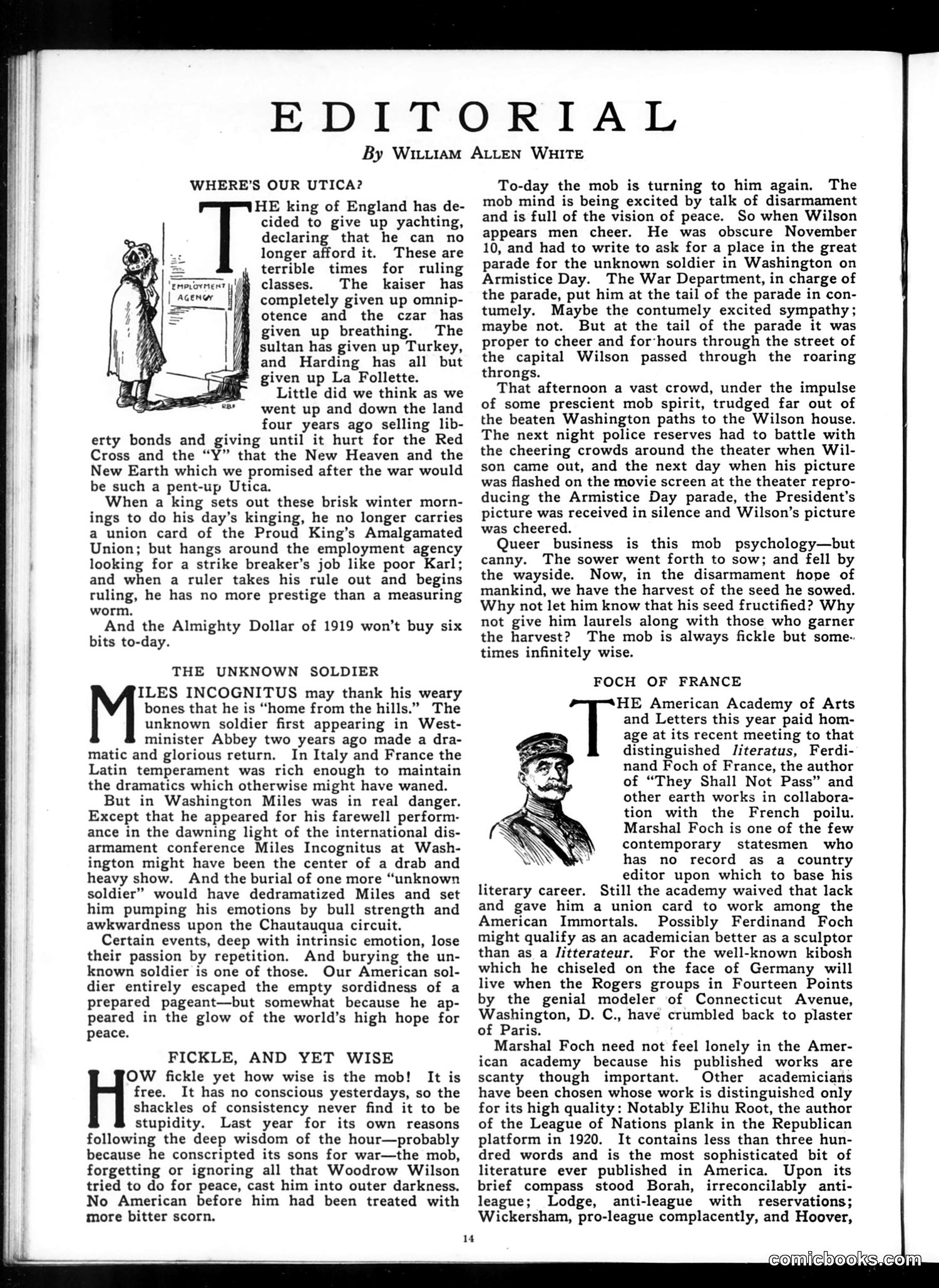
This editorial page by William Allen White satirizes post-WWI disillusionment. The cartoon depicts a figure labeled "EMPLOYMENT AGENCY" showing how monarchs and rulers—including England's king, the kaiser, the czar, and the sultan—have lost their power and prestige after the war, now seeking ordinary jobs like "strike breaker." White's main target is the broken promises of 1919. Americans sacrificed enormously (selling liberty bonds, donating to Red Cross) believing the war would create a utopian "New Heaven and New Earth," but instead got what he sarcastically calls a "pent-up Utica"—a cramped, disappointing reality where even the dollar has lost value. The editorials also address public fickleness regarding Woodrow Wilson: last year the mob scorned him for the war; now they cheer him for peace advocacy. White observes how the emotionally fickle but ultimately "wise" mob operates without historical memory—a pointed critique of democratic inconsistency.
📄 Transcribed text from this page (OCR, searchable)
Machine-transcribed from the original scan — historical spelling and the odd misread are preserved.
EDITORIAL By Wiiu1am ALLEN WHITE WHERE'S OUR UTICA? HE king of England has de- cided to give up yachting, declaring that he can no longer afford it. These are terrible times for ruling classes. The kaiser has completely given up omnip- otence and the czar has given up breathing. The sultan has given up Turkey, and Harding has all but given up La Follette. Little did we think as we went up and down the land four years ago selling lib- erty bonds and giving until it hurt for the Red Cross and the “Y” that the New Heaven and the New Earth which we promised after the war would be such a pent-up Utica. When a king sets out these brisk winter morn- ings to do his day’s kinging, he no longer carries a union card of the Proud King’s Amalgamated Union; but hangs around the employment agency looking for a strike breaker’s job like poor Karl; and when a ruler takes his rule out and begins ruling, he has no more prestige than a measuring worm. And the Almighty Dollar of 1919 won’t buy six bits to-day. THE UNKNOWN SOLDIER ILES INCOGNITUS may thank his weary bones that he is “home from the hills.” The unknown soldier first appearing in West- minister Abbey two years ago made a dra- matic and glorious return. In Italy and France the Latin temperament was rich enough to maintain the dramatics which otherwise might have waned. But in Washington Miles was in real danger. Except that he appeared for his farewell perform- ance in the dawning light of the international dis- armament conference Miles Incognitus at Wash- ington might have been the center of a drab and heavy show. And the burial of one more “unknown soldier” would have dedramatized Miles and set him pumping his emotions by bull strength and awkwardness upon the Chautauqua circuit. Certain events, deep with intrinsic emotion, lose their passion by repetition. And burying the un- known soldier is one of those. Our American sol- dier entirely escaped the empty sordidness of a prepared pageant—but somewhat because he ap- peared in the glow of the world’s high hope for peace. FICKLE, AND YET WISE OW fickle yet how wise is the mob! It is free. It has no conscious yesterdays, so the shackles of consistency never find it to be stupidity. Last year for its own reasons following the deep wisdom of the hour—probably because he conscripted its sons for war—the mob, forgetting or ignoring all that Woodrow Wilson tried to do for peace, cast him into outer darkness. No American before him had been treated with more bitter scorn. To-day the mob is turning to him again. The mob mind is being excited by talk of disarmament and is full of the vision of peace. So when Wilson appears men cheer. He was obscure November 10, and had to write to ask for a place in the great parade for the unknown soldier in Washington on Armistice Day. The War Department, in charge of the parade, put him at the tail of the parade in con- tumely. Maybe the contumely excited sympathy; maybe not. But at the tail of the parade it was proper to cheer and for-hours through the street of the capital Wilson passed through the roaring throngs. That afternoon a vast crowd, under the impulse of some prescient mob spirit, trudged far out of the beaten Washington paths to the Wilson house. The next night police reserves had to battle with the cheering crowds around the theater when Wil- son came out, and the next day when his picture was flashed on the movie screen at the theater repro- ducing the Armistice Day parade, the President’s picture was received in silence and Wilson’s picture was cheered. Queer business is this mob psychology—but canny. The sower went forth to sow; and fell by the wayside. Now, in the disarmament hope of mankind, we have the harvest of the seed he sowed. Why not let him know that his seed fructified? Why not give him laurels along with those who garner the harvest? The mob is always fickle but some- times infinitely wise. FOCH OF FRANCE HE American Academy of Arts and Letters this year paid hom- age at its recent meeting to that distinguished Jiteratus, Ferdi- nand Foch of France, the author of “They Shall Not Pass” and other earth works in collabora- tion with the French poilu. Marshal Foch is one of the few contemporary statesmen who has no record as a country editor upon which to base his literary career. Still the academy waived that lack and gave him a union card to work among the American Immortals. Possibly Ferdinand Foch might qualify as an academician better as a sculptor than as a litterateur. For the well-known kibosh which he chiseled on the face of Germany will live when the Rogers groups in Fourteen Points by the genial modeler of Connecticut Avenue, Washington, D. C., have crumbled back to plaster of Paris. Marshal Foch need not feel lonely in the Amer- ican academy because his published works are scanty though important. Other academicians have been chosen whose work is distinguished only for its high quality: Notably Elihu Root, the author of the League of Nations plank in the Republican platform in 1920. It contains less than three hun- dred words and is the most sophisticated bit of literature ever published in America. Upon its brief compass stood Borah, irreconcilably anti- league; Lodge, anti-league with reservations; Wickersham, pro-league complacently, and Hoover, COMIEHOOKSsCOn