
Judge, 1921-12-10 · page 21 of 36
Judge — December 10, 1921 — page 21: what you’re looking at
What you’re looking at
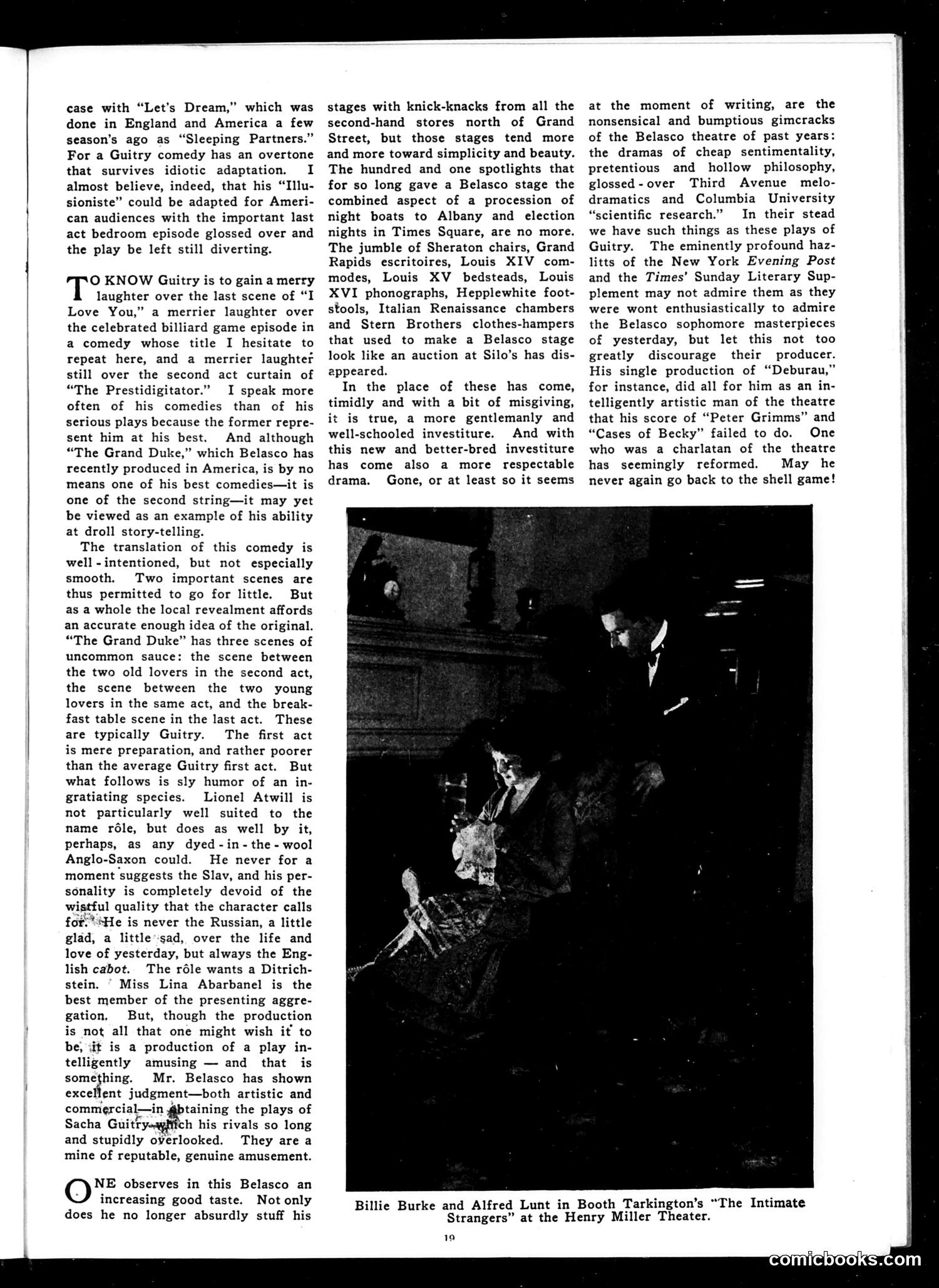
This page is primarily **theater criticism**, not political satire. The author reviews David Belasco's production of Sacha Guitry's French comedy "The Grand Duke" at the Henry Miller Theatre. The accompanying photograph shows **Billie Burke and Alfred Lunt** in a different Guitry play, "The Intimate Strangers," providing performance context. The critic praises Belasco's recent artistic evolution: moving away from cluttered, ostentatious stage design (excessive spotlights, mismatched furniture from junk shops—"Grand Rapids escritoires, Louis XIV commodes") toward elegant simplicity. This represents a shift toward more respectable, refined theatrical taste. The review critiques actor Lionel Atwill as miscast (too Anglo-Saxon, lacking the melancholic Slavic qualities the role requires) and praises Lina Abarbanel's performance. Overall, the critic views the production as "intelligently amusing" despite imperfect translation and casting—a respectable example of Belasco's improved judgment in adapting Guitry's comedies.
📄 Transcribed text from this page (OCR, searchable)
Machine-transcribed from the original scan — historical spelling and the odd misread are preserved.
case with “Let's Dream,” which was done in England and America a few season’s ago as “Sleeping Partners.” For a Guitry comedy has an overtone that survives idiotic adaptation. I almost believe, indeed, that his “Illu- sioniste” could be adapted for Ameri- can audiences with the important last act bedroom episode glossed over and the play be left still diverting. O KNOW Guitry is to gain a merry laughter over the last scene of “I Love You,” a merrier laughter over the celebrated billiard game episode in a comedy whose title I hesitate to repeat here, and a merrier laughter still over the second act curtain of “The Prestidigitator.” I speak more often of his comedies than of his serious plays because the former repre- sent him at his best. And although “The Grand Duke,” which Belasco has recently produced in America, is by no means one of his best comedies—it is one of the second string—it may yet be viewed as an example of his ability at droll story-telling. The translation of this comedy is well-intentioned, but not especially smooth. Two important scenes are thus permitted to go for little. But as a whole the local revealment affords an accurate enough idea of the original. “The Grand Duke” has three scenes of uncommon sauce: the scene between the two old lovers in the second act, the scene between the two young lovers in the same act, and the break- fast table scene in the last act. These are typically Guitry. The first act is mere preparation, and rather poorer than the average Guitry first act. But what follows is sly humor of an in- gratiating species. Lionel Atwill is not particularly well suited to the name réle, but does as well by it, perhaps, as any dyed -in- the - wool Anglo-Saxon could. He never for a moment suggests the Slav, and his per- sonality is completely devoid of the istful quality that the character calls fi tHe is never the Russian, a little glad, a little sad, over the life and love of yesterday, but always the Eng- lish cabot. The rdle wants a Ditrich- stein. Miss Lina Abarbanel is the best member of the presenting aggre- gation, But, though the production is not all that one might wish it to be, iit is a production of a play in- telligently amusing — and that is something. Mr. Belasco has shown excellent judgment—both artistic and commercial—in taining the plays of Sacha Guitry. ich his rivals so long and stupidly overlooked. They are a mine of reputable, genuine amusement. NE observes in this Belasco an increasing good taste. Not only does he no longer absurdly stuff his stages with knick-knacks from all the second-hand stores north of Grand Street, but those stages tend more and more toward simplicity and beauty. The hundred and one spotlights that for so long gave a Belasco stage the combined aspect of a procession of night boats to Albany and election nights in Times Square, are no more. The jumble of Sheraton chairs, Grand Rapids escritoires, Louis XIV com- modes, Louis XV _ bedsteads, Louis XVI phonographs, Hepplewhite foot- stools, Italian Renaissance chambers and Stern Brothers clothes-hampers that used to make a Belasco stage look like an auction at Silo’s has dis- appeared. In the place of these has come, timidly and with a bit of misgiving, it is true, a more gentlemanly and well-schooled investiture. And with this new and better-bred investiture has come also a more respectable drama. Gone, or at least so it seems at the moment of writing, are the nonsensical and bumptious gimcracks of the Belasco theatre of past years: the dramas of cheap sentimentality, pretentious and hollow philosophy, glossed-over Third Avenue melo- dramatics and Columbia University “scientific research.” In their stead we have such things as these plays of Guitry. The eminently profound haz- litts of the New York Evening Post and the Times’ Sunday Literary Sup- plement may not admire them as they were wont enthusiastically to admire the Belasco sophomore masterpieces of yesterday, but let this not too greatly discourage their producer. His single production of “Deburau,” for instance, did all for him as an in- telligently artistic man of the theatre that his score of “Peter Grimms” and “Cases of Becky” failed to do. One who was a charlatan of the theatre has seemingly reformed. May he never again go back to the shell game! Billie Burke and Alfred Lunt in Booth Tarkington’s “The Intimate Strangers” at the Henry Miller Theater. 19