
A complete issue · 36 pages · 1920
Judge — May 1, 1920
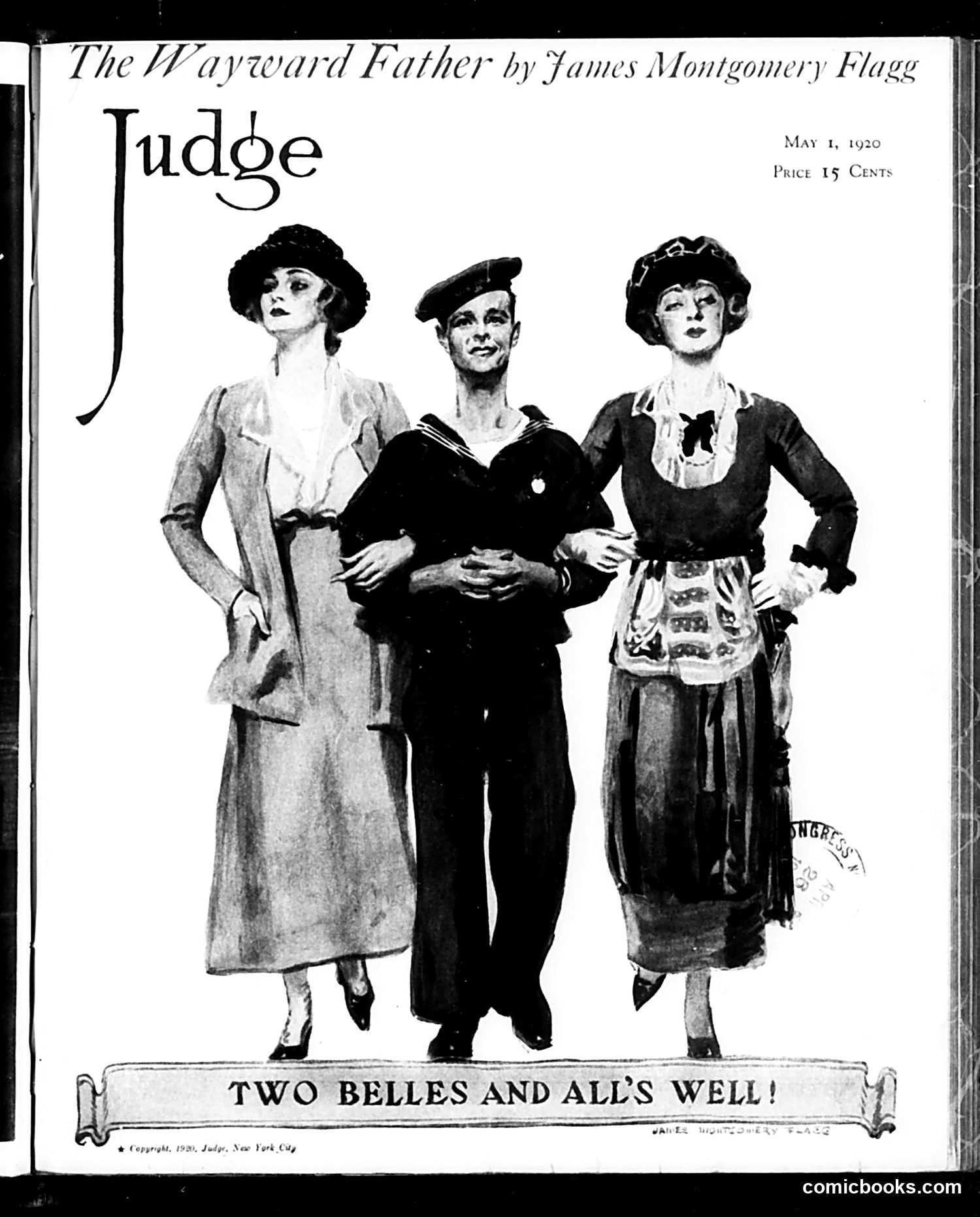
This cover illustrates "The Wayward Father" by James Montgomery Flagg, featuring three figures with the caption "Two Belles and All's Well!" The image shows two women flanking a sailor in the center. The satire appears to target infidelity or romantic complications—the "wayward father" of the title suggests a man straying from family obligations, while "two belles" indicates he's involved with multiple women. The sailor costume and the magazine's 1920 date suggest this may reference post-WWI themes, when returning servicemen faced readjustment to civilian life. The overall tone is lighthearted rather than condemnatory, treating the subject as comedic rather than morally serious—typical of Judge's satirical approach to social behavior and domestic situations of the era.
This is **not a cartoon or satirical content** — it's a straightforward advertisement for Leslie's Illustrated Weekly Newspaper, placed in Judge magazine. The ad uses patriotic imagery (the U.S. Capitol building) and appeals to readers' civic duty during wartime. It references "the greatest problems" the country faces (likely World War I, given the mention of "three wars and three reconstructions" spanning 65 years of the publication's history). The pitch is direct: for five dollars, subscribers receive 52 weekly issues to stay informed on "political, international and industrial aspects of our national life." This was a common subscription appeal during the Progressive Era, positioning newspapers as essential for engaged citizens during national crises. No satire is evident here—Judge is simply running paid advertising content.
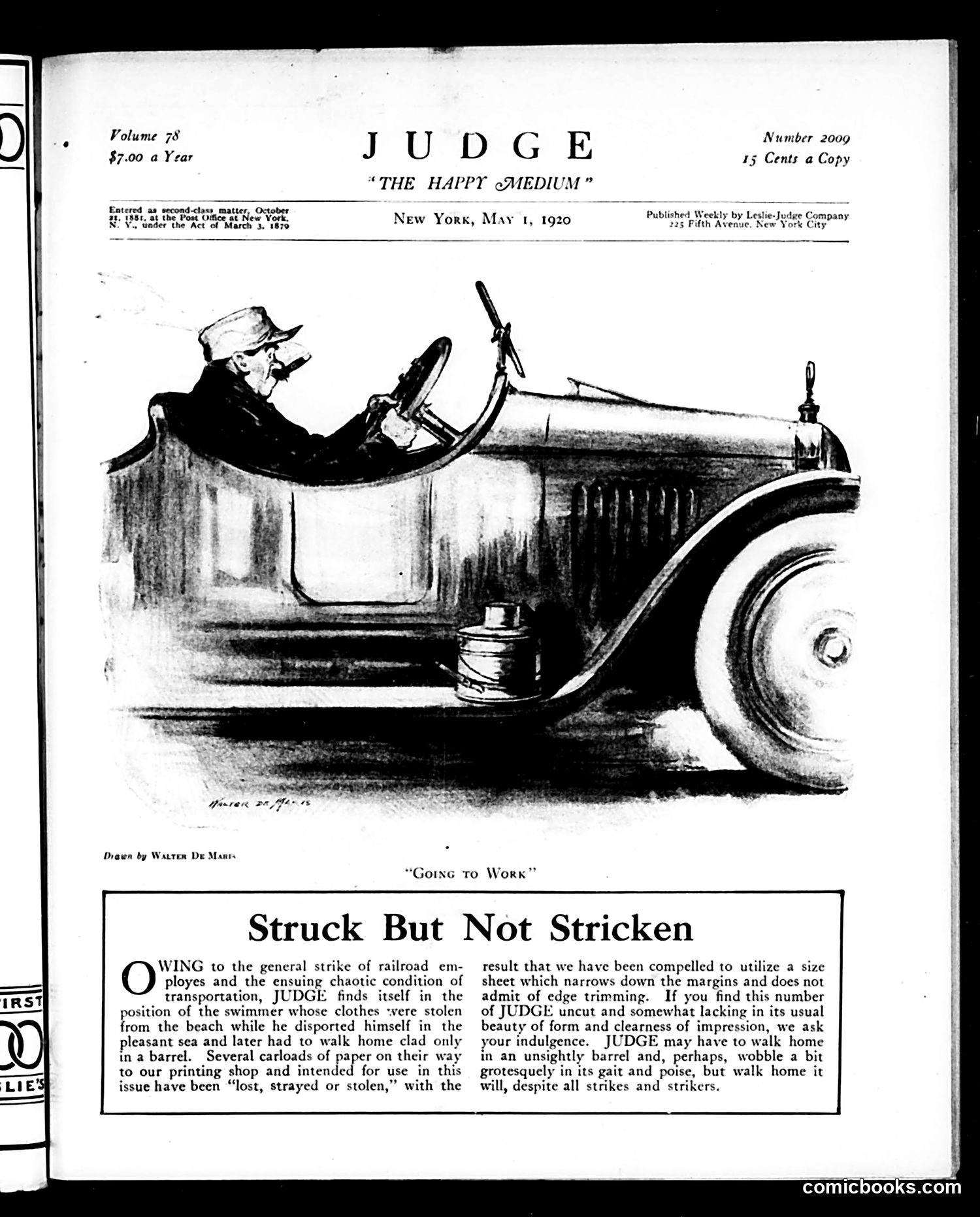
The cartoon depicts a man in formal attire driving an old automobile, titled "Going to Work." The accompanying article references a railroad workers' strike and resulting transportation chaos. The satire targets the disruption caused by labor strikes: the well-dressed commuter must navigate an "unsightly barrel"—likely representing makeshift or inadequate transportation alternatives during the strike. The man appears disheveled and awkwardly positioned, suggesting the indignity of dealing with strike-related hardships. The text humorously notes that *Judge* magazine itself lost printing supplies due to strike-related theft and disruption, creating meta-commentary: the magazine covering the strikes was itself victimized by them. The piece satirizes both labor unrest and its collateral damage on ordinary citizens and institutions.
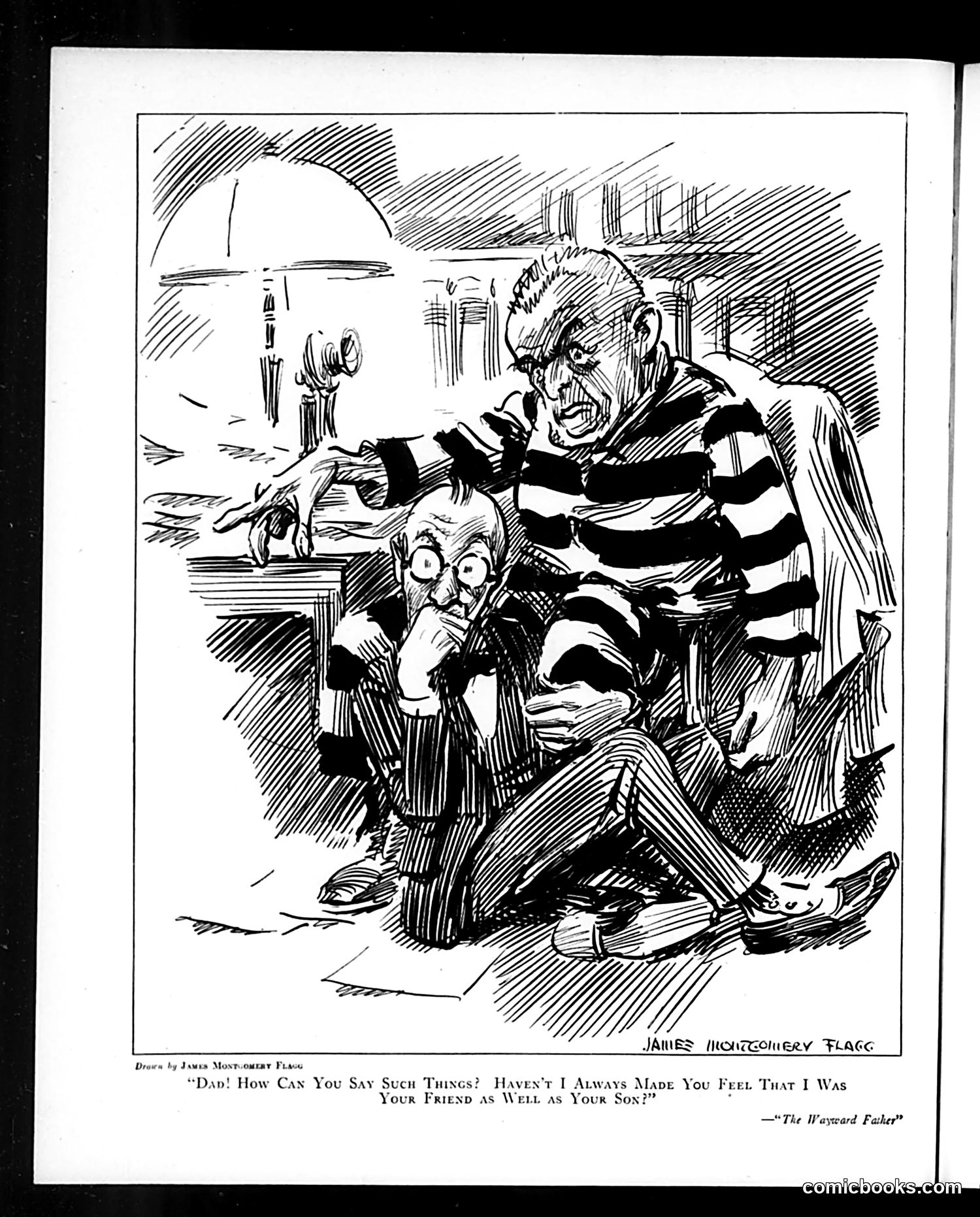
This cartoon by James Montgomery Flagg depicts a domestic conflict scene. An angry man in a striped suit confronts a smaller, frightened man, saying "Dan! How Can You Say Such Things? Haven't I Always Made You Feel That I Was Your Friend as Well as Your Son?" The dialogue reverses expected family hierarchy—the speaker claims to be the son yet asserts he's been a friend "as well as" a parent figure. This appears to satirize confused or inverted family relationships, possibly critiquing modern parenting philosophies where parents try to be their children's friends rather than authority figures. The source is attributed to "The Wayward Father," suggesting this cartoon illustrates themes from that work. The emotional intensity and physical posturing suggest commentary on family dynamics and generational conflict, likely resonating with Judge magazine's middle-class readership concerns about proper domestic order.
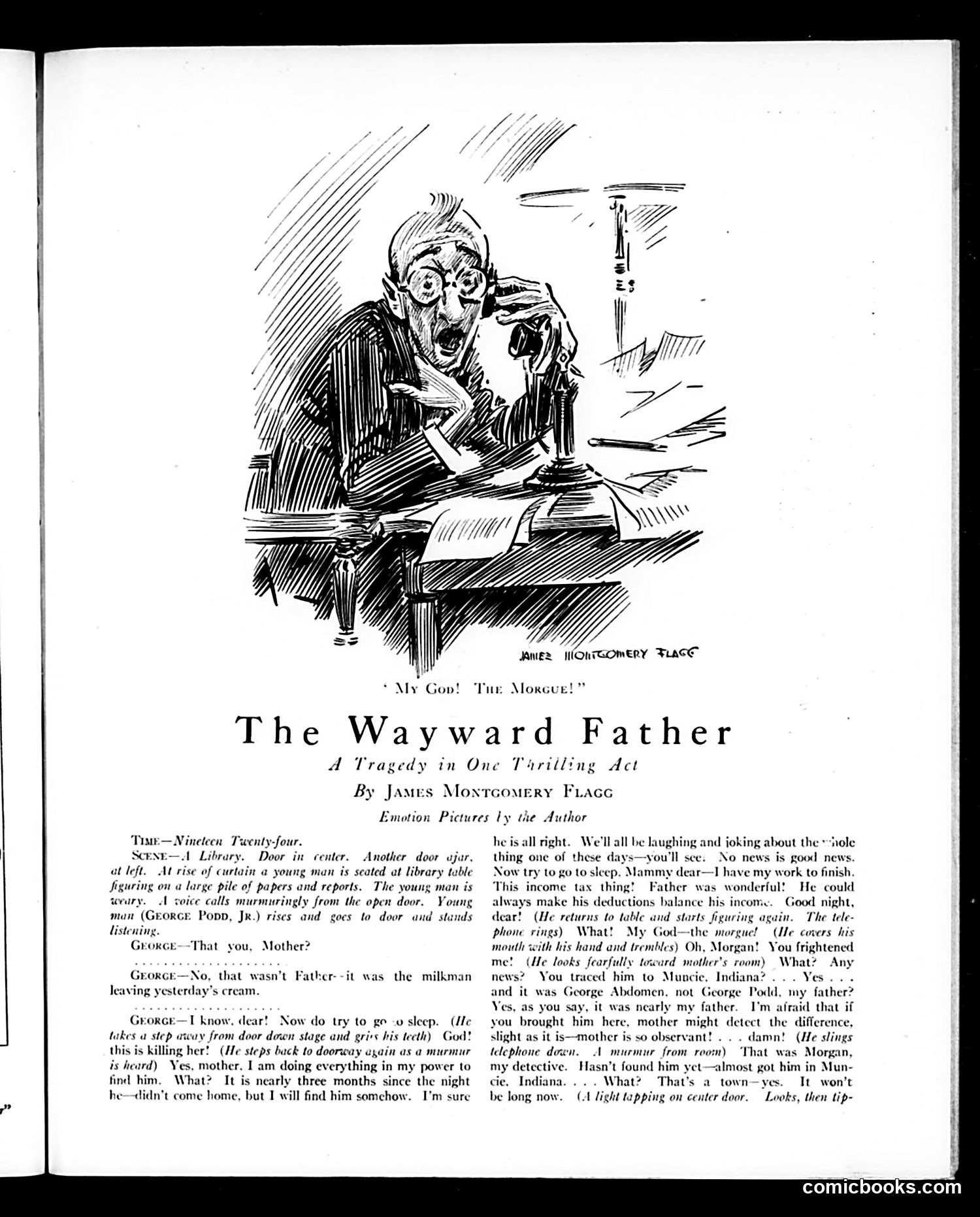
This page presents a one-act theatrical piece by James Montgomery Flagg, illustrated with his characteristic expressive ink drawing. The illustration shows an anxious man on a telephone, mouth agape in shock or distress. The plot involves a young man discovered at a library table with papers, summoned home by his mother. A character named George appears to be the "wayward father" referenced in the title. The dialogue suggests domestic turmoil: a missing father who abandoned the family, a mother conducting detective work to locate him, and complications involving someone named "Morgan" and a town called "Muncie, Indiana." The satire targets paternal irresponsibility and family dysfunction—likely resonating with early 20th-century audiences concerned with domestic morality and masculine duty.
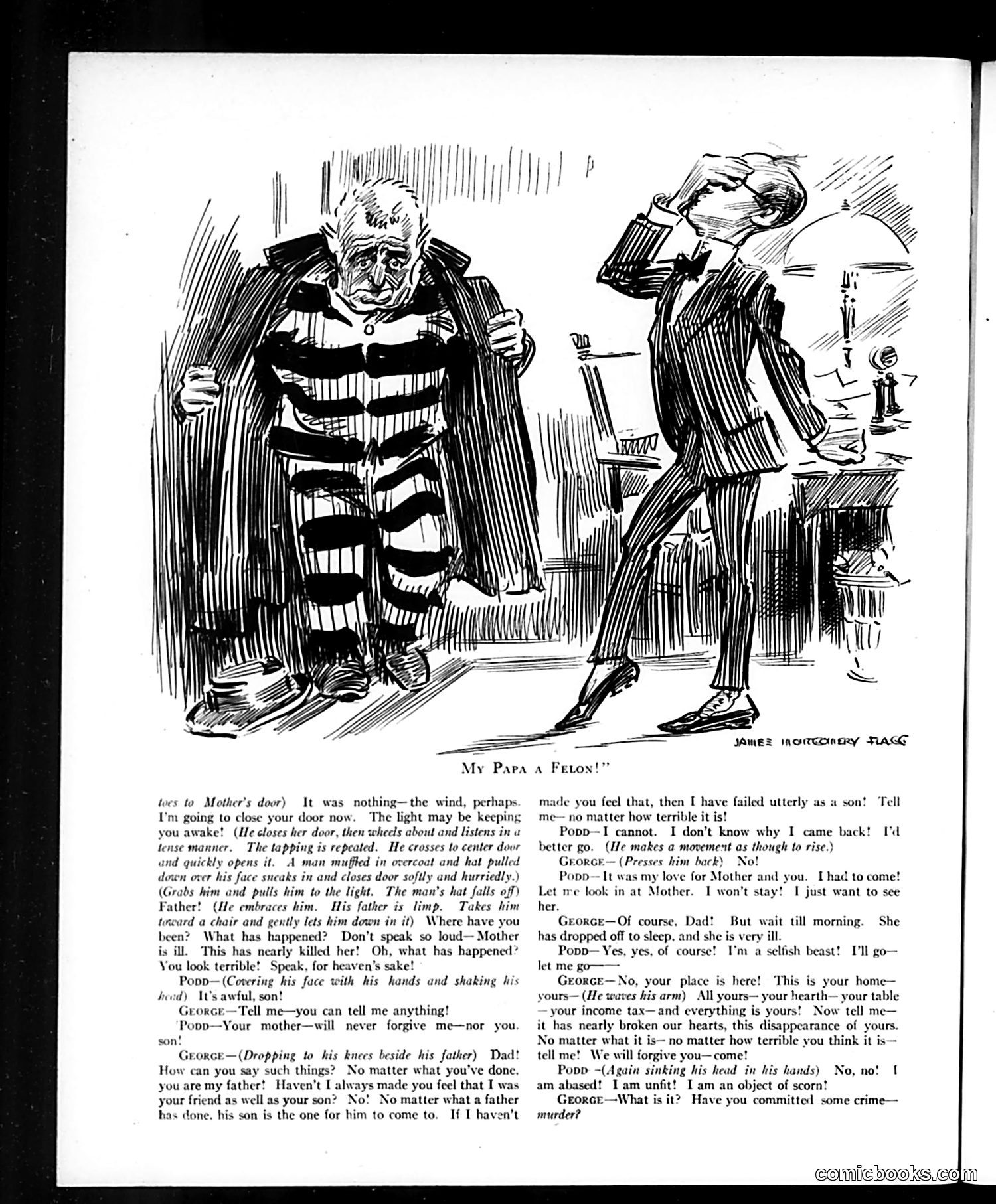
This cartoon illustrates a domestic drama where a son (Pond) returns home to find his father (George) in crisis. The father appears physically distressed—depicted with an exaggerated, skeletal appearance suggesting moral or emotional collapse. The dialogue reveals the core conflict: George believes his son has committed a crime ("Have you committed some crime—murder?"), while Pond insists he's innocent but tormented by shame. George alternates between paternal forgiveness and demands for truth, ultimately declaring "your place is here! This is your home—yours—your table—your income—tax and everything yours!" The satire appears to critique Victorian masculinity and paternal authority—the father's dramatic posturing contrasts with his ultimate capitulation. The exaggerated art style emphasizes the emotional theatricality of upper-class family confrontation, likely mocking both generational conflict and bourgeois anxieties about propriety and inheritance.
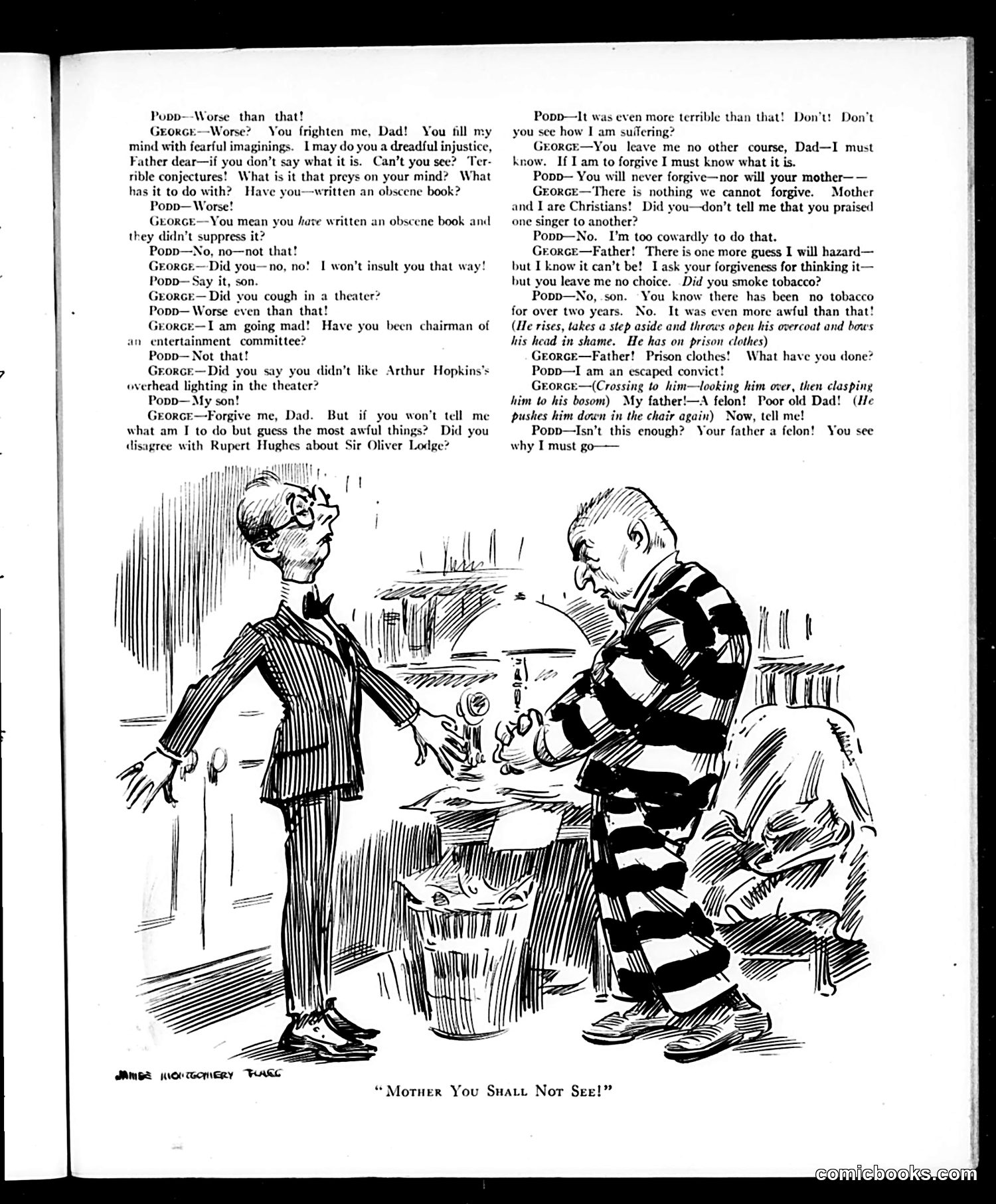
This is a humorous dialogue between a father (Popp) and son (George) where the son repeatedly guesses increasingly scandalous confessions—writing obscene books, coughing in theaters, disagreeing with notable figures like Rupert Hughes or Sir Oliver Lodge, praising singers, smoking tobacco. The punchline reveals Popp is an escaped convict wearing prison clothes. Rather than being scandalized, George emotionally embraces him as "My father!—A felon!" and dramatically declares his mother must never learn the truth. **The satire:** This mocks early 20th-century social hypocrisy and inverted values—the son considers artistic/intellectual disagreements and tobacco use more shameful than harboring a fugitive criminal. It satirizes how middle-class respectability obsesses over trivial social transgressions while overlooking actual moral failings. The title's reference to the mother suggests concerns about maintaining appearances for women, particularly wives.
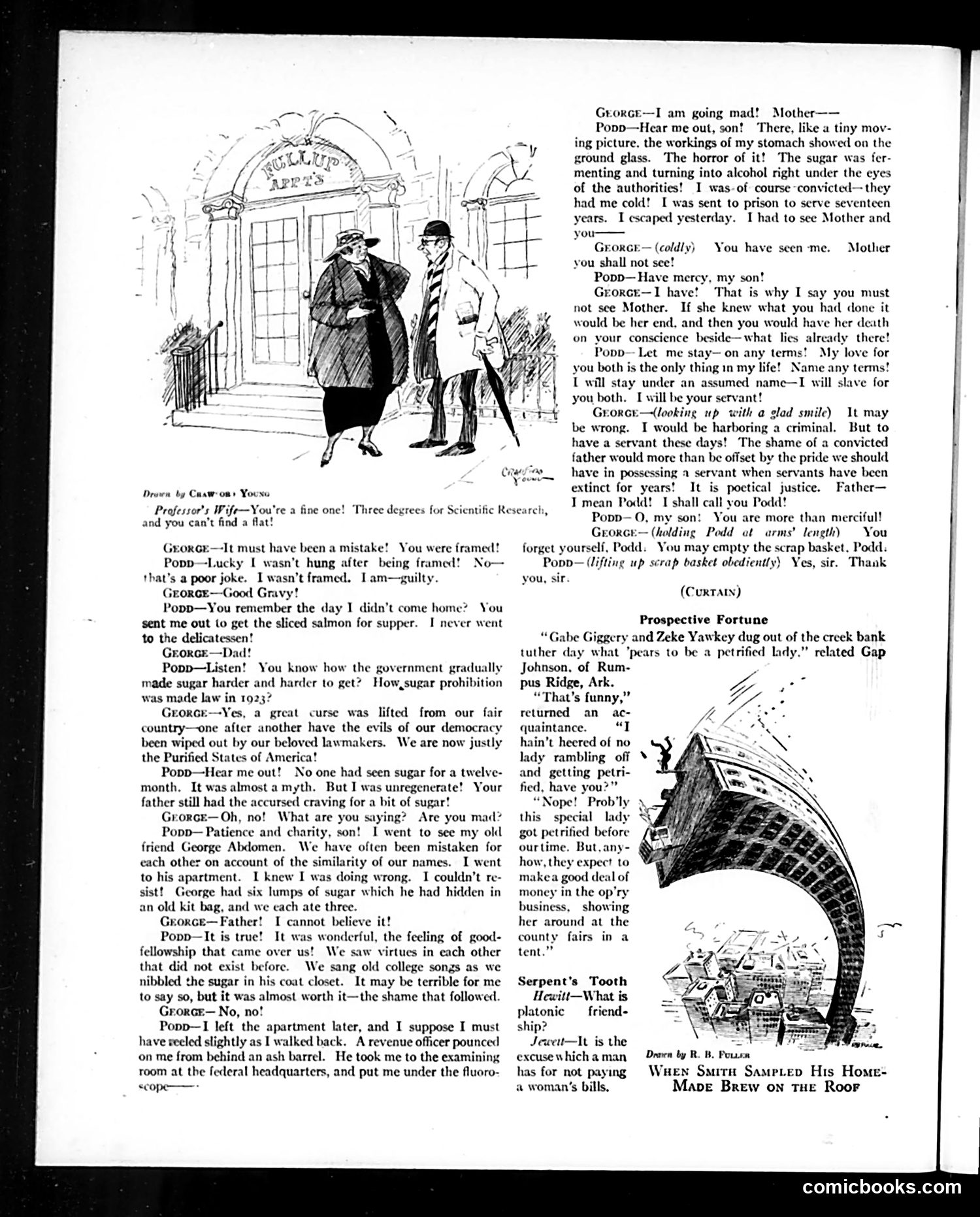
This cartoon satirizes American Prohibition (enacted 1920, referenced as 1923 in the text). The main sketch depicts a father confessing to his son that he illegally consumed sugar—which the government has banned. When the father's stomach is X-rayed by authorities, the sugar ferments into alcohol, getting him convicted and imprisoned for seventeen years. The satire ridicules the absurdity of Prohibition-era enforcement: the government has criminalized an innocent substance so thoroughly that even accidental alcohol production becomes a federal crime. The dark humor intensifies when the son agrees to harbor his fugitive father—not from love, but because post-Prohibition society has become so servant-depleted that possessing even a convict servant outweighs family shame. The cartoon critiques how expansive government control over personal consumption creates tragicomic desperation and moral compromise among citizens.
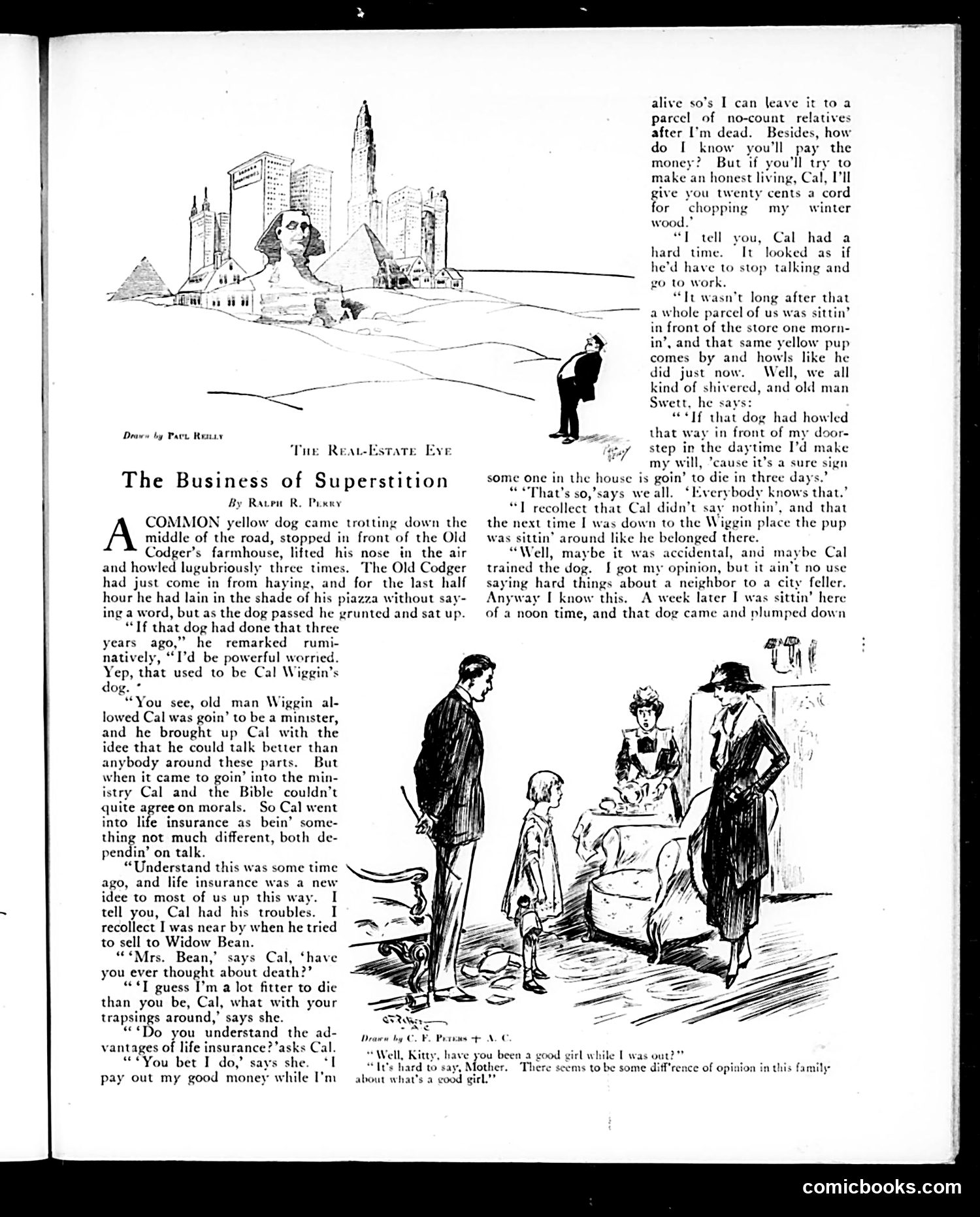
This satirical story mocks rural superstition and exploits it for profit. The narrative describes Cal Wiggin, a failed ministerial candidate who turns to selling life insurance. Unable to convince practical rural customers through honest argument, Cal allegedly trains a dog to howl ominously outside homes—playing on the widespread superstition that a dog's mournful howl portends death within three days. The satire targets both rural gullibility and insurance salesmen's unscrupulous tactics. The top illustration shows an idealized cityscape (representing modern progress), while the bottom depicts Cal's scheme exploiting superstitious country folk. The story suggests that in rural areas, people are so bound by irrational beliefs that even a con man can profit by weaponizing their own fears against them. The joke's dark edge: superstition makes people vulnerable to manipulation.
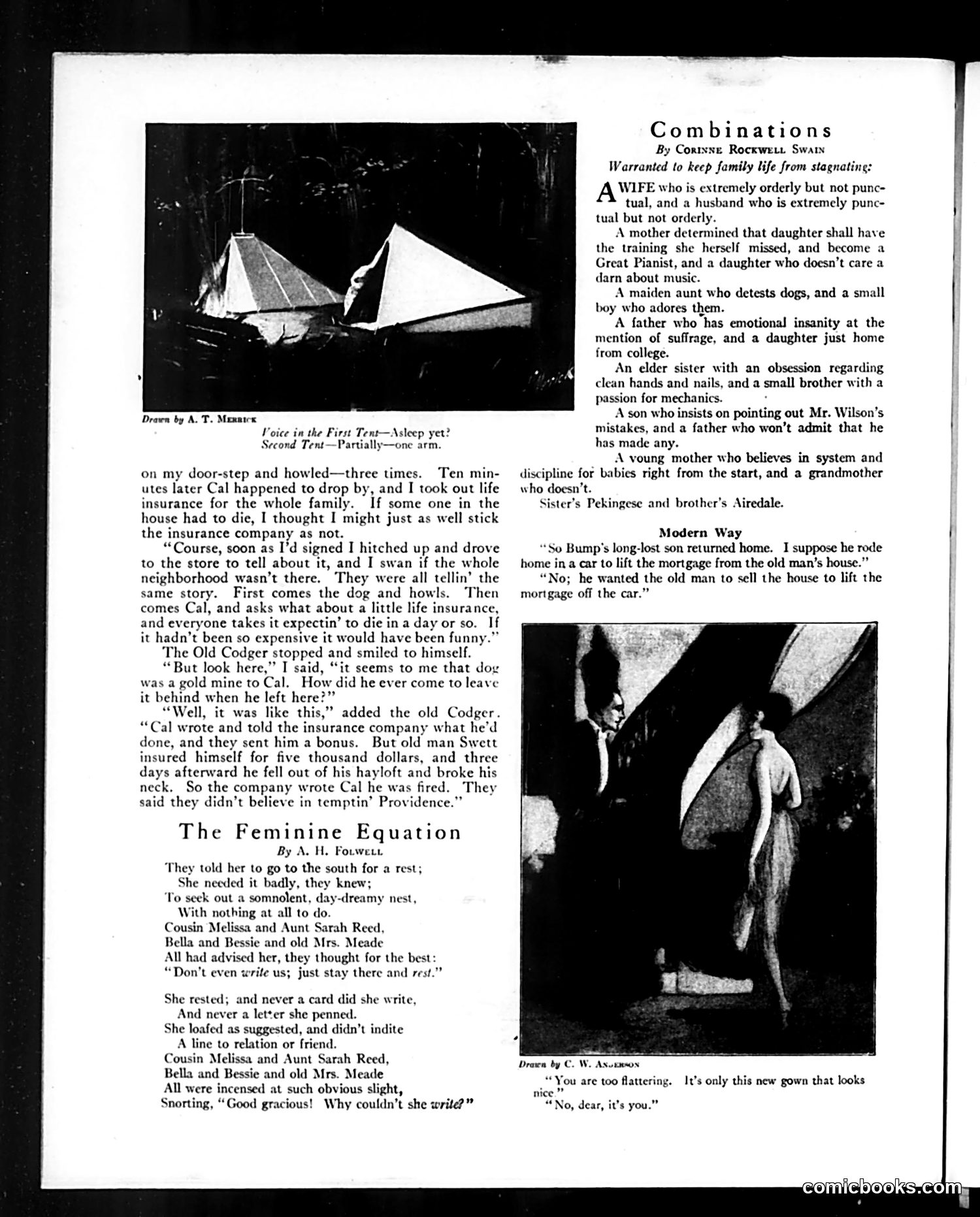
This page contains three separate pieces of satirical humor typical of early 20th-century American magazines: **"The Feminine Equation"** mocks a common domestic contradiction: a woman's relatives insist she rest and stop writing letters, then become indignant when she actually complies. The satire targets the unreasonable expectations placed on women. **"Combinations"** by Corinne Rockwell Swain lists deliberately mismatched personality pairings (punctual husband/disorderly wife, suffrage-opposed father/college-educated daughter) designed to create household friction. This satirizes how family life's inherent conflicts arise from incompatible temperaments—presented as entertainment. **"Modern Way"** jokes about economic priorities: a son returns home not to help his struggling father, but because he's mortgaged his *car* so heavily that the father must sell his house to help pay for the vehicle. This satirizes the era's emerging car culture and how newfound consumer debt was reshaping family finances and values. The cartoons and text together capture Judge's focus on domestic comedy and social observation.
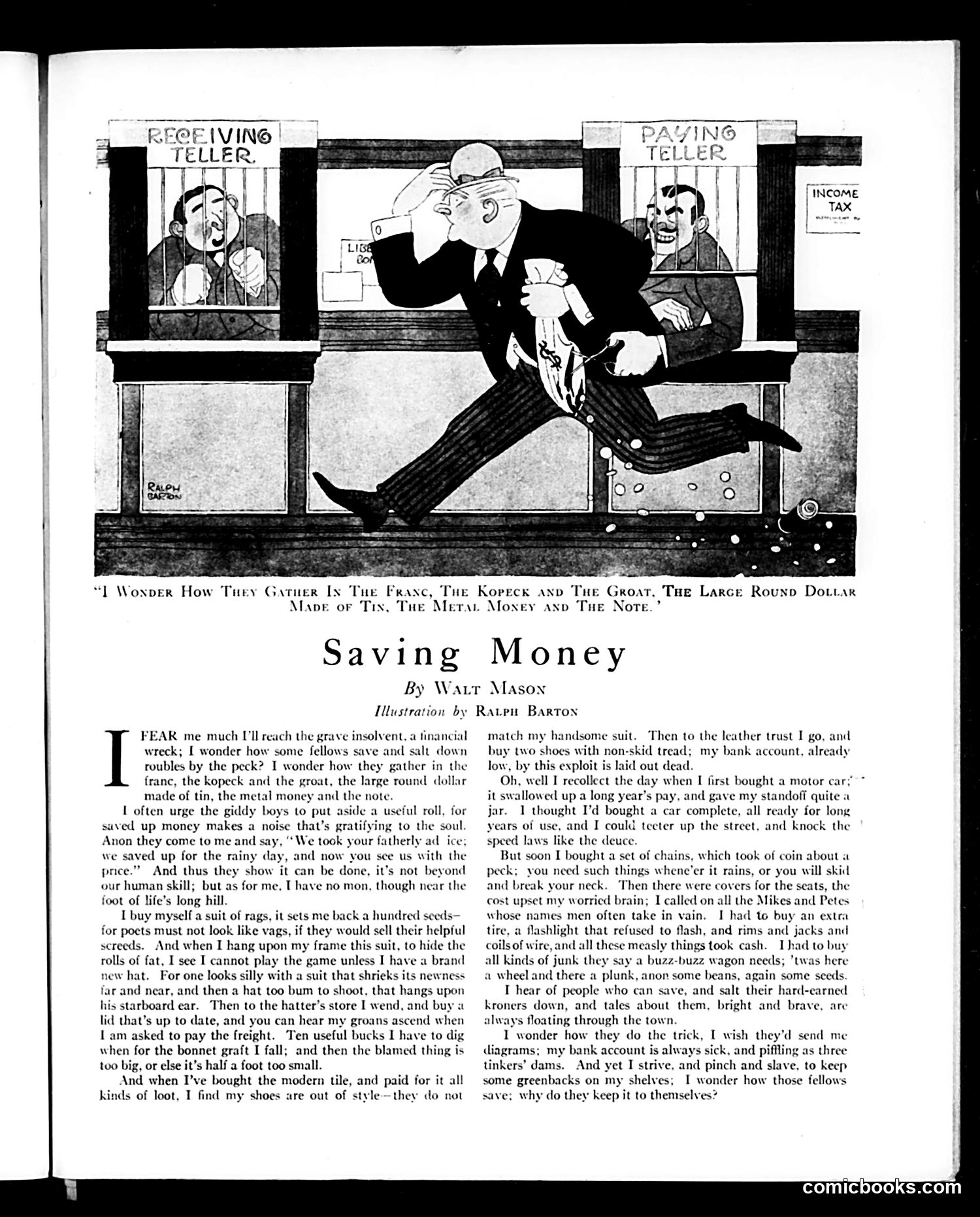
This humorous essay-poem, illustrated by Ralph Barton, satirizes the difficulty of saving money in modern life. The cartoon shows a well-dressed man juggling coins between a "Receiving Teller" and "Paying Teller" at a bank, while an "Income Tax" notice looms nearby. Mason's narrator is a perpetually broke poet who *intends* to save but finds himself perpetually spending on necessities and modern conveniences: new clothes, shoes, a motor car, and endless automobile accessories (chains, seat covers, tires, jacks). Each purchase depletes his bank account. He expresses bewilderment at how others manage to accumulate savings—sarcastically suggesting they keep the secret to themselves. The satire targets both the illusion of thrift in an consumer-driven society and the multiple drains on wages: clothing costs, automotive expenses, and taxes. The humor lies in the gap between good intentions and financial reality.
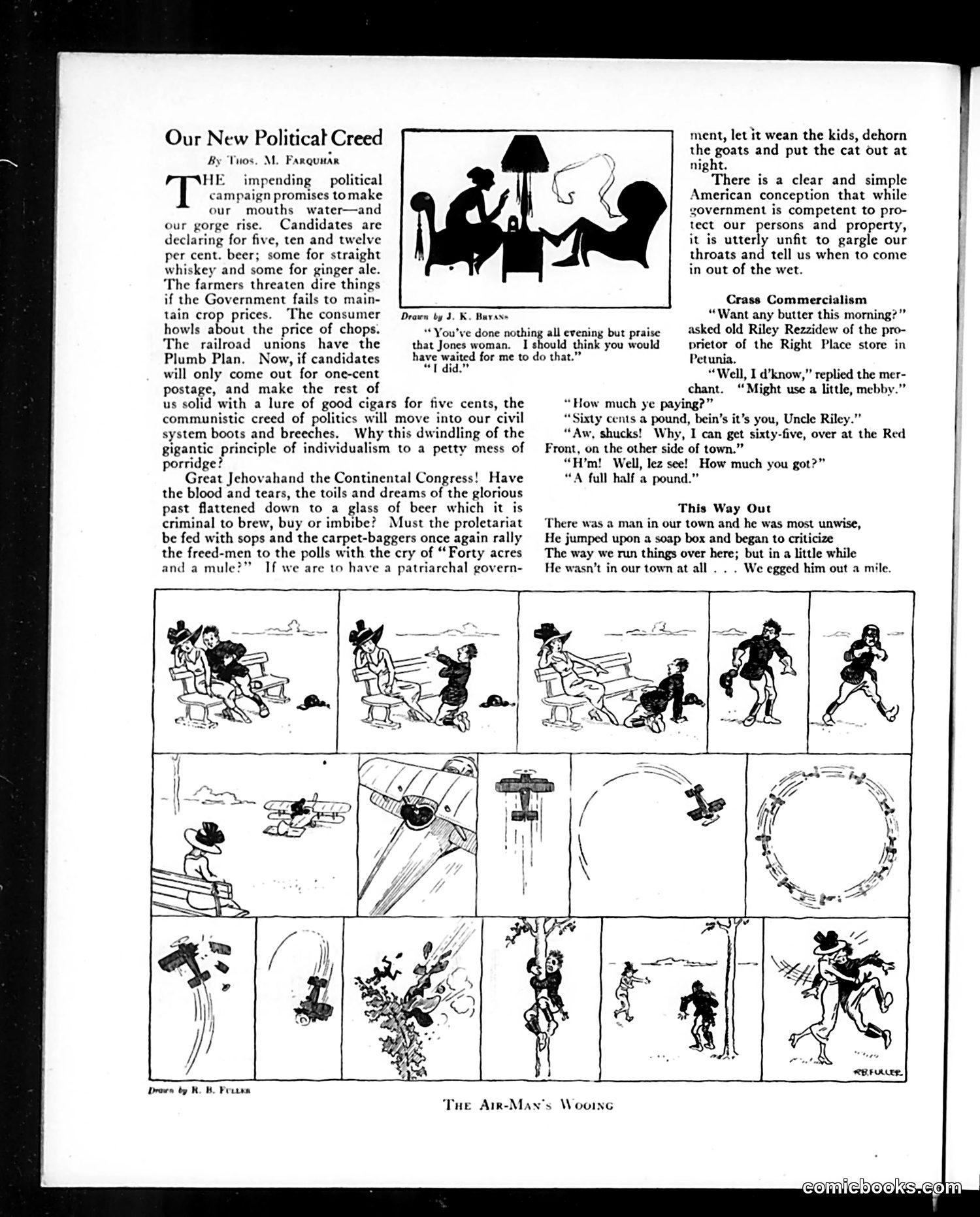
This page satirizes 1920s American politics through multiple pieces: **Main Editorial:** Farquhar mocks candidates pandering with trivial promises—cheaper beer, whiskey, ginger ale, and cigars—rather than addressing serious principles. He contrasts this degradation of civic discourse with the ideals of the Founding Fathers, sarcastically asking if the Revolution was fought merely to negotiate commodity prices. **"Crass Commercialism":** A dialogue between Uncle Riley and a store owner illustrates small-town haggling over butter prices—poking fun at rural commerce and petty negotiations. **"This Way Out":** A brief verse warns that criticizing local affairs gets you driven out of town, satirizing provincial intolerance of dissent. **"The Air-Man's Wooing":** A comic strip (drawn by B.D. Prien) depicts slapstick aerial mishaps—likely mocking early aviation's dangers and romance narratives. The page reflects post-WWI disillusionment with degraded political discourse and American social conformity.
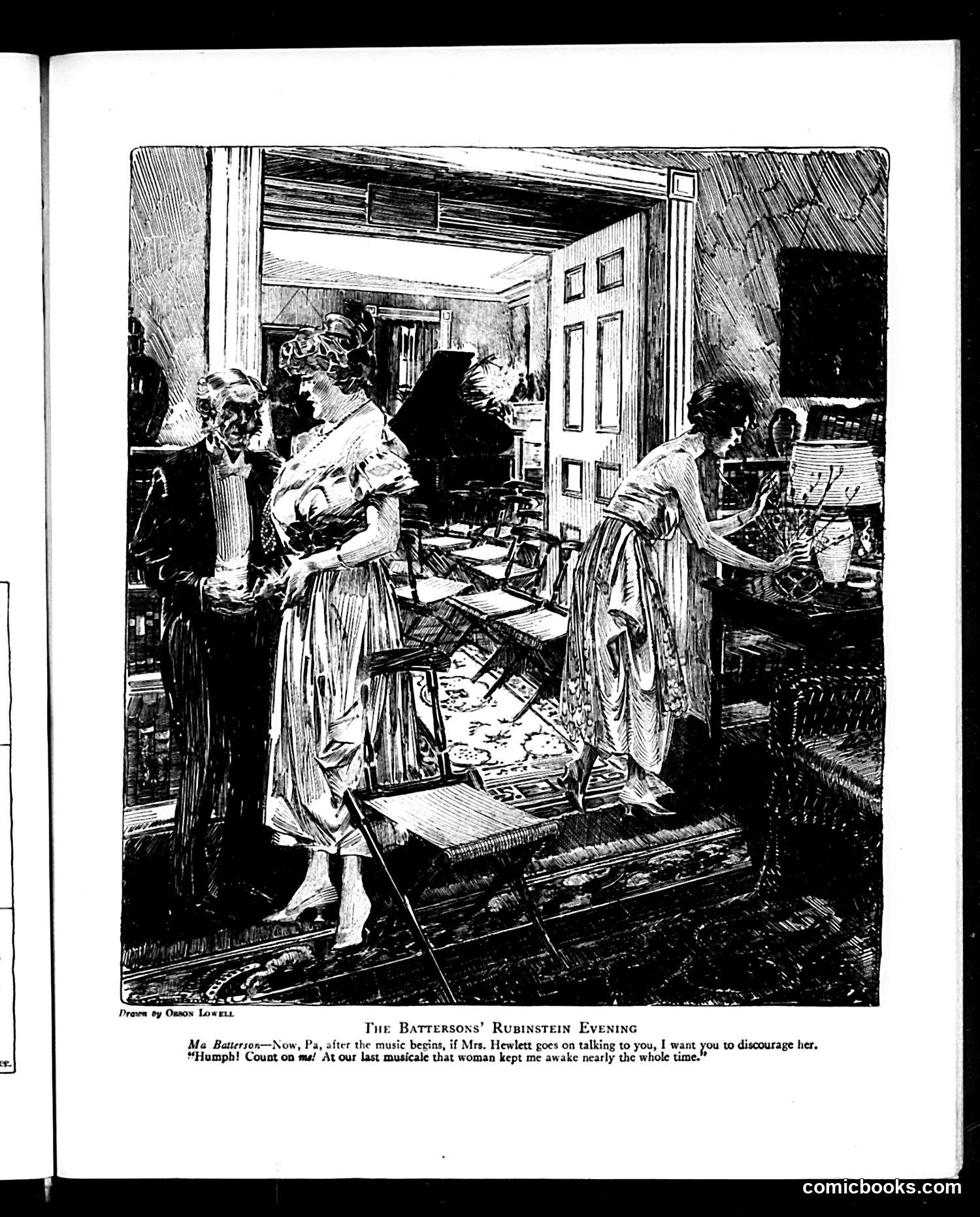
This domestic humor cartoon depicts a common social irritation: Mrs. Batterson instructing her husband to discourage Mrs. Hewlett from talking during a classical music performance (a "musicale" featuring pianist Arthur Rubinstein, likely). The satire targets two social anxieties: wives managing husbands' behavior at cultural events, and inconsiderate guests who chat through concerts. Mr. Batterson's complaint that Mrs. Hewlett kept him awake—suggesting he dozed off—adds ironic humor: he wants to discourage *her* talking, yet he himself slept through the performance. The scene shows upper-middle-class domestic life, where attending musicales was a status marker requiring proper etiquette that not everyone observed.
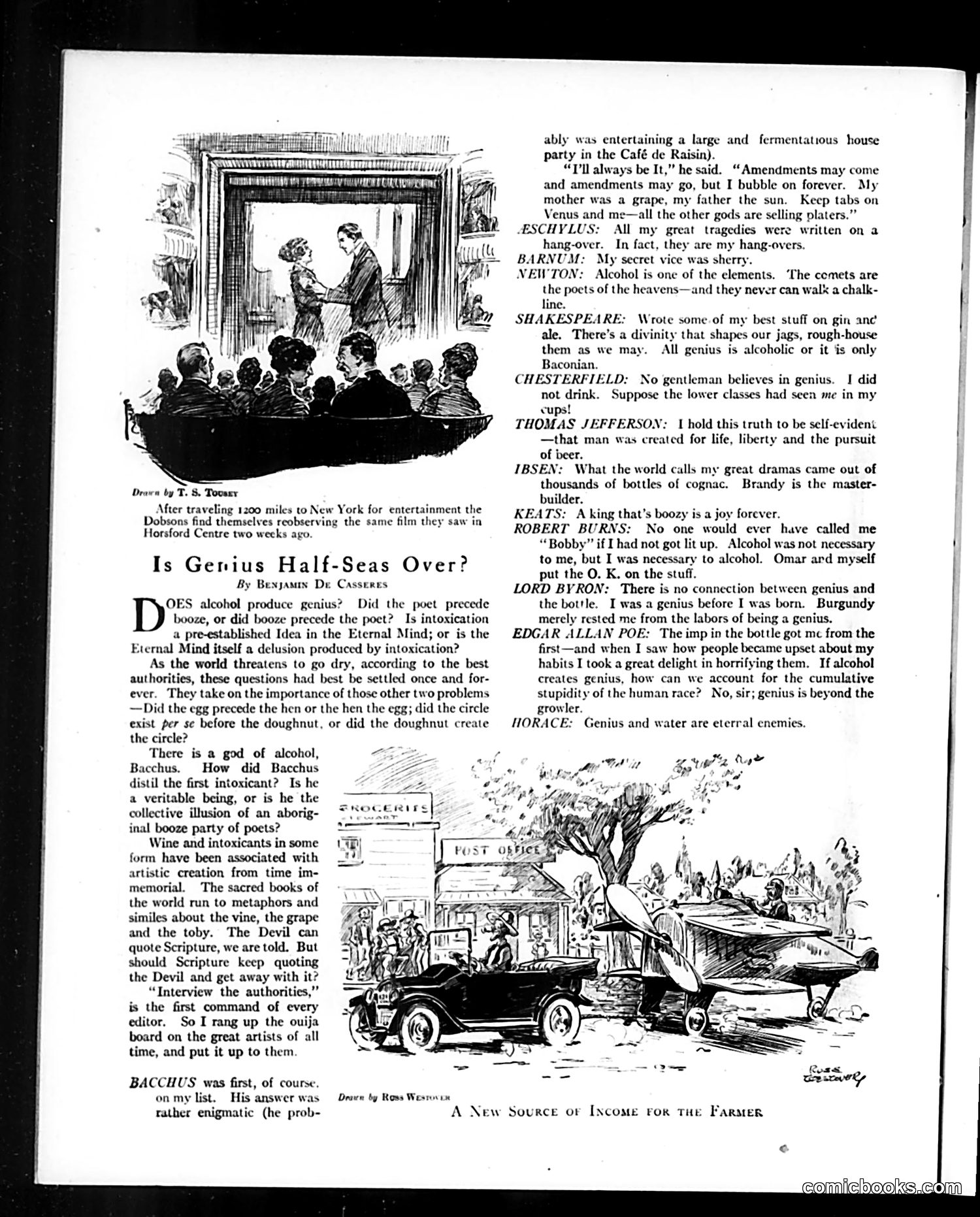
This page satirizes the relationship between alcohol and artistic genius during Prohibition-era America. The main article humorously "interviews" famous historical figures (Shakespeare, Edgar Allan Poe, Lord Byron, etc.) via ouija board, asking whether alcohol produces genius or genius produces alcohol. The satire's point: as America faces going "dry" (Prohibition), the debate becomes absurd. Each literary figure claims alcohol was essential to their work—Shakespeare wrote drunk, Newton claimed alcohol was an element, Jefferson rewrote his philosophy around beer. The piece mocks both romanticized notions of the "tortured genius alcoholic" and the moral certainty of Prohibition advocates. The upper cartoon shows the Dobson family traveling 1,200 miles to New York only to see the same film twice—a separate joke about entertainment repetition, unrelated to the alcohol theme.
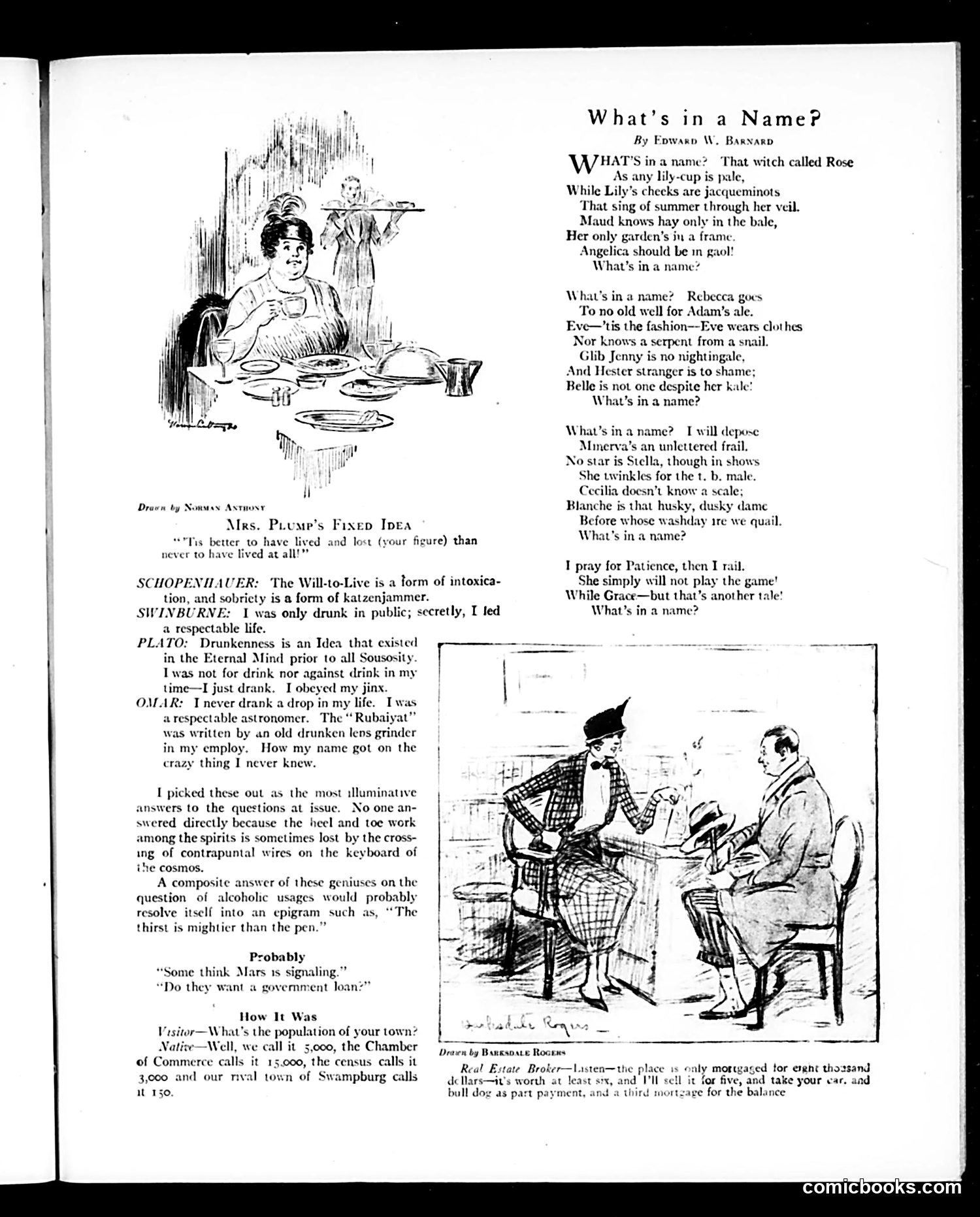
This page contains two distinct pieces of satire: **"What's in a Name?"** — A poem mocking women whose names don't match their actual characteristics. The satire works by pairing female names with their stereotyped meanings (Rose, Lily, Maud, etc.) against the mundane or contradictory realities of the women who bear them. For example, "Lily" has rosy cheeks despite the name suggesting paleness; "Angelica" should be in jail; "Stella" isn't stellar. It's sharp social commentary on the gap between feminine ideals and reality—poking fun at both naming conventions and women's actual lives. **The philosophical dialogue about drunkenness** — A satirical piece attributing contradictory quotes about drinking to famous philosophers (Schopenhauer, Swinburne, Plato, Omar Khayyam), debunking their personas. Omar's claim he never drank, yet his famous poem celebrates wine, is the clearest joke. The piece mocks how historical figures' reputations don't match reality—similar to the "name" poem's theme. Both pieces satirize the gap between appearance/reputation and truth.
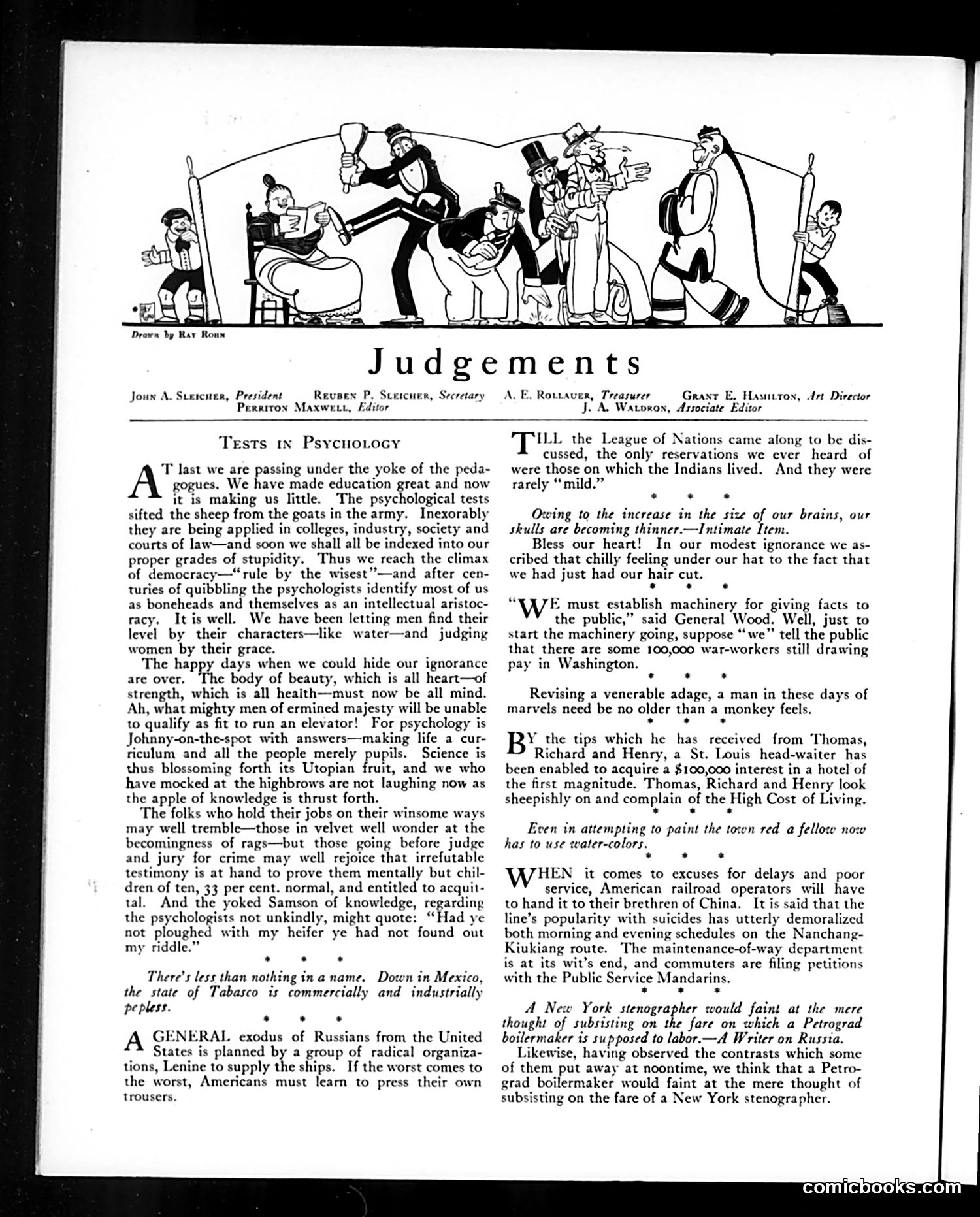
This satirical editorial page attacks the then-fashionable psychological testing movement, particularly its military and educational applications post-WWI. The main essay mocks IQ and aptitude tests that claimed to scientifically sort people into "proper grades of stupidity," creating an "intellectual aristocracy" of psychologists while reducing democracy to rule by supposed experts. The accompanying one-liners satirize contemporary issues: the post-Russian Revolution red scare (Lenin supplying ships for emigrating radicals); League of Nations "reservations" (wordplay on treaty reservations vs. Native American reservations); General Wood's calls for "machinery for giving facts" while 100,000 war-workers still drew Washington salaries; and railroad delays (possibly referencing Chinese labor or service standards). The Ray Roux cartoon header depicts various social types being examined or judged, visualizing the essay's theme of society under scrutiny.
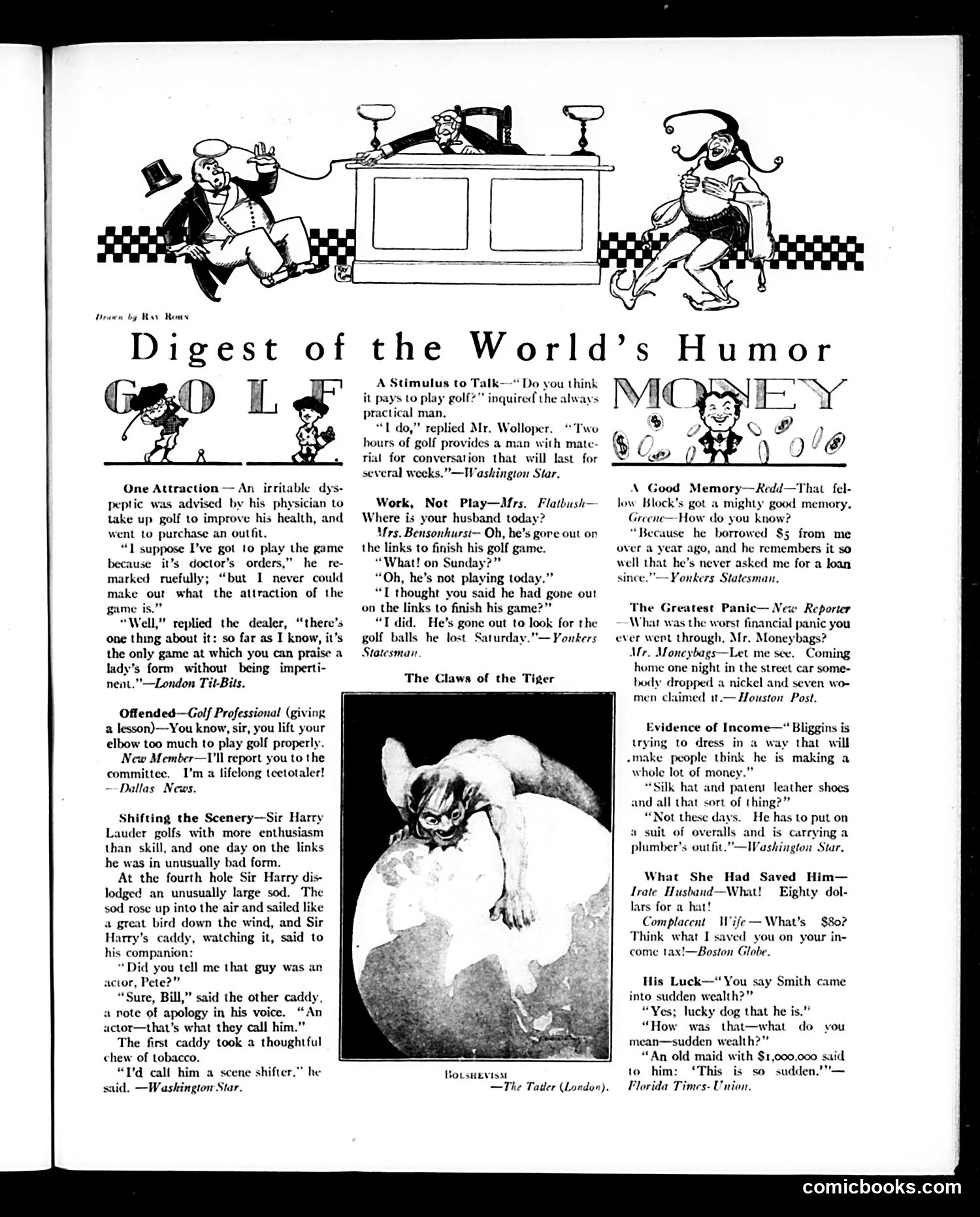
This is a humor digest page featuring golf jokes and brief comedic anecdotes, typical of Judge's satirical content. The central cartoon shows a tiger, captioned "Bousnevism" (likely referencing Bolshevism), though the connection to the surrounding golf humor is unclear from the visible text. The jokes mock golf's absurd appeal: a dyspeptic forced by his doctor to play, a golfer praised for lifting his elbow (innuendo), and Sir Harry Lauder's caddy calling him a "scene shifter" after he dislodges massive turf. Other anecdotes poke fun at married life, financial pretension, and small miseries (a nickel dropped in the street causes panic). The humor reflects early 20th-century middle-class anxieties: health fads, marital dynamics, and economic status anxiety. The "Bolshevism" reference suggests post-WWI concerns, though its relevance to golf remains unexplained.
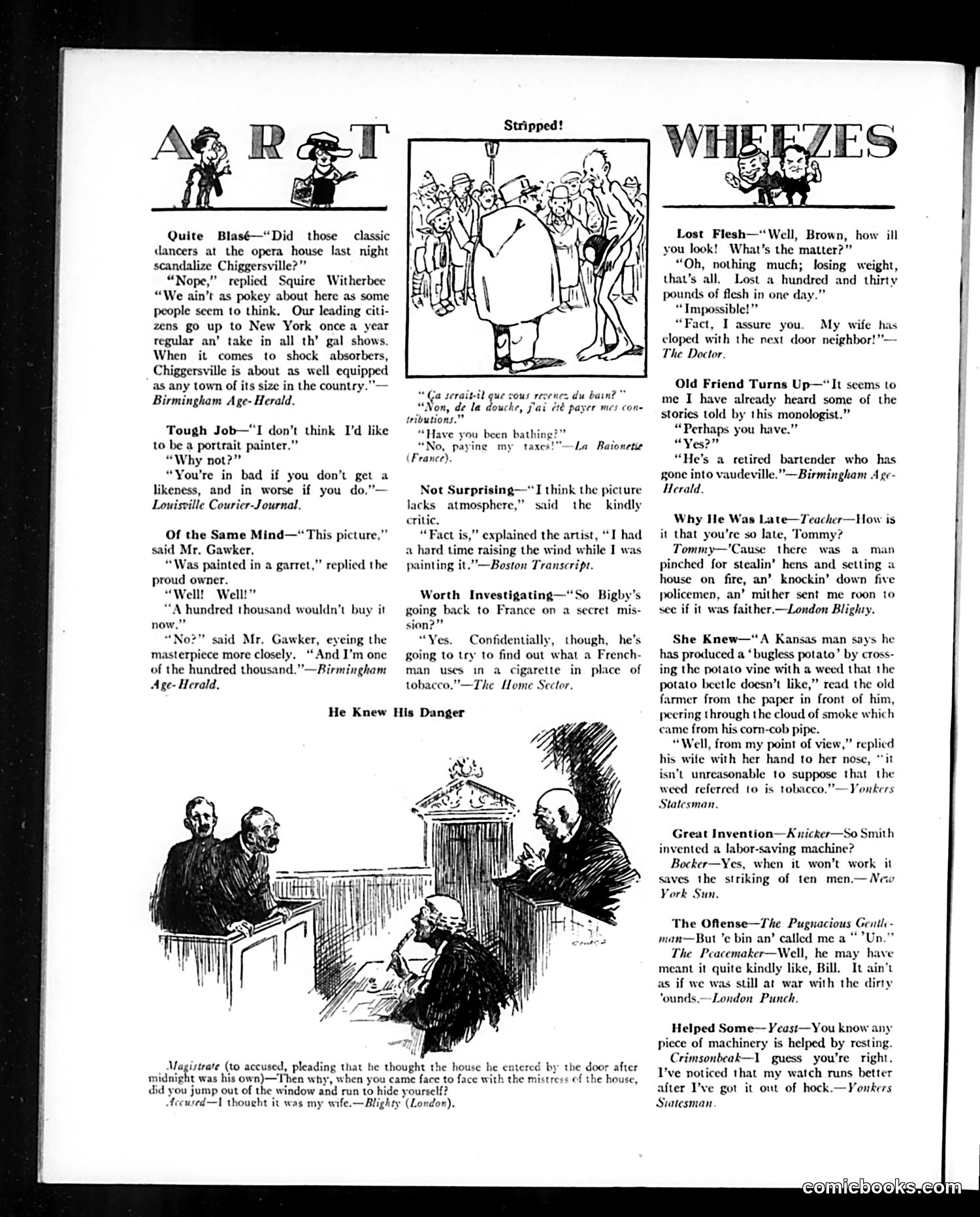
This page collects brief humorous anecdotes from various American and British publications, typical of Judge magazine's format. Key satirical targets include: **Social Pretension**: Multiple jokes mock small-town Americans' attempts at sophistication—like Chiggersville citizens claiming worldliness by attending New York burlesque shows. **Artist/Critic Absurdity**: Jokes about portrait painters and critics reveal anxiety about art's value and authenticity in commercial society. **Marital Discord**: Several anecdotes use marriage troubles for humor—a man confusing his wife with a burglar, another losing weight because his wife eloped. **The Magistrate Cartoon**: Shows a man caught burglarizing a house; he claims he thought it was his own home. The humor hinges on the absurd excuse. **Class and Labor**: Jokes about inventors and labor-saving machines reflect early-industrial anxieties about mechanization and work. **Working-Class Speech**: Heavy use of dialect humor—depicting rural and urban working-class speakers as amusingly unsophisticated. The overall tone is lighthearted mockery of human folly across social strata.
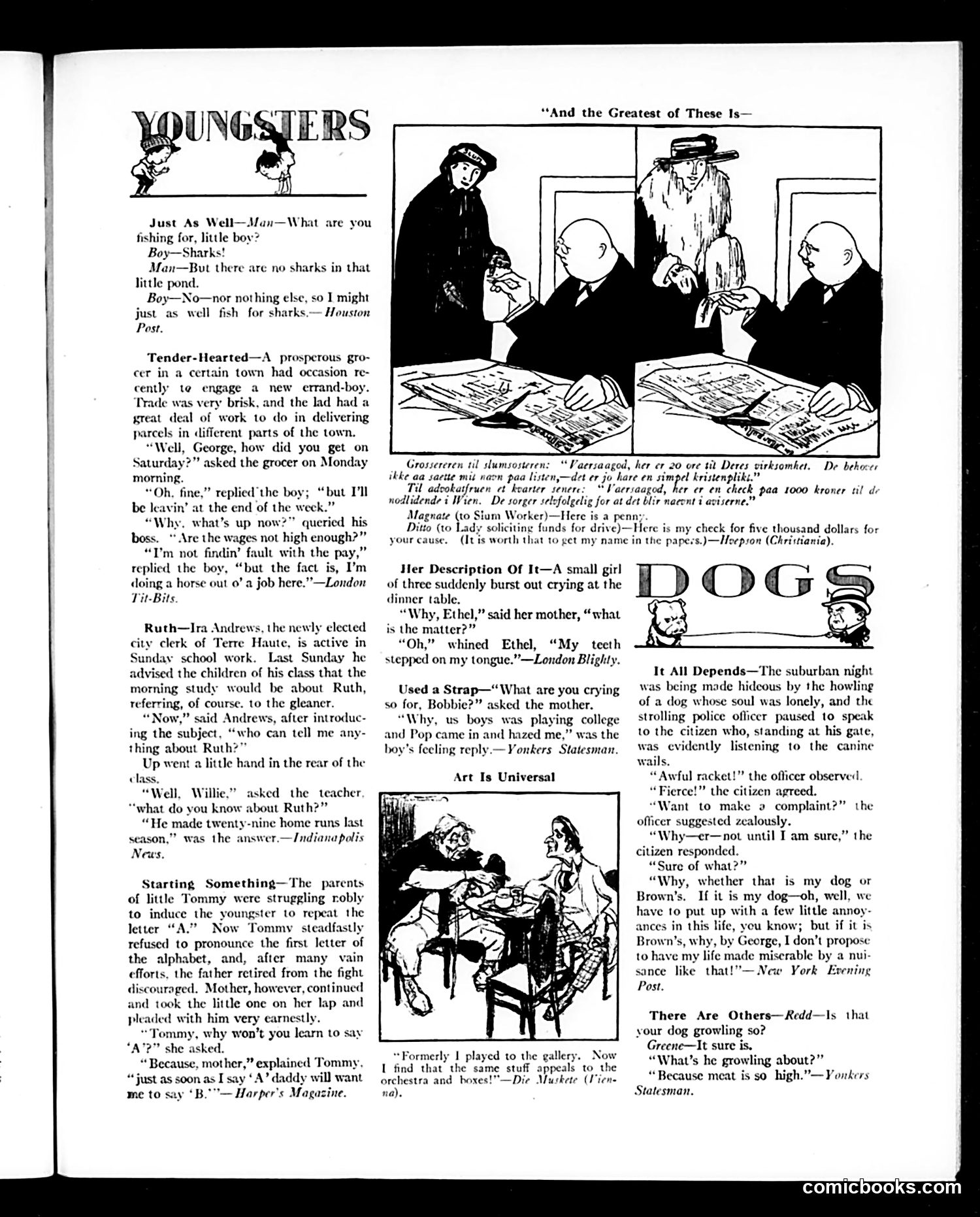
This page collects humorous anecdotes rather than political cartoons. The content reflects early 20th-century American humor: **"Just As Well"** uses absurdist logic—a boy fishing for sharks in a pond because there's nothing else to catch anyway. **"Tender-Hearted"** satirizes a grocer's false piety: he avoids naming his charity work publicly to seem humble, yet immediately brags about a large donation to ensure newspaper credit—exposing hypocrisy around charitable giving. **Sunday School Mix-up** jokes about a teacher discussing the biblical Ruth (a gleaner) while students reference Babe Ruth the baseball player—reflecting the era's competing cultural authorities (religion vs. emerging sports celebrity). **Tommy's Logic** uses childish reasoning for humor: refusing to say "A" because it opens the alphabet door to learning "B"—a common joke structure about inevitable consequences. Other pieces similarly employ simple wordplay and domestic comedy typical of *Judge*'s light satirical approach.
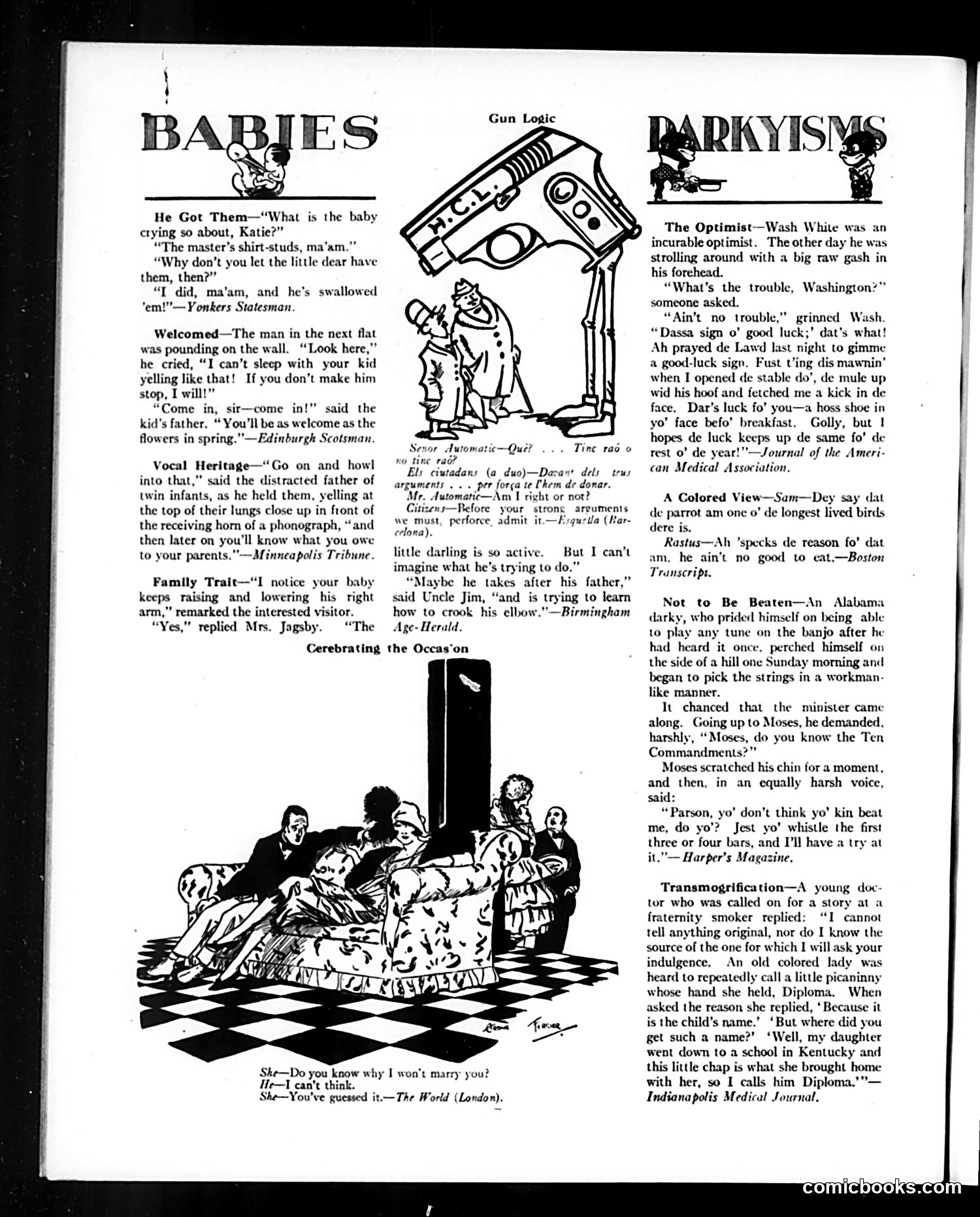
This page from Judge magazine collects humorous anecdotes organized by theme ("Babies," "Darkyisms"). The left side features family humor: babies swallowing shirt studs, noisy infants disturbing neighbors, and a child mimicking his father's drinking gesture. The center shows a "Gun Logic" illustration—a revolver with figures around it, likely satirizing arguments or political disputes settled by force (the Spanish caption references persuasion through strength). The right side, titled "Darkyisms," contains dialect humor featuring African American characters. These pieces—"The Optimist" (an injured man finding silver linings), "A Colored View" (parrots living long because they're useless), and "Not to Be Beaten" (a banjo player confident he can play any tune)—employ heavy racial stereotypes and caricatured speech patterns common to early 20th-century publications. These "darkly" jokes reflect period attitudes; modern readers should recognize them as offensive racial stereotyping presented as entertainment.
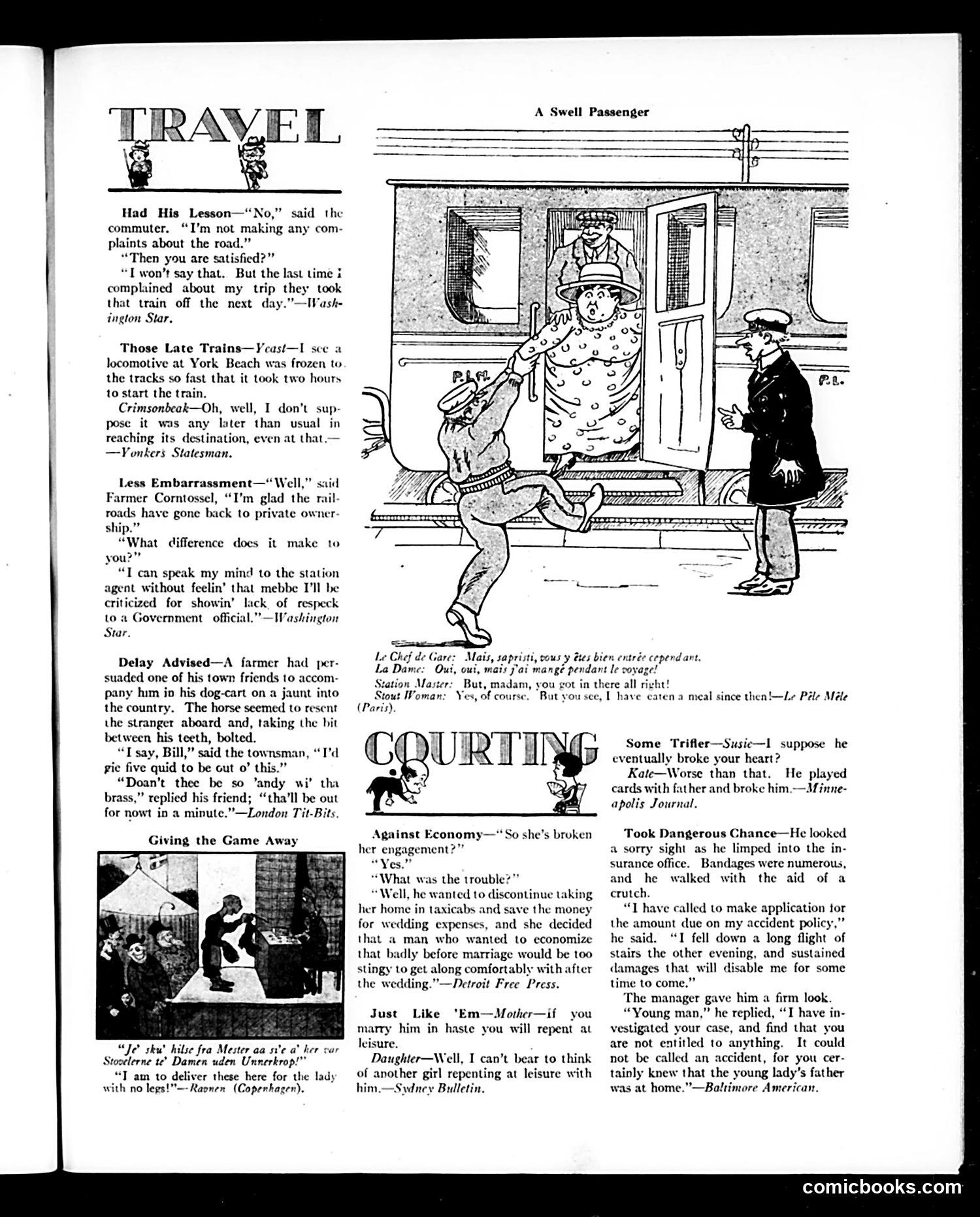
This page contains multiple short humorous anecdotes typical of early 20th-century American satirical journalism. Key themes include: **Railroad Complaints**: Jokes about chronic train delays and poor service. One anecdote notes a locomotive frozen so badly it took two hours to start—yet still arrived on time, suggesting the railroad's tardiness was expected. **Railroad Privatization**: A farmer celebrates railroads returning to "private ownership" because he can complain freely to station agents without worrying about "disrespecting a Government official"—referencing recent U.S. railroad deregulation debates. **Social Comedy**: The main cartoon shows a well-dressed woman ejecting luggage from a train window while a porter protests. The French caption indicates she brought excessive baggage despite claiming to have eaten nothing during her journey—poking fun at travelers' contradictions. Other brief jokes mock relationship dynamics, fiscal responsibility, and insurance fraud. The page reflects contemporary American anxieties about transportation reliability and bureaucratic vs. private service.
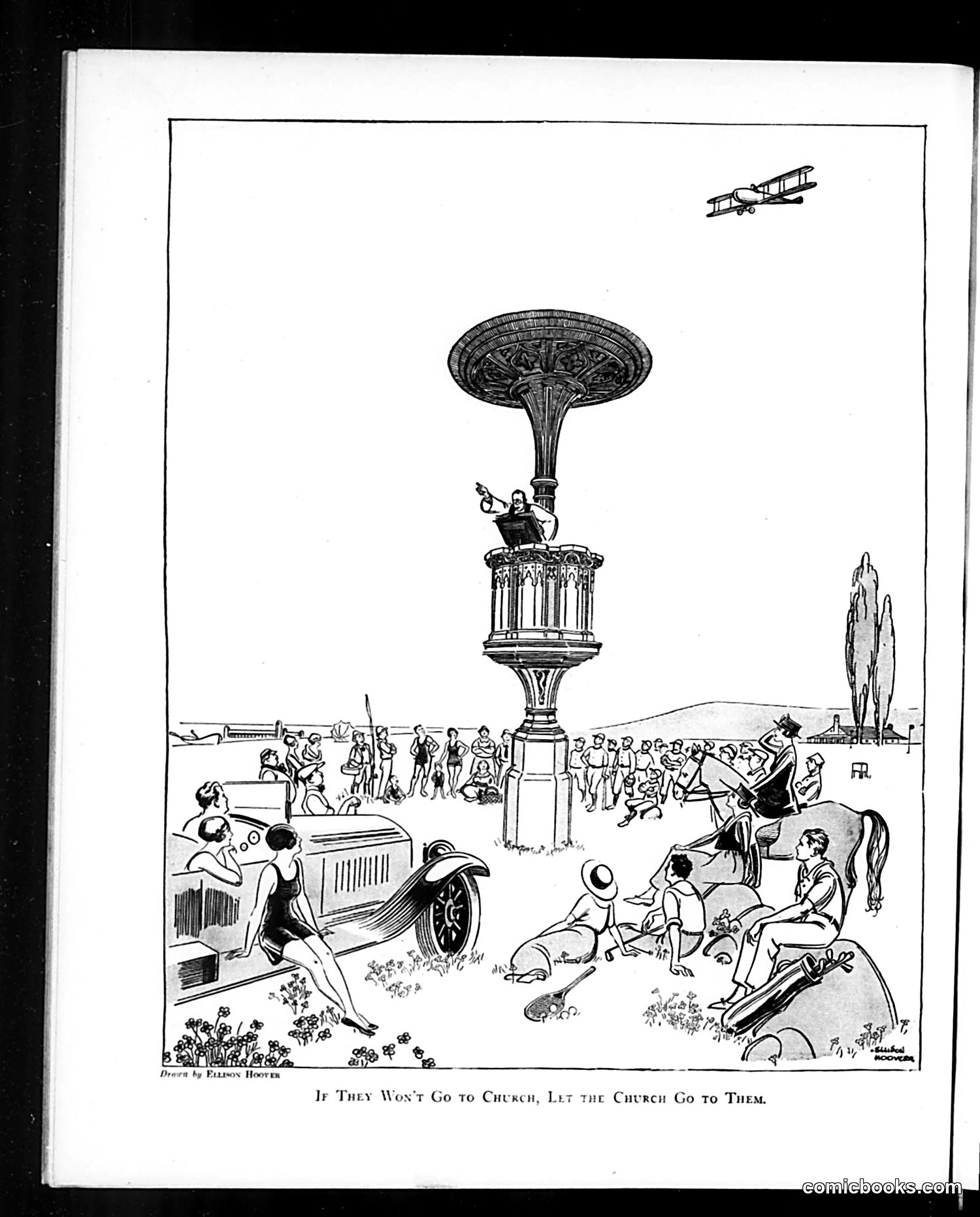
This satirical cartoon critiques declining church attendance in modern times. The central image shows a massive, ornate church structure—complete with decorative umbrella-like canopy—being transported to an outdoor recreational area where people are actively engaged in leisure activities: driving automobiles, playing with children, riding horses, and relaxing. The caption's ironic message suggests that since people won't attend traditional church services, religious institutions should bring themselves to secular spaces where people actually gather. The airplane overhead and automobiles emphasize modernity. The satire targets both the public's preference for worldly pleasures over spiritual devotion and, implicitly, the church's potential desperation to remain relevant in an increasingly secular, mechanized society. The piece reflects early-to-mid 20th century anxieties about religion's declining social authority.
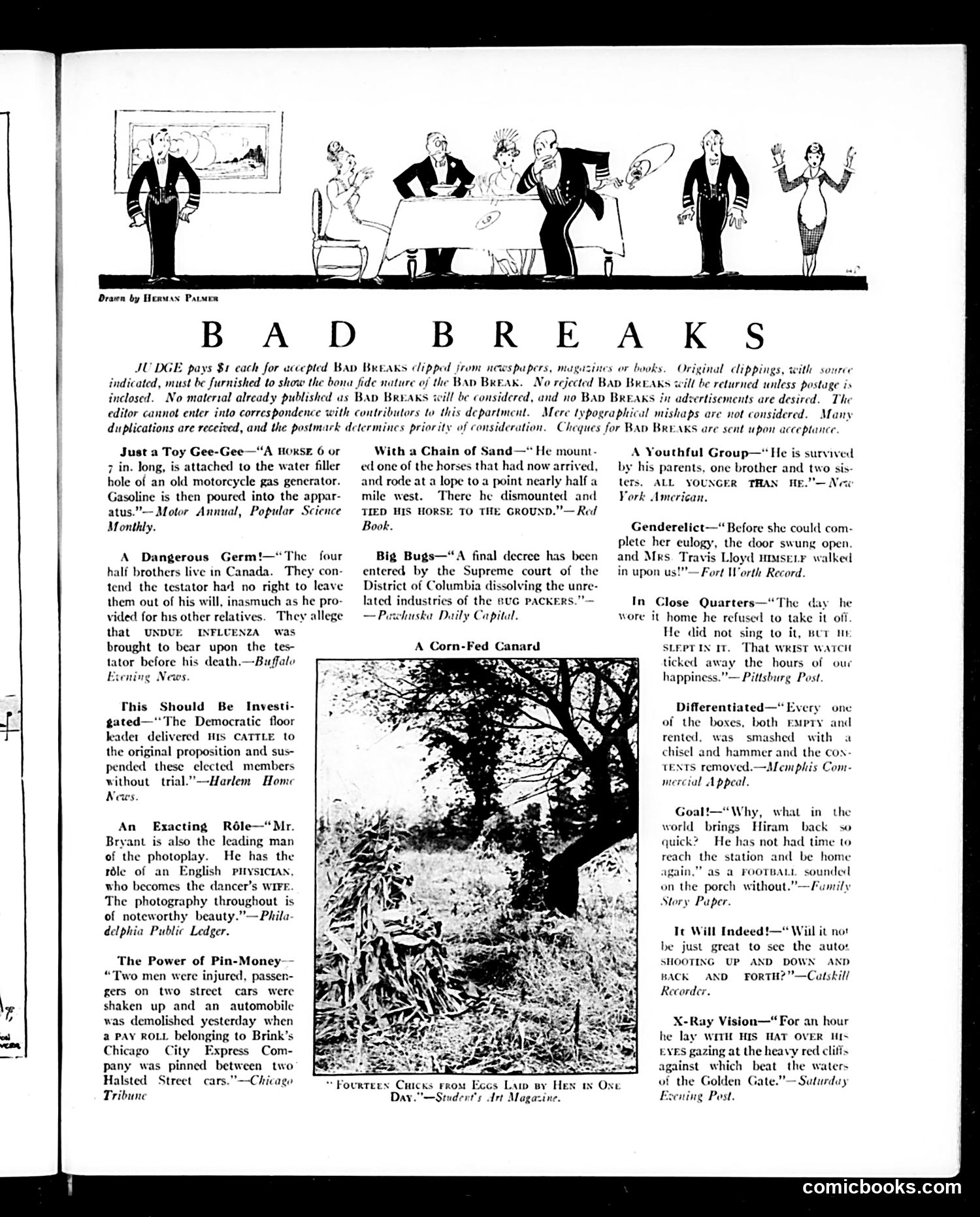
This page showcases **"Bad Breaks,"** Judge magazine's humor section featuring unintentional comic errors clipped from newspapers and publications. Readers submitted newspaper excerpts containing absurd typos, grammatical mistakes, or awkward phrasings that created unintended humor. Examples include: - "Undue **influenza**" (instead of "influence") in a legal dispute - "**Tied his horse to the ground**" (physically impossible) - "**Bug packers**" (likely "beef packers") - "**Younger than he**" (grammatically mangled) The cartoon header by Herman Palmer depicts an editor's office reviewing these submissions, showing the chaotic nature of newspaper production errors. The humor derives from real publishing mistakes that created absurdities—the satire targets sloppy journalism and editing rather than political figures. It's essentially an early version of modern "funny typo" collections, demonstrating how careless writing produces unintentional comedy.
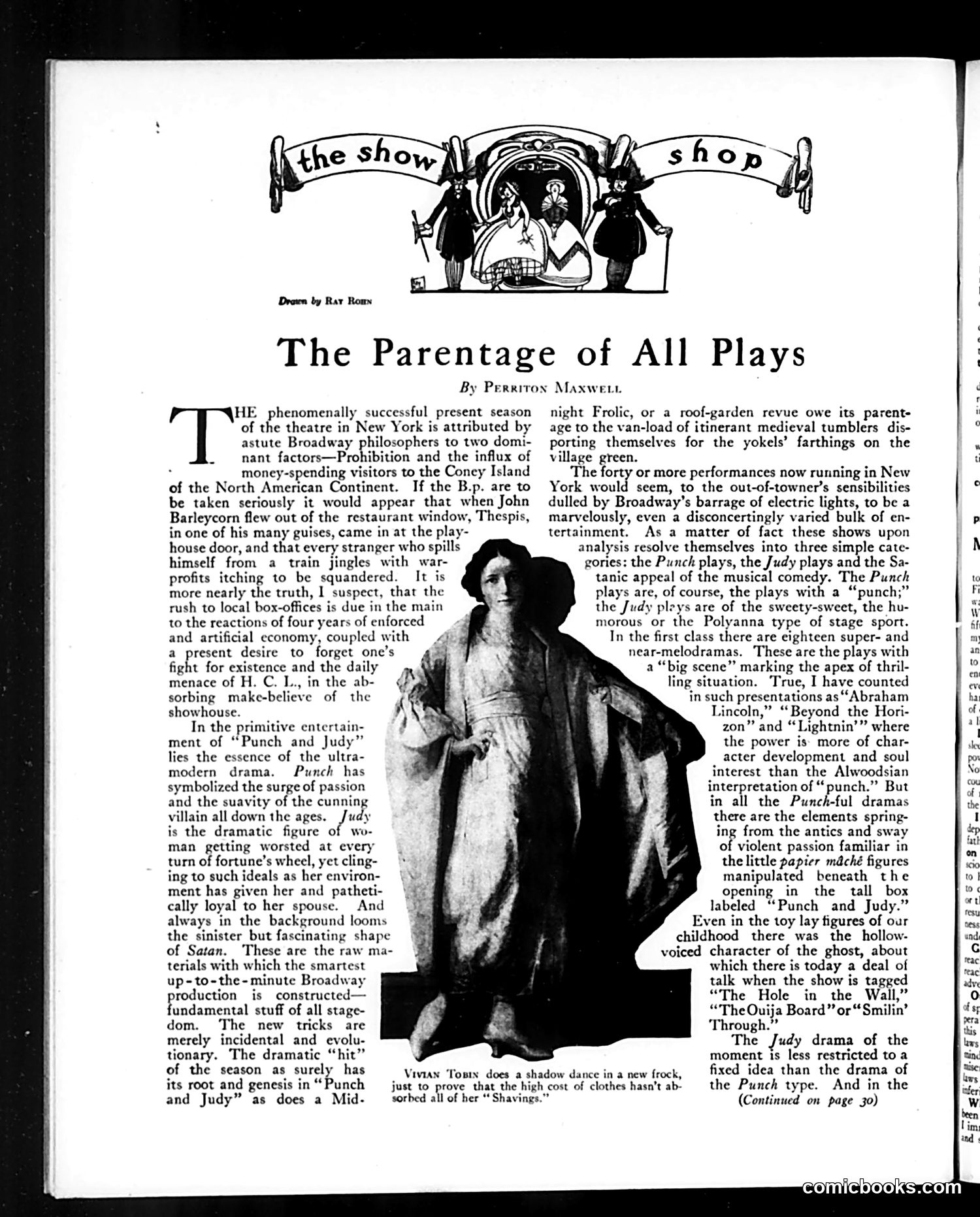
This is a theater criticism essay arguing that all Broadway plays derive from the ancient "Punch and Judy" puppet show tradition. The accompanying photograph shows Vivian Touts performing a shadow dance, illustrating the text's point about theatrical lineage. **The argument:** The author claims Broadway's current success (presumably 1920s, post-Prohibition) stems from audiences seeking escapism. He categorizes modern plays into three types—"Punch plays" (dramatic, action-driven), "Judy plays" (sentimental, sweet), and musical comedies with "Satanic appeal." **The satire's point:** Rather than celebrate modern theatrical innovation, Maxwell suggests sophisticated Broadway productions are merely dressed-up versions of simple puppet-show archetypes: the passionate male character, the suffering female, and evil. High-cost costumes and elaborate staging don't change fundamental dramatic DNA. **Context:** This reflects 1920s theater criticism's obsession with theatrical genealogy and the assumption that "primitive" entertainment held universal truths about human drama.
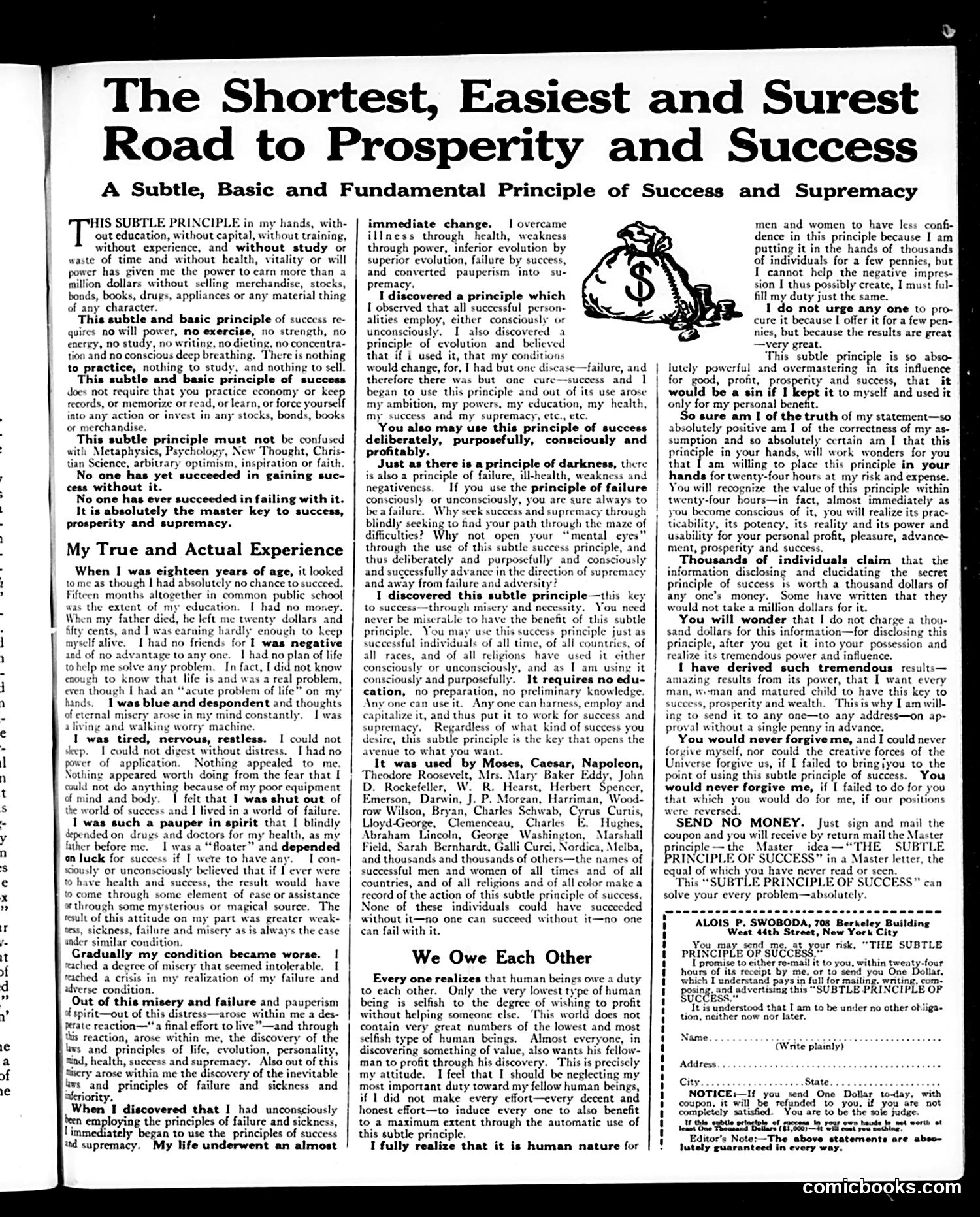
This appears to be a **self-help advertisement disguised as editorial content** from Judge magazine—a classic early 20th-century marketing tactic. The piece is a personal testimony promoting a vague "subtle principle" of success requiring no effort, study, money, or action. The author claims to have earned over a million dollars using only this mysterious principle. **The satire's target**: This likely mocks the proliferation of pseudoscientific self-help schemes popular in that era—particularly "New Thought" movements promising effortless wealth through mental principles alone. The breathless claims ("no will power," "no study," "no writing") are absurdly contradictory to actual success. **What modern readers should know**: Judge was satirizing the widespread con-artist mentality of "get rich quick" schemes that exploited desperate people. The vague mysticism and testimonial format mirror actual scams that preyed on vulnerable populations. The accompanying coupon inviting readers to learn "THE SUBTLE PRINCIPLE OF SUCCESS" for a dollar completes the satire—it's mocking magazines that charged for worthless "secrets."
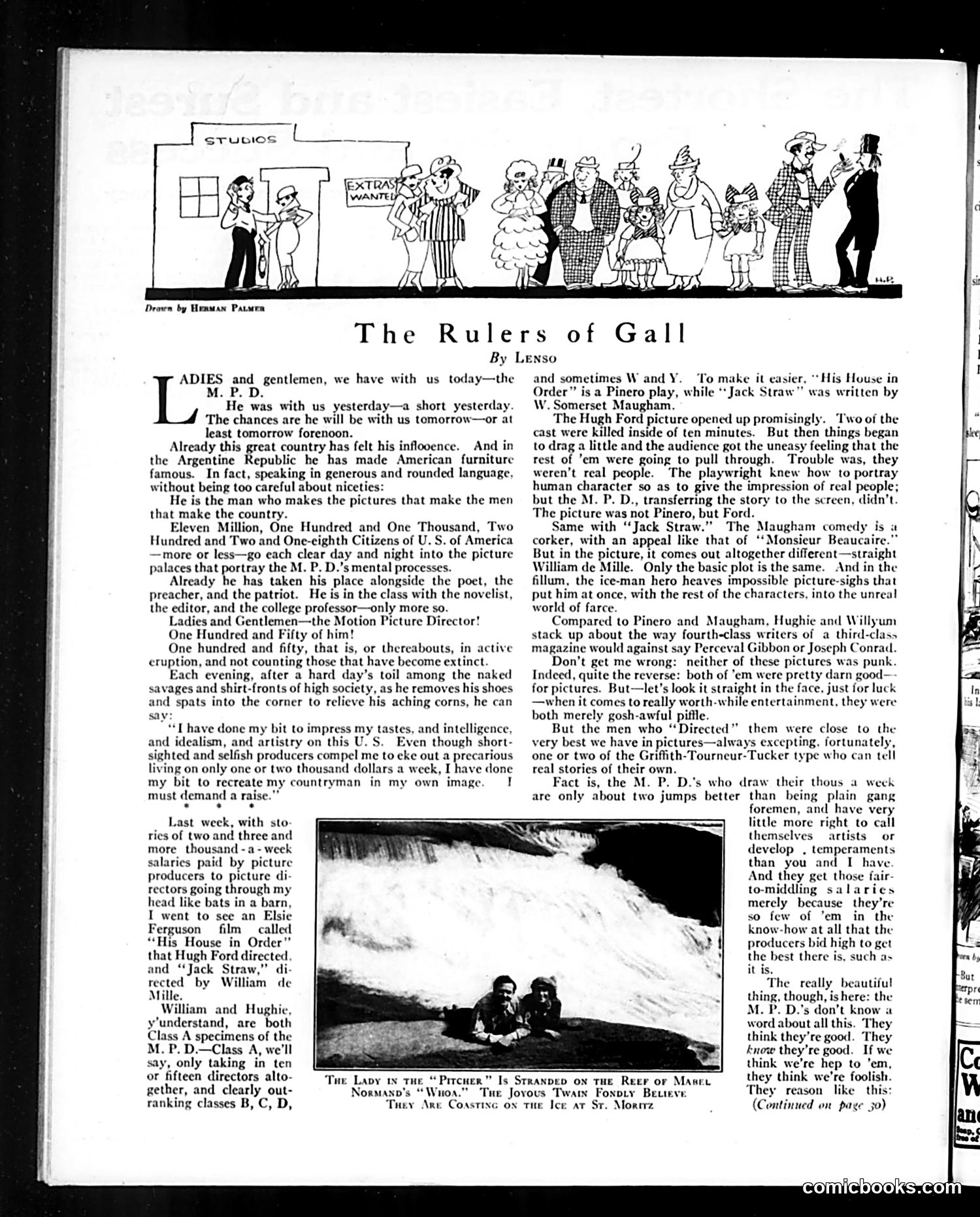
This is a satirical article by Lenso attacking motion picture directors as bloated egotists. The cartoon at top shows a studio scene where directors strut pompously among actors and staff. The text mocks directors like Hugh Ford and William de Mille, who command enormous salaries (thousands weekly) yet lack the artistic sophistication of playwrights like Pinero and Maugham. Lenso argues these directors impose their own shallow tastes on adapted material, destroying the original writers' character development and turning dramatic works into unrealistic farce. The core complaint: approximately 150 active film directors wield enormous cultural influence—reaching millions nightly—despite possessing inferior artistic judgment compared to novelists, poets, and playwrights. They've become the "Rulers of Gall" (audacity), reshaping American culture in their mediocre image while earning princely salaries from insecure producers. The satire targets early Hollywood's nouveau-riche power structure and its displacement of traditional literary authority.
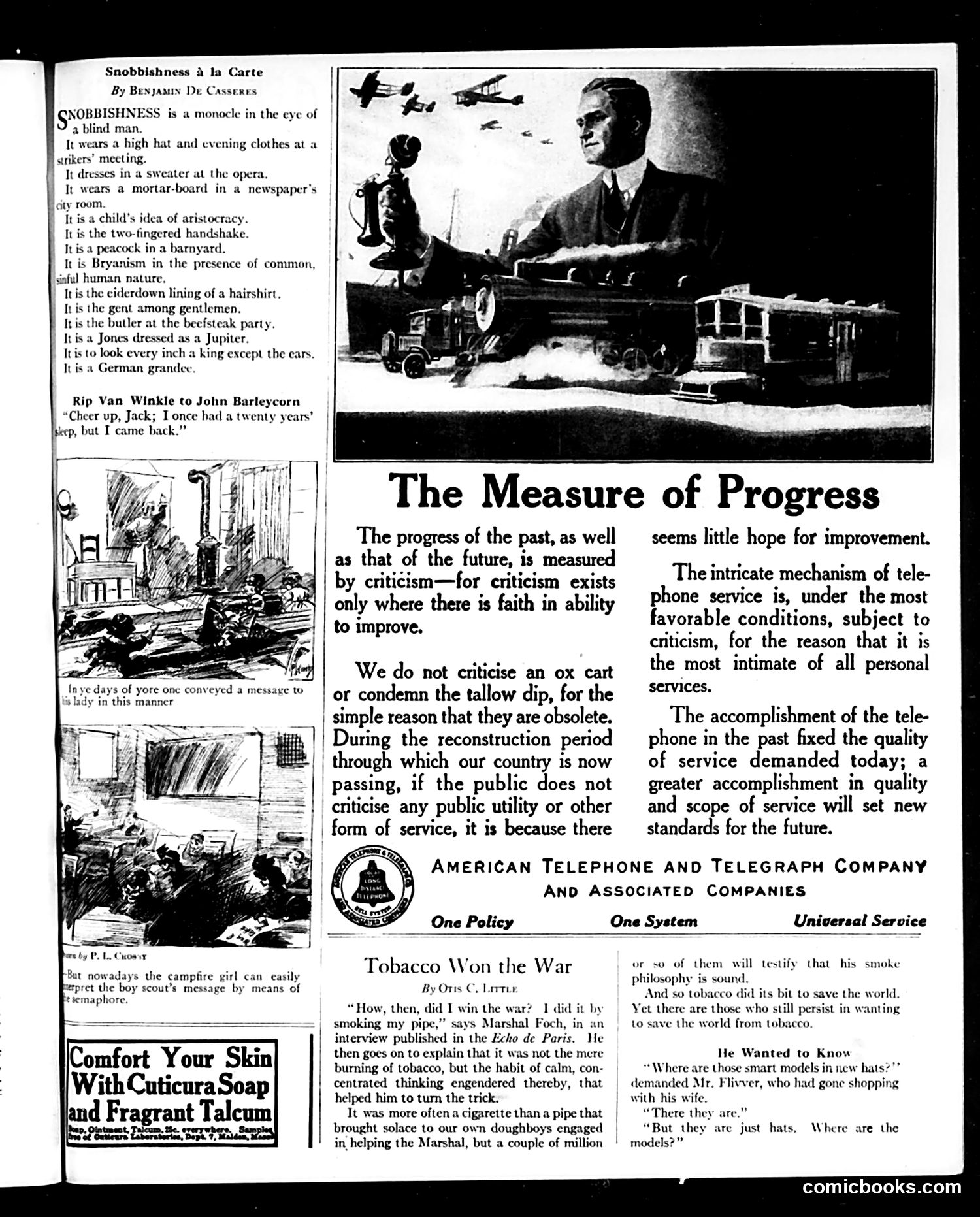
This Judge magazine page contains several satirical pieces: **"Snobbishness à la Carte"** is a humorous list defining snobbery through absurd comparisons—a monocle, high hats, two-fingered handshakes, peacocks in barnyards. It's mocking pretentious upper-class affectation. **The cartoon sketches** (left side) appear to contrast old-fashioned methods of communication with modern ones, likely referencing Boy Scouts and semaphores versus new technology. **"The Measure of Progress"** is a corporate advertisement for AT&T defending telephone service against criticism, arguing that criticism itself proves faith in improvement—a rhetorical defense of their post-war service quality. **"Tobacco Won the War"** credits Marshal Foch's WWI victory to pipe-smoking's calming effects, while defending tobacco against anti-smoking advocates—typical of pre-health-awareness era advocacy. **"He Wanted to Know"** is a brief joke about fashion: a man complains that new hat styles are just hats, not displaying the models wearing them—mocking shallow fashion marketing.
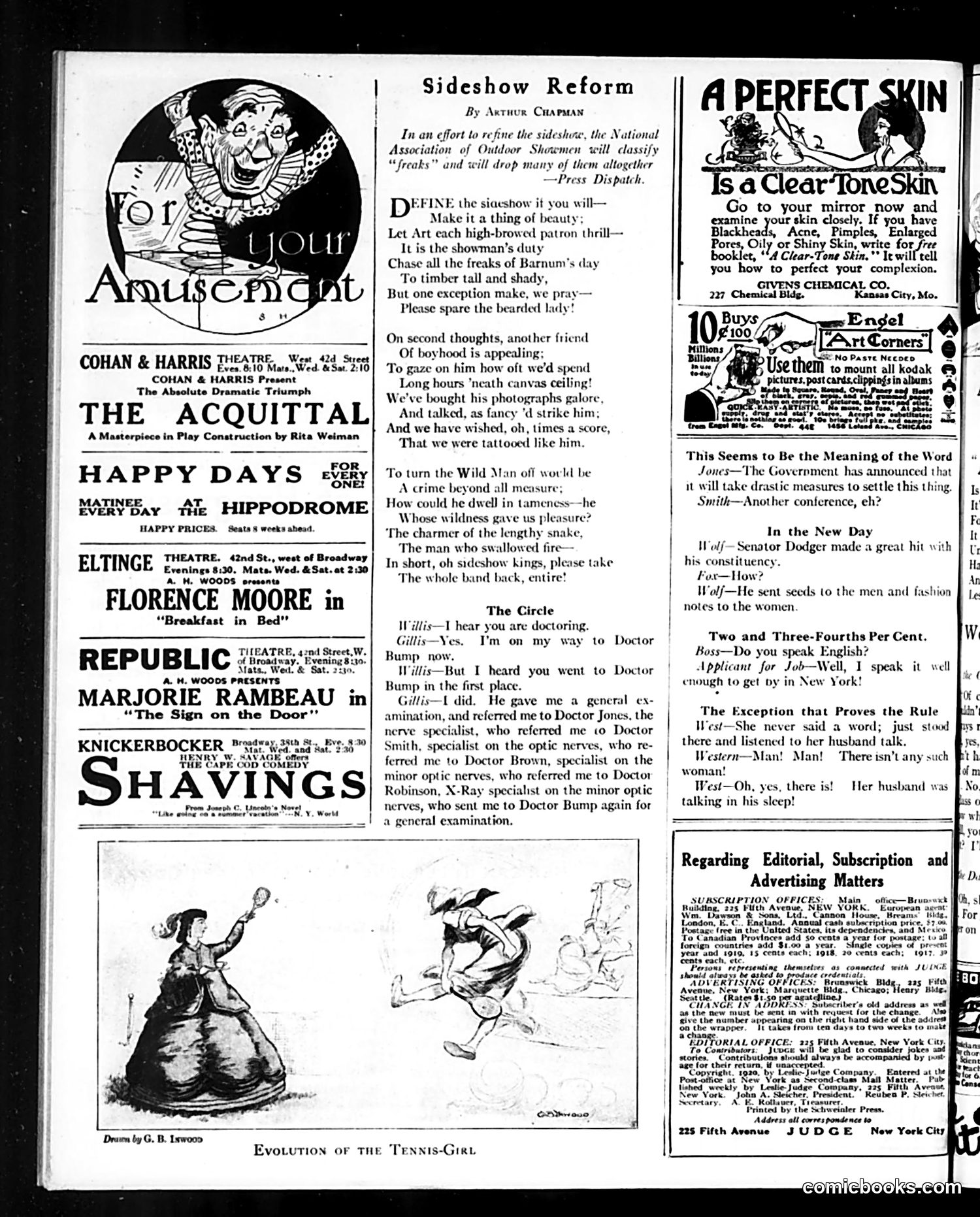
The main cartoon by Arthur Chapman satirizes efforts to "reform" traveling sideshows by eliminating "freak" attractions. The poem ironically pleads to spare "the bearded lady" while proposing to remove other traditional sideshow spectacles—the wild man, the snake charmer, the fire-swallower. The satire's point appears two-fold: it mocks both the reform impulse itself (presented as misguided sentiment about entertainment) and perhaps the naive belief that regulating such attractions would actually succeed. The poem's sentimental tone—"another friend / Of boyhood is appealing"—suggests Chapman finds the reformers' nostalgia-driven objections somewhat ridiculous. The cartoon functions as social commentary on Progressive Era "improvement" movements that sought to regulate public entertainment, deemed exploitative or morally questionable. The bearded lady's special exemption is the joke: reform advocates couldn't quite commit to their own principles.
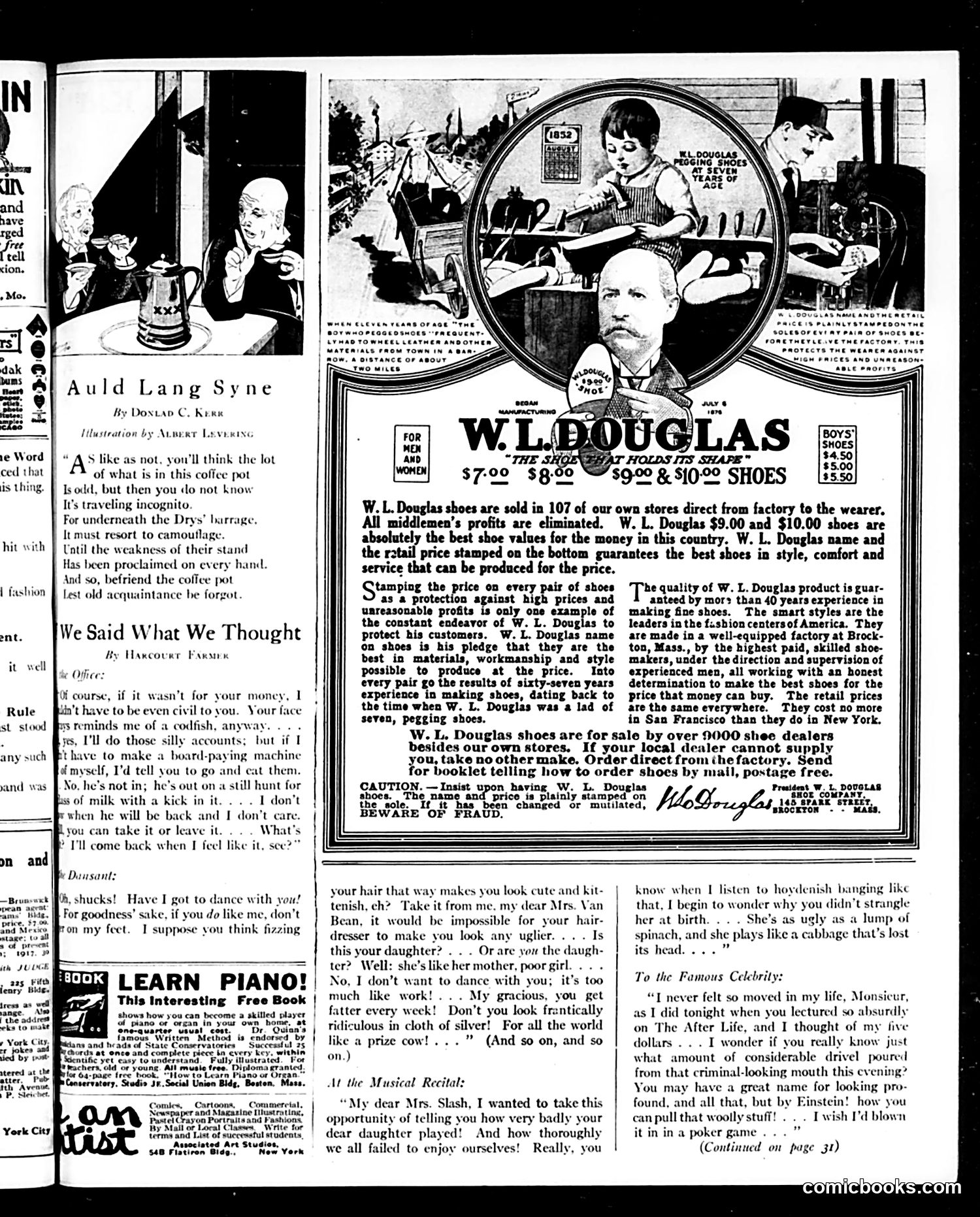
This is primarily an **advertising page** rather than satirical content. The dominant feature is a large **W.L. Douglas shoe advertisement** occupying most of the right side, promoting shoes at $7-$10 priced as "the best values for the money" sold through direct factory-to-consumer sales that eliminated middlemen profits. The left side contains minor satirical pieces, including "Auld Lang Syne" (likely nostalgia-themed humor) and "We Said What We Thought," which presents office workers and social situations making cutting, rude remarks—the humor deriving from unfiltered bluntness rather than political commentary. The scattered dialogue snippets on the bottom mock pretentious behavior (discussing hairstyles, dance partners, daughters' musical abilities) in a manner typical of early-20th-century social satire focused on manners and class performance. **No clear political references or notable caricatures are visible.** This appears to be a commercial-focused issue blending advertisements with light social humor.
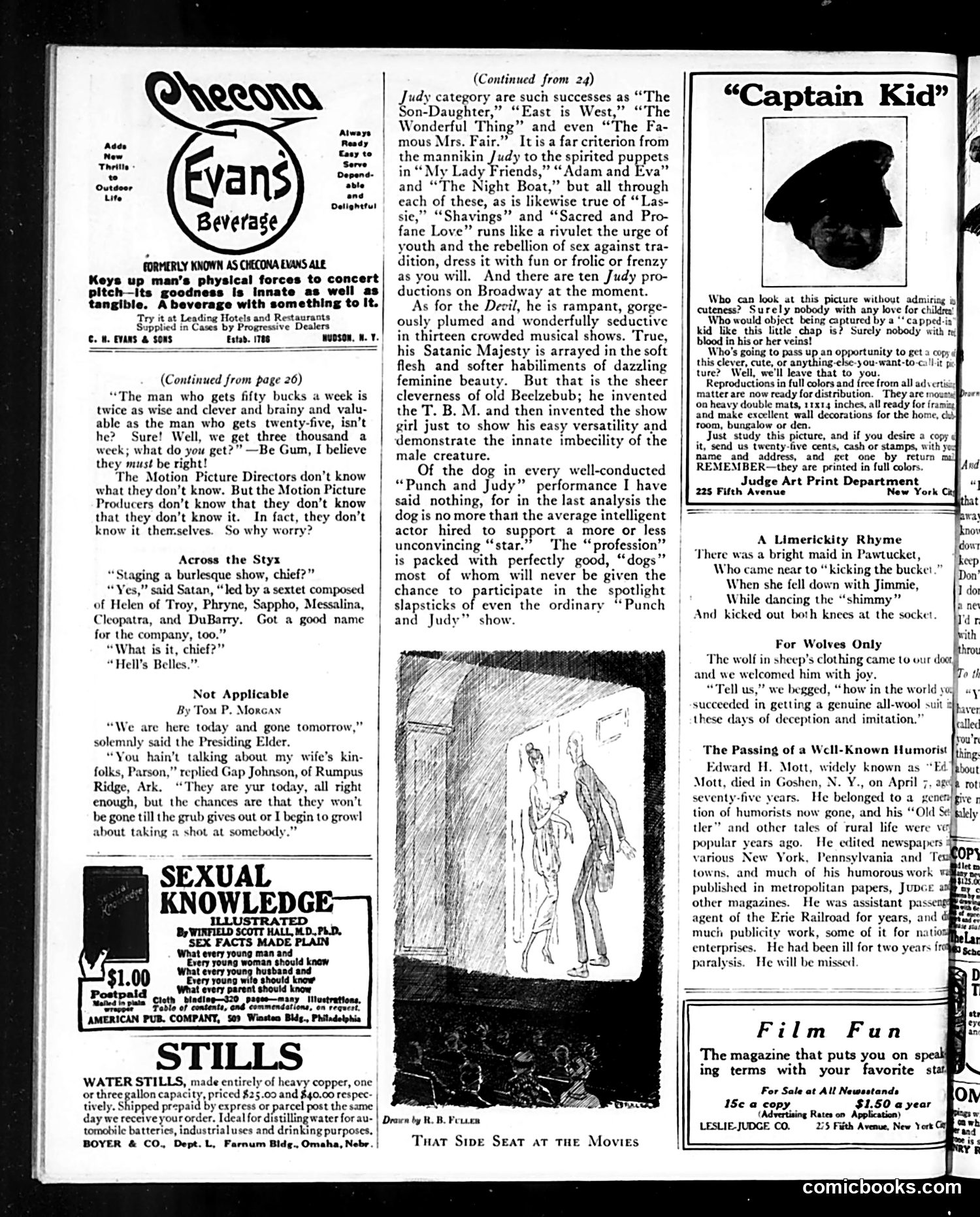
This page from Judge (a satirical American magazine) contains primarily **humor pieces and advertisements** rather than political cartoons. The main content includes brief comedic sketches mocking Hollywood's pretensions—producers and directors who "don't know what they don't know"—and a joke about Hell's entertainment featuring famous historical women (Helen of Troy, Cleopatra, etc.) in a burlesque show called "Hell's Belles." The largest illustration labeled "That Side Seat at the Movies" depicts a cute child—likely meant to advertise a children's publication or product—with accompanying text praising the child's "cuteness." **No clear political satire appears here.** The humor targets entertainment industry absurdities and includes domestic jokes (a preacher's awkward comment about in-laws). Advertisements for beverages (Checona Evans ale) and water stills occupy substantial space. The "Captain Kid" section appears to be a separate advertisement or feature promoting children's content, unrelated to pirate history or politics.
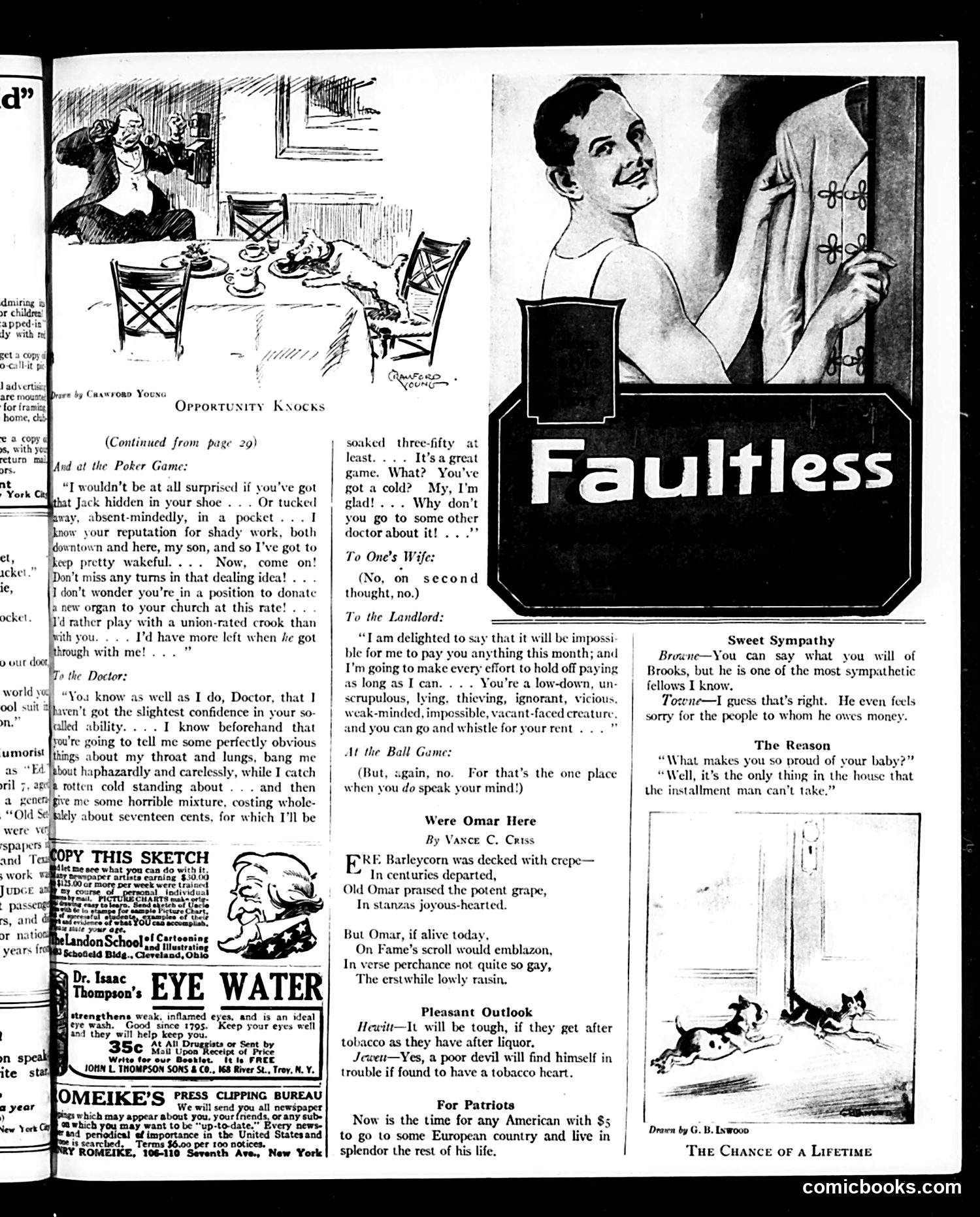
This page from *Judge* (a satirical American magazine) contains several humor pieces mocking social hypocrisy and financial dishonesty of the early 20th century. **"Opportunity Knocks"** (top left) depicts a poker game where a character boasts of his shady reputation "downtown and here" while simultaneously donating organs to church—satirizing how the wealthy laundered ill-gotten gains through charitable donations. The dialogue exchanges that follow ridicule various professions: doctors dispensing useless treatments, landlords exploiting tenants, and generally corrupt individuals. The tone suggests widespread distrust of authority figures and professionals. **"Were Omar Here"** (center) compares the Persian poet Omar Khayyam, historically celebrated for praising wine, to modern times when even humble raisins have become suspect—likely referencing Prohibition-era moral panic. **"The Chance of a Lifetime"** (bottom right, by G.B. Elwood) shows impoverished figures, captioned to suggest emigrating to Europe with just $5 as preferable to American poverty—commentary on economic inequality and the American Dream's failure. The page satirizes corruption, professional incompetence, and class disparities.
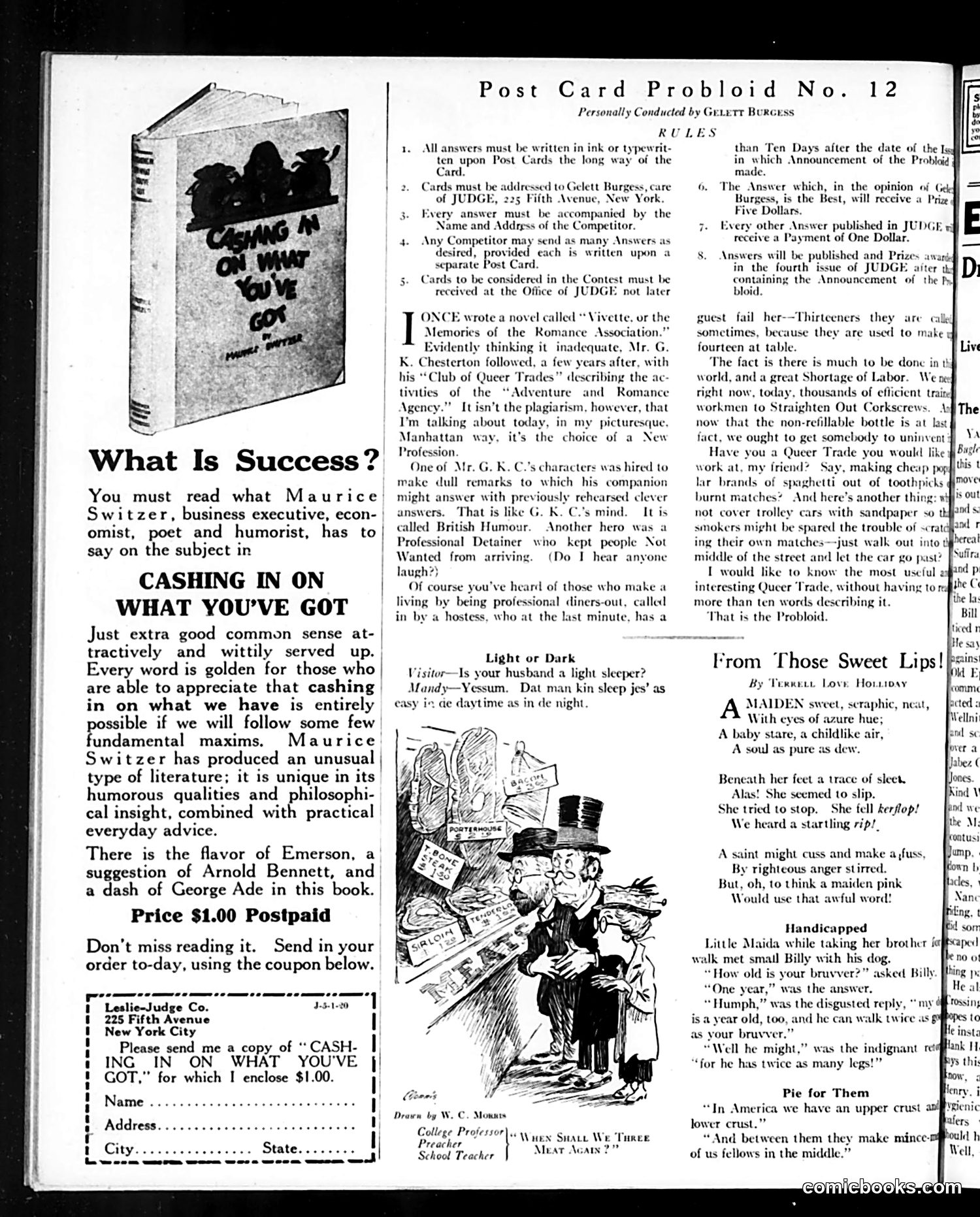
This page primarily features **advertising and a puzzle contest** rather than political satire. The main content advertises Maurice Switzer's self-help book *"Cashing in on What You've Got,"* positioning it as practical wisdom in the style of Ralph Waldo Emerson and George Ade—appealing to early 20th-century readers seeking business success through common sense. Below that is **"Post Card Probloid No. 12,"** a reader-submission contest conducted by Gelett Burgess (famous humorist). The puzzle references G.K. Chesterton's "Club of Queer Trades"—a 1905 short-story collection about eccentric professions. The page asks readers to invent humorous "Queer Trades" (unusual occupations), with the best answer winning five dollars. The cartoon shows a well-dressed couple discussing sleep habits, using dialect humor common to the era—a simple domestic joke unrelated to the larger page content. This is primarily a **commercial and entertainment page** rather than political commentary.
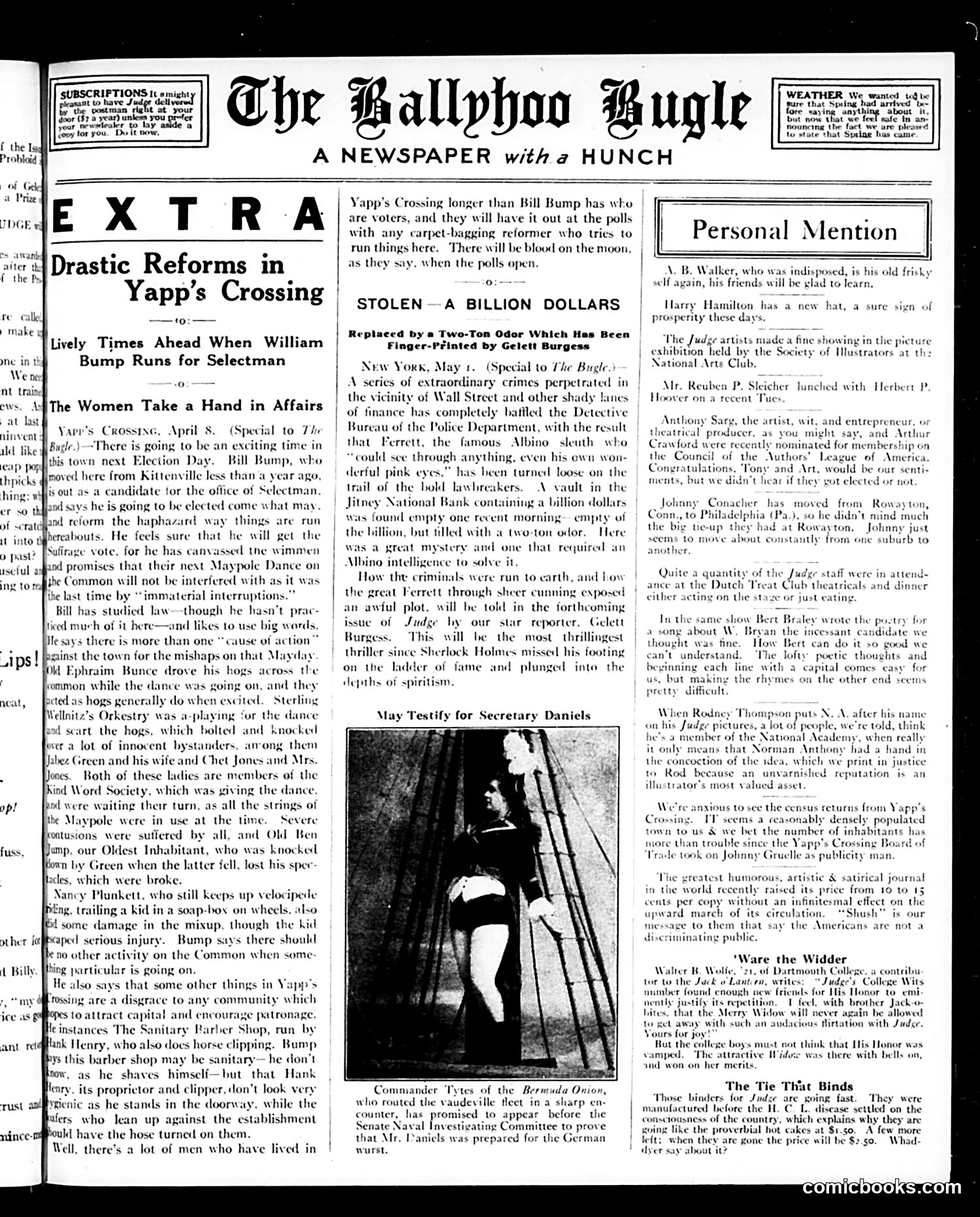
This page satirizes small-town politics and reform movements. The main story, "Drastic Reforms in Yapp's Crossing," mocks a newcomer named William Bump who's running for local office (Selectman) on a reform platform. The joke is that Bump complains about trivial disruptions—a Maypole dance interrupted by loose hogs, a messy barber shop—while using inflated language about "immaterial interruptions" and "disgrace to any community." The satire targets carpet-bagging reformers (outsiders arriving with big plans) who alienate longtime residents with their sanctimonious critiques of minor local issues. The phrase "There will be blood on the moon, as they say, when the polls open" suggests real anger at Bump's presumption. The other items ("Stolen—A Billion Dollars," "May Testify for Secretary Daniels") appear to be satirical fake news headlines typical of Judge's format, parodying sensationalized newspaper coverage.
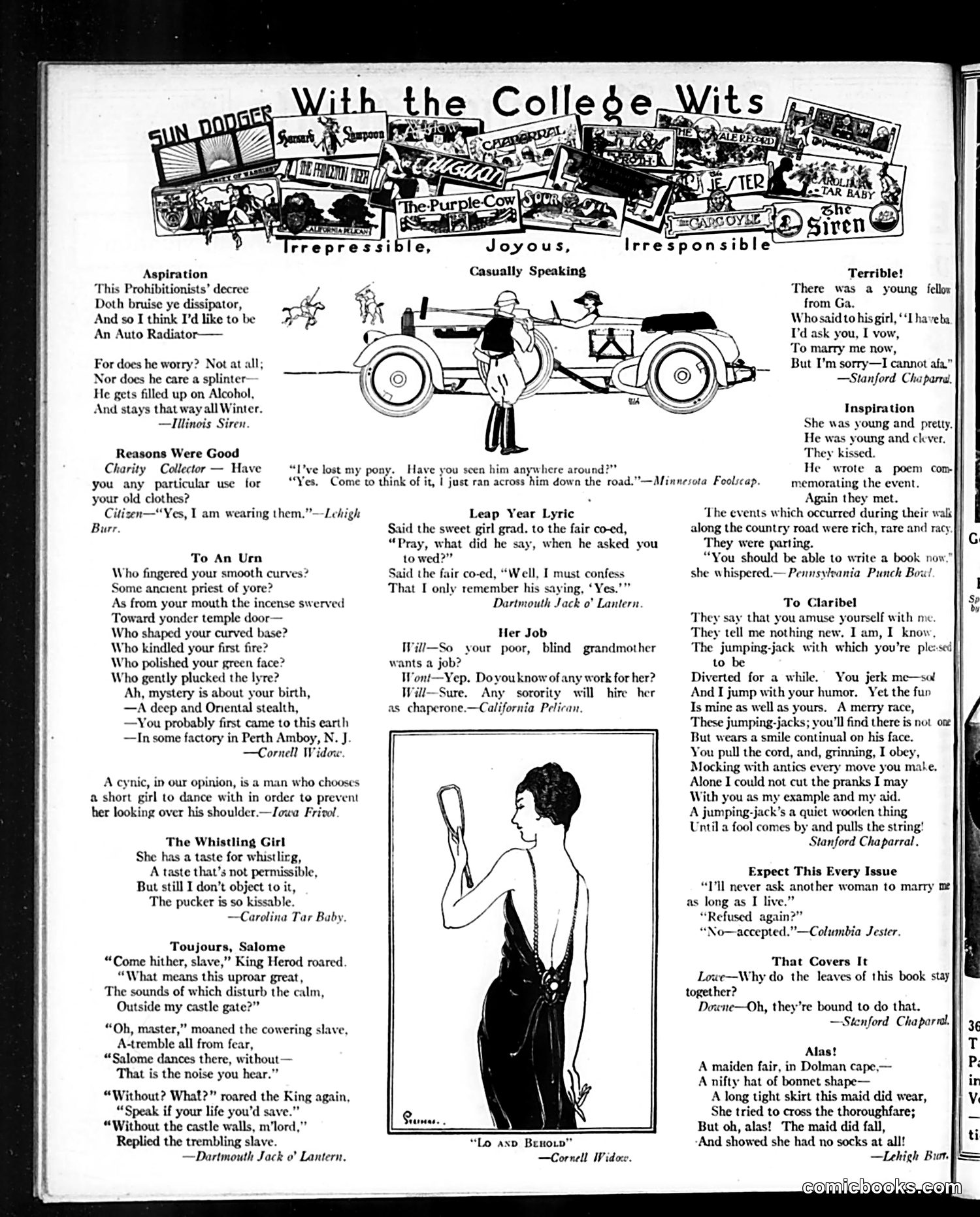
This page collects humorous verse and jokes from various college humor magazines (Cornell Widow, Dartmouth Jack o'Lantern, etc.), typical of Judge's format showcasing collegiate wit. **Key satirical content:** - **"Aspiration"** mocks Prohibition by suggesting an auto radiator has it better—it gets filled with alcohol legally and "stays that way all Winter," attacking the absurdity of the ban. - **"To An Urn"** satirizes affected poetic pretension, building mystique around an ancient artifact before revealing it was mass-produced in Perth Amboy, New Jersey—deflating romantic notions. - **"Her Job"** makes a dark joke about sororities hiring a blind grandmother as chaperone (implying they need supervision themselves). - **"Expect This Every Issue"** pokes fun at marriage refusals—the man swears off proposing after being accepted (suggesting marriage itself is the real rejection). The cartoon depicts a fashionable woman, consistent with Jazz Age imagery. Overall, the page represents 1920s collegiate irreverence toward social institutions: Prohibition, romance, and respectability.
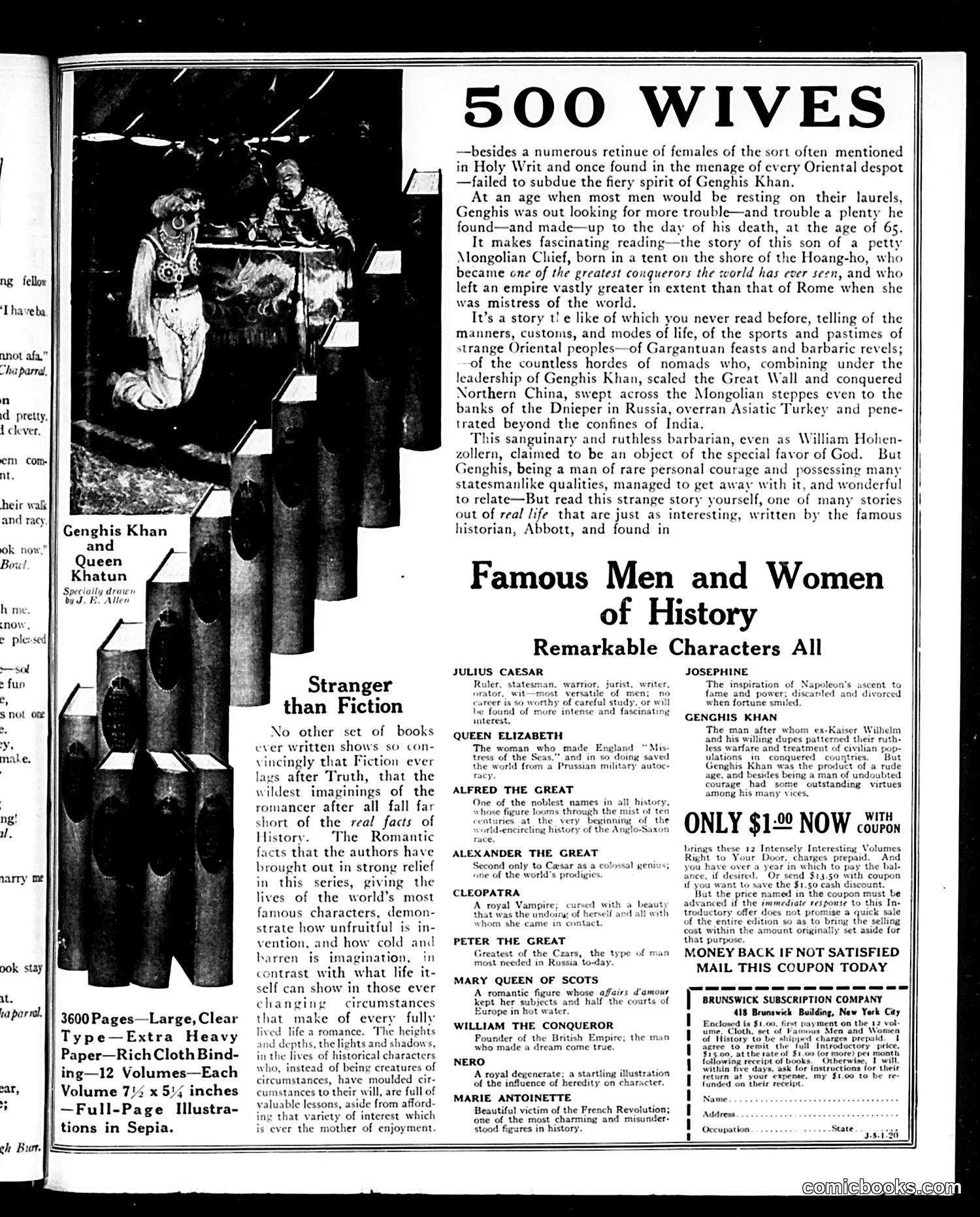
This is primarily **an advertisement page**, not political satire. It promotes a 12-volume history book series titled *"Famous Men and Women of History."* The left side features an illustration labeled "Genghis Khan and Queen Khatun" (drawn by J.E. Allen), depicting the Mongolian conqueror with one of his wives. The accompanying text sensationalizes Genghis Khan's life—emphasizing his 500 wives, military conquests, and ruthless ambition—to hook readers with dramatic biographical content. The advertisement uses the framing device "Stranger than Fiction" to argue that real historical facts are more compelling than invented stories. It lists notable historical figures included in the series (Caesar, Cleopatra, Queen Elizabeth, etc.) to demonstrate the collection's scope. The $1.00 price offer (with coupon) positions this as an affordable educational product for early-20th-century consumers. There is no apparent political commentary—this is straightforward marketing material aimed at readers interested in history and biography.
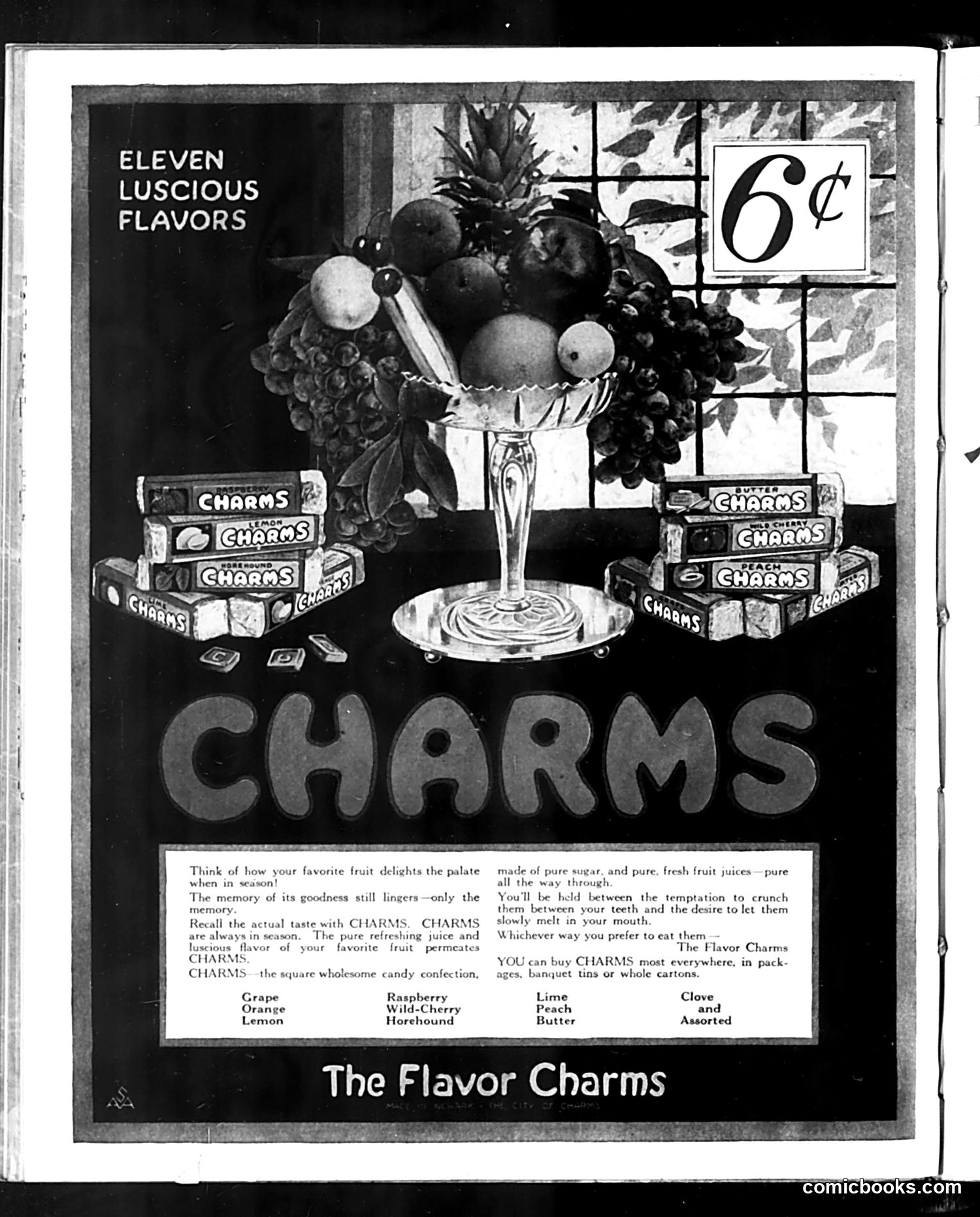
This is primarily a **product advertisement**, not political satire or a cartoon. It promotes "Charms," a square candy confection priced at 6 cents. The ad features a decorative still-life display: a glass goblet overflowing with various fruits (grapes, orange, lemon, raspberry, etc.) surrounded by stacked Charms candy boxes. The visual emphasizes the product's "eleven luscious flavors." The marketing copy appeals to sensory pleasure and nostalgia, describing how eating Charms recreates the taste of fresh fruit. It lists available flavors (Grape, Orange, Lemon, Raspberry, Wild-Cherry, Horehound, Lime, Peach, Butter, Clove, and Assorted) and notes wide availability in "packages, banquet tins or whole cartons." This appears to be a standard early 20th-century advertisement, likely from Judge magazine's commercial content rather than satirical material.