
Judge, 1920-05-01 · page 26 of 36
Judge — May 1, 1920 — page 26: what you’re looking at
What you’re looking at
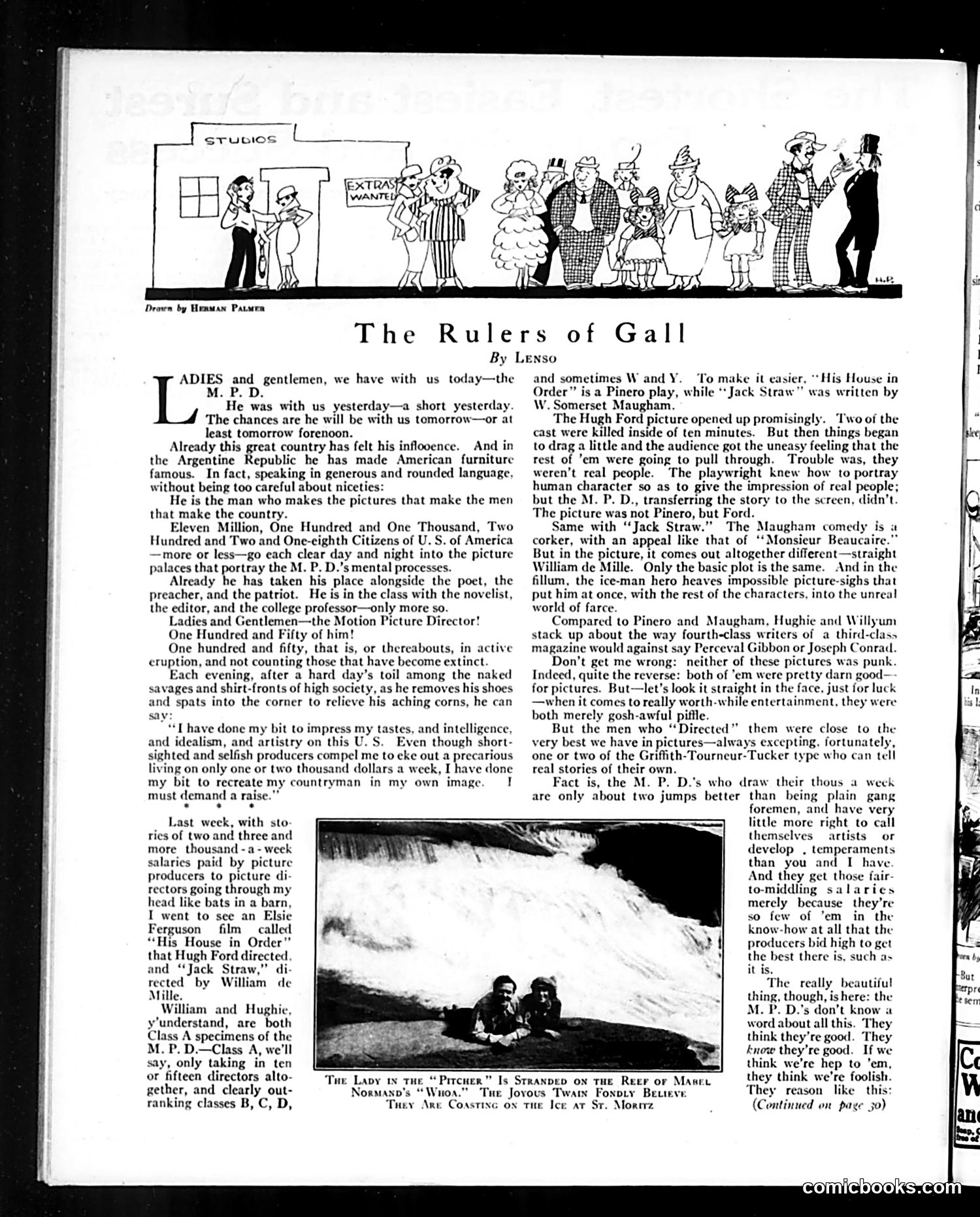
This is a satirical article by Lenso attacking motion picture directors as bloated egotists. The cartoon at top shows a studio scene where directors strut pompously among actors and staff. The text mocks directors like Hugh Ford and William de Mille, who command enormous salaries (thousands weekly) yet lack the artistic sophistication of playwrights like Pinero and Maugham. Lenso argues these directors impose their own shallow tastes on adapted material, destroying the original writers' character development and turning dramatic works into unrealistic farce. The core complaint: approximately 150 active film directors wield enormous cultural influence—reaching millions nightly—despite possessing inferior artistic judgment compared to novelists, poets, and playwrights. They've become the "Rulers of Gall" (audacity), reshaping American culture in their mediocre image while earning princely salaries from insecure producers. The satire targets early Hollywood's nouveau-riche power structure and its displacement of traditional literary authority.
📄 Transcribed text from this page (OCR, searchable)
Machine-transcribed from the original scan — historical spelling and the odd misread are preserved.
Drown by Heawax Pataen The Rulers of Gall By Lenso ADIES and gentlemen, we have with us today—the M. P. D. He was with us yesterday—a short yesterday. The chances are he will be with us tomorrow—or at least tomorrow forenoon. Already this great country has felt his inflooence. And in the Argentine Republic he has made American furniture famous. In fact, speaking in generous and rounded language, without being too careful about niceties: He is the man who makes the pictures that make the men that make the country. Eleven Million, One Hundred and One Thousand, Two Hundred and Two and One-eighth Citizens of U. S. of America —more or less—go each clear day and night into the picture palaces that portray the M. P. D.’s mental processes. Already he has taken his place alongside the poet, the preacher, and the patriot. He is in the class with the novelist, the editor, and the college professor—only more so. Ladies and Gentlemen—the Motion Picture Director! One Hundred and Fifty of him! One hundred and fifty, that is, or thereabouts, in active eruption, and not counting those that have become extinct. Each evening, after a hard day’s toil among the naked savages and shirt-fronts of high society, as he removes his shoes and spats into the corner to relieve his aching corns, he can say: “T have done my bit to impress my tastes, and intelligence, and idealism, and artistry on this U.S. Even though short- ighted and selfish producers compel me to eke out a precarious living on only one or two thousand dollars a week, I have done my bit to recreate my countryman in my own image I must demand a rai Last week, with sto ries of two and three and more thousand - a- week salaries paid by picture producers to picture di- rectors going through my head like bats in a barn, I went to see an Elsie Ferguson film called “His House in Order” that Hugh Ford directed. and “Jack Straw,” di rected by William de Mille. William and Hughie, y’understand, are both Class A A speciniens of the M. P. D.—Class A, we'll say, only taking in ten or fifteen directors alto- gether, and clearly out- ranking classes B, C, D, They " Is Srranpep on THE Reer or Mase. F : Jovous Twat Ane: Coastine ox tHe Ice at Sr. Monere and sometimes W and Y. ‘To make it easier, “His House in Order” is a Pinero play, while “Jack Straw” was written by W. Somerset Maugham. The Hugh Ford picture opened up promisingly. ‘Two of the cast were killed inside of ten minutes. But then things began to drag a little and the audience got the uneasy feeling that the rest of ’em were going to pull through. Trouble was, they weren’t real people. The playwright knew how to portray human character so as to give the impression of real people; but the M. P. D., transferring the story to the screen, didn’t. The picture was not Pinero, but Ford. Same with “Jack Straw.” The Maugham comedy is corker, with an appeal like that of ‘‘Monsicur Bea But in the picture, it comes out altogether different William de Mille. Only the basic plot is the same. And in the fillum, the ice-man hero heaves impossible picture-sighs that put him at once, with the rest of the characters, into the unreal world of farce. Compared to Pinero and Maugham, Hughie and Willyum stack up about the way fourth-class writers of a third-class magazine would against say Perceval bon or Joseph Conrad. Don’t get me wrong: neither of these pictures was punk. Indeed, quite the reverse: both of 'em were pretty darn good— for pictures. But—let’s look it straight in the face, just for luck —when it comes to really worth-while entertainment, they were both merely gosh-awful pifile. But the men who “Directed” them were close to the very best we have in pictures—alwa. scepting, fortunately, one or two of the Griffith-Tourneur-Tucker type who can tell real stories of their own. Fact is, the M. P. D.’s who draw their thous a week are only about two jumps better than being plain gang foremen, and have very little more right to call themselves art or develop , tempera ments than you and I ha And they get those fair- to-middling salaries merely because they’re so few of ’em in the know-how at all that the producers bid high to get the best there is, such as he really beautiful thing, though, is here: the M. P. D.’s don’t know a word about all this. They think they’re good. They know they’re good. If we think we're hep to 'em, they think we're foolish. They reason like this: xpLY Betteve 1 (Continued on page 30)