
Judge, 1920-05-01 · page 24 of 36
Judge — May 1, 1920 — page 24: what you’re looking at
What you’re looking at
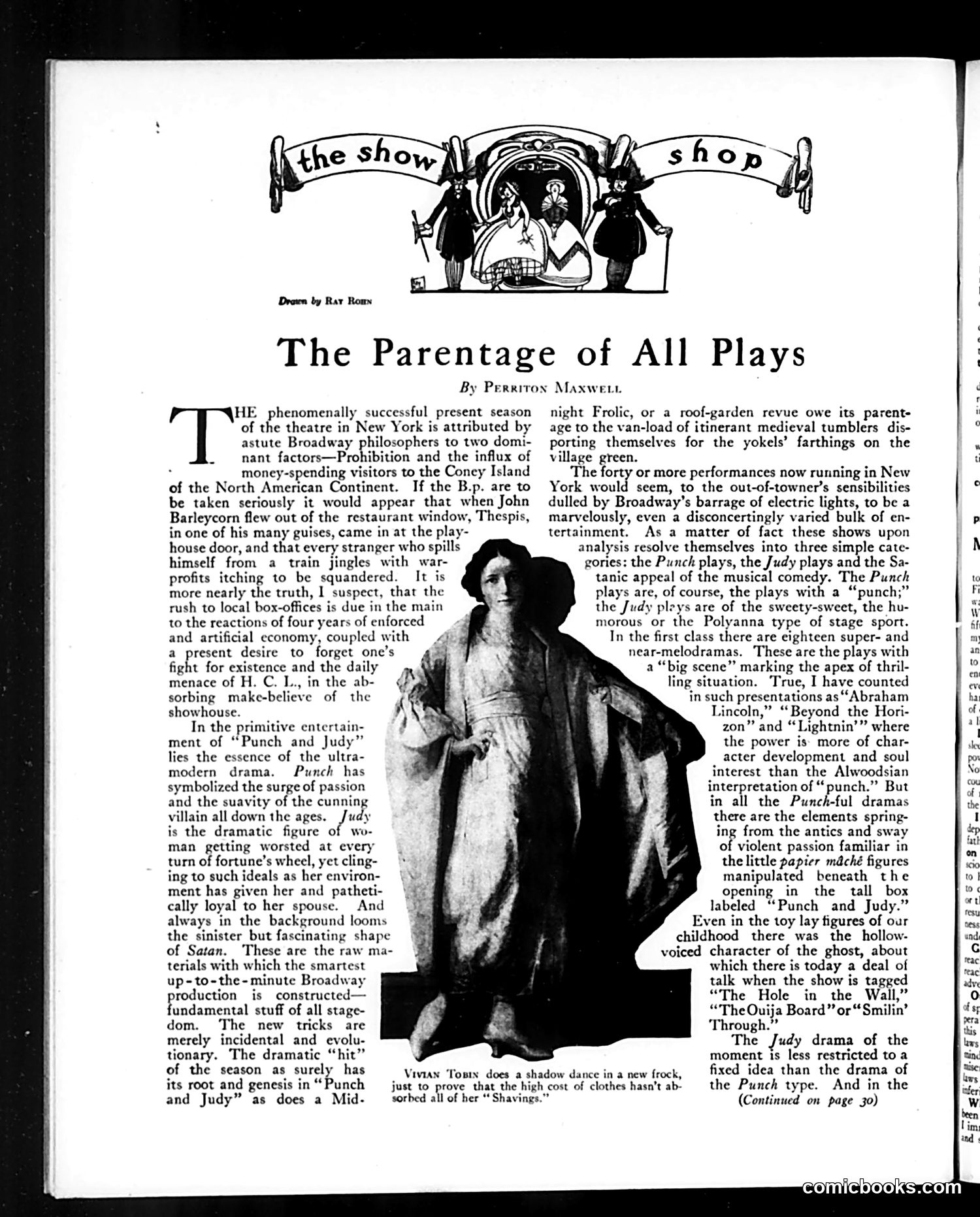
This is a theater criticism essay arguing that all Broadway plays derive from the ancient "Punch and Judy" puppet show tradition. The accompanying photograph shows Vivian Touts performing a shadow dance, illustrating the text's point about theatrical lineage. **The argument:** The author claims Broadway's current success (presumably 1920s, post-Prohibition) stems from audiences seeking escapism. He categorizes modern plays into three types—"Punch plays" (dramatic, action-driven), "Judy plays" (sentimental, sweet), and musical comedies with "Satanic appeal." **The satire's point:** Rather than celebrate modern theatrical innovation, Maxwell suggests sophisticated Broadway productions are merely dressed-up versions of simple puppet-show archetypes: the passionate male character, the suffering female, and evil. High-cost costumes and elaborate staging don't change fundamental dramatic DNA. **Context:** This reflects 1920s theater criticism's obsession with theatrical genealogy and the assumption that "primitive" entertainment held universal truths about human drama.
📄 Transcribed text from this page (OCR, searchable)
Machine-transcribed from the original scan — historical spelling and the odd misread are preserved.
Drown by Rav Romy The Parentage of All Plays By Perriton Maxweut. HE phenomenally successful present season of the theatre in New York is attributed by astute Broadway philosophers to two domi- nant factors—Prohibition and the influx of : money-spending visitors to the Concy Island of the North American Continent. If the B.p. are to be taken seriously it would appear that when John Barleycorn flew out of the restaurant window, Thespis, in one of his many guises, came in at the play- house door, and that every stranger who spills himself from a train jingles with war- profits itching to be squandered. It is more nearly the truth, I suspect, that the rush to local box-offices is due in the main to the reactions of four years of enforced and artificial economy, coupled with 4 a present desire to forget one’s x fight for existence and the daily menace of H. C. L., in the ab- sorbing make-believe of the showhouse. In the primitive entertain- ment of “Punch and Judy” lies the essence of the ultra- modern drama. Punch has symbolized the surge of passion and the suavity of the cunning villain all down the ages. Judy is the dramatic figure of wo- man getting worsted at every turn of fortune’s wheel, yet cling- ing to such ideals as her environ- ment has given her and patheti- cally loyal to her spouse. And always in the background looms the sinister but fascinating shape of Satan. These are the raw ma- terials with which the smartest up-to-the-minute Broadway production is constructed— fundamental stuff of all stage- dom. The new tricks are merely incidental and evolu- tionary. The dramatic “hit” of the season as surely has its root and genesis in “Punch and Judy” as does a Mid- _ Vivian Touts does a shadow dance in a new frock, just to prove that the high cost of clothes hasn't ab- sorbed all of her “ Shavings.” night Frolic, or a roof-garden revue owe its parent- age to the van-load of itinerant medieval tumblers dis- porting themselves for the yokels’ farthings on the village green. The forty or more performances now running in New York would seem, to the out-of-towner’s sensibilities dulled by Broadway's barrage of electric lights, to be a marvelously, even a disconcertingly varied bulk of en- tertainment. As a matter of fact these shows upon analysis resolve themselves into three simple cate- gories: the Punch plays, the Judy plays and the Sa- tanic appeal of the musical comedy. The Punch plays are, of course, the plays with a “punch;” the Judy pleys are of the sweety-sweet, the hu- morous or the Polyanna type of stage sport. In the first class there are eighteen super- and near-melodramas. These are the plays with a “big scene” marking the apex of thril- ling situation. True, I have counted in such presentations as “Abraham Lincoln,” “Beyond the Hori- zon” and “Lightnin’” where the power is: more of char- acter development and soul interest than the Alwoodsian interpretation of “punch.” But in all the Punch-ful dramas there are the elements spring- ing from the antics and sway of violent passion familiar in the little papier maché figures manipulated beneath the opening in the tall box labeled ‘Punch and Judy.” Even in the toy lay figures of our childhood there was the hollow- voiced character of the ghost, about which there is today a deal of talk when the show is tagged “The Hole in the Wall,” “TheOuija Board” or“ Smilin’ ‘Through.” The Judy drama of the moment is less restricted to a fixed idea than the drama of the Punch type. And in the (Continued on page 30)