
Judge, 1920-05-01 · page 12 of 36
Judge — May 1, 1920 — page 12: what you’re looking at
What you’re looking at
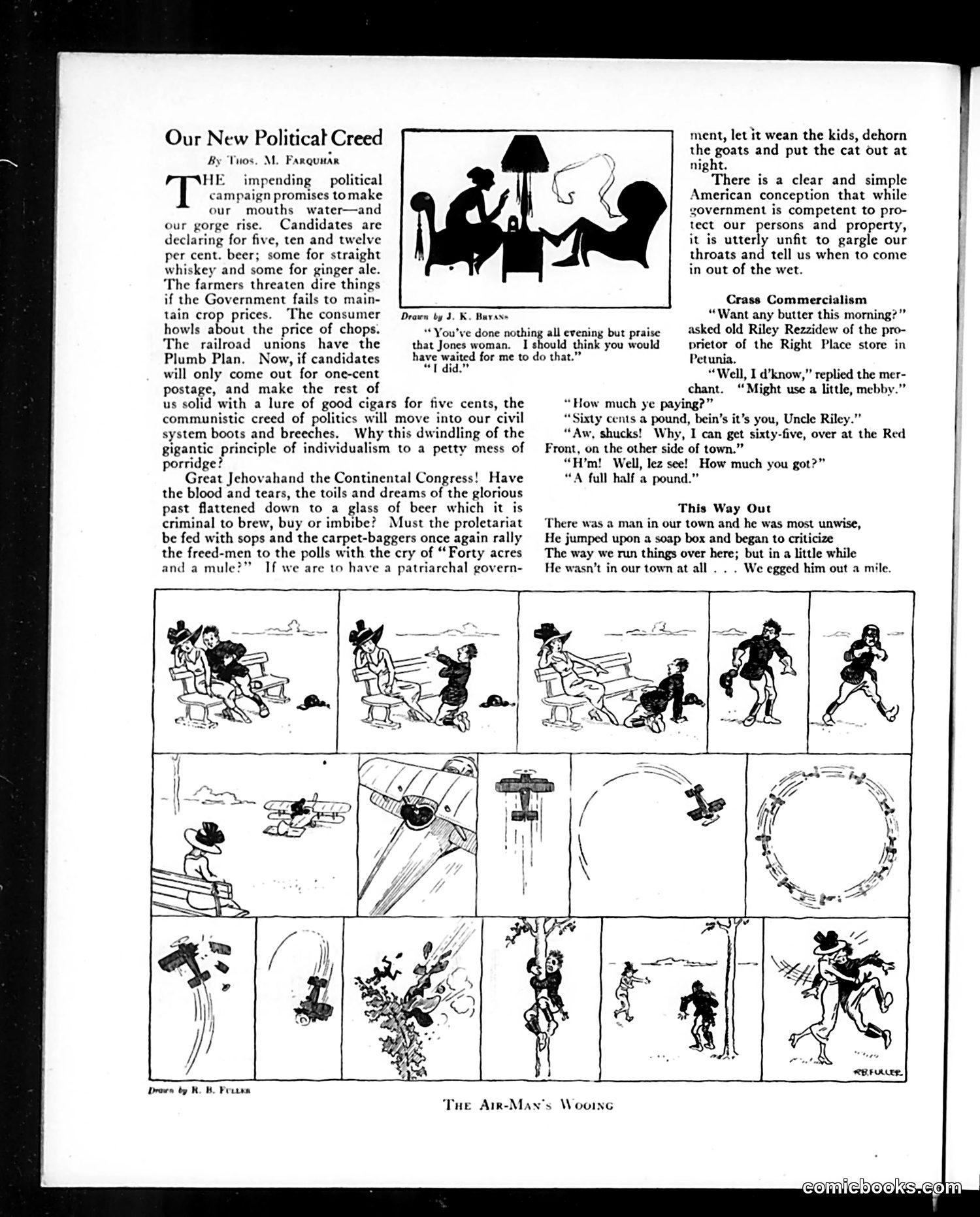
This page satirizes 1920s American politics through multiple pieces: **Main Editorial:** Farquhar mocks candidates pandering with trivial promises—cheaper beer, whiskey, ginger ale, and cigars—rather than addressing serious principles. He contrasts this degradation of civic discourse with the ideals of the Founding Fathers, sarcastically asking if the Revolution was fought merely to negotiate commodity prices. **"Crass Commercialism":** A dialogue between Uncle Riley and a store owner illustrates small-town haggling over butter prices—poking fun at rural commerce and petty negotiations. **"This Way Out":** A brief verse warns that criticizing local affairs gets you driven out of town, satirizing provincial intolerance of dissent. **"The Air-Man's Wooing":** A comic strip (drawn by B.D. Prien) depicts slapstick aerial mishaps—likely mocking early aviation's dangers and romance narratives. The page reflects post-WWI disillusionment with degraded political discourse and American social conformity.
📄 Transcribed text from this page (OCR, searchable)
Machine-transcribed from the original scan — historical spelling and the odd misread are preserved.
Our New Politicat Creed By Tuos. M. Farquuar HE impending _ political campaign promises tomake our mouths water—and our gorge rise. Candidates are declaring for five, ten and twelve per cent. beer; some for straight whiskey and some for ginger ale. The farmers threaten dire things if the Government fails to main- tain crop prices. The consumer howls about the price of chops. The railroad unions have the Plumb Plan. Now, if candidates will only come out for one-cent postage, and make the rest of us solid with a lure of good cigars for five cents, the communistic creed of politics will move into our civil system boots and breeches. Why this dwindling of the gigantic principle of individualism to a petty mess of porridge? Great Jehovahand the Continental Congress! Have the blood and tears, the toils and dreams of the glorious past flattened down to a glass of beer which it is criminal to brew, buy or imbibe? Must the proletariat be fed with sops and the carpet-baggers once again rally the freed-men to the polls with the cry of “Forty acres and a mule?” If we are to have a patriarchal govern- Drawn by J. K. Bavaxs that Jones woman. “1 did.” “You've done nothing all evening but praise I should have waited for me to do that.” ment, let it wean the kids, dehorn the goats and put the cat out at night. There is a clear and simple American conception that while government 1s competent to pro- tect our persons and property, it is utterly unfit to gargle our throats and tell us when to come in out of the wet. Crass Commercialism “Want any butter this morning?” asked old Riley Rezzidew of the pro- prietor of the Right Place store in Petunia. “Well, I d’know,” replied the mer- chant. “Might use a little, mebby.” “How much ye paying?” “Sixty cents a pound, bein’s it’s you, Uncle Riley.” “Aw, shucks! Why, I can get sixty-five, over at the Red Front, on the other side of town.” “H’m! Well, lez see! How much you got?” “A full half a pound.” think you would This Way Out There was a man in our town and he was most unwise, He jumped upon a soap box and began to criticize The way we run things over here; but in a little while He wasn’t in our town at all . . . We egged him out a mile. Draws by KB. Prien ‘Tue Air-Man’s Wooinc