
Judge, 1920-05-01 · page 21 of 36
Judge — May 1, 1920 — page 21: what you’re looking at
What you’re looking at
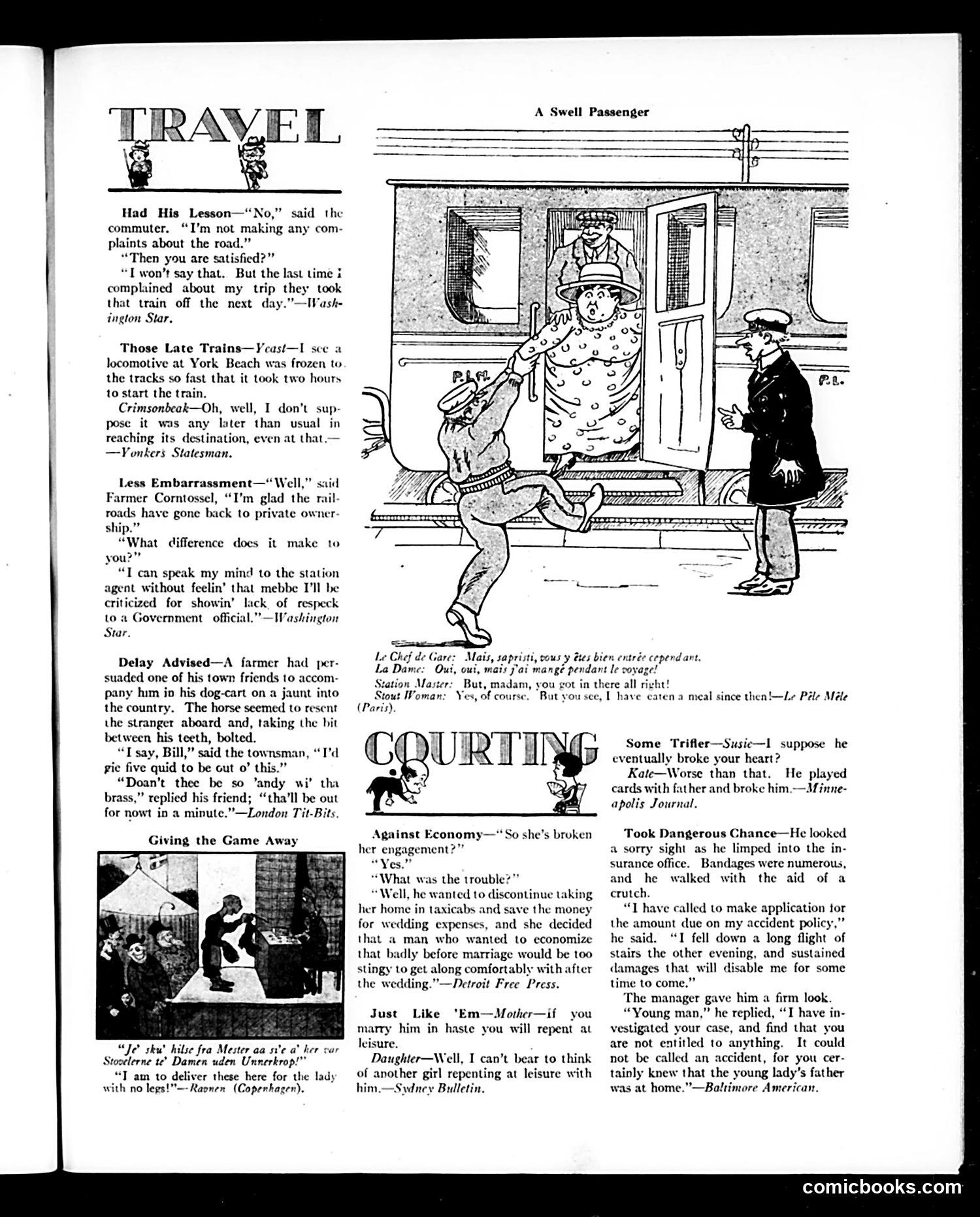
This page contains multiple short humorous anecdotes typical of early 20th-century American satirical journalism. Key themes include: **Railroad Complaints**: Jokes about chronic train delays and poor service. One anecdote notes a locomotive frozen so badly it took two hours to start—yet still arrived on time, suggesting the railroad's tardiness was expected. **Railroad Privatization**: A farmer celebrates railroads returning to "private ownership" because he can complain freely to station agents without worrying about "disrespecting a Government official"—referencing recent U.S. railroad deregulation debates. **Social Comedy**: The main cartoon shows a well-dressed woman ejecting luggage from a train window while a porter protests. The French caption indicates she brought excessive baggage despite claiming to have eaten nothing during her journey—poking fun at travelers' contradictions. Other brief jokes mock relationship dynamics, fiscal responsibility, and insurance fraud. The page reflects contemporary American anxieties about transportation reliability and bureaucratic vs. private service.
📄 Transcribed text from this page (OCR, searchable)
Machine-transcribed from the original scan — historical spelling and the odd misread are preserved.
Had His Lesson—‘‘No,” said the commuter. “I’m not making any com- plaints about the road.” “Then you are satisfied?” “IT won’t say that. But the last time i complained about my trip they took that train off the next day.”—Wash- ington Star. Those Late Trains—YVeast—I sce a locomotive at York Beach was frozen to the tracks so fast that it took two hours to start the train. Crimsonbeak—Oh, well, I don't sup- pose it was any later than usual in reaching its destination, even at that.— —Vonkers Statesman. Less Embarrassment—“ Well,” said Farmer Corntossel, “I’m glad the rail- roads have gone back to private owner- ship.” “What you?” “TI can speak my mind to the station agent without feelin’ that mebbe I'll be criticized for showin’ lack, of respeck to a Government official.” —Washington Star. difference docs it make to Delay Advised—A farmer had per- suaded one of his town friends to accom- pany him io his dog-cart on a jaunt into the country. The horse seemed to resent the stranger aboard and, taking the bit between his teeth, bolted. “Tsay, Bill,” said the townsman, “I'd gie five quid to be out o’ this.” “Doan’t thee be so ’andy wi’ tha brass,” replied his friend; ‘“tha’ll be out for nowt in a minute.”—London Tit-Bits. Giving the Game Aw: “Je? sku’ hilse fra Mester aa sie a’ her car Stovelerne te’ Damen uden Unnerkrop!”” “T am to deliver these here for the lady with no legs!"—-Raonen (Copenhagen). A Swell Passenger Station Master Stout Woman: (Paris). But, madam, you got int es, of course. Against Economy—" So her engagement?” “Yes.” “What was the trouble?” “Well, he wanted to discontinue taking her home in taxicabs and save the money for wedding expenses, and she decided that a man who wanted to economize that badly before marriage would be too stingy to get along comfortably with after the wedding.”—Detroit Free Press. she’s broken Just Like "Em—Mother—if you marry him in haste you will repent at leisure. Daughter—Well, I can’t bear to think of another girl repenting at leisure with him.—Sydney Bulletin. Mais, sapristi, cous y tes bien oui, mais jai mangé pendant le coyage! + ceperdart, re all rivht! But you see, I have caren a meal since then!—Le Pe Méle Some Trifler—Susie—I suppose he eventually broke your heart? Kate—Worse than that. He played cards with father and broke him.—Minne- apolis Journal, Took Dangerous Chance—He looked a sorry sight as he limped into the in- surance office. Bandages were numerous, and he walked with the aid of a crutch. “1 have called to make application tor the amount due on my accident policy,” he said. “I fell down a long flight of stairs the other evening, and sustained damages that will disable me for some time to come.” The manager gave him a firm look. “Young man,” he replied, “I have in- vestigated your case, and find that you are not entitled to anything. It could not be called an accident, for you cer- tainly knew that the young lady’s father was at home.”—Baltimore American. comicbooks.com