
Judge, 1920-05-01 · page 11 of 36
Judge — May 1, 1920 — page 11: what you’re looking at
What you’re looking at
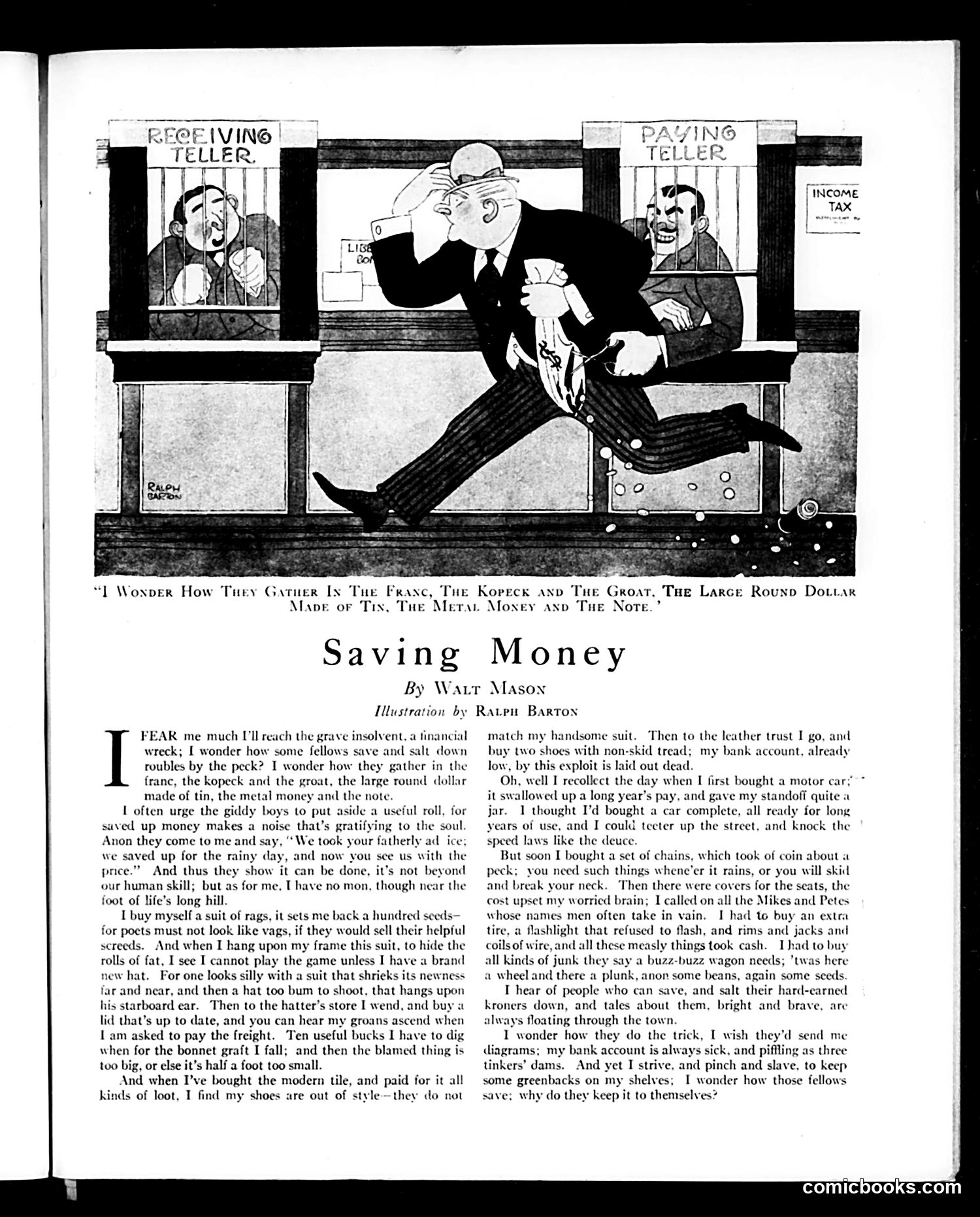
This humorous essay-poem, illustrated by Ralph Barton, satirizes the difficulty of saving money in modern life. The cartoon shows a well-dressed man juggling coins between a "Receiving Teller" and "Paying Teller" at a bank, while an "Income Tax" notice looms nearby. Mason's narrator is a perpetually broke poet who *intends* to save but finds himself perpetually spending on necessities and modern conveniences: new clothes, shoes, a motor car, and endless automobile accessories (chains, seat covers, tires, jacks). Each purchase depletes his bank account. He expresses bewilderment at how others manage to accumulate savings—sarcastically suggesting they keep the secret to themselves. The satire targets both the illusion of thrift in an consumer-driven society and the multiple drains on wages: clothing costs, automotive expenses, and taxes. The humor lies in the gap between good intentions and financial reality.
📄 Transcribed text from this page (OCR, searchable)
Machine-transcribed from the original scan — historical spelling and the odd misread are preserved.
Saving By Warr Mason Illustration by Raven Barton FEAR me much I'll reach the grave insolvent, a financial wreck; I wonder how some fellows save and salt down roubles by the peck? I wonder how they gather in the franc, the kopeck and the groat, the large round dollar made of tin, the metal money and the note. I often urge the giddy boys to put aside a useful roll, for saved up money makes a noise that’s gratifying to the soul. Anon they come to me and say, “We took your fatherly ad_ ice; we saved up for the rainy day, and now you sce us with the price.” And thus they show it can be done, it’s not beyond our human skill; but as for me, T have no mon, though near the foot of life’s long hill. I buy myself a suit of rags, it sets me back a hundred seeds— for poets must not look like vags, if they would sell their helpful screeds. And when I hang upon my frame this suit, to hide the rolls of fat, I see I cannot play the game unless I have a brand new hat. For one looks silly with a suit that shrieks its newness far and near, and then a hat too bum to shoot, that hangs upon his starboard ear. Then to the hatter’s store I wend, and buy a lid that’s up to date, and you can hear my groans ascend when 1 am asked to pay the freight. Ten useful bucks I have to dig when for the bonnet graft I fall; and then the blamed thing is too big, or else it’s half a foot too small. And when I’ve bought the modern tile, and paid for it all kinds of loot, I find my shoes are out of style—they do not [INcome TAX Money match my handsome suit. Then to the leather trust I go, and buy two shoes with non-skid tread; my bank account, already low, by this exploit is laid out dead. Oh, well I recollect the day when I first bought a motor car; it swallowed up a long year’s pay, and gave my standoff quite a jar. 1 thought I’d bought a car complete, all ready for long years of use, and I could teeter up the street, and knock the speed laws like the deuce. But soon I bought a set of chains, which took of coin about a peck; you need such things whene'er it rains, or you will skid and break your neck. Then there were covers for the seats, the cost upset my worried brain; I called on all the Mikes and Petes whose names men often take in vain. I 1 to buy an extra tire, a flashlight that refused to flash, and rims and jacks and coils of wire, and all these measly things took cash. I had to buy all kinds of junk they say a buzz-buzz wagon needs; ‘twas here a wheel and there a plunk, anon some beans, again some sceds. T hear of people who can save, and salt their hard-earned kroners down, and tales about them, bright and brave, are always floating through the town. I wonder how they do the trick, I wish they’d send me diagrams; my bank account is always sic tinkers’ dams. nd yet I strive, and pinch and slave, to keep some greenbacks on my shelves; I wonder how those fellows save; why do they keep it to themselves?