
Judge, 1920-05-01 · page 20 of 36
Judge — May 1, 1920 — page 20: what you’re looking at
What you’re looking at
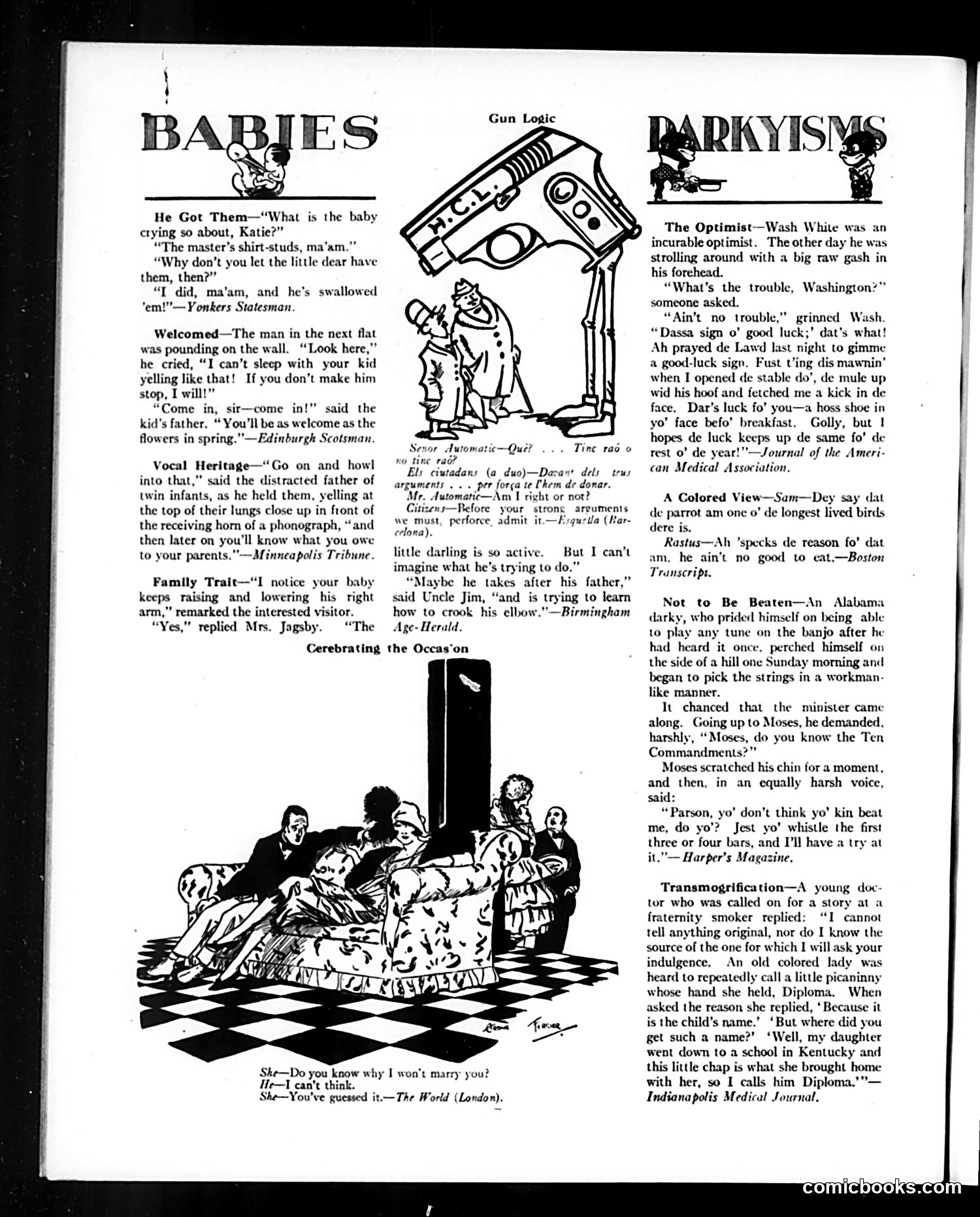
This page from Judge magazine collects humorous anecdotes organized by theme ("Babies," "Darkyisms"). The left side features family humor: babies swallowing shirt studs, noisy infants disturbing neighbors, and a child mimicking his father's drinking gesture. The center shows a "Gun Logic" illustration—a revolver with figures around it, likely satirizing arguments or political disputes settled by force (the Spanish caption references persuasion through strength). The right side, titled "Darkyisms," contains dialect humor featuring African American characters. These pieces—"The Optimist" (an injured man finding silver linings), "A Colored View" (parrots living long because they're useless), and "Not to Be Beaten" (a banjo player confident he can play any tune)—employ heavy racial stereotypes and caricatured speech patterns common to early 20th-century publications. These "darkly" jokes reflect period attitudes; modern readers should recognize them as offensive racial stereotyping presented as entertainment.
📄 Transcribed text from this page (OCR, searchable)
Machine-transcribed from the original scan — historical spelling and the odd misread are preserved.
ES He Got Them—“What is the baby crying so about, Katie?” “The master’s shirt-studs, ma’am.”” “Why don’t you let the little dear have them, then?” “I did, ma'am, and he’s swallowed *em!”—Yonkers Statesman. Welcomed—The man in the next flat was pounding on the wall. “Look here,” he cried, “I can’t sleep with your kid yelling like that! If you don’t make him stop, I will!” “Come in, sir—come in!” said the kid's father. “ You'll be as welcome as the flowers in spring.” —Edinburgh Scotsman. Vocal Heritage—‘Go on and howl into that,” said the distracted father of twin infan s he held them, yelling at the top of their lungs close up in front of the receiving horn of a phonograph, “and then later on you'll know what you owe to your parents.""—Minneapolis Tribune. Family Trait—“I notice your baby keeps raising and lowering his right arm,” remarked the interested visitor. “Yes,” replied Mrs. Jagsby. “The He—I can't think. She—You've guessed Cerebrating the Occas‘on Senor Automatic—Qué? ... Tine raé 0 no tine rad? Els ciutadans (a duo)—Darant dels teus arguments . . . per forca te Chem de donar. Mr, Automatic—Am I right or not? Citizens—Before your strong areuments ucla (Bar- we must, perforce, admit it—E crlona). little darling is so active. But I can’t imagine what he’s trying to do.” “Maybe he takes after his father,” said Uncle Jim, “and is trying to learn how to crook his elbow.”—Birmingham Age- Herald. Ske—Do you know why I won't marry you? .—The World (London). The Optimist—Wash White was an incurable optimist. The other day he was strolling around with a big raw gash in his forehead. “What’s the trouble, Washington?” someone asked. “Ain't no trouble,” grinned Wash. “Dassa sign o’ good luck;’ dat’s what! Ah prayed de Lawd last night to gimme a good-luck sign, Fust ting dis mawnin’ when I opened de stable do’, de mule up wid his hoof and fetched me a kick in de face. Dar’s luck fo’ you—a hoss shoe in yo’ face befo’ breakfast. Golly, but I hopes de luck keeps up de same fo’ de rest o’ de year!”’—Journal of the Ameri- can Medical Association. A Colored View—Sam—Dey say dat de parrot am one o’ de longest lived birds dere is. Rastus—Ah 'specks de reason fo’ dat am, he ain’t no good to cat.—Boston Transcript. t to Be Beaten—An Alabama darky, who prided himself on being able to play any tune on the banjo after he had heard it once, perched himself on the side of a hill one Sunday morning and began to pick the strings in a workman- like manner. It chanced that the minister came along. Going up to Moses, he demanded, harshly, “Moses, do you know the Ten Commandments?” Moses scratched his chin for a moment, and then, in an equally harsh voice, said: “Parson, yo’ don’t think yo’ kin beat me, do yo’? Jest yo’ whistle the first three or four bars, and I'l! have a try at it.”— Harper’s Magazine. Transmogrification—A young doc- tor who was called on for a story at a fraternity smoker replied: “I cannot tell anything original, nor do I know the source of the one for which I will ask your indulgence. An old colored lady was heard to repeatedly call a little picaninny whose hand she held, Diploma. When asked the reason she replied, ‘Because it is the child’s name.’ ‘But where did you get such a name?’ ‘Well, my daughter went down to a school in Kentucky and this little chap is what she brought home with her, so I calls him Diploma.’”— Indianapolis Medical Journal,