
Judge, 1920-05-01 · page 9 of 36
Judge — May 1, 1920 — page 9: what you’re looking at
What you’re looking at
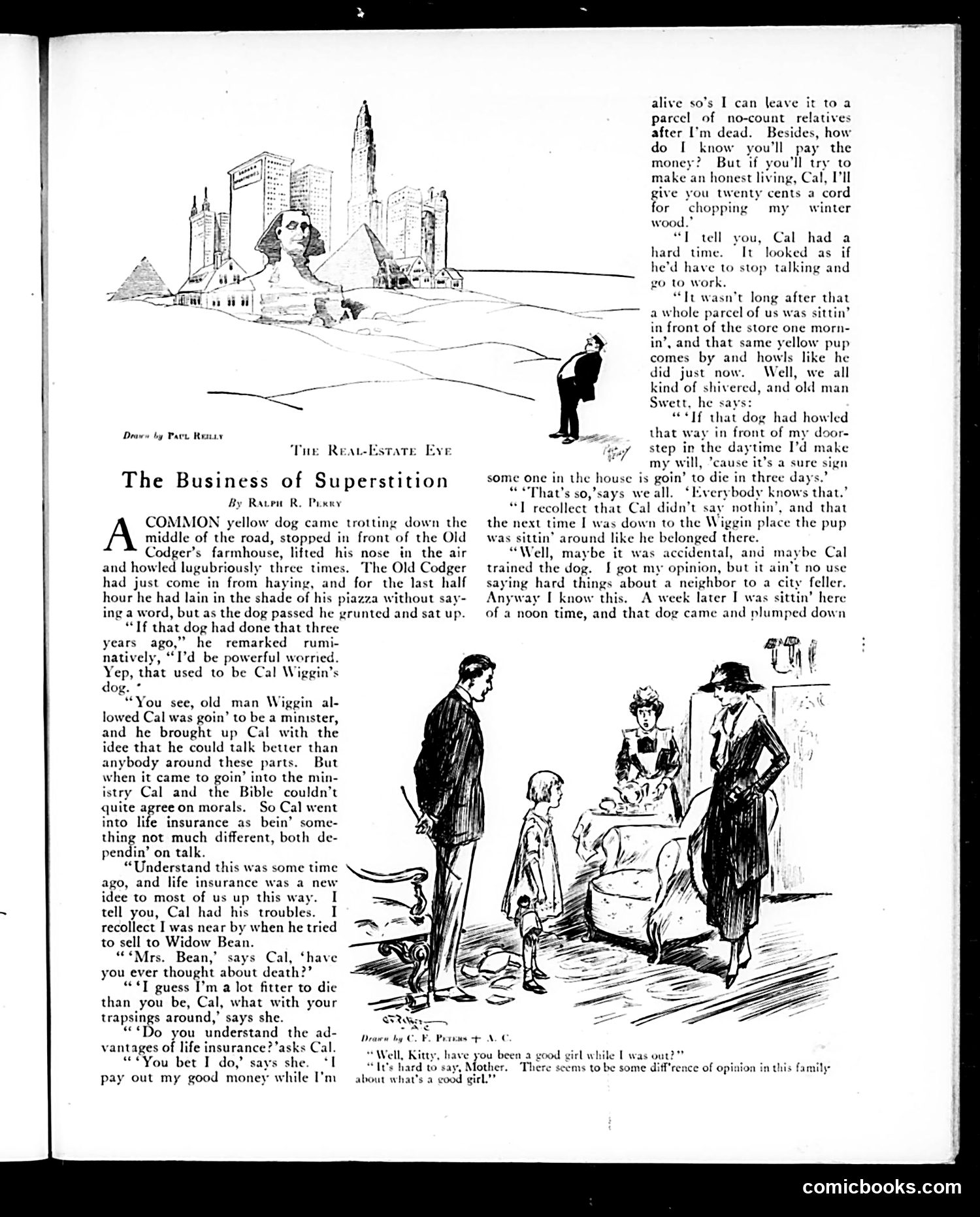
This satirical story mocks rural superstition and exploits it for profit. The narrative describes Cal Wiggin, a failed ministerial candidate who turns to selling life insurance. Unable to convince practical rural customers through honest argument, Cal allegedly trains a dog to howl ominously outside homes—playing on the widespread superstition that a dog's mournful howl portends death within three days. The satire targets both rural gullibility and insurance salesmen's unscrupulous tactics. The top illustration shows an idealized cityscape (representing modern progress), while the bottom depicts Cal's scheme exploiting superstitious country folk. The story suggests that in rural areas, people are so bound by irrational beliefs that even a con man can profit by weaponizing their own fears against them. The joke's dark edge: superstition makes people vulnerable to manipulation.
📄 Transcribed text from this page (OCR, searchable)
Machine-transcribed from the original scan — historical spelling and the odd misread are preserved.
Draw by Pact Reniy The Reat-Estate Eve The Business of Superstition By Raven R. COMMON yellow dog came trotting down the middle of the road, stopped in front of the Old Codger’s farmhouse, lifted his nose in the air and howled lugubriously three times. The Old Codger had just come in from haying, and for the last half hour he had lain in the shade of his piazza without say- Puxny ing a word, but as the dog passed he grunted and sat up. “Tf that dog had done that three years ago,” he remarked rumi- natively, “I'd be powerful worried. Yep, that used to be Cal Wiggin’s dog. * “You see, old man Wiggin al- lowed Cal was goin’ to be a minister, and he brought up Cal with the idee that he could talk better than anybody around these parts. But when it came to goin’ into the min- istry Cal and the Bible couldn't quite agree on morals. So Cal went into life insurance as bein’ some- thing not much different, both de- pendin’ on talk. “Understand this was some time ago, and life insurance was a new idee to most of us up this way. I tell you, Cal had his troubles. I recollect I was near by when he tried to sell to Widow Bean. “‘Mrs. Bean,’ says Cal, ‘have you ever thought about death?’ “ST guess I’m a lot fitter to die than you be, Cal, what with your trapsings around,’ says she. “Do you understand the ad- vantages of life insurance?’asks Cal. “*You bet I do,’ says she. ‘1 pay out my good money while I'm alive so’s I can leave it to a parcel of no-count relatives after I'm dead. Besides, how do [ know you'll pay the money? But if you'll try to make an honest living, Cal, I'll give you twenty cents a cord for chopping my — winter wood.” “T tell you, Cal had a hard time. It looked as if he'd have to stop talking and go to work, “Tt wasn’t long after that a whole parcel of us was sittin’ in front of the store one morn- in’, and that same yellow pup comes by and howls like he did just now. Well, we all kind of shivered, and old man Swett, he says: “Tf that dog had howled that way in front of my door- step in the daytime I’d make my will, ’cause it’s a sure sign G in the house is goin’ to die in three days.” hat’s so,’says we all. ‘Everybody knows that.’ “1 recollect that Cal didn’t say nothin’, and that the next time I was down to the Wiggin place the pup was sittin’ around like he belonged there. “Well, maybe it was accidental, and maybe Cal trained the dog. [ got my opinion, but it ain't no use saying hard things about a neighbor to a city feller. Anyway I know this. A week later I was sittin’ here of a noon time, and that dog came and plumped down some we have you been a good girl while | was ou} Mother. The about what's a cood girl.” cms to be some diffrence of opinion in this family: comicbooks.com