
A complete issue · 32 pages · 1918
Judge — August 24, 1918
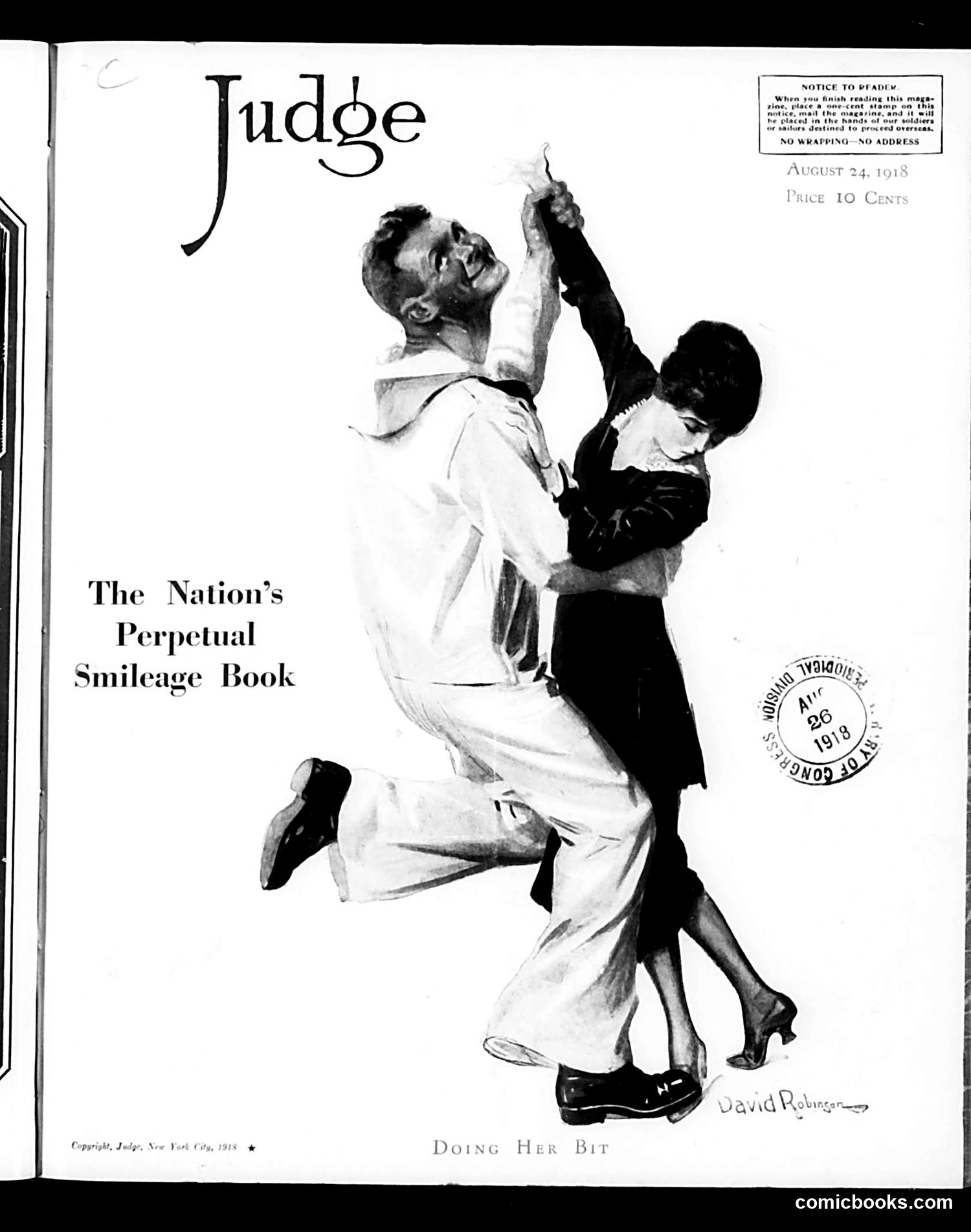
This is the cover of Judge magazine from August 24, 1918, during World War I. The illustration by David Robinson depicts a couple dancing, captioned "Doing Her Bit." The woman appears to be a young patriotic American, while the man in lighter clothing is likely meant to represent a soldier or serviceman. The satire targets women's wartime contributions to the war effort. "Doing her bit" was a contemporary phrase for civilian participation in WWI support—through bond drives, rationing, factory work, or morale-boosting activities. The cartoon suggests that some women interpreted their patriotic duty narrowly as socializing with servicemen, dancing being a popular wartime pastime. The humor likely critiques this as a superficial or self-interested form of patriotism compared to more substantive sacrifice.
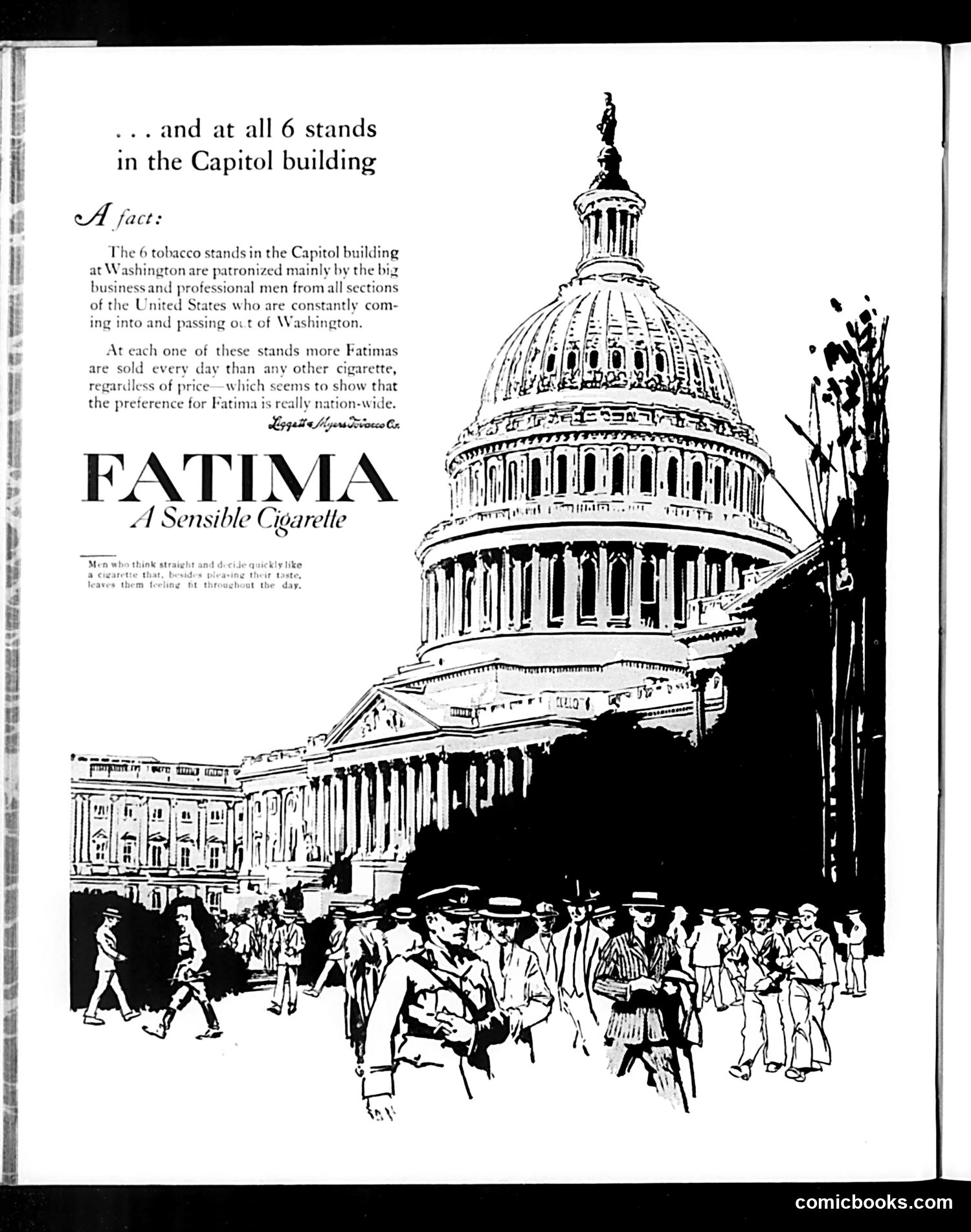
This page is primarily a **cigarette advertisement** for Fatima brand, not political satire. The image depicts the U.S. Capitol building with crowds of visitors outside. The ad copy claims that Fatima cigarettes are sold at all 6 stands in the Capitol building, and that more Fatimas are sold daily at each stand than any other cigarette brand—supposedly demonstrating nation-wide preference among "big business and professional men from all sections of the United States." The satirical angle is subtle: by advertising cigarettes *inside* the Capitol building itself, the ad implies that even America's lawmakers and most important politicians smoke Fatimas, lending prestige through association with power and authority. This reflects early 20th-century advertising norms before tobacco regulation.
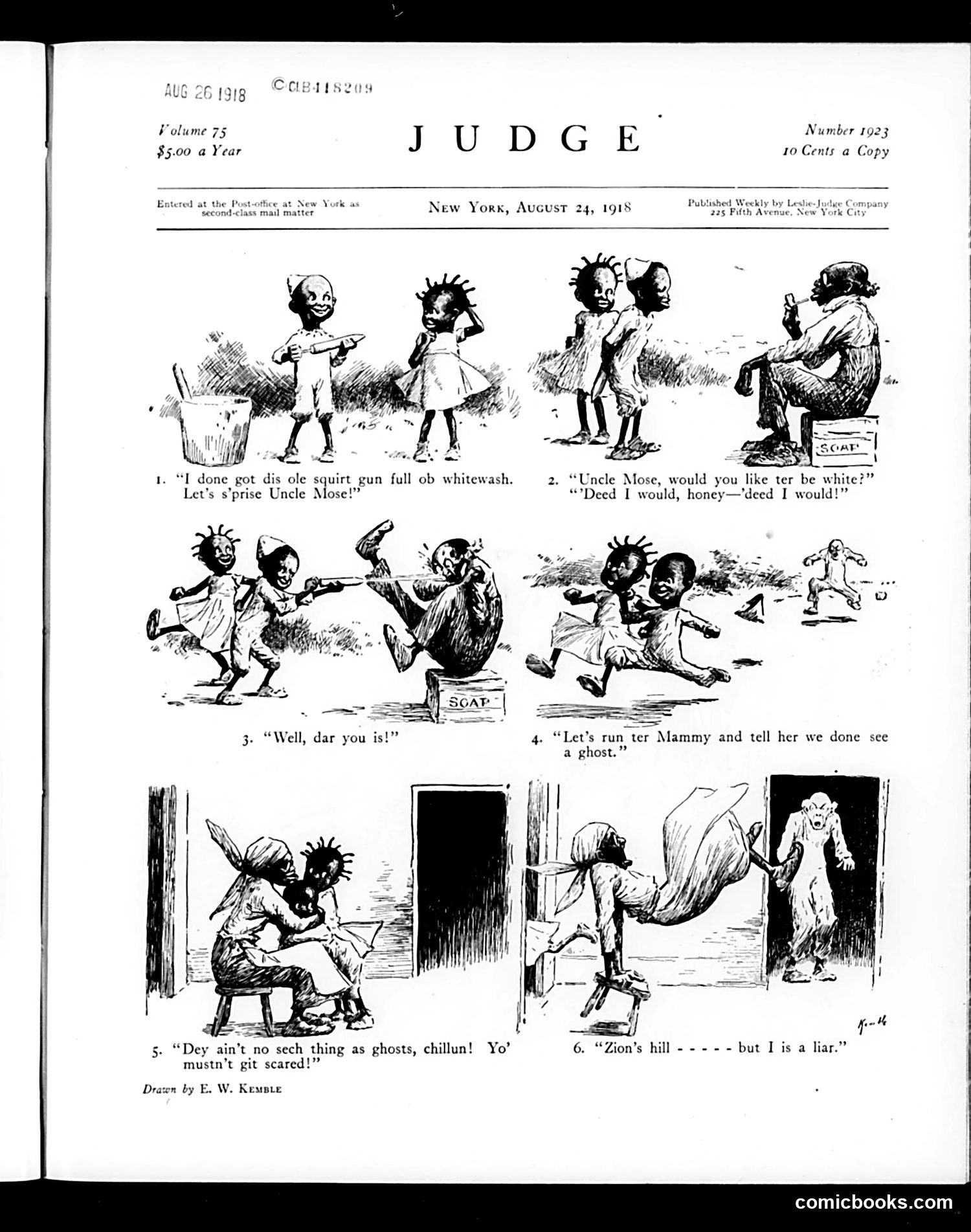
This 1918 Judge cartoon uses racist caricatures and dialect to depict Black children in a narrative sequence. The six-panel comic follows children playing a game where they pretend to scare "Mammy" by disguising themselves as a ghost. The "joke" relies on period racist stereotypes: exaggerated facial features, African American Vernacular English ("Deed I would, honey"), and the premise that Black people are superstitious and fearful of ghosts. Panel 5's caption—"Dey ain't no sech thing as ghosts, chillin! Yo' musn't git scared!"—presents an older caregiver reassuring frightened children, reinforcing harmful stereotypes about Black communities. The satire targets no political issue; rather, it exemplifies the racist content mainstream American publications routinely published during this era.
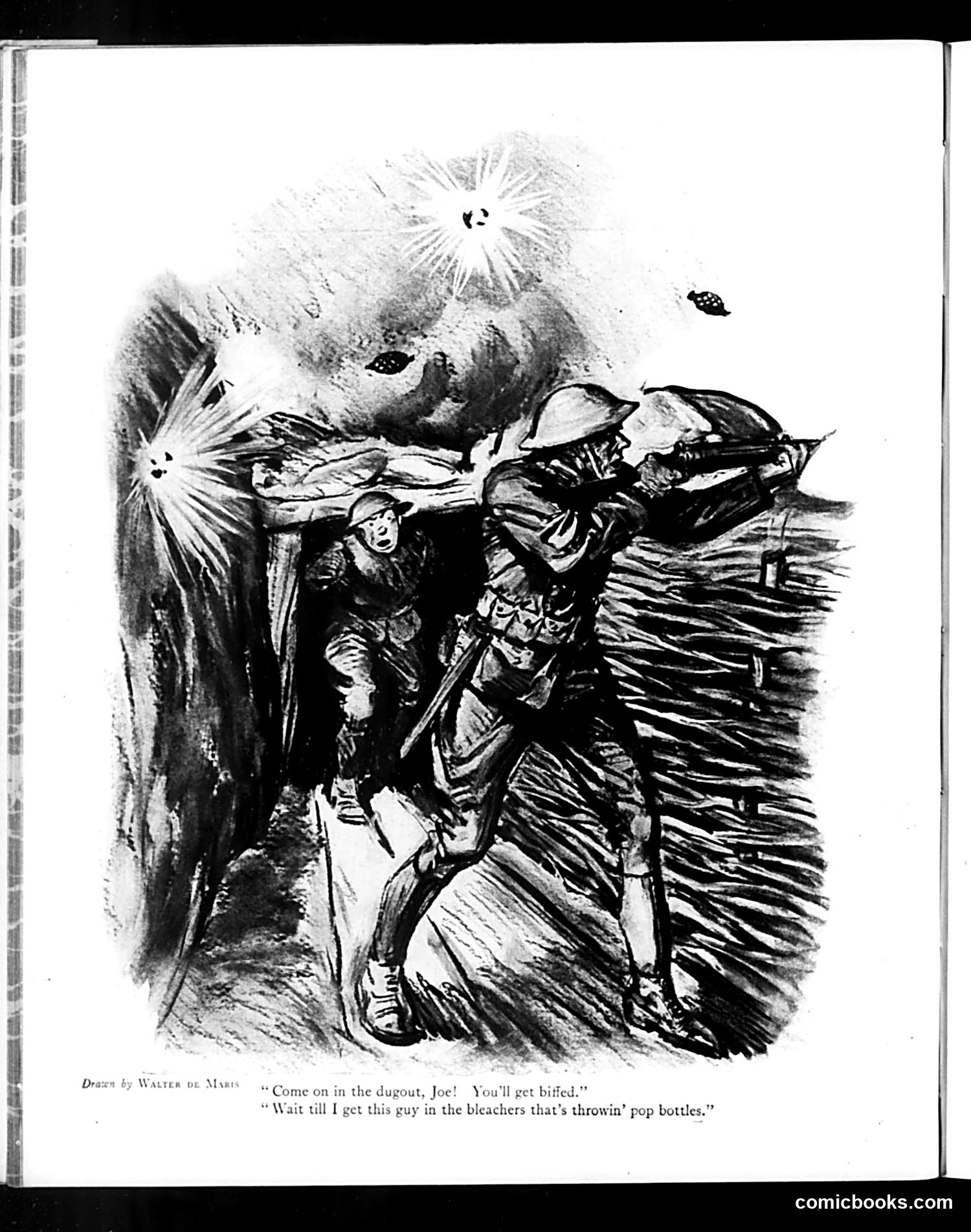
This Walter de Maris cartoon from *Judge* magazine depicts a WWI-era military scene. Two soldiers in a dugout (trench shelter) are having a conversation. One soldier urges "Joe" to come into the dugout, warning he'll "get bifed" (hit/struck). Joe responds he'll wait until he can get "this guy in the bleachers that's throwin' pop bottles." The satire appears to reference the contrast between actual combat dangers and petty grievances. "Bleachers" suggests spectators or observers (possibly civilians or journalists watching the war). The joke mocks soldiers prioritizing minor annoyances—being hit with bottles by onlookers—over legitimate military threats. It's satirizing either public behavior during wartime or the absurdity of soldiers' concerns when facing real danger.
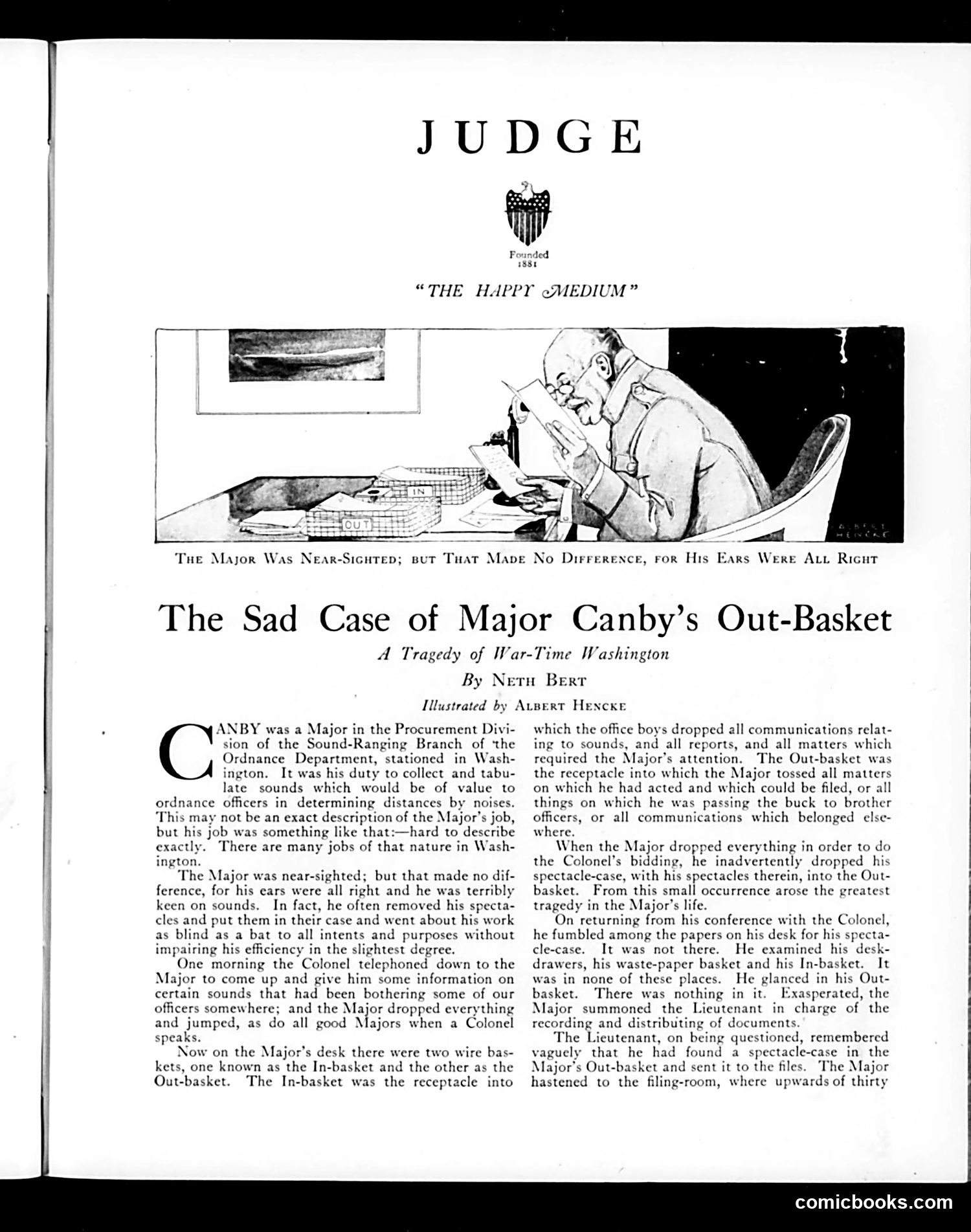
This is a humorous story by Neth Bert (illustrated by Albert Hencke) satirizing **wartime Washington bureaucracy during World War I**. The narrative mocks the absurdity of military procurement procedures through Major Canby, a near-sighted officer in the Ordnance Department tasked with evaluating sound distances. The joke centers on Canby's catastrophic loss of his spectacles—accidentally dropped into his office "Out-basket" (outgoing documents tray). His subsequent frantic search through filing rooms and the cascade of confusion this creates illustrates the ridiculousness of military red tape and inefficiency during wartime. The satire targets bloated government bureaucracy, the chaos of wartime administration, and how small mishaps create disproportionate institutional mayhem.
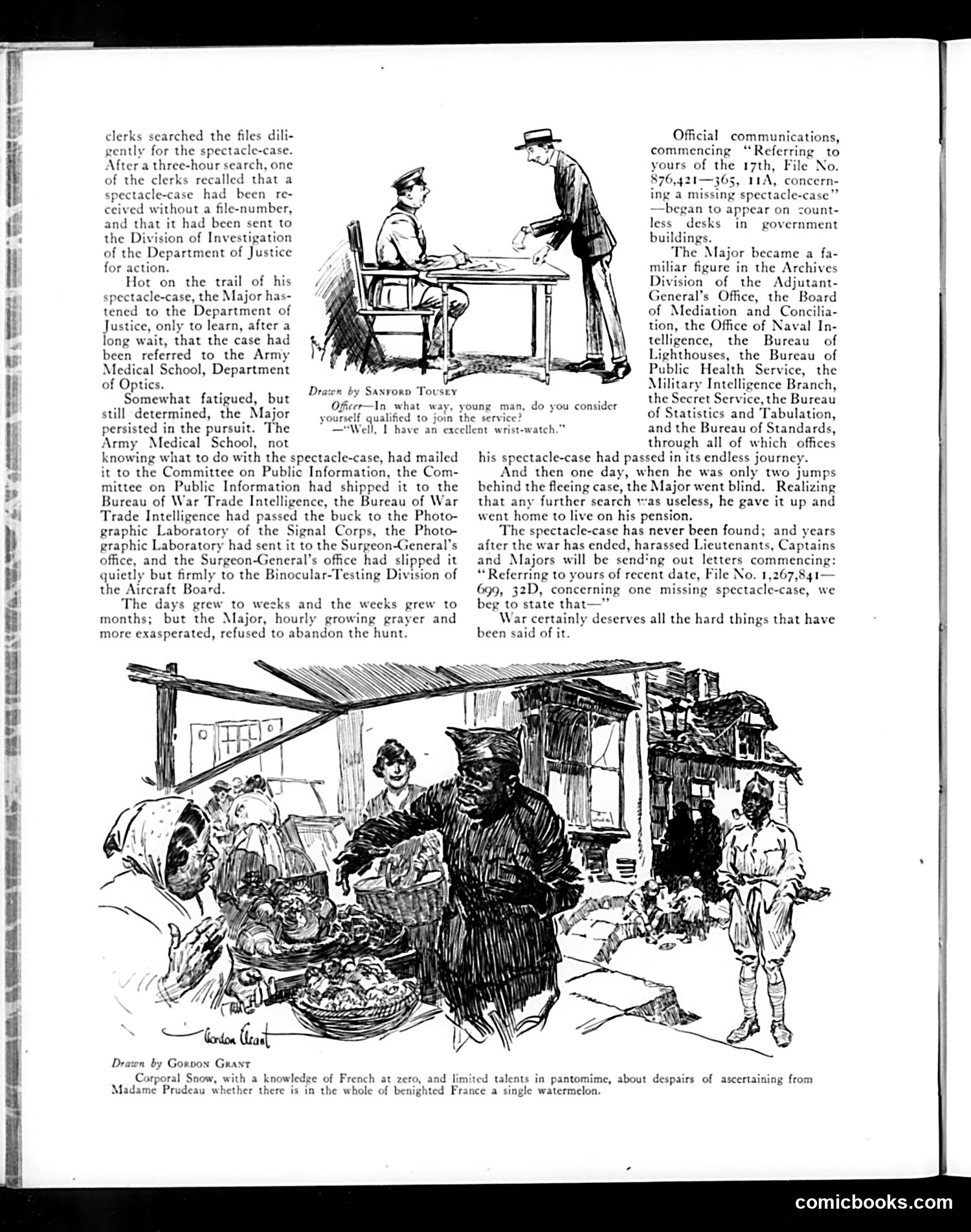
This page satirizes a bureaucratic absurdity: a missing spectacle-case that traveled through numerous War Department offices during WWI without resolution. The **top cartoon** (by Sanford Tousey) depicts a recruitment officer asking a young man about his qualifications, with the candidate claiming an "excellent wristwatch"—implying that practical job skills matter less than having the right accessories. The **bottom cartoon** (by Gordon Grant) shows Corporal Snow, described as having "knowledge of French at zero, and limited talents in pantomime," desperately trying to determine from a French woman whether France possesses "a single watermelon." Together, these mock military incompetence and the disconnect between soldiers' actual capabilities and their assignments—a common WWI-era complaint about army organization and the absurd situations soldiers faced.
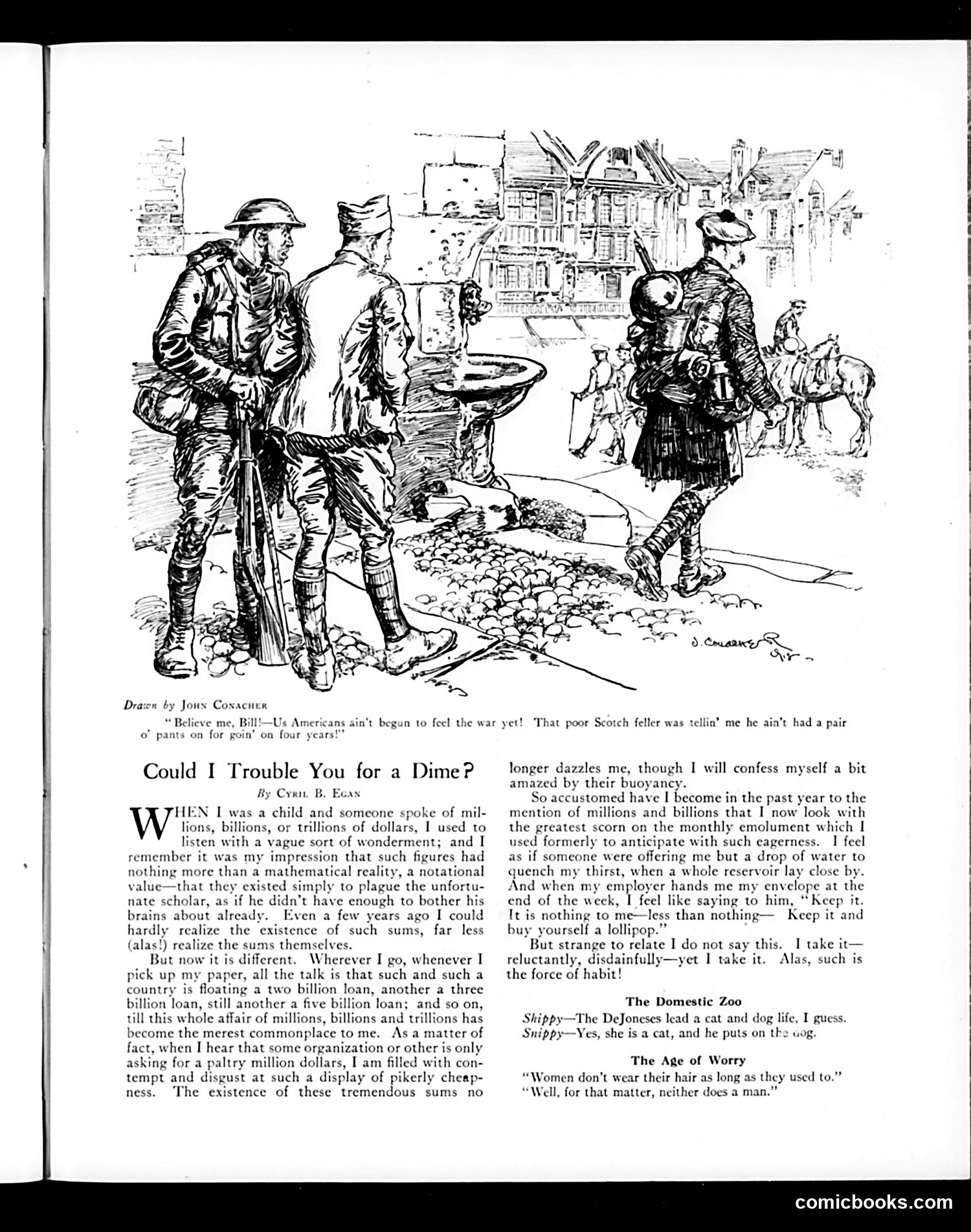
The top illustration by John Coxacher depicts World War I soldiers in a European town. The caption's dialogue—one soldier remarking that Americans "ain't begun to feel the war yet" while a Scottish soldier complains about lacking pants for four years—contrasts American inexperience with European suffering during the war. The accompanying article by Cyril B. Egan satirizes how wartime has normalized astronomical government spending (billions and trillions in loans). The author describes becoming so accustomed to massive war expenditures that his regular monthly salary now seems contemptibly insignificant—a "drop of water." The satire critiques how inflation and war financing have distorted civilian perception of money's value, making ordinary wages feel worthless despite their actual necessity for survival.
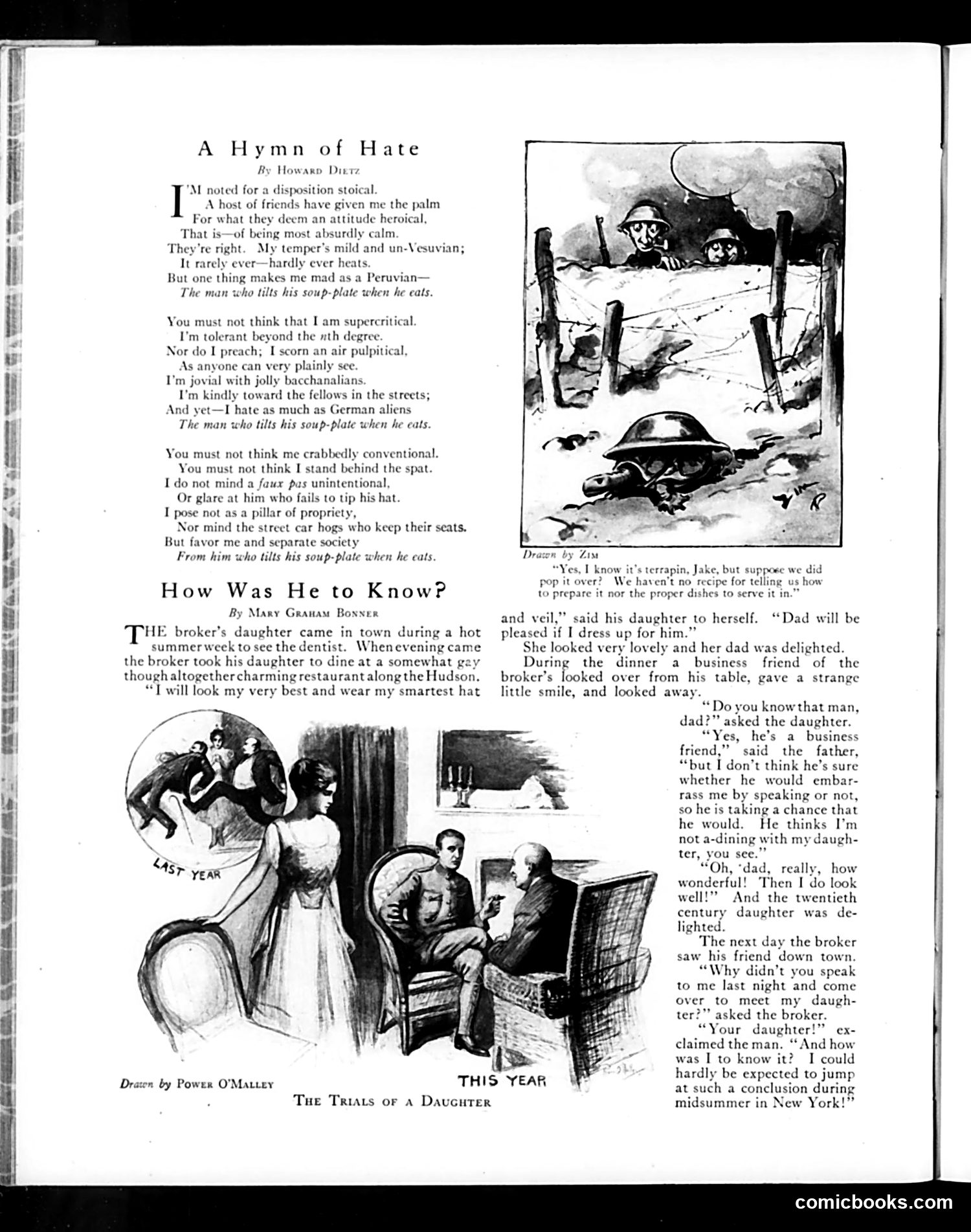
**"A Hymn of Hate"** is a humorous complaint poem by Howard Dietz mocking obsessive etiquette-consciousness. The speaker claims tolerance and calm temperament but repeatedly excepts one pet peeve: men who tilt their soup plates while eating. The satire targets stuffy Victorian social conventions—the poem exaggerates how trivial table manners become objects of intense moral judgment among the genteel classes. It's poking fun at people who pride themselves on sophistication while fixating on minor behaviors. **"How Was He to Know?"** by Mary Graham Bonner is a short comic story about a broker dining with his well-dressed daughter at a Hudson River restaurant. A business acquaintance sees them but doesn't approach, fearing to presume their relationship. The joke: in summer 1920s New York, a man and woman dining together could plausibly be assumed to be on a date rather than father and daughter—so the friend's polite distance ironically disappoints the daughter, who'd dressed up hoping to impress her father.
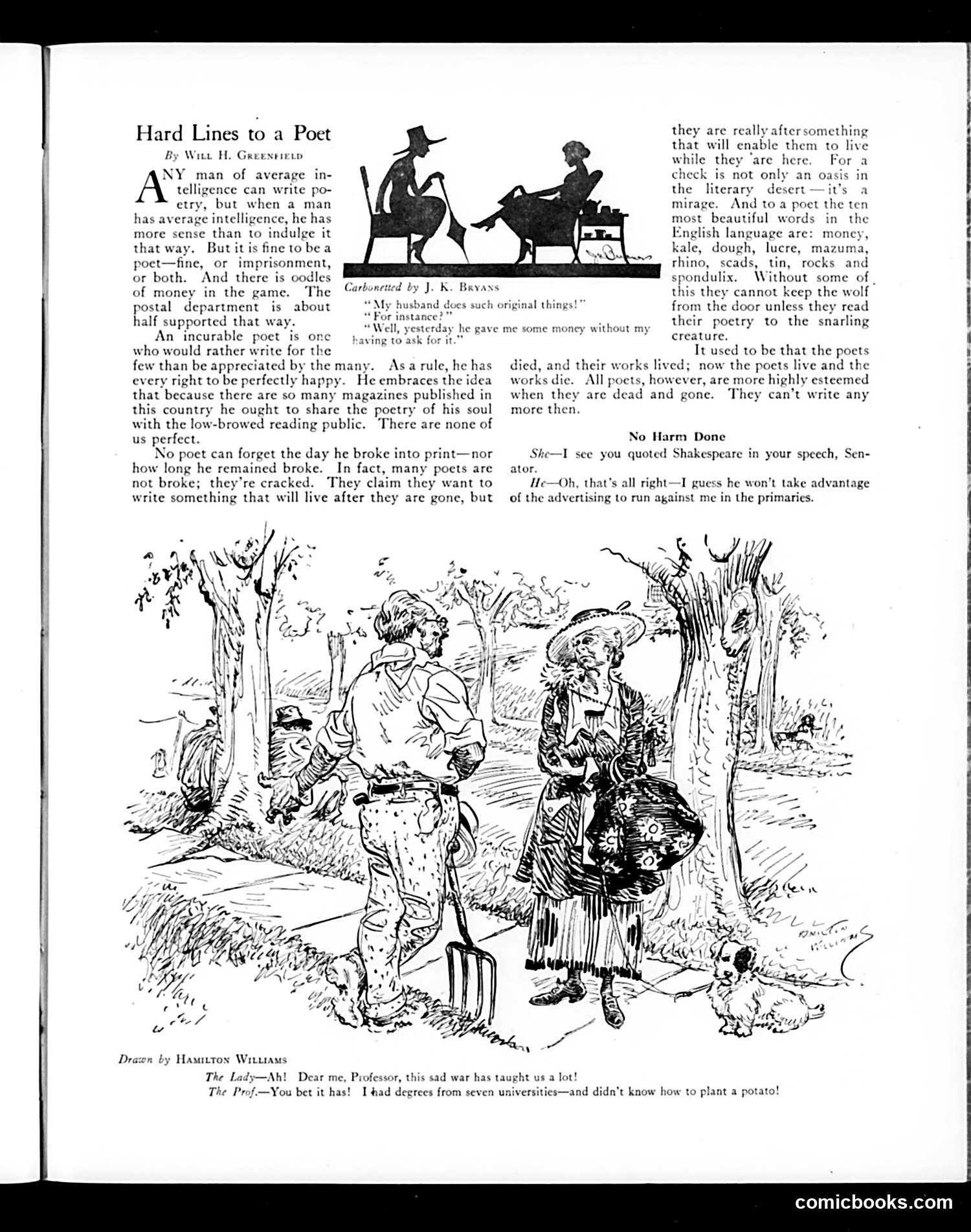
This page contains satirical commentary on poets and their financial struggles. The main article by Will H. Greenfield mocks poets as impractical dreamers who claim to write for posterity but actually desperately need money to survive. The humor lies in the contradiction: poets romanticize art while obsessing over payment—Greenfield lists ten slang terms for money, suggesting desperation. The two cartoon vignettes mock different types of pretension: the top cartoon shows a man quoting Shakespeare to avoid paying for advertising (suggesting dishonest use of culture), while the bottom cartoon depicts a professor with seven university degrees who learned nothing practical—the war taught him he can't even plant a potato. Both satirize educated elites as out-of-touch with real-world knowledge and survival.
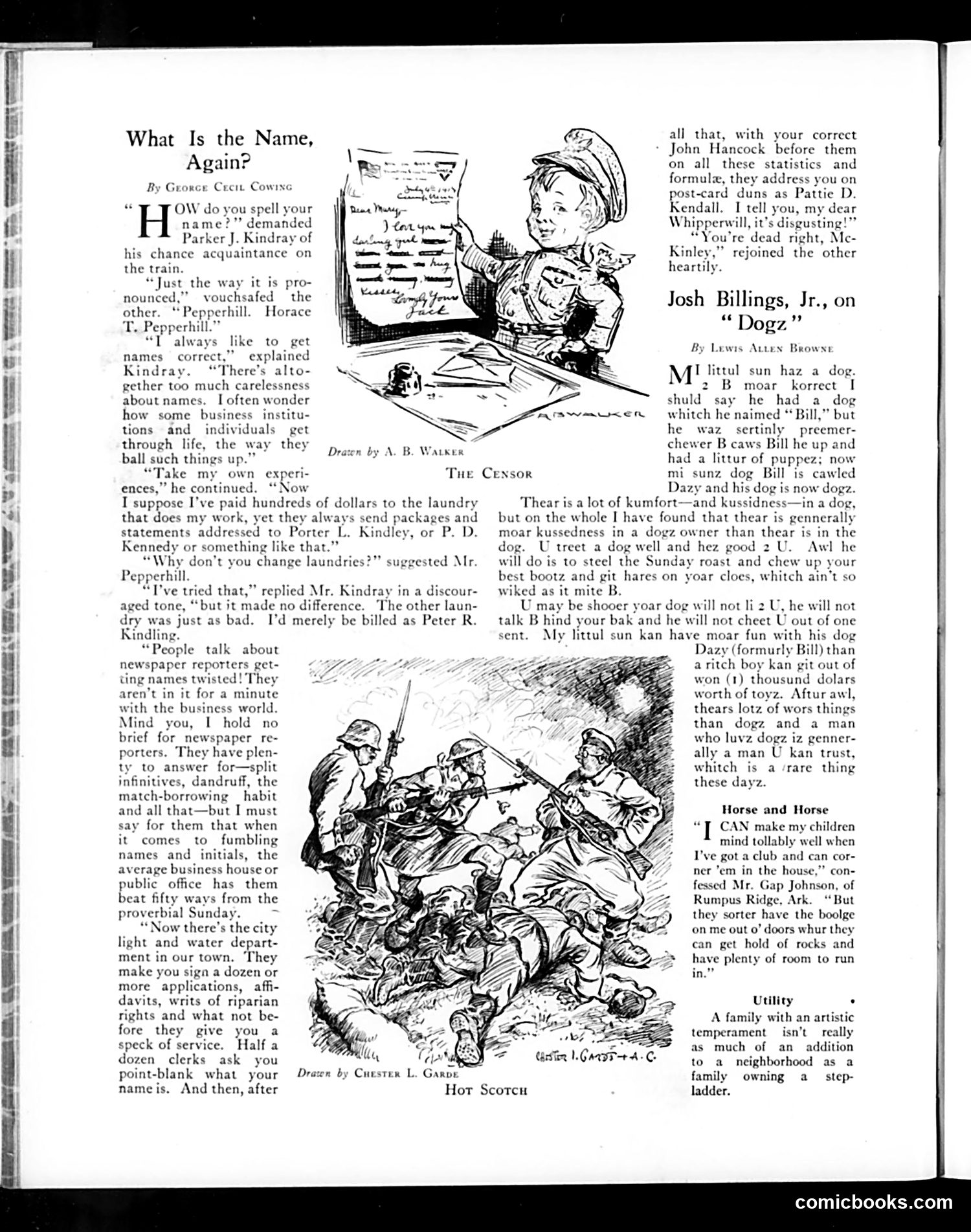
This page contains three satirical pieces: **"What Is the Name, Again?"** (top left) mocks business inefficiency. Parker J. Kindray complains that despite paying hundreds of dollars to laundries and city services, they consistently misspell his name on bills and statements—addressing him as "Porter L. Kindley" or "Pattie D. Kendall." The joke targets corporate bungling: businesses demand extensive paperwork and signatures yet remain incompetent at basic record-keeping. Kindray defends newspaper reporters against criticism, noting that private companies fumble names worse than the press does. **"Josh Billings, Jr., on 'Dogz'"** (right) parodies the 19th-century humorist Josh Billings through intentional phonetic misspelling ("littul," "shuld," "korrect"). It celebrates dogs as loyal, trustworthy companions superior to expensive toys, concluding that dog-lovers are inherently honest people—a rare virtue. **"Horse and Horse"** and **"Utility"** are brief, humorous observations about childhood discipline and domestic life, respectively. The page exemplifies Judge's early 20th-century satirical style: poking fun at institutional incompetence and celebrating folksy wisdom.
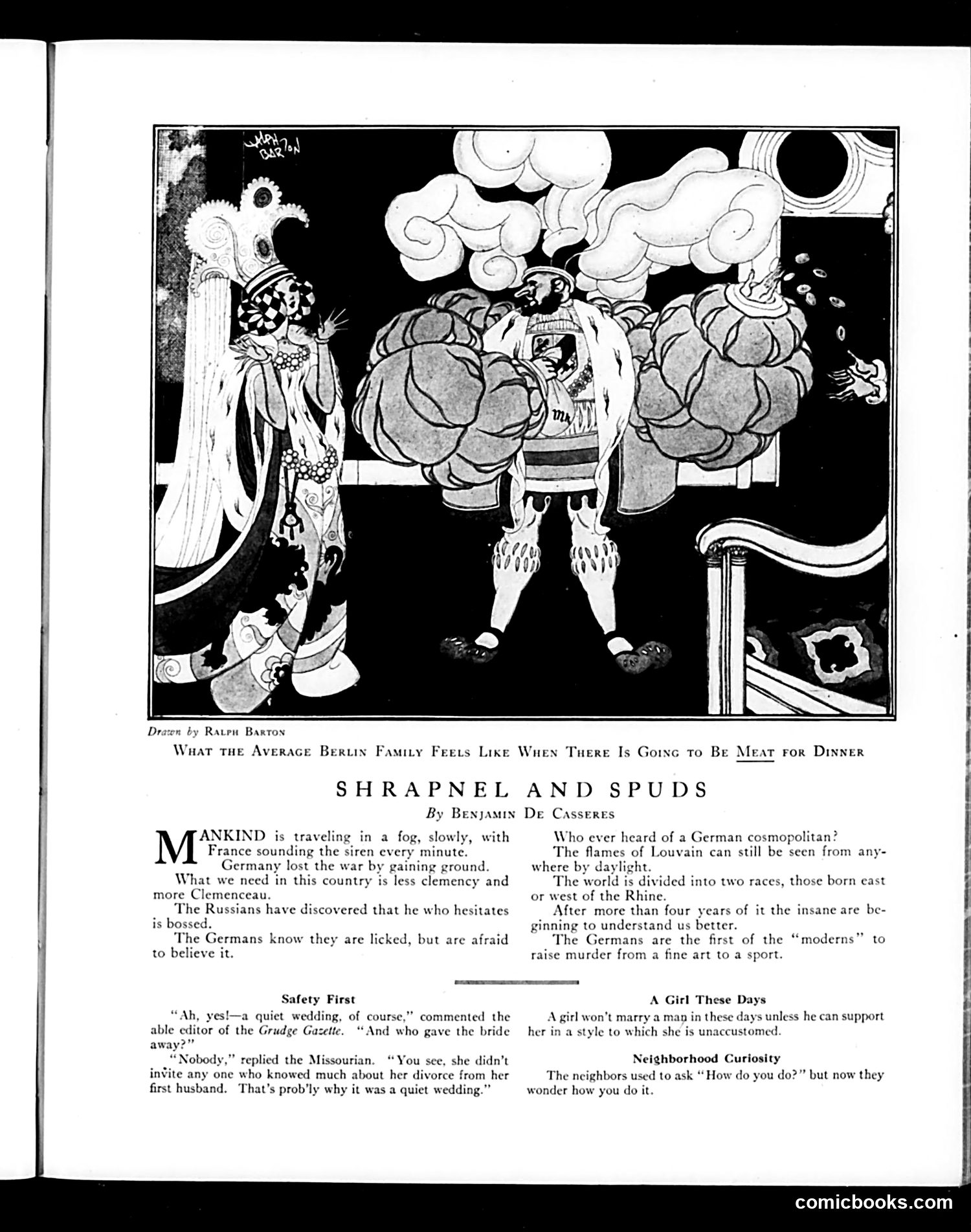
This Judge magazine page contains WWI-era anti-German satire. The main illustration depicts a bloated German figure surrounded by artillery shells and oversized potatoes—visual metaphors for Germany's military aggression and food shortages that plagued civilians during the war's final years. The accompanying essay by Benjamin De Casseres delivers pointed jabs at Germany: mocking German militarism as raising "murder from a fine art to a sport," referencing the 1914 burning of Louvain (a Belgian city destroyed by German forces), and suggesting Germans are culturally incapable of cosmopolitanism. The text praises French determination ("Clemenceau") while criticizing American leniency toward Germany. The three humorous asides below offer domestic American commentary on wartime conditions—quiet weddings due to scandal, women's economic expectations, and neighbors' nosiness—providing lighter relief from the heavy wartime messaging above.
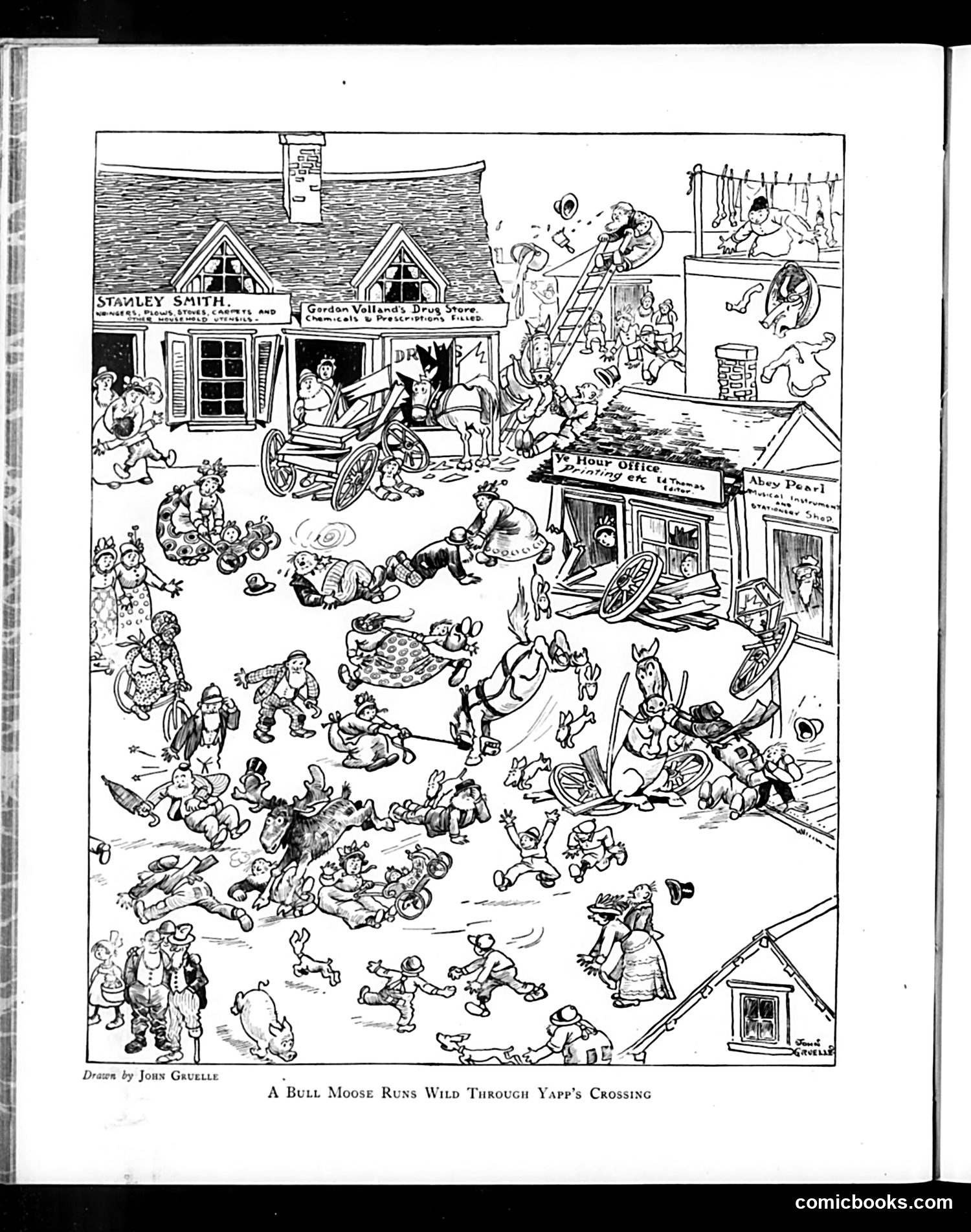
This is a chaotic street scene drawn by John Gueville showing a bull moose stampeding through a village crossroads, causing mayhem among pedestrians, animals, and buildings. The title references the "Bull Moose" Party—Theodore Roosevelt's 1912 Progressive Party splinter movement—suggesting the cartoon satirizes Roosevelt's political disruption as destructive chaos. The moose crashes through storefronts (including "Gordon Valland's Drug Store" and "Abbey Pearl"), scattering people, overturning carriages, and creating general pandemonium. The joke appears to equate Roosevelt's third-party campaign splitting Republican votes with an actual wild animal destroying a town. This reflects Judge magazine's satirical take on Roosevelt's controversial 1912 presidential bid against President Taft and Democrat Wilson.
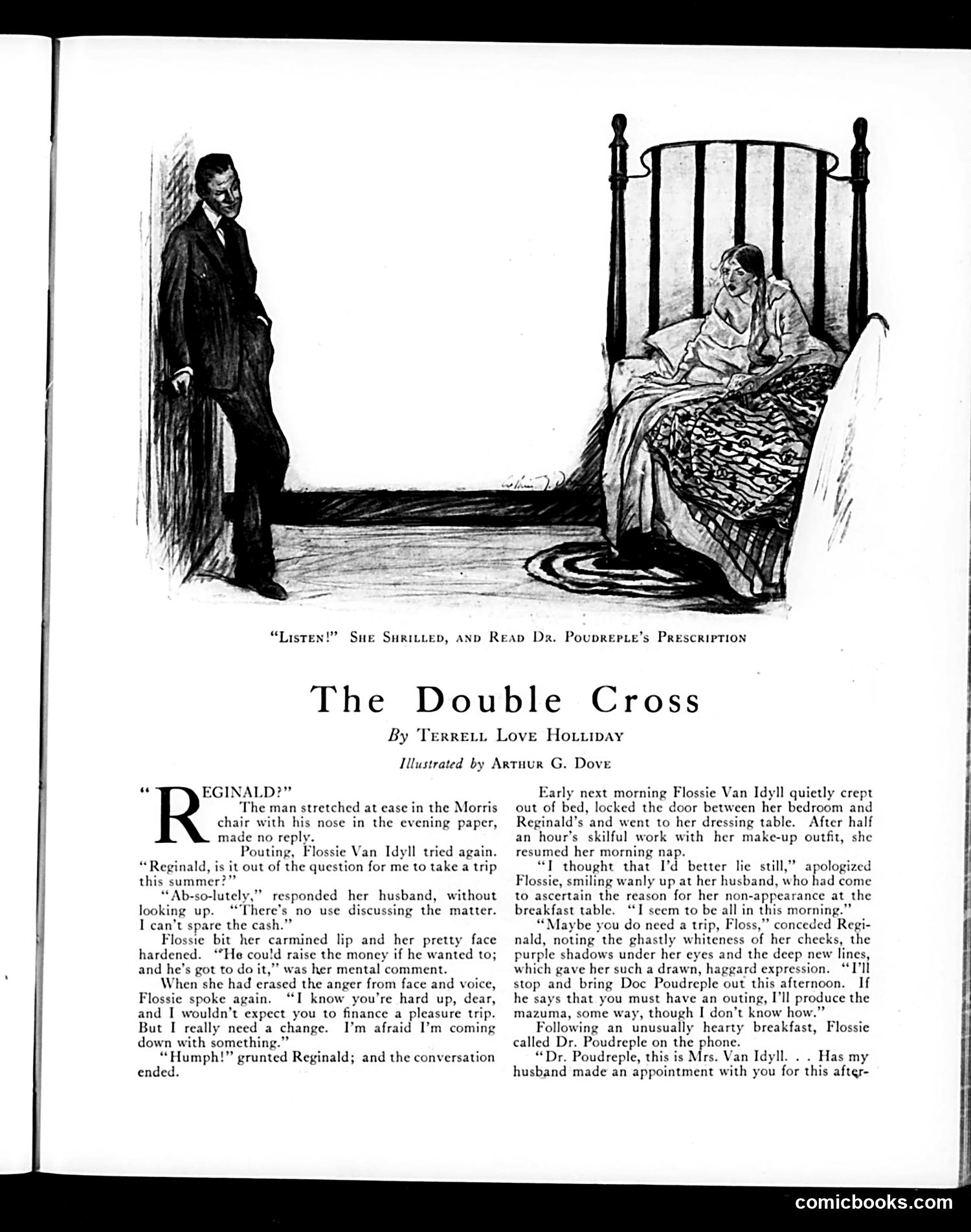
This is the opening of a domestic comedy story, not political satire. The narrative depicts a marital negotiation: Reginald Van Idyll refuses his wife Flossie's request for a summer trip, citing lack of funds. When he dismisses her, Flossie secretly applies theatrical makeup to simulate illness—creating dark circles and a haggard appearance—to convince him she needs the trip for health reasons. The "double cross" refers to Flossie's deception: she manufactures false symptoms to manipulate her husband into financing the trip he'd refused. The story satirizes early-20th-century marital dynamics and feminine cunning rather than political issues. The illustration shows the setup: Reginald (left, indifferent) and Flossie in bed (right, plotting). This reflects period attitudes about women's limited autonomy and the strategies they employed to obtain their desires.
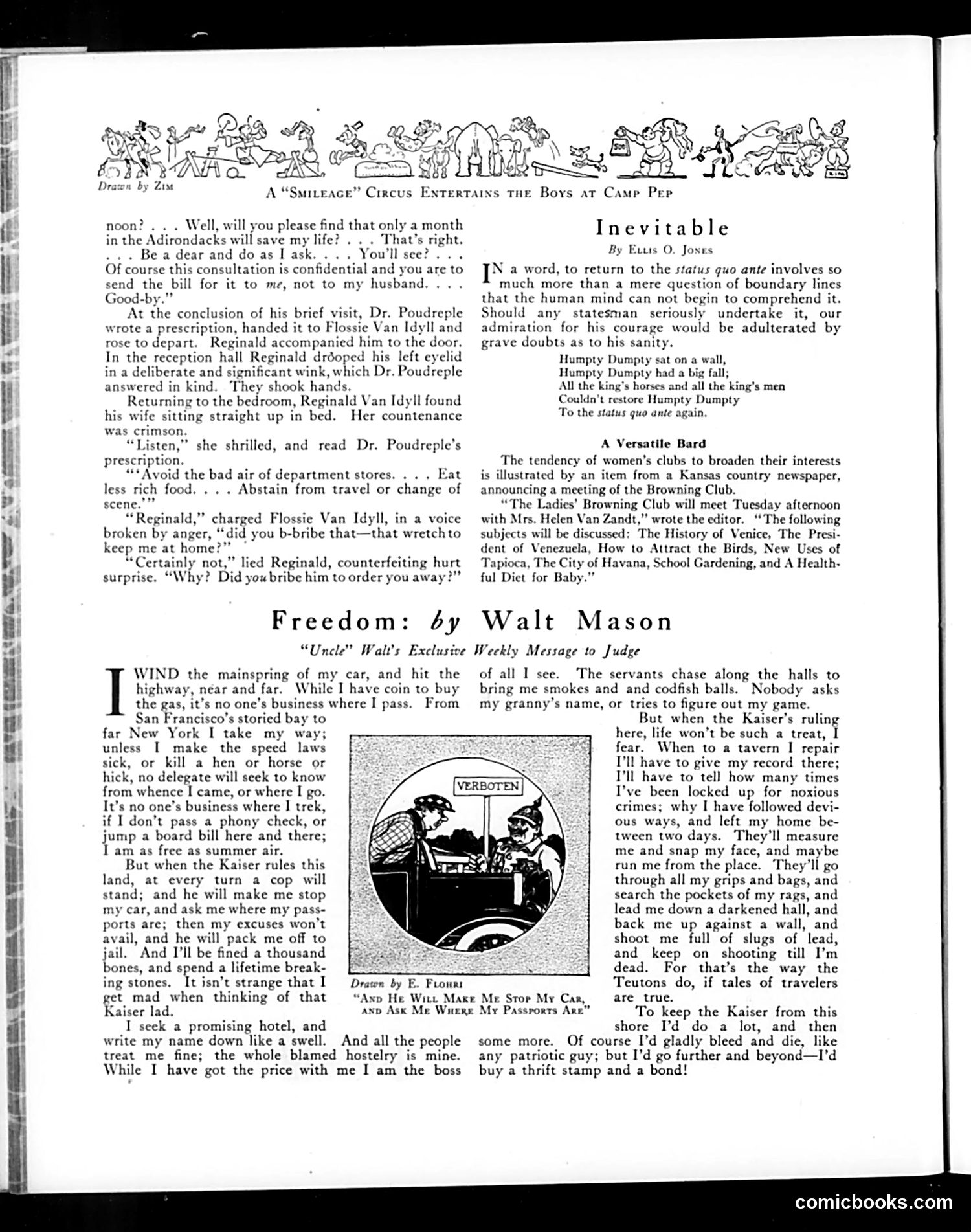
This page contains three satirical pieces from the World War I era: **"Freedom" by Walt Mason** (center/right): A cynical commentary on American liberty versus German militarism. The speaker boasts of American freedom—driving without permission, no passport checks, anonymity—contrasting sharply with the oppressive control promised under "the Kaiser's ruling." The implicit threat: if Germany wins, Americans will lose these freedoms entirely. This is wartime propaganda opposing German imperial expansion. **"Inevitable" by Ellis O. Jones** (top right): Uses the Humpty Dumpty nursery rhyme to argue that restoring pre-war conditions after the conflict would be impossibly complex. It mocks any statesman naive enough to attempt returning Europe to its pre-war state—suggesting the war has fundamentally altered the world. **Domestic satire** (left): A husband and wife scheme—she feigns illness to escape to the Adirondacks; he bribes the doctor to prescribe she stay home instead. Their winking complicity satirizes upper-class marital manipulation. The cartoons reflect 1910s American anxieties about war, freedom, and social propriety.
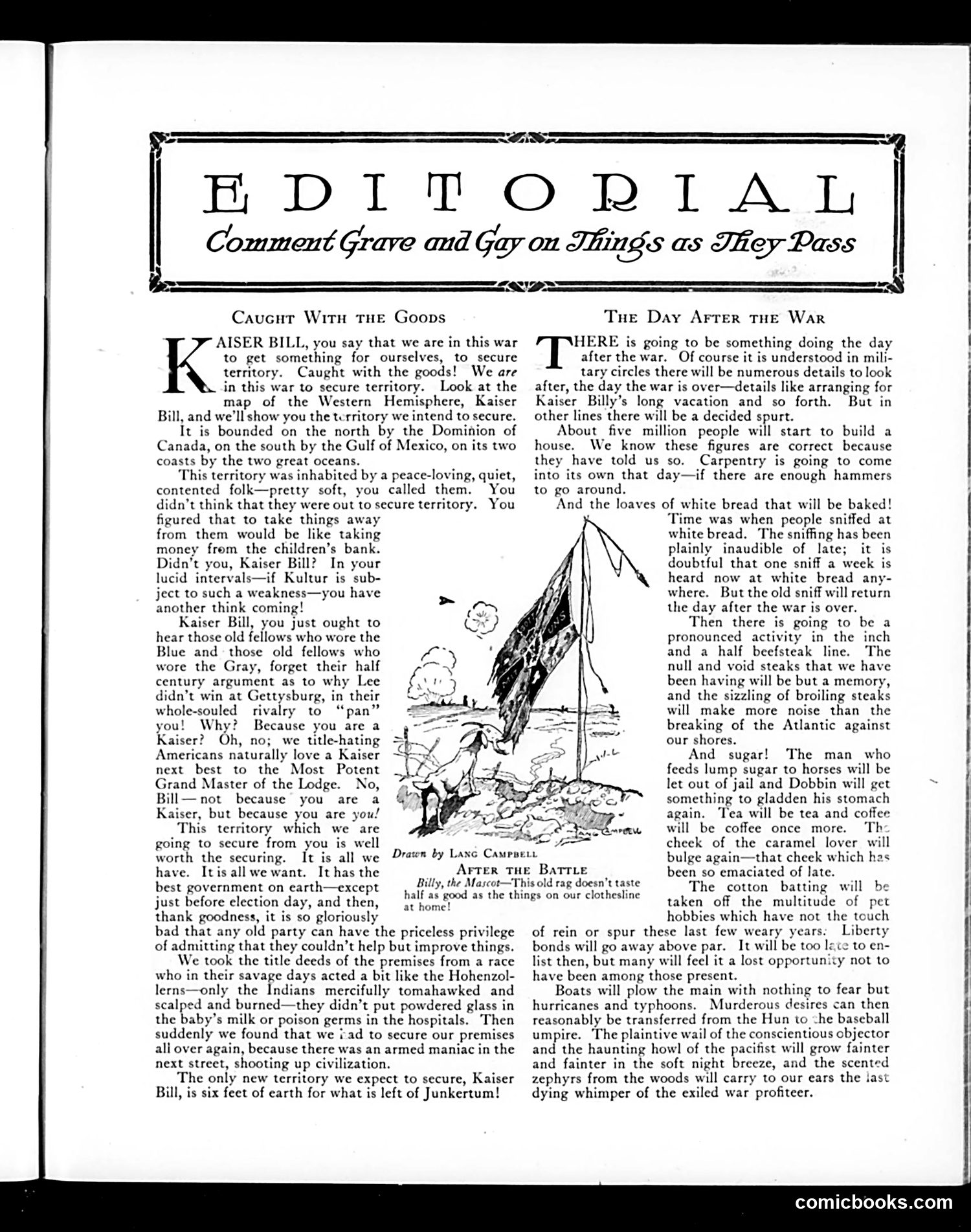
This page contains two satirical editorials from Judge, likely published during World War I (references to "Kaiser Bill" indicate anti-German sentiment). **"Caught with the Goods"** sarcastically addresses Kaiser Wilhelm II, accusing Germany of territorial aggression. The writer argues Americans fight to defend their own territory (North America) against German imperialism, not for conquest. He mocks the Kaiser's underestimation of American resolve, noting that even Civil War veterans (Blue and Gray) unite against him—not because Americans love monarchies, but because they despise his specific tyranny. The piece concludes grimly: America expects to gain only "six feet of earth" from Germany's defeat (graves for soldiers). **"The Day After the War"** humorously imagines post-war civilian life: five million people building houses, abundant white bread (rationed during wartime), full-fat beefsteaks, and sugar for horses. The satire criticizes wartime deprivations and celebrates anticipated peacetime abundance. The illustration shows a tattered flag—symbolizing war's toll.
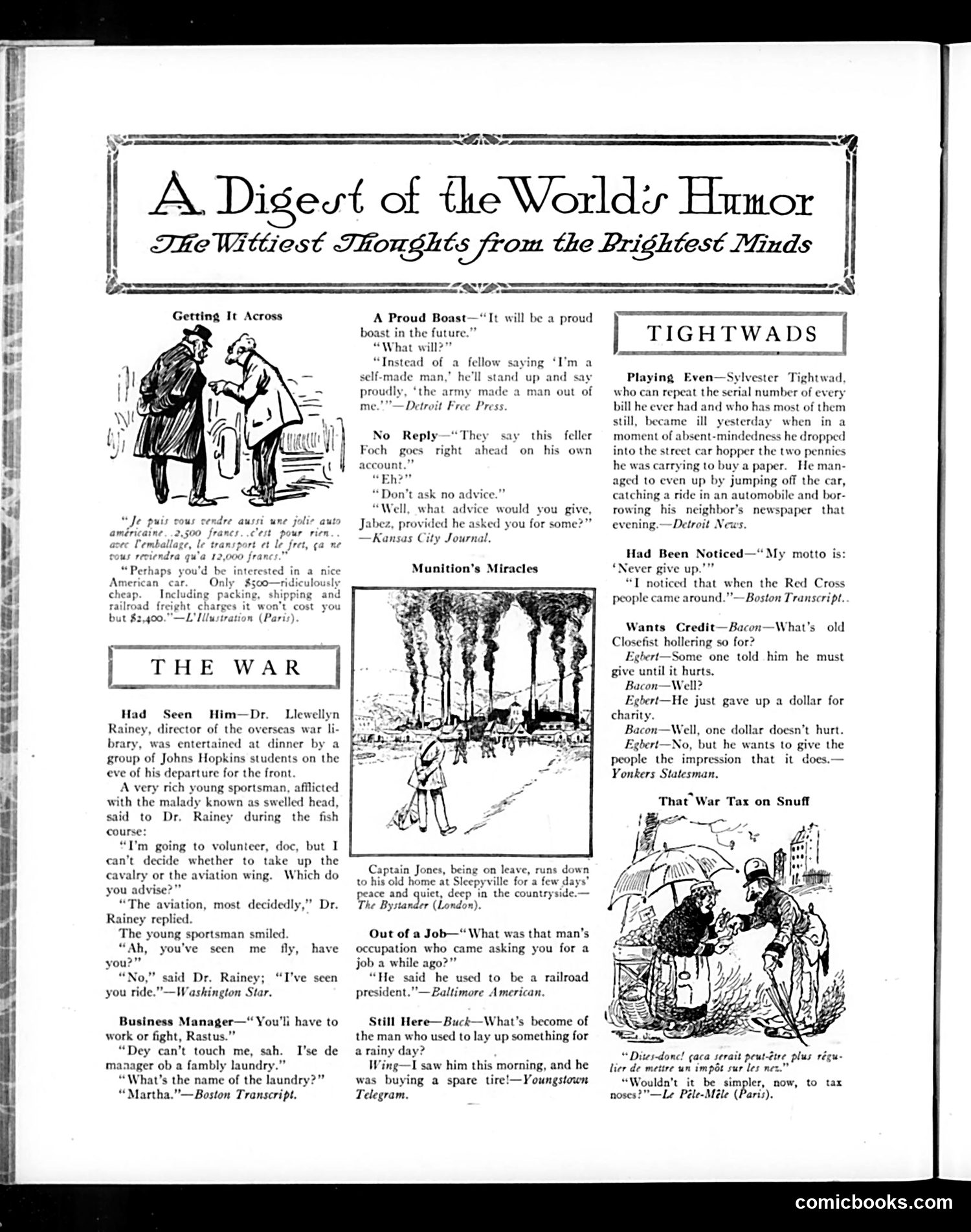
This page collects brief humorous anecdotes organized by theme. The jokes reflect World War I-era American concerns: **"The War" section** satirizes attitudes toward military service—particularly the arrogance of wealthy volunteers and the absurdity of those seeking exemptions. A wealthy young man asks a doctor which military branch to join; the doctor advises aviation, admitting he's recommending it because he's seen the man ride poorly (implying he'd be safer in the air). Another joke features a Black character claiming exemption as a laundry manager, reflecting period racial stereotypes. **"Tightwads" section** mocks miserly behavior through exaggerated character portraits—a miser so penny-pinching he retrieves dropped coins from a streetcar. **"Munition's Miracles"** shows wartime industrial transformation, while other jokes mock those claiming former importance ("used to be a railroad president"). The **snuff tax cartoon** makes a visual pun about taxation on luxury goods, suggesting taxing noses instead of snuff. These pieces exemplify Judge's satirical style: gentle mockery of American character types, wartime anxieties, and class dynamics during WWI.
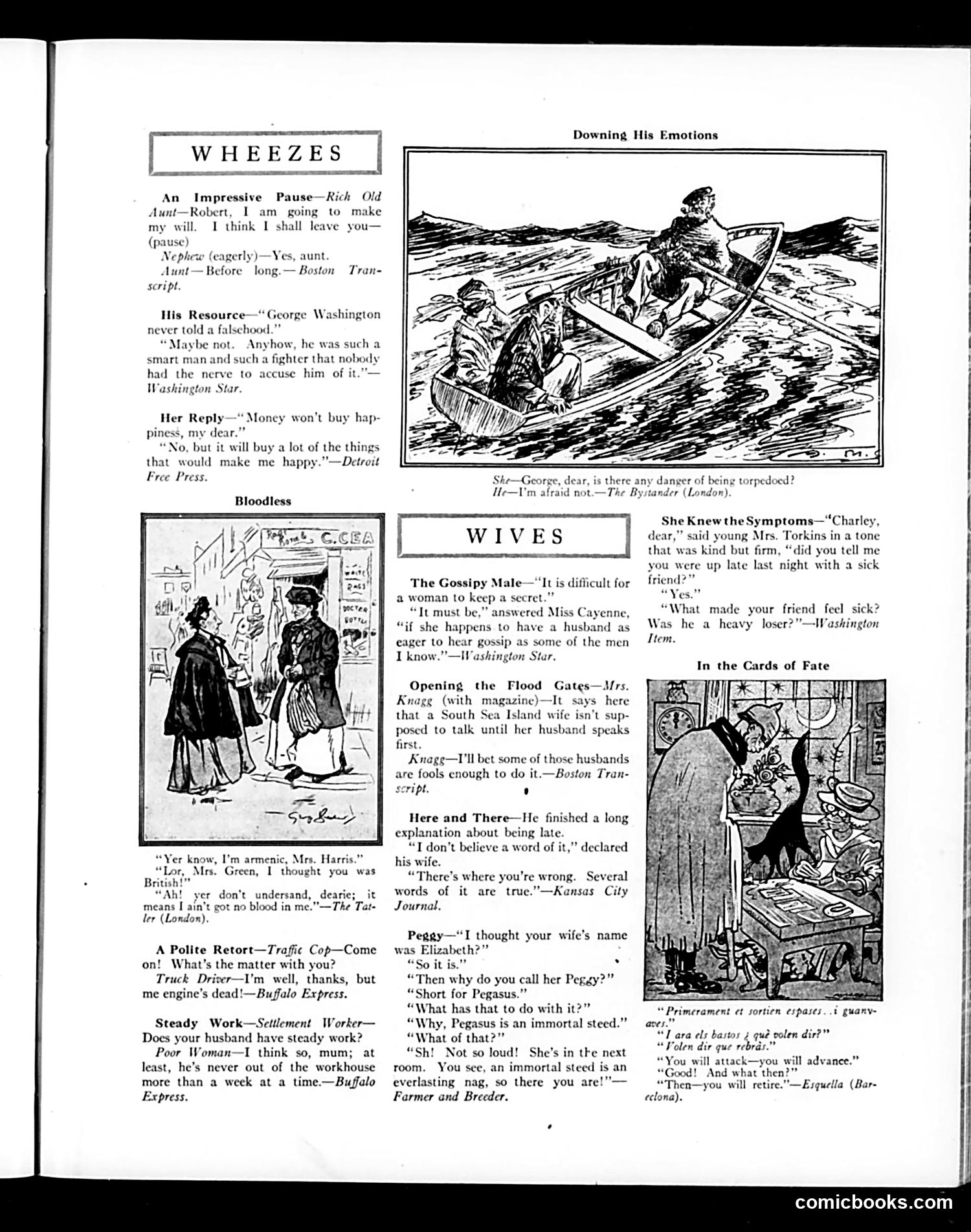
This page from Judge contains brief humorous anecdotes ("wheezers") satirizing early 20th-century social conventions and relationships. The cartoons mock: **"Wheezes" section**: Elderly wealth dynamics (the aunt's will pause), George Washington mythology, and money's role in happiness—reflecting anxieties about inheritance and materialism. **"Wives" section**: Gender stereotypes—women's gossip, wives nagging husbands ("everlasting nag"), marital deception about late nights. The "Pegasus" joke equates wives to tireless, complaining creatures. **"Downing His Emotions"** (illustration): A man in a boat appears emotionally composed despite danger, likely referencing wartime anxieties (the "torpedoed" reference suggests WWI-era concerns). **"In the Cards of Fate"**: A fortune-teller's reading about "attack," "advance," and "retreat" satirizes both fortune-telling hokum and possibly wartime fatalism. The overall tone mocks domesticity, class pretension, and gender relations through brief, cynical jokes typical of Judge's satirical style.
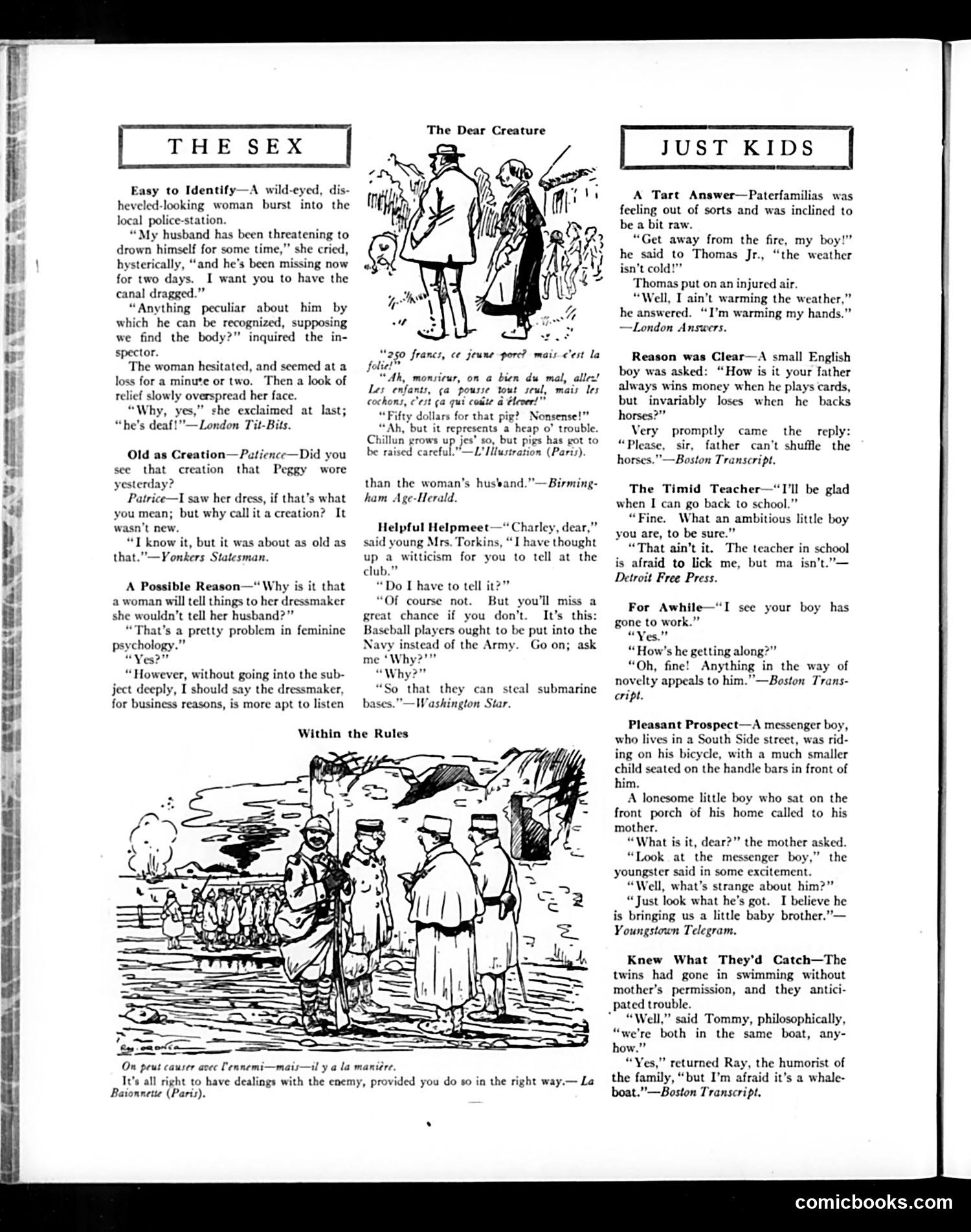
This page contains satirical humor pieces typical of early 20th-century American magazines, organized into three sections. **"The Sex"** features male-centered jokes mocking women: a wife relieved her missing (possibly dead) husband is deaf; a dressmaker keeping secrets from clients; and a wife scripting her husband's club jokes. The satire targets both women's perceived superficiality and men's dependence on them. **"The Dear Creature"** includes a French anecdote about raising pigs versus children—suggesting children are less costly to raise than livestock (likely commentary on family economics during WWI-era France). **"Just Kids"** presents children's witty comebacks to adults: a boy correcting his father's logic, explaining why his father wins at cards but loses on horses, and a child noting a messenger boy carrying his baby brother. These celebrate children's precocious reasoning. The cartoon "Within the Rules" shows soldiers—likely WWI-era—illustrating the French caption about conducting business with enemies while maintaining proper decorum. The overall tone reflects wartime publication with gendered humor and observational comedy about class and family life.
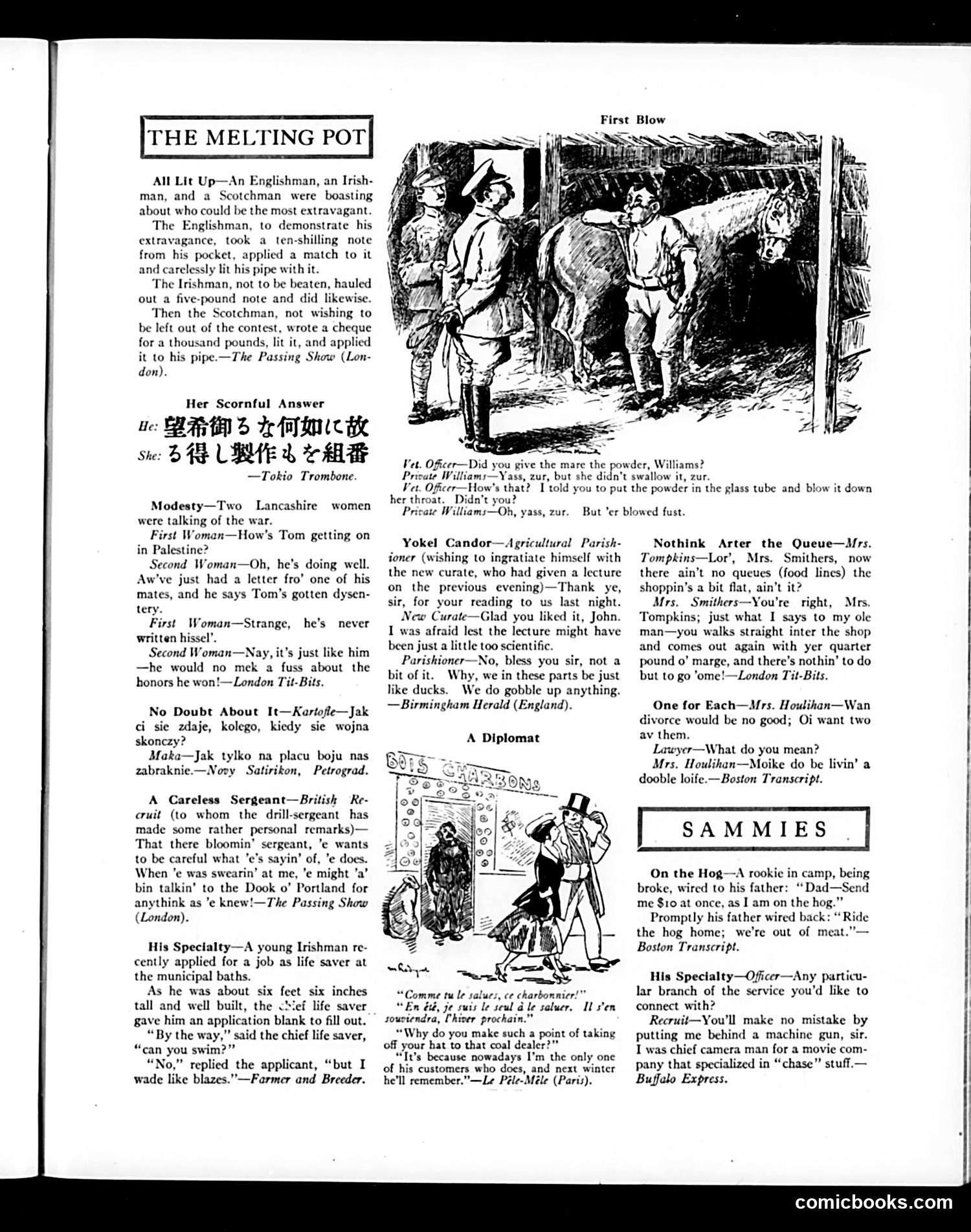
This Judge magazine page collects brief humor pieces satirizing national stereotypes and wartime conditions. The main cartoon "First Blow" depicts a WWI military scene with officers and soldiers, accompanying a joke about a veterinary officer and a horse—likely poking fun at military incompetence or the absurdities of army life. The surrounding anecdotes employ ethnic stereotyping common to the era: a Scottish character's financial canniness, an Irishman's physical strength but lack of swimming ability, and working-class British and Irish speech patterns used for comic effect. Several pieces reference WWI (soldiers in Palestine, dysentery, life-saving duties), suggesting this was published during or shortly after the war. The "Sammies" section references American soldiers, using contemporary slang. Overall, the page reflects early-20th-century humor conventions relying heavily on national caricatures and dialect comedy—content that would be considered offensive by modern standards.
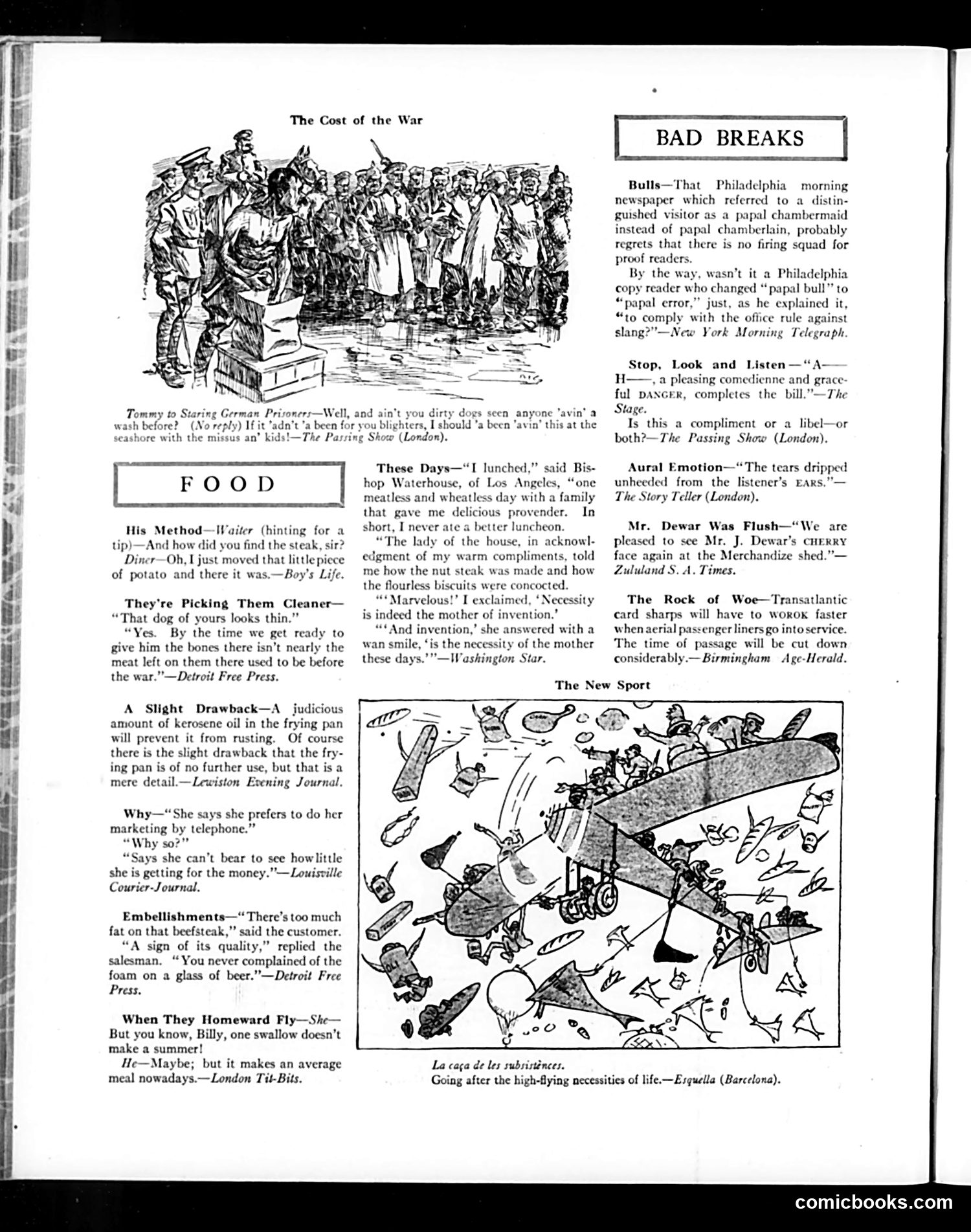
This page collects wartime humor (likely WWI era, given references to "meatless and wheatless days") focused on food shortages and rationing. The main cartoon depicts German prisoners witnessing Allied soldiers' meager rations—the ironic point being that even the victors are starving due to war's economic toll. The "BAD BREAKS" section ridicules newspaper errors, while the "FOOD" anecdotes mock wartime scarcity through jokes: a diner finds his steak by moving aside a tiny potato; a dog is so thin there's "no meat left on the bones"; kerosene ruins a frying pan but preserves it; people avoid shopping in person to hide how little food money buys; one swallow (food) becomes "an average meal." "The New Sport" cartoon shows figures harvesting necessities from wreckage—depicting civilians desperately scavenging amid wartime destruction. The humor darkly illustrates widespread deprivation affecting everyone, civilian and military alike.
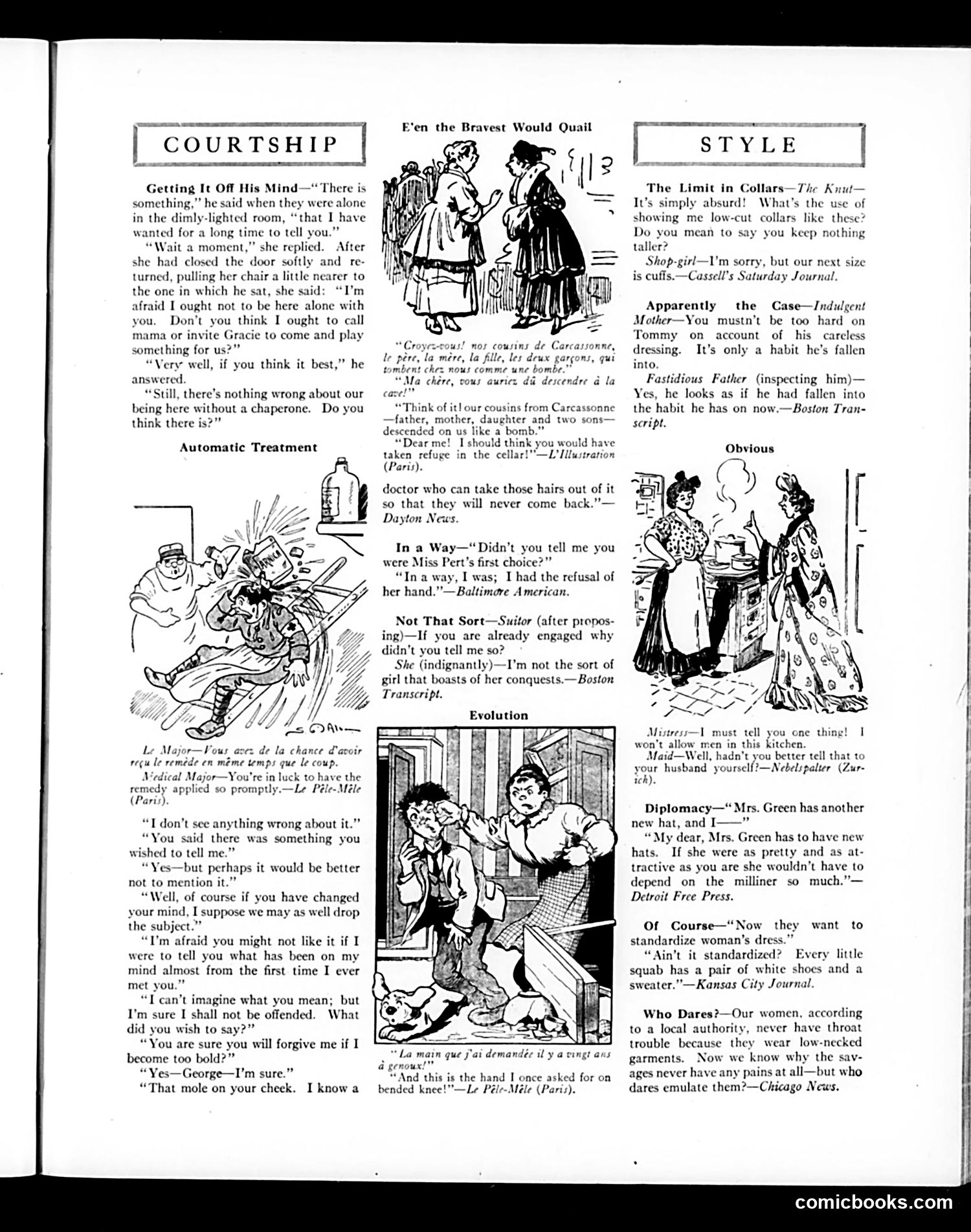
This page presents multiple short humorous anecdotes about courtship and domestic life, typical of early 20th-century American humor magazines. The main "Courtship" section satirizes awkward romantic encounters. A man struggles to confess something to his companion, but when finally pressed, his "confession" is merely that she has unsightly facial hair—a deflating anticlimax that mocks both male cowardice and female vanity. The "Automatic Treatment" and other sections offer quick jokes about relationships: a soldier receiving medical treatment simultaneously with his injury; a woman claiming an "engagement refusal" rather than honest rejection; a suitor discovering his fiancée was never actually his first choice. The "Evolution" cartoon contrasts a man proposing on bended knee versus later demanding the same hand—implying marriage transforms romantic devotion into entitlement. Throughout, the humor targets gender dynamics: women's fashion obsessions, men's inability to communicate honestly, and the gap between courtship promises and married reality. The frequent citations of European publications suggest these were international reprints, reflecting shared Anglo-European cultural anxieties about modern romance.
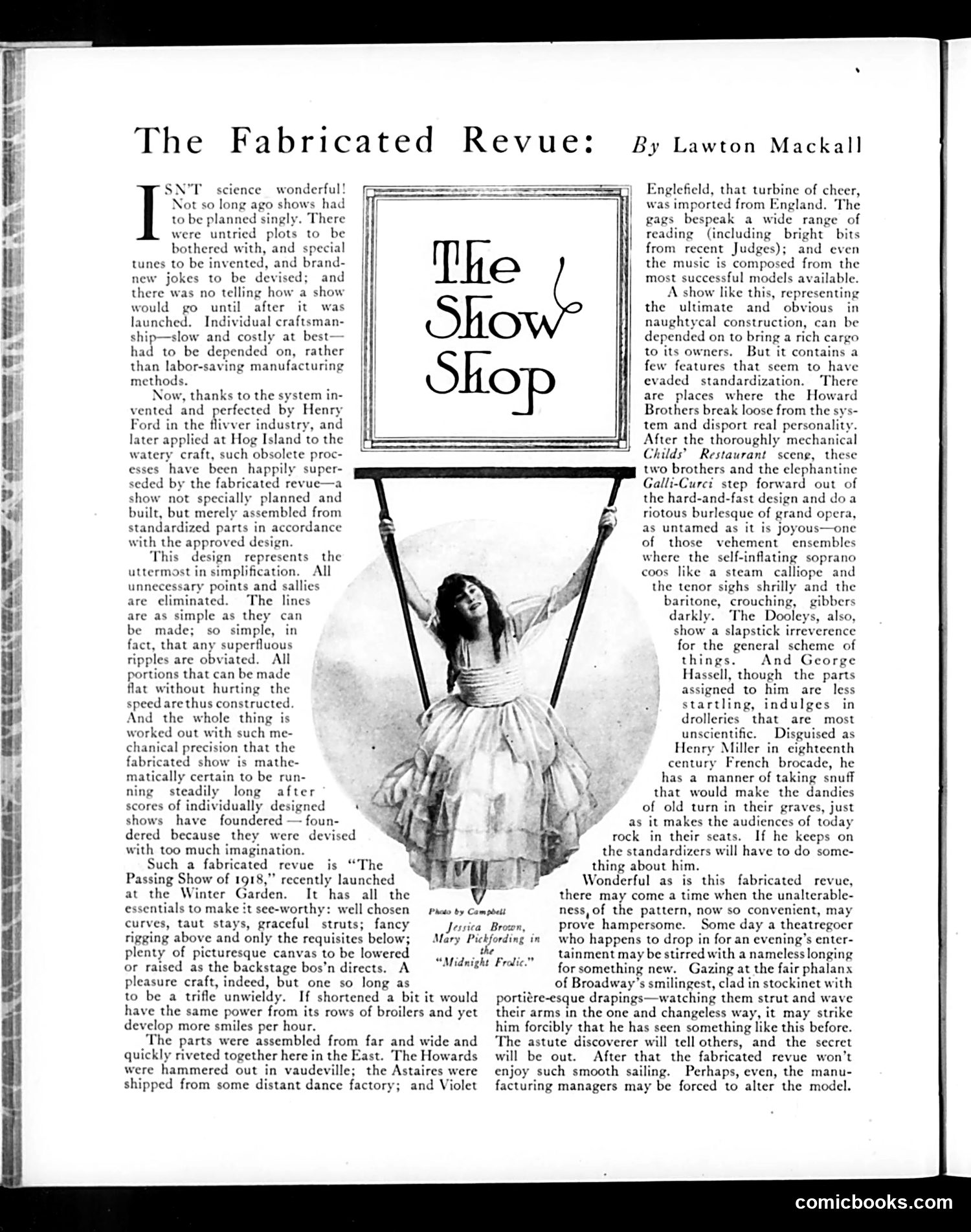
This article satirizes the application of Henry Ford's assembly-line manufacturing methods to Broadway theatrical production. The text describes "The Passing Show of 1918"—a revue constructed from standardized, interchangeable parts: pre-made gags, recycled music, stock performers (the Howards, the Astaires), and simplified staging. The satire's point: while efficiency creates predictable commercial success, it deadens artistic vitality. Mackall notes that some performers—Jessica Brown, George Hassell, and the Dooleys—occasionally "break loose" and inject genuine personality, suggesting authentic talent still struggles against mechanical standardization. The accompanying illustration of a woman on a swing epitomizes this: a mass-produced theatrical "product," aesthetically pleasing but fundamentally interchangeable. The satire critiques how Broadway's commercialization prioritizes profit and predictability over creativity and individual artistry.
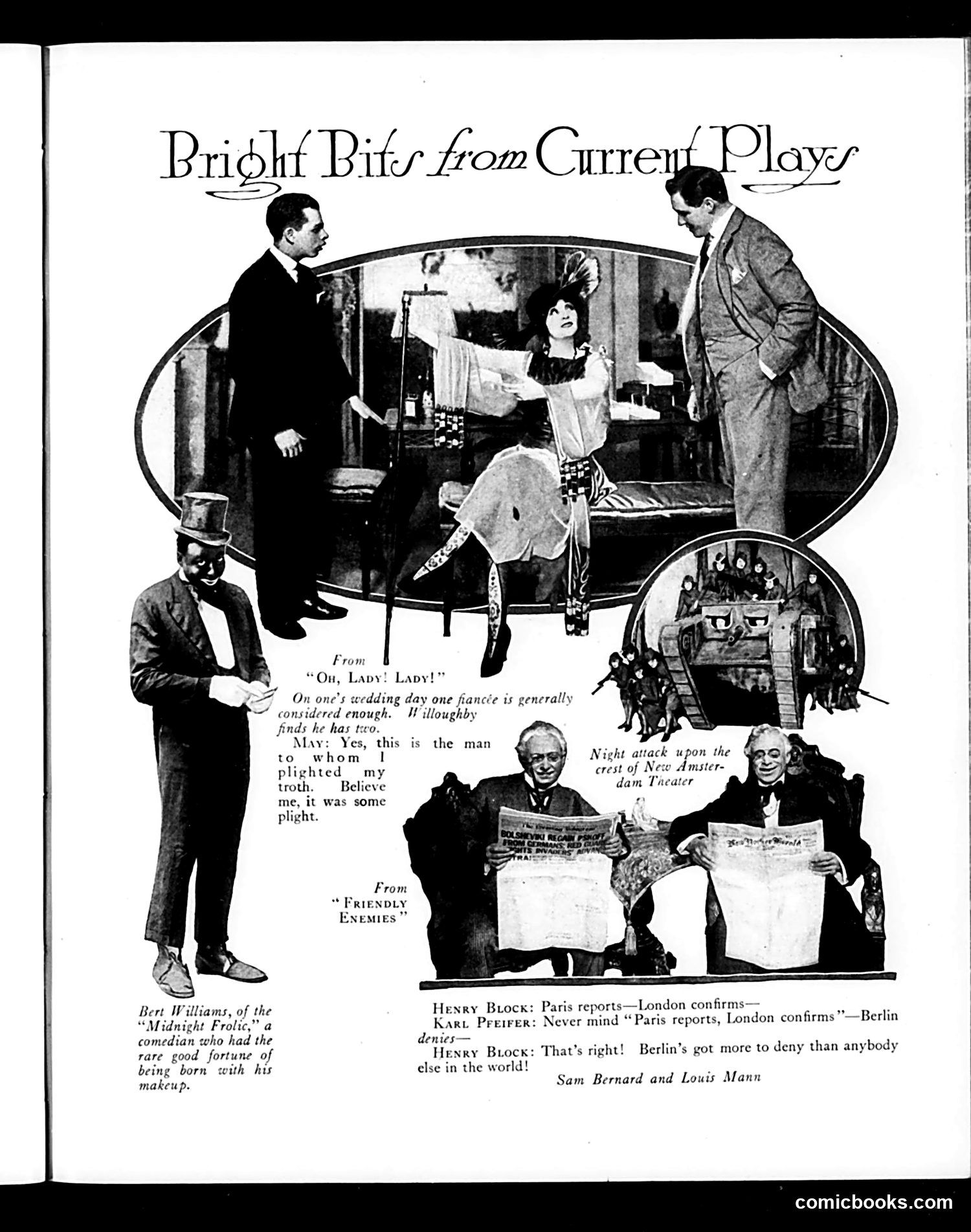
This page collects theatrical gossip and jokes from Judge magazine's entertainment section. The top scene from "Oh, Lady! Lady!" depicts a wedding-day comedy where a groom discovers his fiancée is one of two—a joke about marital complications. Below, Bert Williams (a renowned Black comedian from the "Midnight Frolic") is noted for his natural comedic talent. The lower section features a rapid-fire joke exchange between Henry Block, Karl Pfeifer, Sam Bernard, and Louis Mann about conflicting international reports regarding Paris, London, and Berlin. The humor hinges on the idea that Berlin has the most to deny or cover up—likely a post-WWI reference to Germany's war responsibilities or diplomatic denials during the interwar period when trust between nations was fractured.
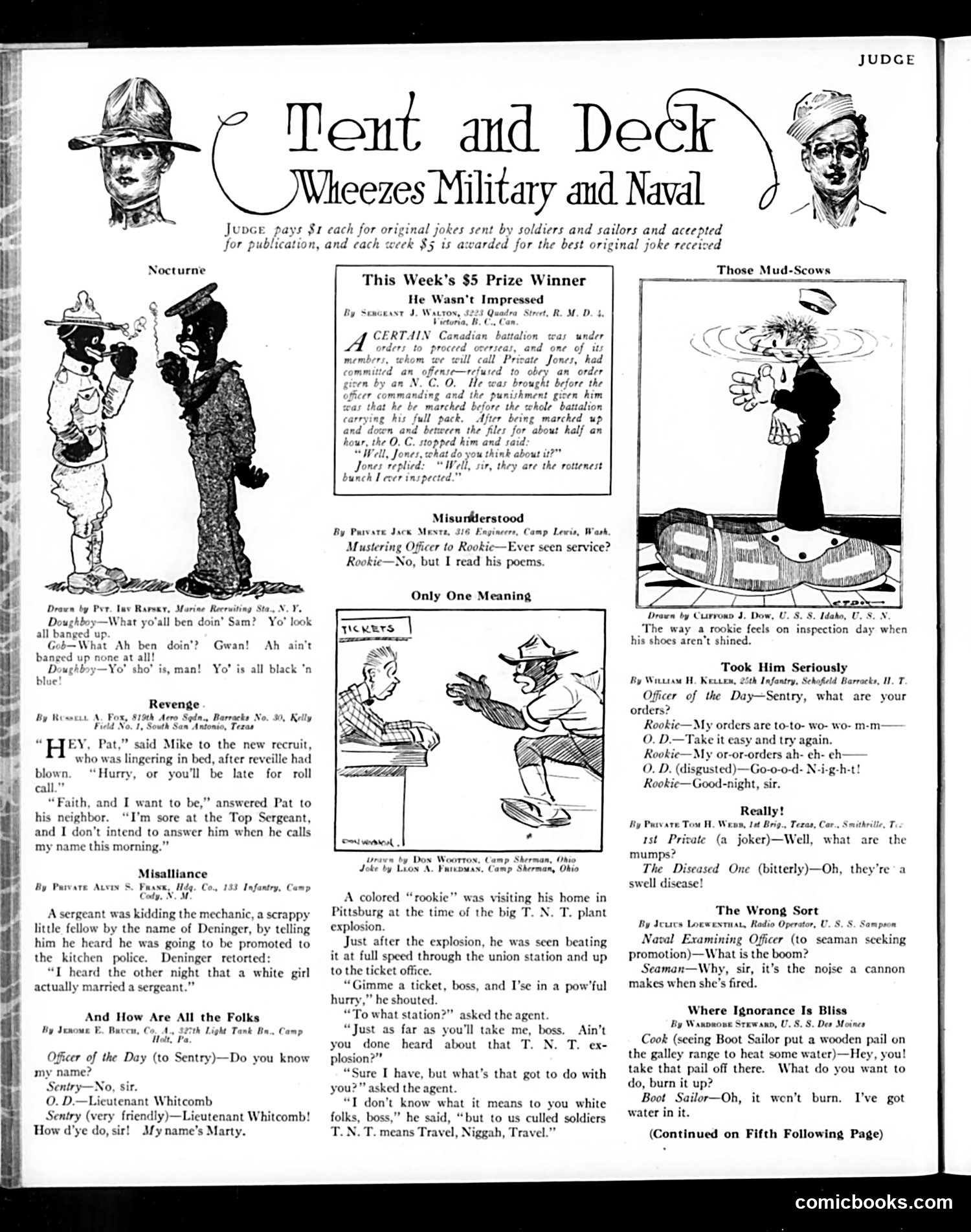
This page collects brief jokes and cartoons submitted by servicemen during World War I, paying $1 per joke and $5 for the best. The humor reflects military life's frustrations and absurdities. The jokes feature common soldier experiences: a doughboy and sailor joking about bruises; a recruit deliberately missing roll call to avoid a sergeant; soldiers making fun of military hierarchy and incompetence. Most notably, one joke contains a racial slur in its punchline, where a Black soldier's fear of a TNT explosion is reduced to a dehumanizing "joke" about what "T.N.T." means to "colored soldiers." This reflects the deeply racist attitudes embedded in period military culture and mainstream publications. Other humor targets rookie mistakes, stammering recruits, and officers' lack of self-awareness—standard barracks comedy. The cartoons show slapstick military scenarios with exaggerated drawings typical of the era.
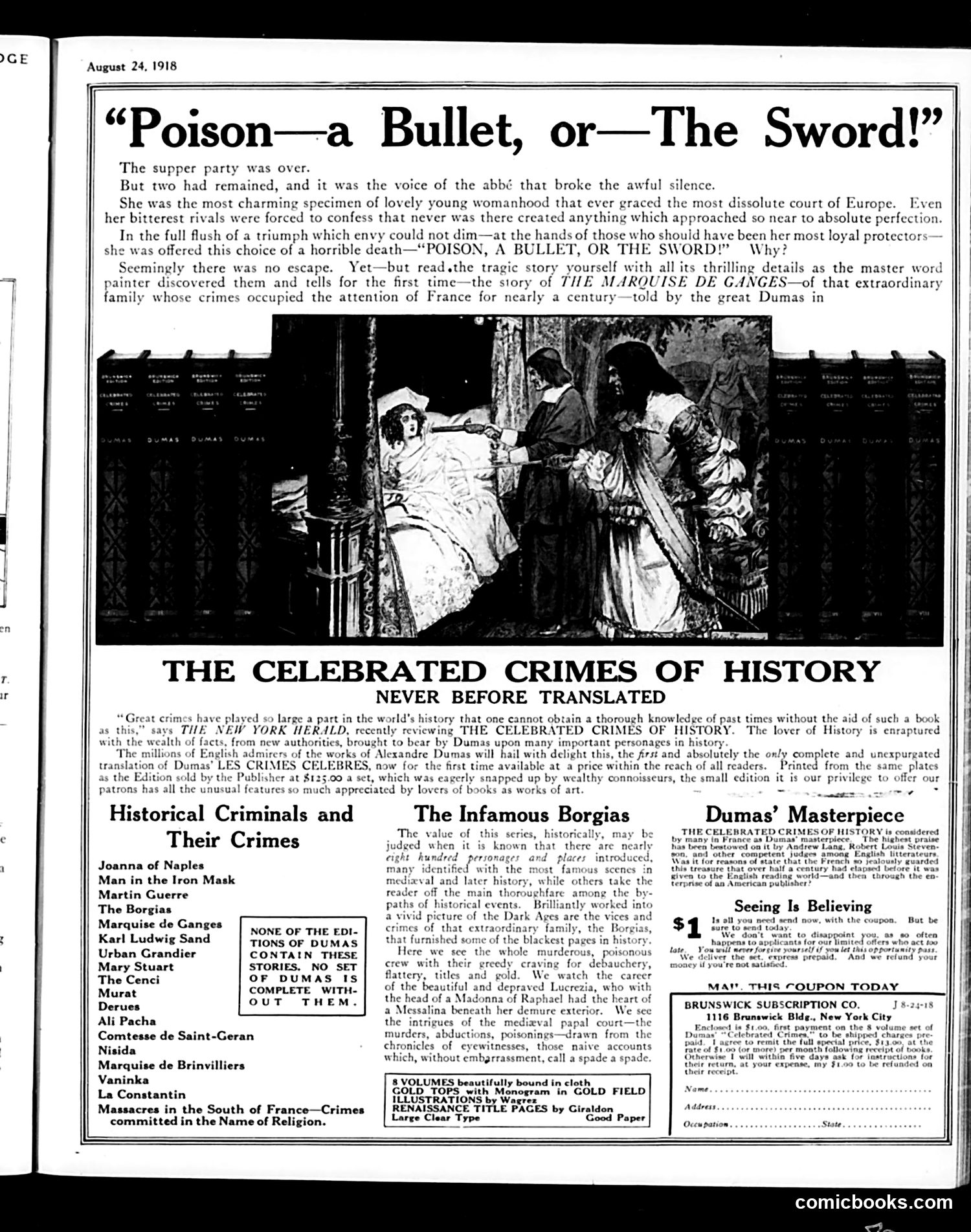
This is primarily **advertising content**, not a political cartoon. The page promotes "The Celebrated Crimes of History" by Alexandre Dumas—a multi-volume book set being sold by Brunswick Subscription Co. The illustrated header dramatizes *The Marquise de Ganges*, one of Dumas's historical crime narratives, depicting a young woman offered a gruesome choice of death methods by mysterious figures. This serves as marketing copy: the sensational imagery and narrative hook are designed to entice readers to purchase the complete collection. The list of subjects—"Joanna of Naples," "The Borgias," "Man in the Iron Mask," etc.—emphasizes the scope and historical prestige of the work. The text quotes *The New York Herald* praising the book and notes this is the first "complete and unexpurgated" English translation at an affordable price (previously expensive limited editions existed). The coupon at bottom invites readers to purchase. This is a straightforward literary advertisement exploiting public fascination with historical crime and scandal.
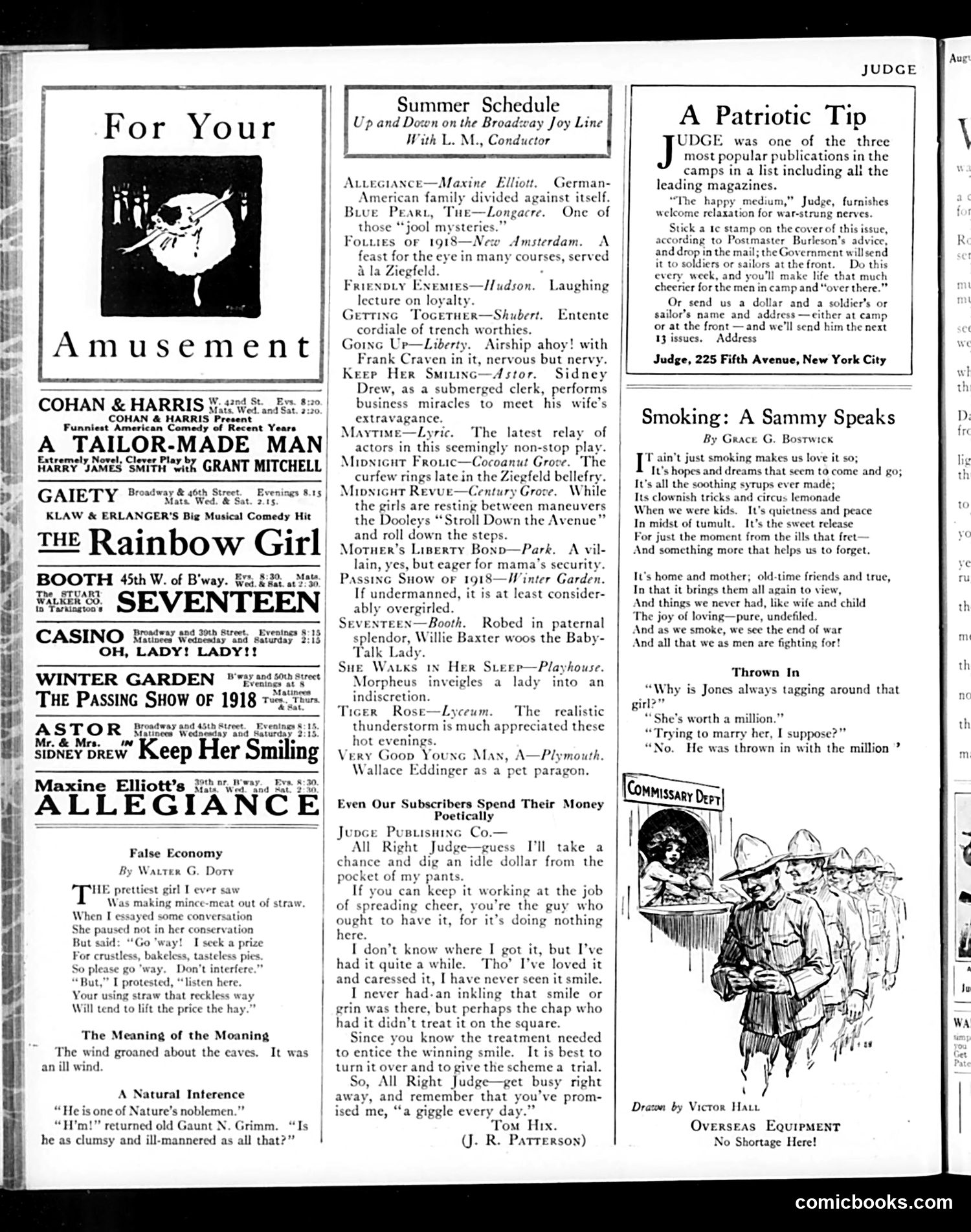
This page is primarily **theatrical advertising and light humor**, not political satire. The left side showcases Broadway shows popular in 1918, including titles like *A Tailor-Made Man*, *The Rainbow Girl*, and *Keep Her Smiling*—typical entertainment advertisements. The three poems on the left ("False Economy," "The Meaning of the Moaning," "A Natural Inference") are gentle, whimsical pieces with no political content. They use wordplay and mild irony on everyday topics. The right side's sketch shows soldiers at a "Commissary Dept" counter—a subtle WWI reference, as this magazine circulated in military camps. The accompanying article encourages readers to send the publication to servicemen, framing it as patriotic support. Overall, this appears to be a **morale-boosting issue** designed for wartime audiences, mixing entertainment promotion with subtle military support messaging rather than sharp political commentary.
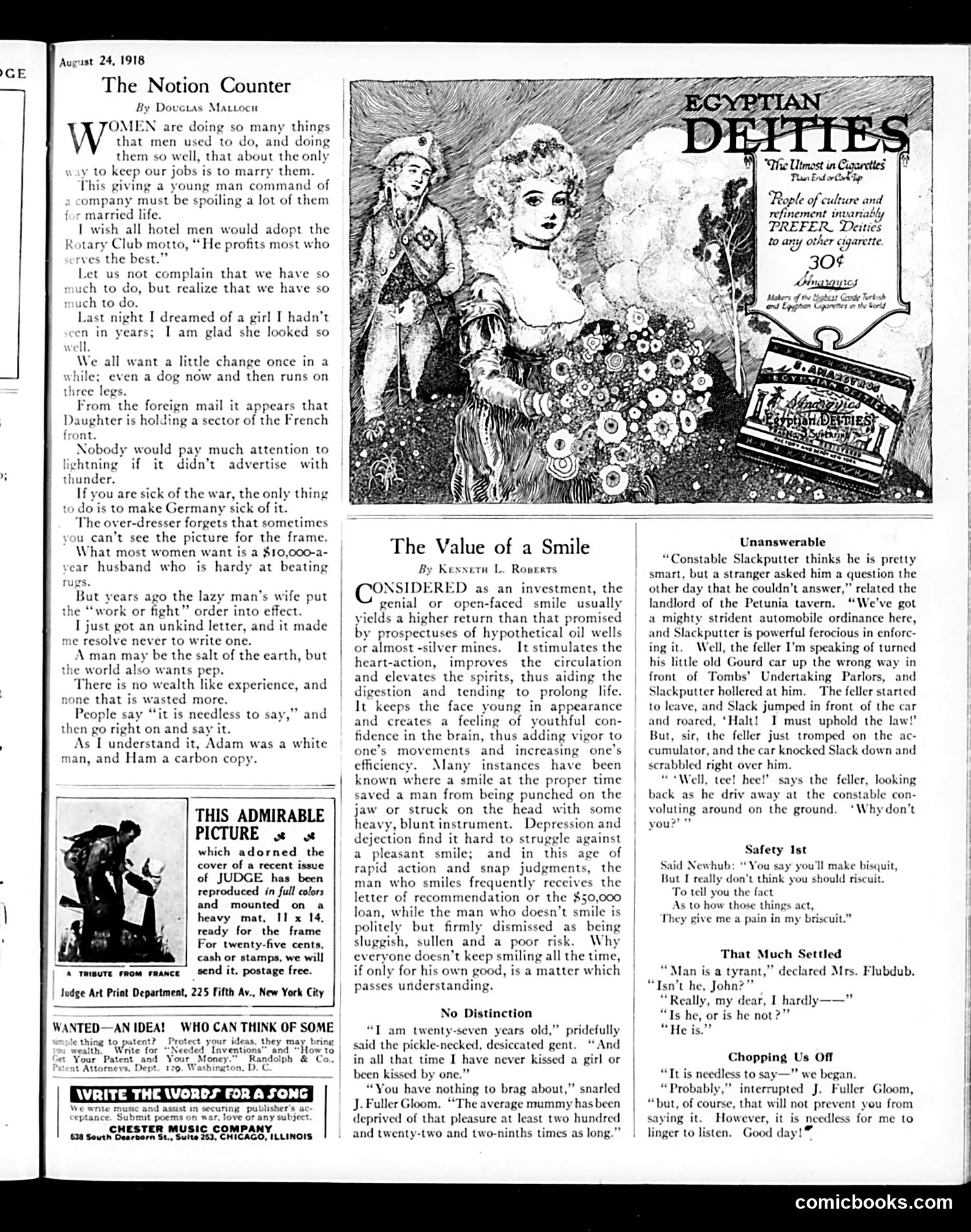
This page reflects American life during World War I's final months. "The Notion Counter" column by Doreas Matlock presents brief social observations, notably commenting that women are competently performing men's jobs during wartime ("Daughter is holding a sector of the French front"), suggesting both respect and anxiety about gender roles. The writer paradoxically worries this wartime employment will "spoil" women for married life. The main illustrated content advertises "Egyptian Deities" — a cigarette brand. The ornate illustration depicts figures in Egyptian costume, typical advertising design of the era. "The Value of a Smile" is a serious essay promoting smiling as beneficial to health, success, and avoiding conflict ("saved a man from being punched on the jaw"). This reflects early-20th-century popular psychology emphasizing positive thinking. The page also includes patent and songwriting advertisements, typical Judge revenue sources. Overall, this captures 1918 American concerns: women's wartime labor, commercial consumption, and optimistic self-help philosophy.
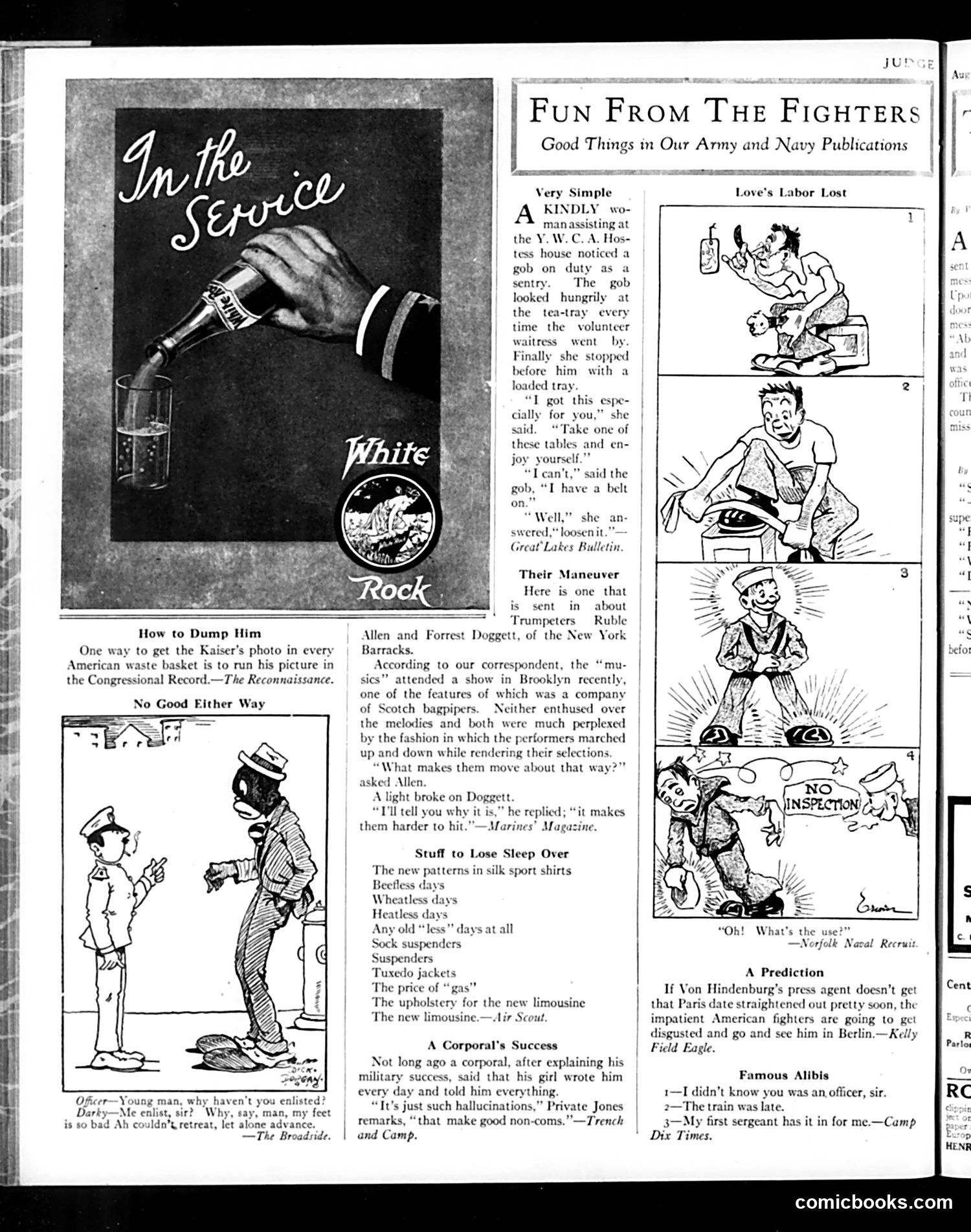
This page from Judge contains WWI-era military humor targeting servicemen. The cartoons mock common soldier complaints and situations: **"How to Dump Him"** ridicules a Black soldier's excuse for not enlisting—claiming his feet prevent retreat. It uses period racist stereotypes and dialect. **"Their Maneuver"** jokes about two Army trumpeters puzzled by Scottish bagpipers marching while playing, with one concluding it makes them "harder to hit"—absurdist military humor. **"Love's Labor Lost"** depicts a sailor unable to eat at a YMCA hostess house because his belt prevents it—physical comedy about military constraints. **"A Prediction"** references German General Von Hindenburg, suggesting American soldiers will visit Berlin to confront him if peace negotiations stall—expressing impatience with the war's duration. The page reflects American home-front attitudes: frustration with war delays, mockery of minority soldiers, and affectionate ribbing of military life through soldier-submitted jokes from service publications.
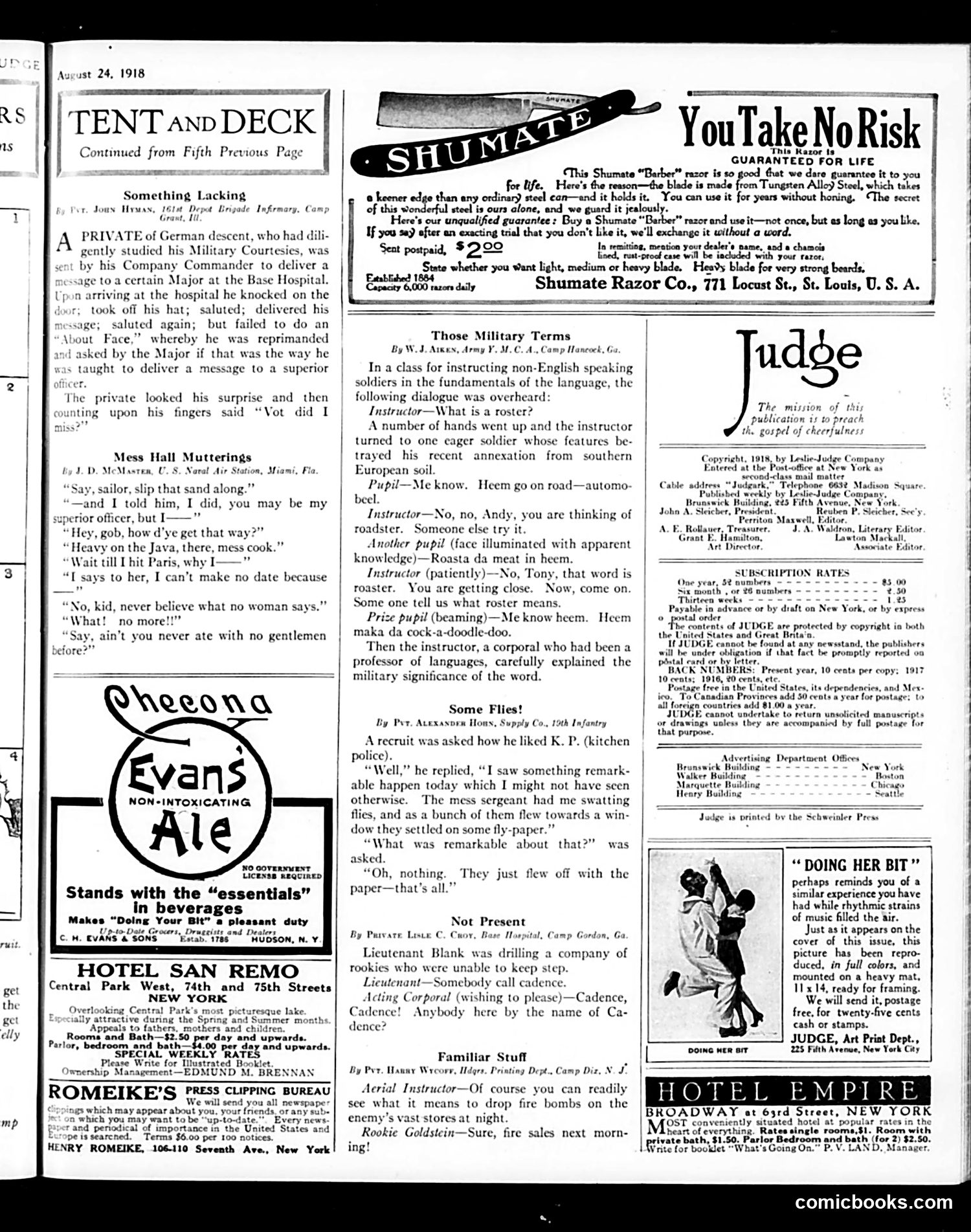
This page contains **primarily advertisements and humor columns** rather than political cartoons. The main content includes: **"Tent and Deck" humor column**: Military anecdotes satirizing WWI soldier life and language barriers. One story mocks a German-American private's over-literal interpretation of military courtesy. Another section, "Those Military Terms," jokes about non-English-speaking soldiers (appearing to be recent immigrants from Southern Europe) hilariously misunderstanding English words—confusing "roster" with "roaster" and making farm animal sounds. **Key context**: Published August 1918, near WWI's end, the humor reflects American attitudes toward immigrant soldiers and military life. The satire gently pokes fun at language barriers and cultural misunderstandings rather than mocking the soldiers themselves. **Advertisements dominate**: Shumate razors, Pheona Evans ale, Hotel San Remo, and other period products occupy significant space. No identifiable political figures or sharp political satire appear on this page.
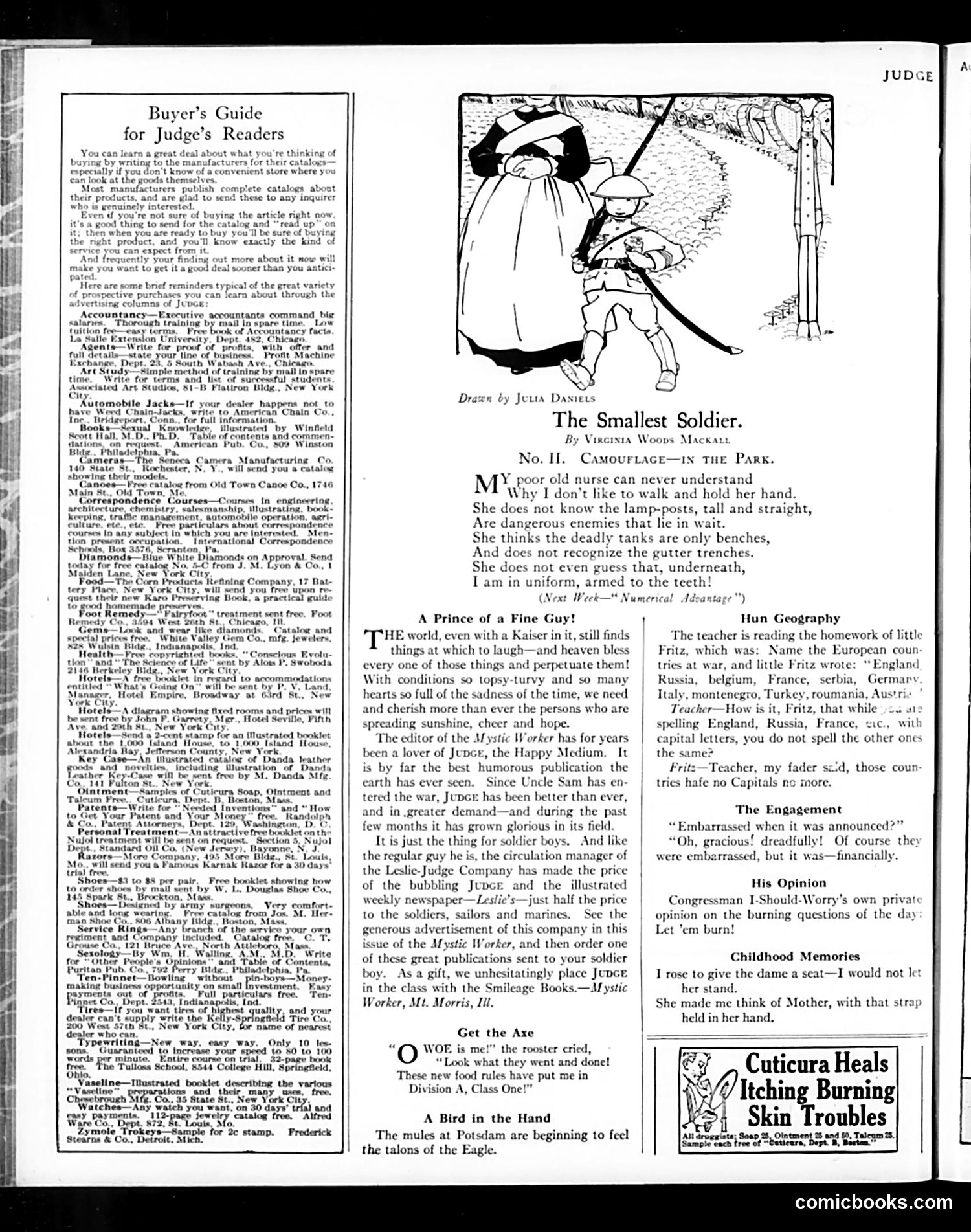
This page contains a **buyer's guide** (advertising directory) alongside light satirical content typical of Judge magazine. The main cartoon, "The Smallest Soldier" by Julia Daniels, depicts a child in military uniform with an adult nurse. The satire mocks how a child playing soldier sees ordinary urban objects—lamp-posts, benches, gutters—as military threats (enemies, tanks, trenches). It's a commentary on **how war imagery saturates civilian life**, particularly affecting children's perception of their everyday surroundings. The "(Next Week—'Numerical Advantage')" suggests this is part of a series. "Hun Geography" presents another war-related joke: a student named Fritz lists warring European nations (England, Russia, Belgium, France, Serbia, Germany, Italy, Montenegro, Turkey, Romania, Austria) but capitalizes them inconsistently. His excuse—that his father said those countries "have no capitals anymore"—is dark humor about **World War I's destruction and territorial chaos**. The term "Hun" was contemporary American/British propaganda slang for Germans. Both pieces reflect **WWI-era anxieties** about militarization and the war's impact on European geography and civilian life.
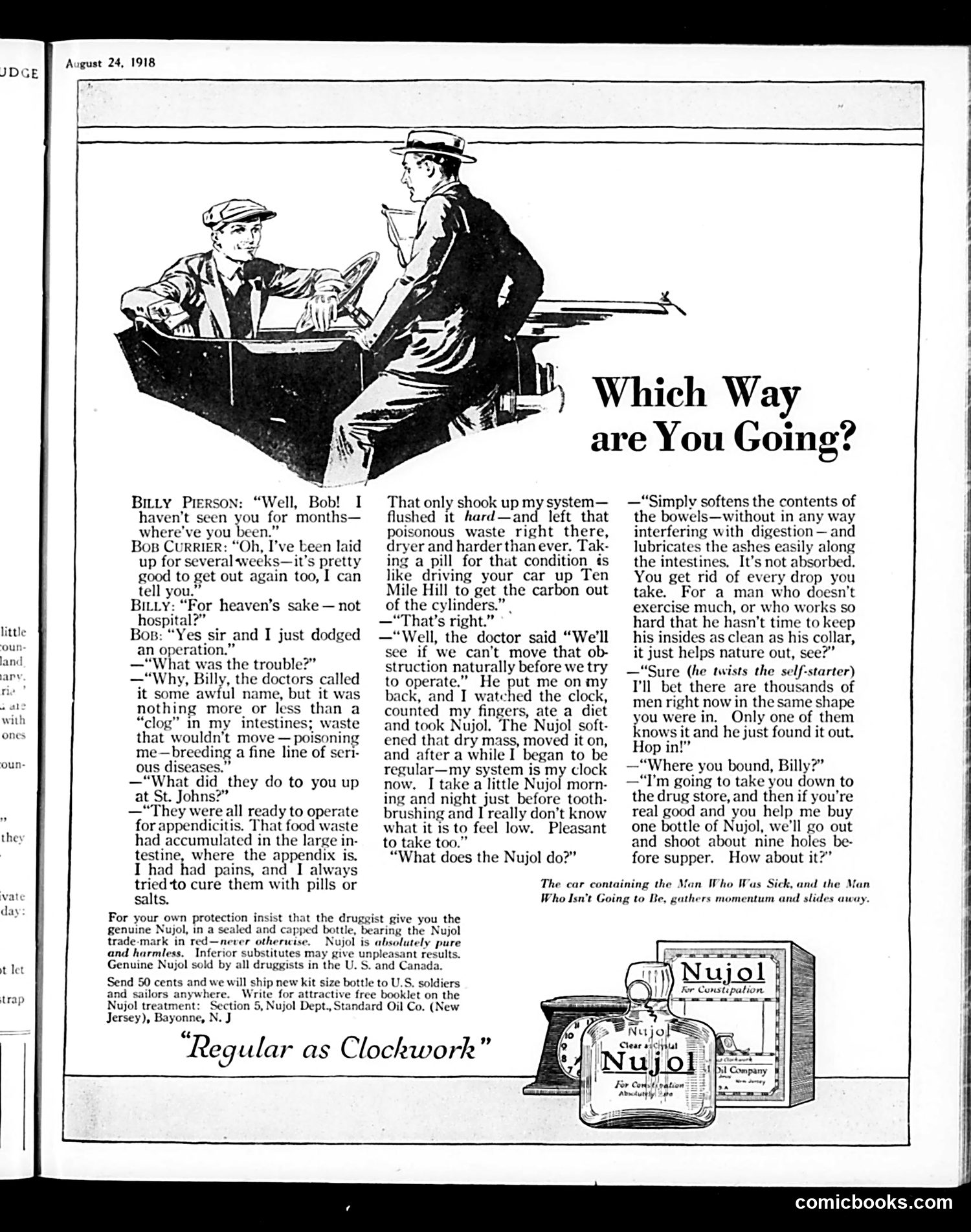
This is primarily a **Nujol laxative advertisement** disguised as editorial content in Judge magazine. Two men—Billy Pierson and Bob Currier—discuss Bob's recent intestinal troubles. Bob explains he avoided unnecessary surgery after doctors wanted to operate for appendicitis, choosing instead to take Nujol, a mineral oil product that softens stool without interfering with digestion. The "satire" is gentle product placement: the dialogue contrasts the old medical approach (surgery, pills, salts) with Nujol's gentler mechanism. The framing as two friends' casual conversation lends credibility. The wartime context matters—the ad explicitly offers to send bottles to U.S. soldiers and sailors, positioning Nujol as supporting troops' health. The cartoon's mild joke is the final image of the car "gathering momentum and sliding away"—a visual pun on Nujol's laxative function. This blurs advertising and editorial content typical of early 20th-century magazine publishing.
This page is primarily **advertising disguised as testimonial journalism**—a common early 20th-century marketing technique. The main article features Victor Jones, presented as a "memory expert" who claims to teach remarkable memory skills in "one evening." The narrative structure uses a fabricated anecdote: Jones supposedly impresses someone at a hotel by accurately recalling details about a man he met years prior, establishing his credibility. The testimonials (from "Addison Sims" and others) appear designed to seem like genuine endorsements but are likely fictional. The repeated emphasis that "anyone" can learn these techniques appeals to ordinary readers' aspirations. **The satire or social commentary is subtle**: Judge magazine may be gently mocking the era's proliferation of self-improvement "courses" and memory-training schemes—products that promised quick, miraculous personal transformation. The breathless tone and inflated claims reflect actual advertising hyperbole of the period. The bottom coupon offering "free examination" was standard direct-mail marketing. The phrase "Send No Money" was designed to lower purchase resistance. This represents early mass-market consumer manipulation targeting business professionals seeking competitive advantages.