
Judge, 1918-08-24 · page 9 of 32
Judge — August 24, 1918 — page 9: what you’re looking at
What you’re looking at
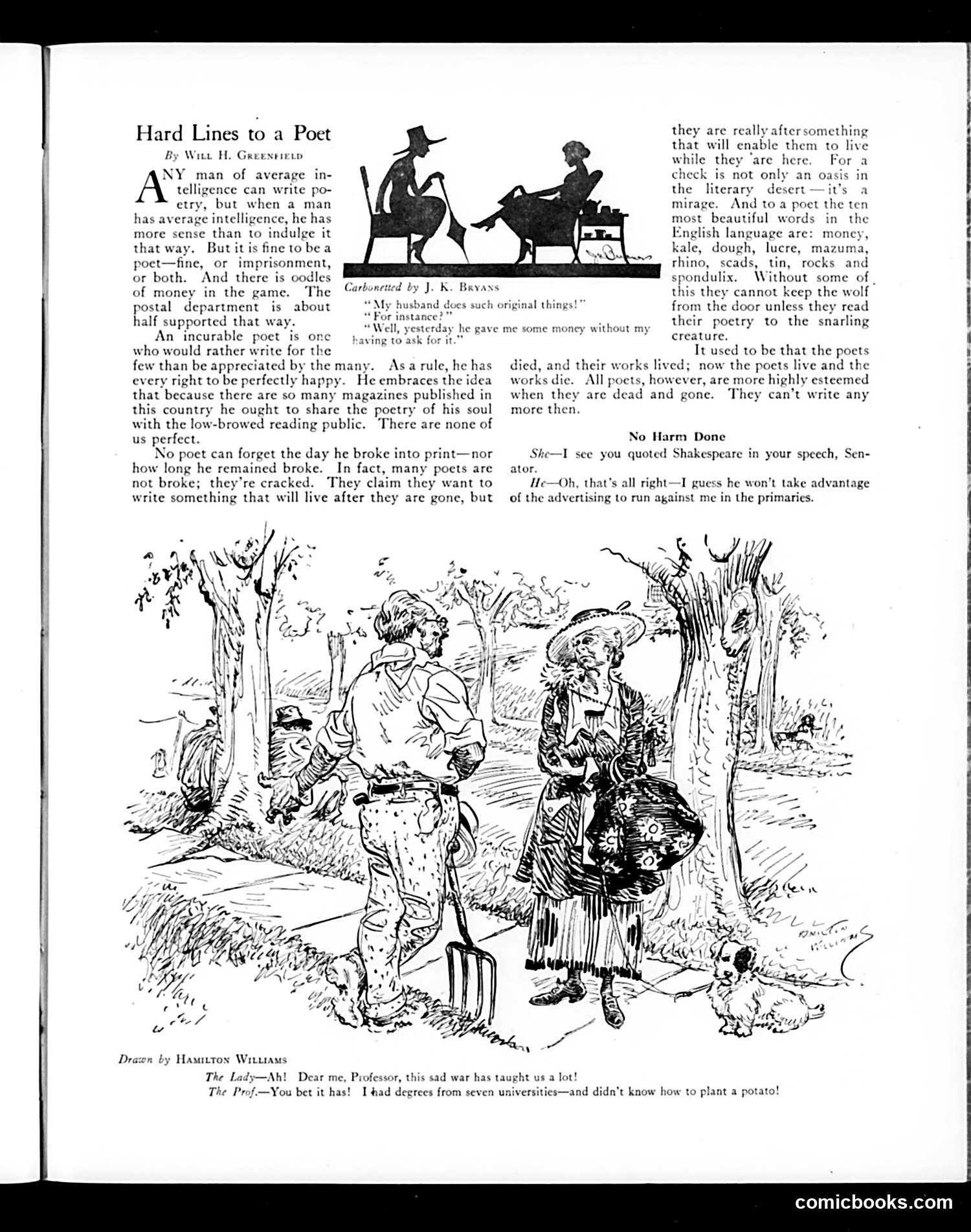
This page contains satirical commentary on poets and their financial struggles. The main article by Will H. Greenfield mocks poets as impractical dreamers who claim to write for posterity but actually desperately need money to survive. The humor lies in the contradiction: poets romanticize art while obsessing over payment—Greenfield lists ten slang terms for money, suggesting desperation. The two cartoon vignettes mock different types of pretension: the top cartoon shows a man quoting Shakespeare to avoid paying for advertising (suggesting dishonest use of culture), while the bottom cartoon depicts a professor with seven university degrees who learned nothing practical—the war taught him he can't even plant a potato. Both satirize educated elites as out-of-touch with real-world knowledge and survival.
📄 Transcribed text from this page (OCR, searchable)
Machine-transcribed from the original scan — historical spelling and the odd misread are preserved.
Hard Lines to a Poet y Witt H. Greentietp Y man of average in- telligence can write po- y, but when a man has average intelligence, he has more sense than to indulge it that way. Butitis fine to bea poet—fine, or imprisonment, or both. And there is oodles of money in the game. postal department is about half supported that way. An incurable poet is one who would rather write for the few than be appreciated by the many. Asa rule, he has every right to be perfectly happy. He embraces the idea that because there are so many magazines published in this country he ought to share the poetry of his soul with the low-browed reading public. There are none of us perfect. No poet can forget the day he broke into print—nor how long he remained broke. In fact, many poets are not broke; they’re cracked. They claim they want to write something that will live after they are gone, but My husband aving to ask for it /, ty Vy out y — Dracon by Hasurtos Wituass The Car? ‘d by J. K. Bryans does such original things!" Well, yesterday he gave me some money without my they are really aftersomething that will enable them to live while they ‘are here. For a check is not only an oasis in the literary desert—it’s a mirage. And toa poct the ten most beautiful words in the English language are: money, kale, dough, lucre, mazuma, rhino, scads, tin, rocks and spondulix. Without some of , this they cannot keep the wolf from the door unless they read their poetry to the snarling creature. It used to be that the poets died, and their works lived; now the poets live and the works die. All poets, however, are more highly esteemed when they are dead and gone. They can’t write any more then. No Harm Done She—I see you quoted Shakespeare in your speech, Sen- ator. He—Oh, that’s all right—I guess he won’t take advantage of the advertising to run against me in the primaries. The Lady—Ah! Dear me, Professor, this sad war has taught us a lot! The Prof—You bet it has! I had degrees from seven universities—and didn’t know how to plant a potato! comicbooks.com