
Judge, 1918-08-24 · page 20 of 32
Judge — August 24, 1918 — page 20: what you’re looking at
What you’re looking at
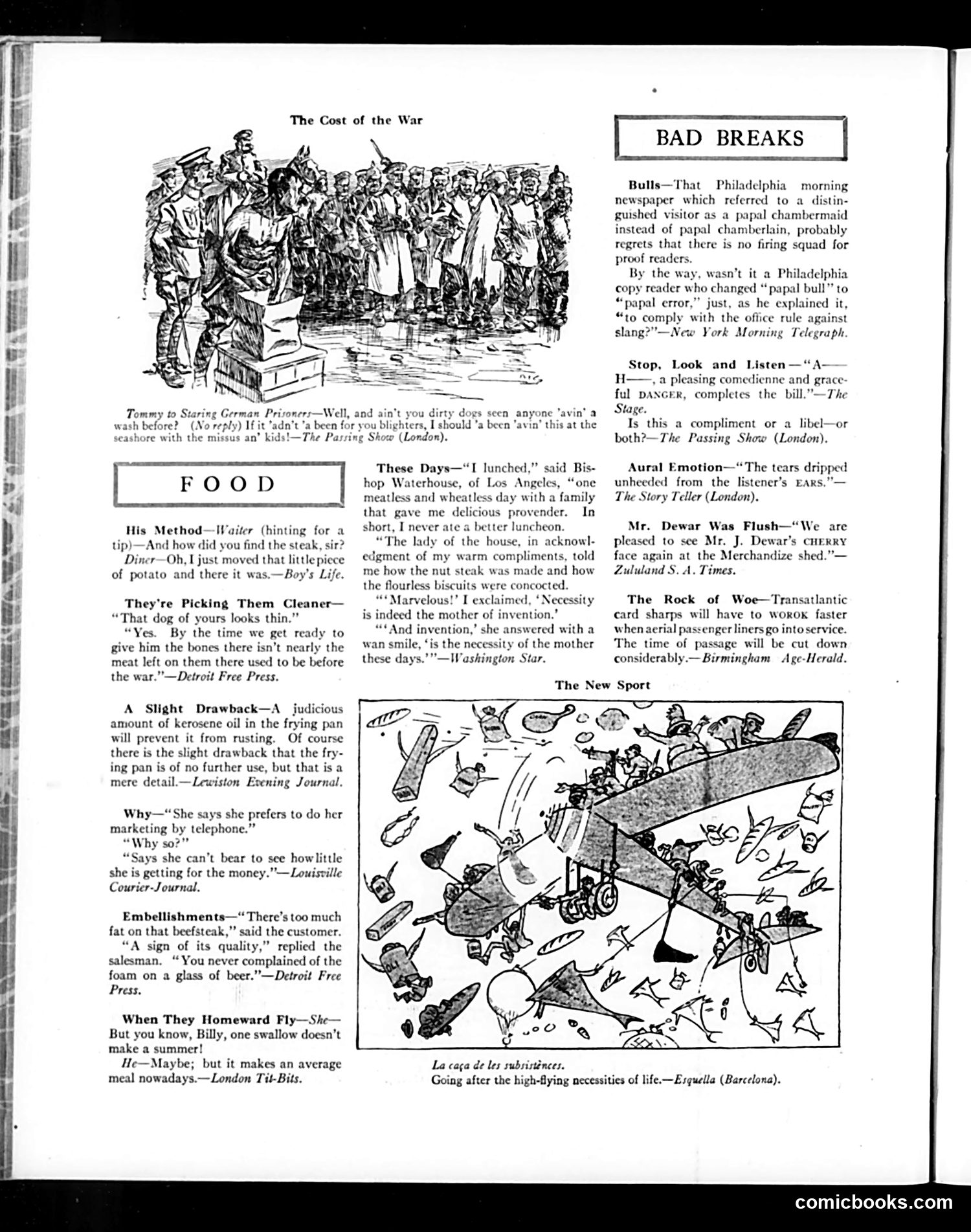
This page collects wartime humor (likely WWI era, given references to "meatless and wheatless days") focused on food shortages and rationing. The main cartoon depicts German prisoners witnessing Allied soldiers' meager rations—the ironic point being that even the victors are starving due to war's economic toll. The "BAD BREAKS" section ridicules newspaper errors, while the "FOOD" anecdotes mock wartime scarcity through jokes: a diner finds his steak by moving aside a tiny potato; a dog is so thin there's "no meat left on the bones"; kerosene ruins a frying pan but preserves it; people avoid shopping in person to hide how little food money buys; one swallow (food) becomes "an average meal." "The New Sport" cartoon shows figures harvesting necessities from wreckage—depicting civilians desperately scavenging amid wartime destruction. The humor darkly illustrates widespread deprivation affecting everyone, civilian and military alike.
📄 Transcribed text from this page (OCR, searchable)
Machine-transcribed from the original scan — historical spelling and the odd misread are preserved.
His Method—IWaiter (hinting for a tip)—And how did you find the steak, sir? Diner—Oh, I just moved that little pie of potato and there it was.—Boy's Life. They're Picking Them Cleaner— “That dog of yours looks thin.” “Yes. By the time we get ready to give him the bones there isn’t nearly the meat left on them there used to be before the war.” —Detroit Free Press. A Slight Drawback—A judicious amount of kerosene oil in the frying pan will prevent it from rusting. Of course there is the slight drawback that the fry- ing pan is of no further use, but that is a mere detail—Lewiston Evening Journal. Why—" She says she prefers to do her marketing by telephone.” “Why so?” “Says she can't bear to see howlittle she is getting for the money.”—Louisville Courier-Journal. Embellishments—* There's too much fat on that beefsteak,” said the customer. “A sign of its quality,” replied the salesman. “ You never complained of the foam on a glass of beer.”—Detroit Free Press. When They Homeward Fly—She— But you know, Billy, one swallow doesn’t make a summer! He—Maybe; but it makes an average meal nowadays.—London Tit-Bits. The Cost of the War to Staring German Prisoners—Well, and ain't you dirty dogs seen anyone ‘avin’ a (No reply) If it 'adn’t ‘a been for you b he missus an’ kids!—The Passing Sk ers, I should ’a been ‘avin’ this at the (London). These Days—‘“T lunched,” said Bis- hop Waterhouse, of Los Angeles, “one meatless and wheatless day with a family that gave me delicious provender. In short, I never ate a better luncheon. “The lady of the house, in acknowl- edgment of my warm compliments, told me how the nut steak was made and how the flourless biscuits were concocted. “* Marvelous!’ I exclaimed, ‘Necessity indeed the mother of invention.’ nd invention,’ she answered with a the necessity of the mother —Washington Star. is wan smile, ‘ these days.’ BAD BREAKS Bulls—That Philadelphia morning newspaper which referred to a distin- guished visitor as a papal chambermaid instead of papal chamberlain, probably regrets that there is no firing squad for proof readers. By the way, wasn’t it a Philadelphia copy reader who changed “papal bull” to “papal error,” just, as he explained it, “to comply with the office rule against slang?”—New York Morning Telegraph. Stop, Look and Listen —‘ A— H—, a pleasing comedienne and grace- ful DANGER, completes the bill.”—The Stage. Is this a compliment or a libel—or both?—The Passing Show (London), Aural Emotion—“ The tears dripped unheeded from the listener’s EARs.”— The Story Teller (London). Mr. Dewar Was Flush—“We are d to see Mr. J. Dewar’s CHERRY face again at the Merchandize shed.”"— Zululand S.A. Times. The Rock of Woe—Transatlantic card sharps will have to worox faster when acrial passenger liners go into service. The time of passage will be cut down considerably.—Birmingham Age-Herald. The New Sport La caca de les subsistinces. Going after the high-flying necessities of life. —Esquella (Barcelona). comicbooks.com