
Judge, 1918-08-24 · page 5 of 32
Judge — August 24, 1918 — page 5: what you’re looking at
What you’re looking at
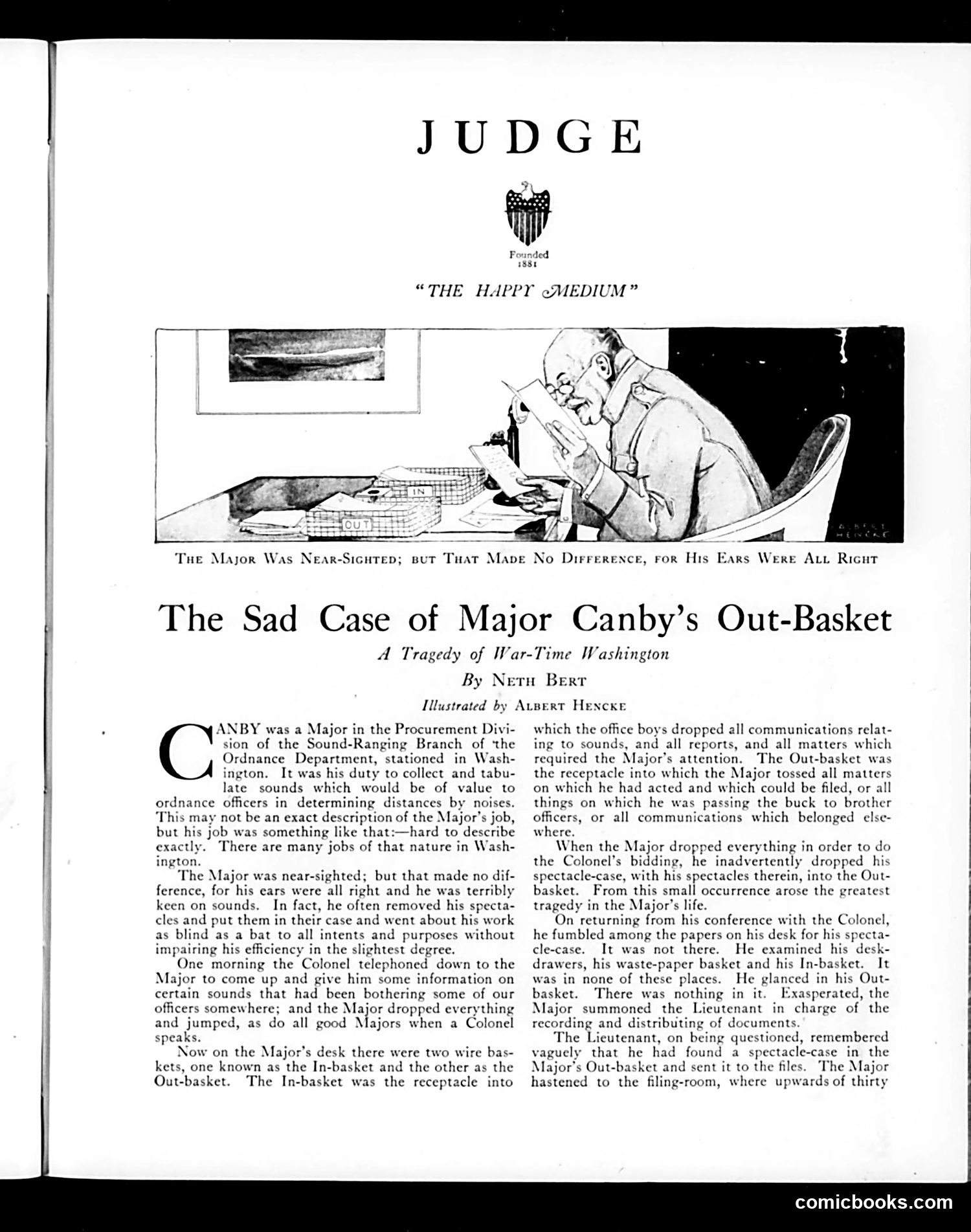
This is a humorous story by Neth Bert (illustrated by Albert Hencke) satirizing **wartime Washington bureaucracy during World War I**. The narrative mocks the absurdity of military procurement procedures through Major Canby, a near-sighted officer in the Ordnance Department tasked with evaluating sound distances. The joke centers on Canby's catastrophic loss of his spectacles—accidentally dropped into his office "Out-basket" (outgoing documents tray). His subsequent frantic search through filing rooms and the cascade of confusion this creates illustrates the ridiculousness of military red tape and inefficiency during wartime. The satire targets bloated government bureaucracy, the chaos of wartime administration, and how small mishaps create disproportionate institutional mayhem.
📄 Transcribed text from this page (OCR, searchable)
Machine-transcribed from the original scan — historical spelling and the odd misread are preserved.
JUDGE Tue Major Was Near-Sicutep; put Tuat Mape No Dirrerence, ror His Ears Were Att Ricut The Sad Case of Major Canby’s Out-Basket A Tragedy of War-Time Washington By Netu Berr Illustrated by Avsert HencKe ANBY was a Major in the Procurement Divi- sion of the Sound-Ranging Branch of ‘the Ordnance Department, stationed in Wash- ington. It was his duty to collect and tabu- late sounds which would be of value to ordnance officers in determining distances by noises. ‘This may not be an exact description of the Major's job, but his job was something like that:—hard to describe exactly. There are many jobs of that nature in Wash- ington. The Major was near-sighted; but that made no dif- ference, for his ears were all right and he was terribly keen on sounds. In fact, he often removed his specta- cles and put them in their case and went about his work as blind as a bat to all intents and purposes without impairing his efficiency in the slightest degree. One morning the Colonel telephoned down to the Major to come up and give him some information on certain sounds that had been bothering some of our officers somewhere; and the Major dropped everything and jumped, as do all good Majors when a Colonel speaks. Now on the Major’s desk there were two wire bas- kets, one known as the In-basket and the other as the Out-basket. The In-basket was the receptacle into which the office boys dropped all communications relat- ing to sounds, and all reports, and all matters which required the Major’s attention. The Out-basket was the receptacle into which the Major tossed all matters on which he had acted and which could be filed, or all things on which he was passing the buck to brother officers, or all communications which belonged else- where. When the Major dropped everything in order to do the Colonel’s bidding, he inadvertently dropped _his spectacle-case, with his spectacles therein, into the Out- basket. From this small occurrence arose the greatest tragedy in the Major’s life. On returning from his conference with the Colonel, he fumbled among the papers on his desk for his specta- cle-case. It was not there. He examined his desk- drawers, his waste-paper basket and his In-basket. It was in none of these places. He glanced in his Out- basket. There was nothing in it. Exasperated, the Major summoned the Lieutenant in charge of the recording and distributing of documents. The Lieutenant, on being questioned, remembered vaguely that he had found a spectacle-case in the Major’s Out-basket and sent it to the files. The Major hastened to the filing-room, where upwards of thirty comicbooks.com