
Judge, 1918-08-24 · page 7 of 32
Judge — August 24, 1918 — page 7: what you’re looking at
What you’re looking at
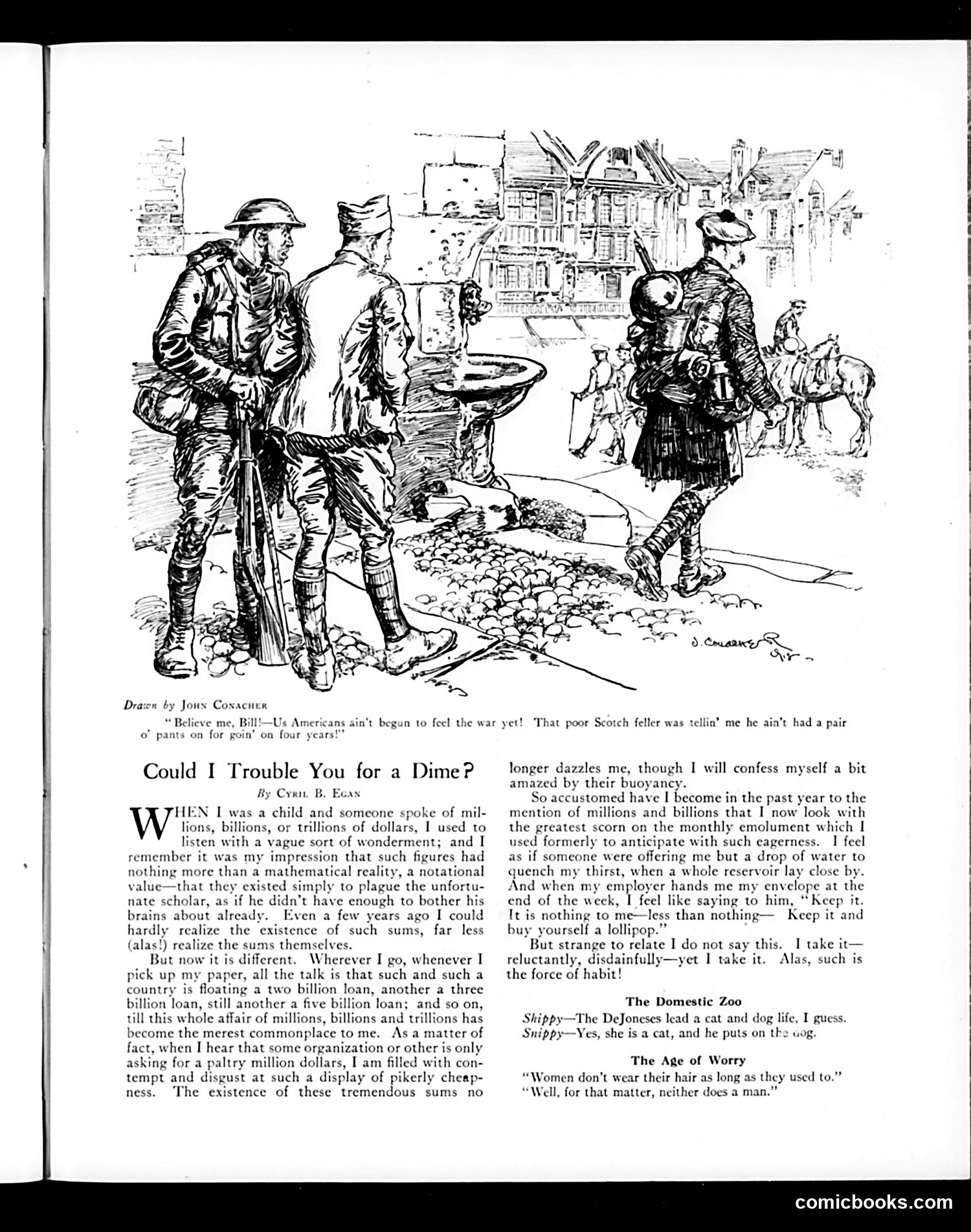
The top illustration by John Coxacher depicts World War I soldiers in a European town. The caption's dialogue—one soldier remarking that Americans "ain't begun to feel the war yet" while a Scottish soldier complains about lacking pants for four years—contrasts American inexperience with European suffering during the war. The accompanying article by Cyril B. Egan satirizes how wartime has normalized astronomical government spending (billions and trillions in loans). The author describes becoming so accustomed to massive war expenditures that his regular monthly salary now seems contemptibly insignificant—a "drop of water." The satire critiques how inflation and war financing have distorted civilian perception of money's value, making ordinary wages feel worthless despite their actual necessity for survival.
📄 Transcribed text from this page (OCR, searchable)
Machine-transcribed from the original scan — historical spelling and the odd misread are preserved.
WN NY Draien by Joux Coxacuer o” pants in’ "on four years! Could I Trouble You for a Dime? By Cyr B. Ecax HEN I was a child and someone spoke of mil- W lions, billions, or trillions of dollars, I used to listen with a vague sort of wonderment; and I remember it was my impression that such figures had nothing more than a mathematical reality, a notational value—that they existed simply to plague the unfortu- nate scholar, as if he didn’t have enough to bother his brains about already. Even a few years ago I could hardly realize the existence of such sums, far less (alas!) realize the sums themselves. But now it is different. Wherever I go, whenever I pick up my paper, all the talk is that such and such a country is floating a two billion loan, another a three billion loan, still another a five billion loan; and so on, till this whole affair of millions, billions and trillions has become the merest commonplace to me. As a matter of fact, when I hear that some organization or other is only asking for a paltry million dollars, I am filled with con- tempt and disgust at such a display of pikerly cheap- ness. ‘The existence of these tremendous sums no ¢, Bill!—Us Americans ain't begun to feel the war yet! That poor Scotch feller was tellin’ me he ain’t had a pair longer dazzles me, though I will confess myself a bit amazed by their buoyancy. So accustomed have I become in the past year to the mention of millions and billions that I now look with the greatest scorn on the monthly emolument which | used formerly to anticipate with such cagerness. I feel as if someone were offering me but a drop of v quench my thirst, when a whole reservoir lay And when my employer hands me my envelope at the end of the week, I feel like saying to him, “Keep it. It is nothing to me—less than nothing— Keep it and buy yourself a lollipop.” But strange to relate I do not say this. I take it— reluctantly, disdainfully—yet I take it. Alas, such is the force of habit! The Domestic Zoo Shippy—The DeJoneses lead a cat and dog life, I guess. Snippy—Yes, she is a cat, and he puts on the wog. The Age of Worry “Women don’t wear their hair as long as they used to.” “Well, for that matter, neither does a man.” comicbooks.com