
Judge, 1918-08-24 · page 22 of 32
Judge — August 24, 1918 — page 22: what you’re looking at
What you’re looking at
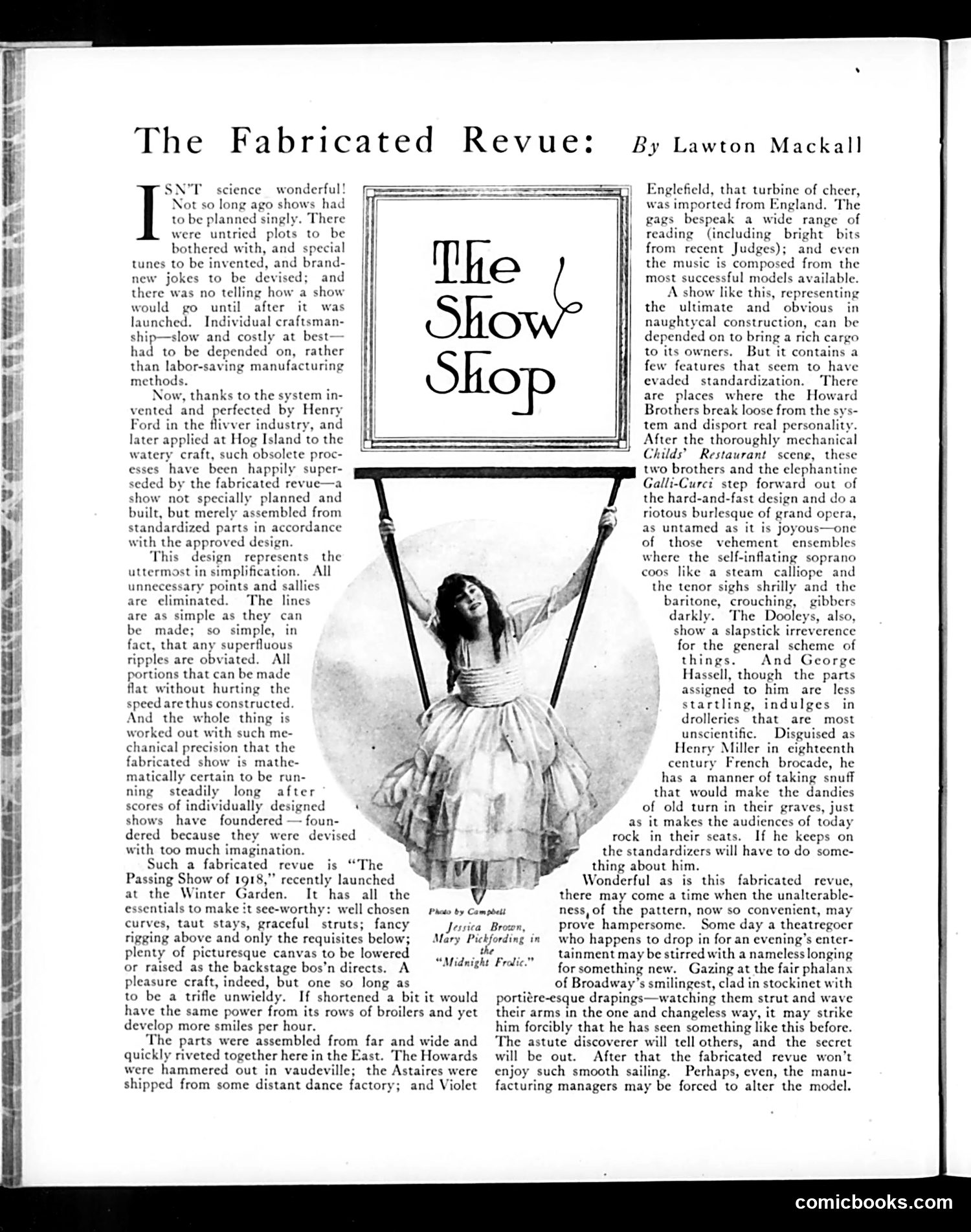
This article satirizes the application of Henry Ford's assembly-line manufacturing methods to Broadway theatrical production. The text describes "The Passing Show of 1918"—a revue constructed from standardized, interchangeable parts: pre-made gags, recycled music, stock performers (the Howards, the Astaires), and simplified staging. The satire's point: while efficiency creates predictable commercial success, it deadens artistic vitality. Mackall notes that some performers—Jessica Brown, George Hassell, and the Dooleys—occasionally "break loose" and inject genuine personality, suggesting authentic talent still struggles against mechanical standardization. The accompanying illustration of a woman on a swing epitomizes this: a mass-produced theatrical "product," aesthetically pleasing but fundamentally interchangeable. The satire critiques how Broadway's commercialization prioritizes profit and predictability over creativity and individual artistry.
📄 Transcribed text from this page (OCR, searchable)
Machine-transcribed from the original scan — historical spelling and the odd misread are preserved.
T science wonderful! Not so long ago shows had to be planned singly. There were untried plots to be " bothered with, and special tunes to be invented, and brand- new jokes to be devised; and there was no telling how a show would go until after it was launched. Individual craftsman- ship—slow and costly at best- had to be depended on, rather than labor-saving manufacturing methods. Now, thanks to the system in- vented and perfected by Henry Ford in the flivver industry, and The Fabricated Revue: By Lawton Mackall Englefield, that turbine of cheer, was imported from England. The gags bespeak a wide range of reading (including bright bits from recent Judges); and even the music is composed from the most successful models available. A show like this, representing the ultimate and obvious in naughtycal construction, can be depended on to bring a rich cargo to its owners. But it contains a few features that seem to have evaded standardization. There are places where the Howard Brothers break loose from the sys- tem and disport real personality. later applied at Hog Island to the watery craft, such obsolete proc- esses have been happily super- seded by the fabricated revue—a show not specially planned and built, but merely assembled from standardized parts in accordance with the approved des This design represents the uttermost in simplification. All unnecessary points and sallies are eliminated. The lines are as simple as they can be made; so simple, in fact, that any superfluous ripples are obviated. All portions that can be made flat without hurting the speed are thus constructed. And the whole thing is worked out with such me- chanical precision that the fabricated show is mathe- matically certain to be run- ning steadily long after scores of individually designed shows have foundered — foun- dered because they were devised with too much imagination. Such a fabricated revue is “The Passing Show of 1918,” recently launched Ls SSS rigging above and only the requisites below; plenty of picturesque canvas to be lowered or raised as the backstage bos’n directs. A pleasure craft, indeed, but one so long as to be a trifle unwieldy. If shortened a bit it would have the same power from its rows of broilers and yet develop more smiles per hour. The parts were assembled from far and wide and quickly riveted together here in the East. The Howards were hammered out in vaudeville; the Astaires were shipped from some distant dance factory; and Violet ——<. = at the Winter Garden. It has all the essentials to make it see-worthy: well chosen Pacts by Campbett curves, taut sta graceful struts; fancy Jessica Brown, Mary Pickfording in th the “Midnight Frolic.” After the thoroughly mechanical Childs’ Restaurant sceng, these two brothers and the elephantine Galli-Curci step forward out of the hard-and-fast design and doa riotous burlesque of grand opera, as untamed as it is joyous—one of those vehement ensembles where the self-inflating soprano coos like a steam calliope and the tenor sighs shrilly and the baritone, crouching, gibbers darkly. The Dooleys, als show a slapstick irreveren: for the general scheme of . And George Il, though the parts assigned to him are les startling, indulges in drolleries that are most unscientific. Disguised as Henry Miller in eighteenth century French brocade, he has a manner of taking snuff that would make the dandies of old turn in their graves, just as it makes the audiences of today rock in their seats. If he keeps on the standardizers will have to do some- thing about him. Wonderful as is this fabricated revue, there may come a time when the unalterable- ness, of the pattern, now so convenient, may prove hampersome. Some day a theatregoer who happens to drop in for an evening's enter- tainment may be stirred with a nameless longing for something new. Gazing at the fair phalanx of Broadway’s smilingest, clad in stockinet with portitre-esque drapings—watching them strut and wave their arms in the one and changeless way, it may strike him forcibly that he has seen something like this before. The astute discoverer will tell others, and the secret will be out. After that the fabricated revue won’t enjoy such smooth sailing. Perhaps, even, the manu- facturing managers may be forced to alter the model. comicbooks.com