
Judge, 1918-08-24 · page 8 of 32
Judge — August 24, 1918 — page 8: what you’re looking at
What you’re looking at
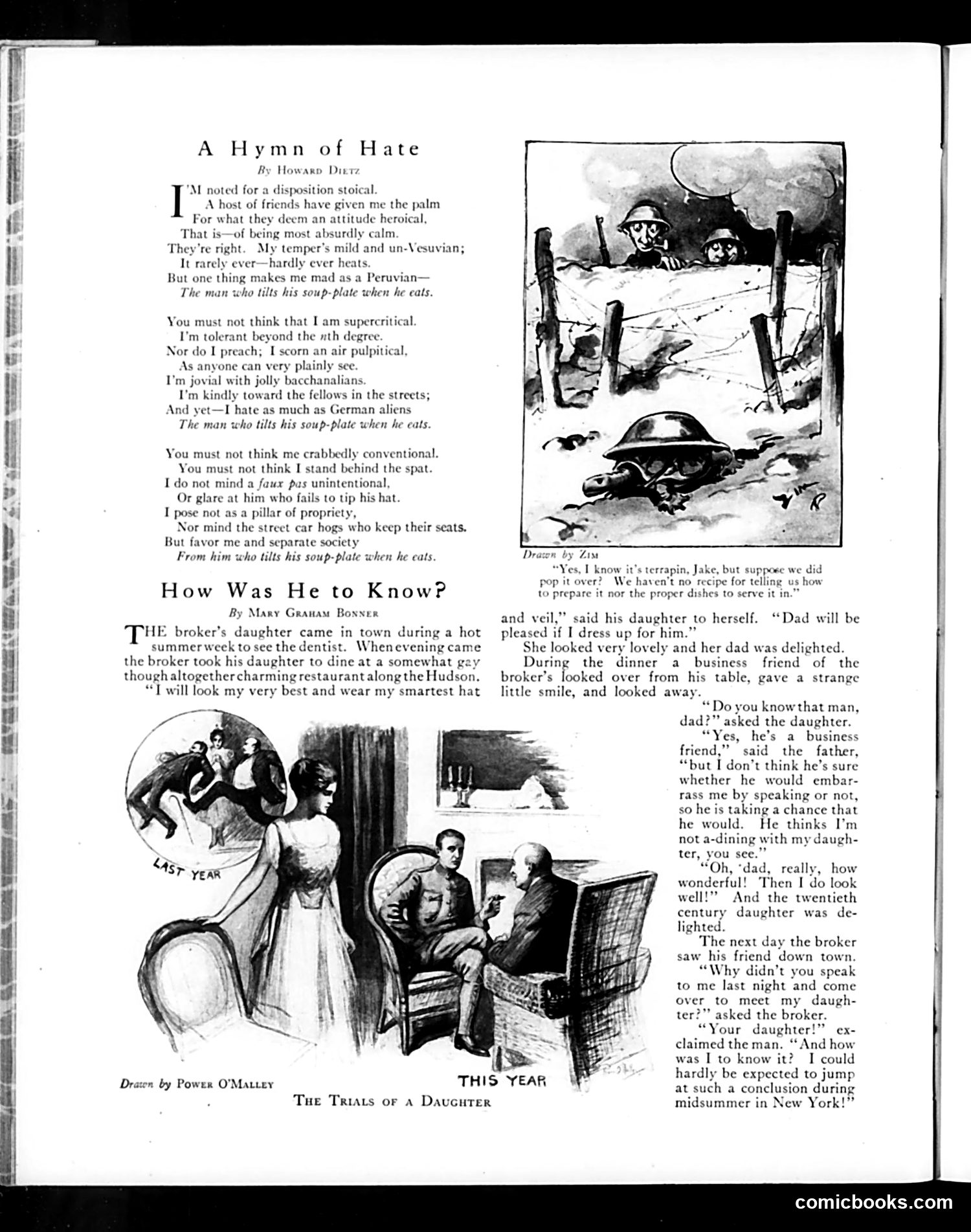
**"A Hymn of Hate"** is a humorous complaint poem by Howard Dietz mocking obsessive etiquette-consciousness. The speaker claims tolerance and calm temperament but repeatedly excepts one pet peeve: men who tilt their soup plates while eating. The satire targets stuffy Victorian social conventions—the poem exaggerates how trivial table manners become objects of intense moral judgment among the genteel classes. It's poking fun at people who pride themselves on sophistication while fixating on minor behaviors. **"How Was He to Know?"** by Mary Graham Bonner is a short comic story about a broker dining with his well-dressed daughter at a Hudson River restaurant. A business acquaintance sees them but doesn't approach, fearing to presume their relationship. The joke: in summer 1920s New York, a man and woman dining together could plausibly be assumed to be on a date rather than father and daughter—so the friend's polite distance ironically disappoints the daughter, who'd dressed up hoping to impress her father.
📄 Transcribed text from this page (OCR, searchable)
Machine-transcribed from the original scan — historical spelling and the odd misread are preserved.
S=se ) ii GMmeat.. | SSS Ves ee A Hymn of Hate Ry Howarn Ditrz 'M noted for a disposition stoical I A host of friends have given me the palm For what they deem an attitude heroical, That is—of being most absurdly calm They're right. My temper’s mild and un-Vesuvian; It rarely ever—hardly ever heats. But one thing makes me mad as a Peruvian— The man who tilts his soup-plate when he eats. You must not think that I am supercritical. I'm tolerant beyond the nth degree. Nor do I preach; I scorn an air pulpitical, As anyone can very plainly see. I'm jovial with jolly bacchanalians I'm kindly toward the fellows in the streets; And yet—I hate as much as German aliens The man who tilts his soup-plate when he eats. You must not think me crabbedly conventional. You must not think I stand behind the spat. I do not mind a faux pas unintentional, Or glare at him who fails to tip his hat. I pose not as a pillar of propriety, Nor mind the street car hogs who keep their seats. But favor me and separate society From him who tilts his soup-plate when he eats. How Was He to KnowP By Mary Grauam Bonner HE broker's daughter came in town during a hot summer week to see the dentist. Whenevening came the broker took his daughter to dine at a somewhat gay though altogethercharming restaurant along the Hudson, “T will look my very best and wear my smartest hat Dr. by Power O'Mattey Tue Triats or a Daucuter [> THIS YEAR es, 1 know rapin, Jake, but suppose we did pop it over? We haven't no recipe for telling us how to prepare it nor the proper dishes to serve it in.” and veil,” said his daughter to herself. “Dad will be pleased if I dress up for him.” She looked very lovely and her dad was delighted. During the dinner a business friend of the broker’s looked over from his table, gave a strange little smile, and looked away. “Do you know that man, dad?” asked the daughter. “Yes, he’s a business friend,” said the father, “but I don’t think he’s sure whether he would embar- rass me by speaking or not, so he is taking a chance that he would. He thinks I’m not a-dining with my daugh- ter, you see.” “Oh, ‘dad, really, how wonderful! Then I do look well!” And the twentieth century daughter was de- lighted. The next day the broker saw his friend down town. “Why didn’t you speak to me last night and come over to meet my daugh- ter?” asked the broker. “Your daughter!” ex- claimed the man. ‘And how was I to know it? I could hardly be expected to jump at such a conclusion durin: midsummer in New York See Oe comicbooks.com