
A complete issue · 37 pages · 1918
Judge — June 29, 1918
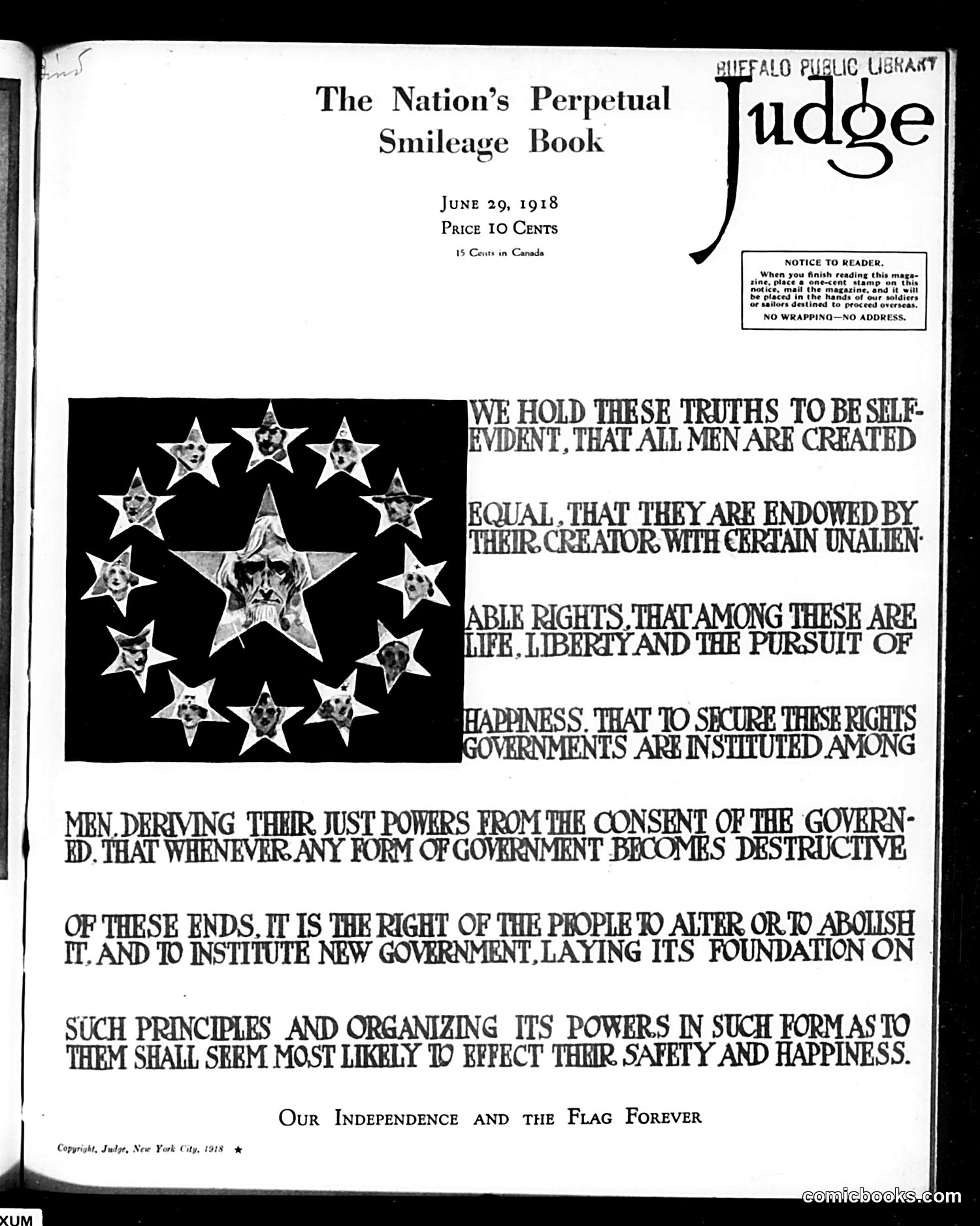
This June 29, 1918 page from Judge magazine features the opening lines of the Declaration of Independence prominently displayed around a central star illustration containing thirteen smaller stars (representing the original states). The layout appears patriotic rather than satirical—it reprints the famous "We hold these truths to be self-evident..." passage about unalienable rights and governmental legitimacy. The caption reads "Our Independence and the Flag Forever." Given the 1918 date (during World War I's final months), this likely served as a patriotic affirmation of American democratic principles, possibly boosting wartime morale or responding to political debates about America's war aims. The presentation emphasizes foundational American ideals rather than mocking any particular figure or policy. The page functions as inspirational content rather than satire.
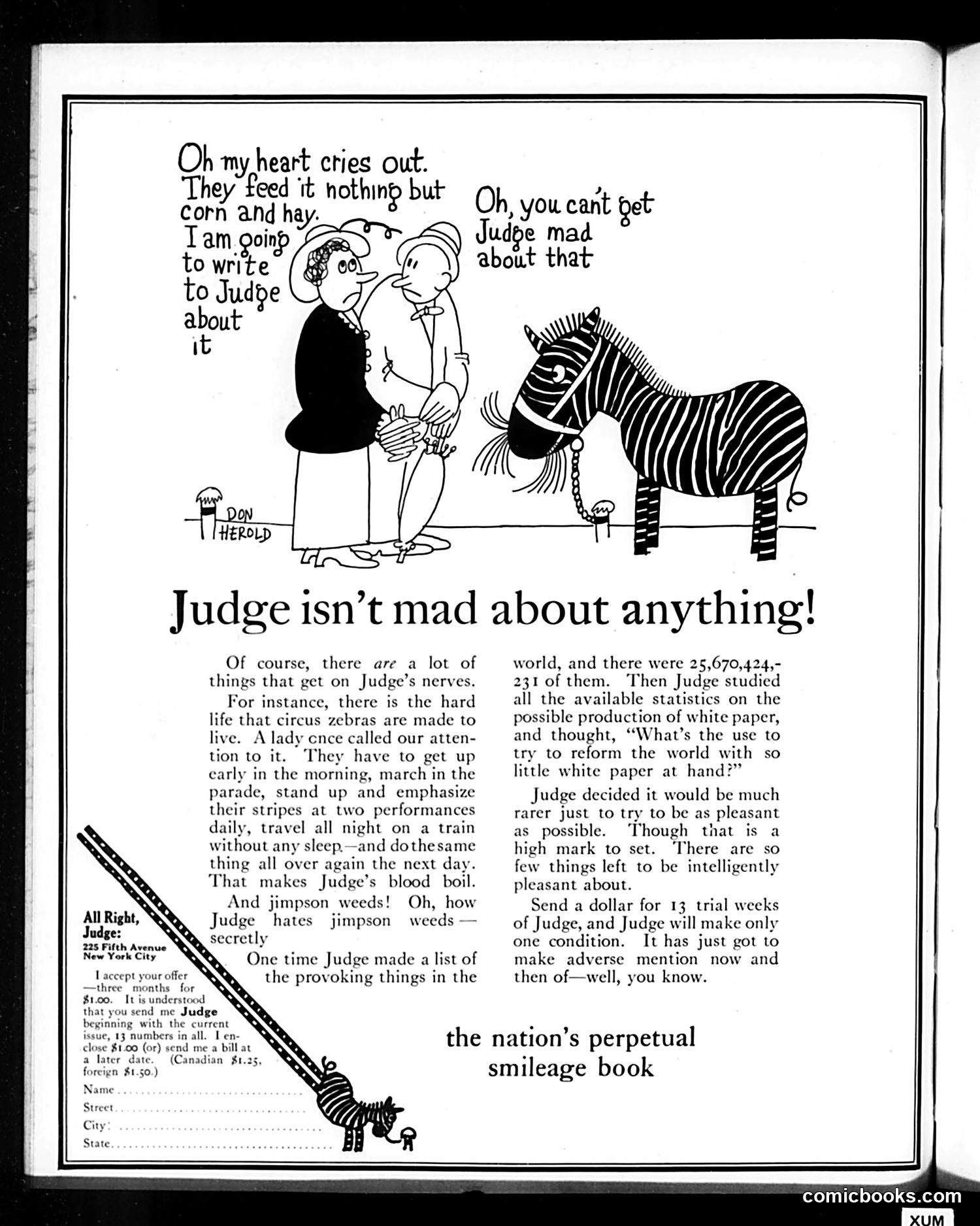
This is a **Judge magazine advertisement** for a recurring humor column called "Judge," described as "the nation's perpetual smileage book." The cartoon depicts a woman complaining to a man about her horse being fed only corn and hay, threatening to write to "Judge" about it. The man dismissively responds that "you can't get Judge mad about anything." The ad's point: Judge magazine takes a deliberately **detached, good-humored stance** on current events. Rather than crusading for reform, Judge's philosophy (explained in the text) is to remain pleasant and avoid serious commentary—treating problems with lighthearted satire instead. The ad humorously suggests Judge won't rage against injustice, only gently mock it. This reflects Judge's actual editorial approach as a satirical magazine focused on gentle humor over hard-hitting political critique.
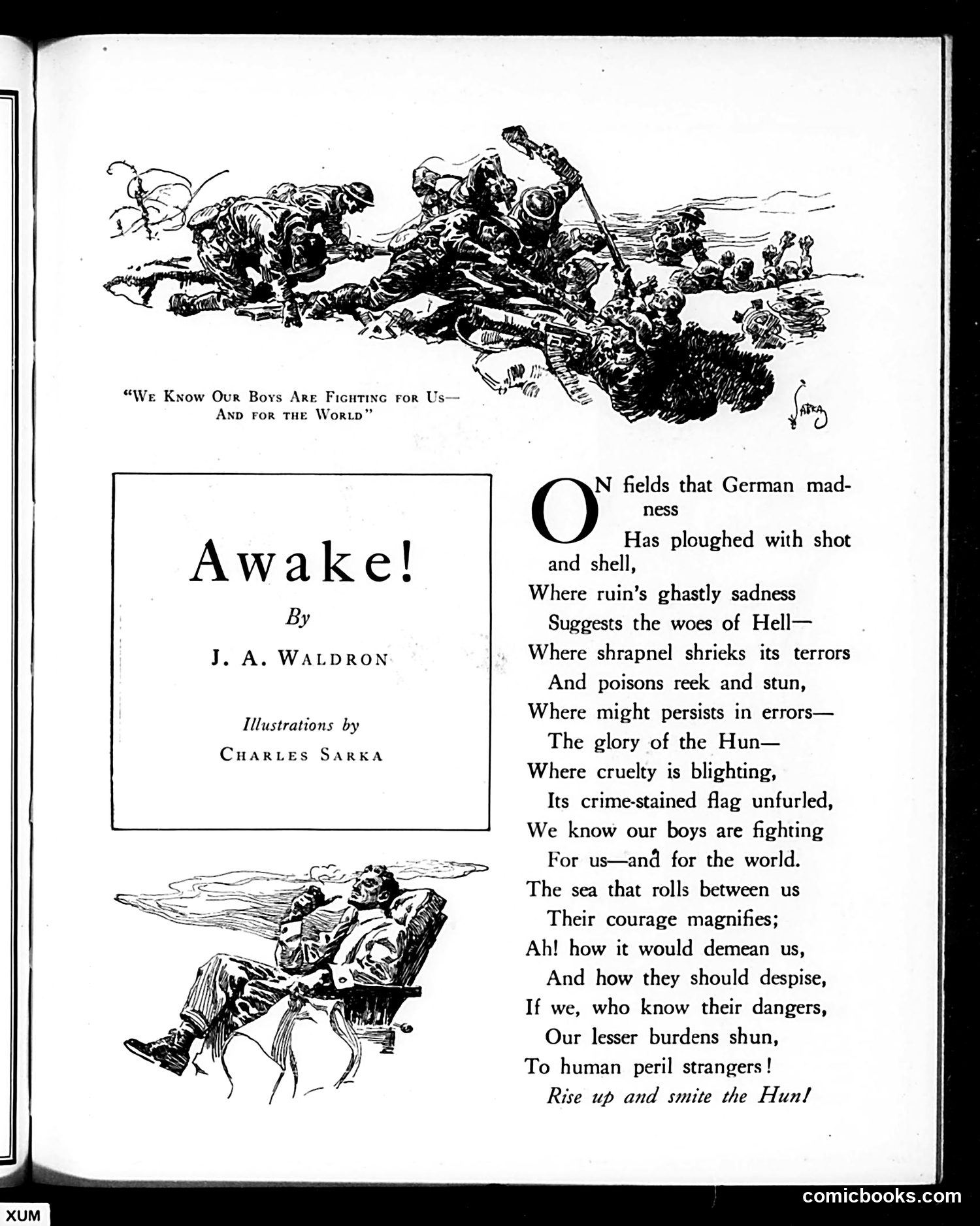
This is **World War I propaganda poetry** illustrated by Charles Sarka. The piece appeals to American home-front readers to support the war effort, likely published when the U.S. was considering or had recently entered the conflict (1917-1918). The **top illustration depicts battlefield carnage**—soldiers fallen among devastation. The **bottom illustration shows two figures resting**, possibly representing weary soldiers or home-front citizens. The poem argues that American soldiers fighting in Europe face horrors ("German madness," "shrapnel shrieks") so that civilians at home need not. It shames those remaining passive, urging them to "Rise up and smite the Hun!"—using dehumanizing language for Germans common in WWI propaganda. The message: Americans must actively support the war effort to honor soldiers' sacrifices.
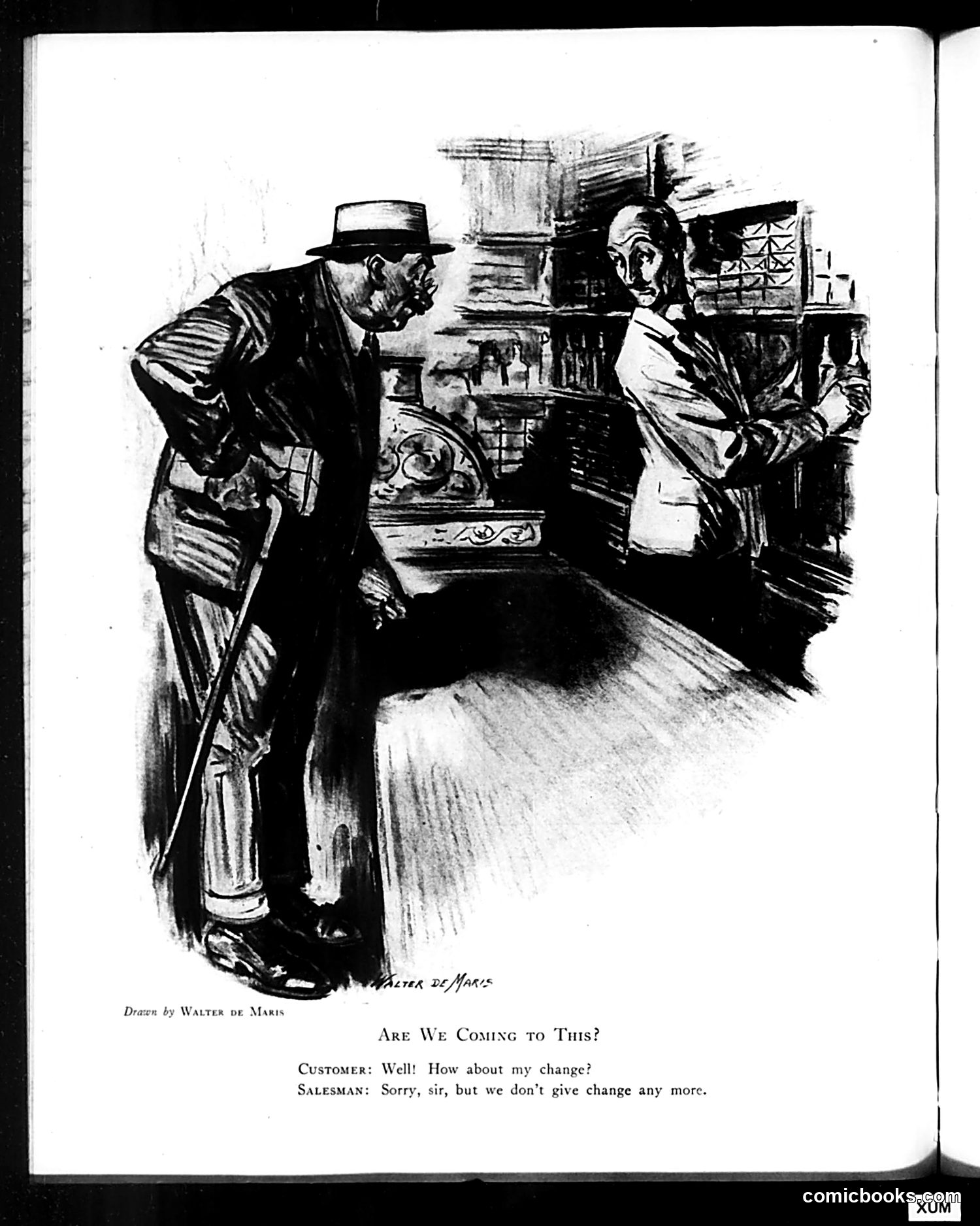
This cartoon by Walter de Maris satirizes the elimination of retail change-making. The scenario shows a customer asking a salesman for change, only to be told "Sorry, sir, but we don't give change any more." The title's question—"Are We Coming to This?"—suggests this was a satirical warning about a potential future practice. The cartoon critiques what would have been a controversial retail policy: refusing to return change to customers, presumably keeping it as profit or encouraging exact-payment purchases only. The drawing's style and the magazine's satirical nature indicate this was meant as social commentary on emerging retail practices that readers would have found absurd or objectionable. The cartoon warns against normalized customer exploitation disguised as business convenience.
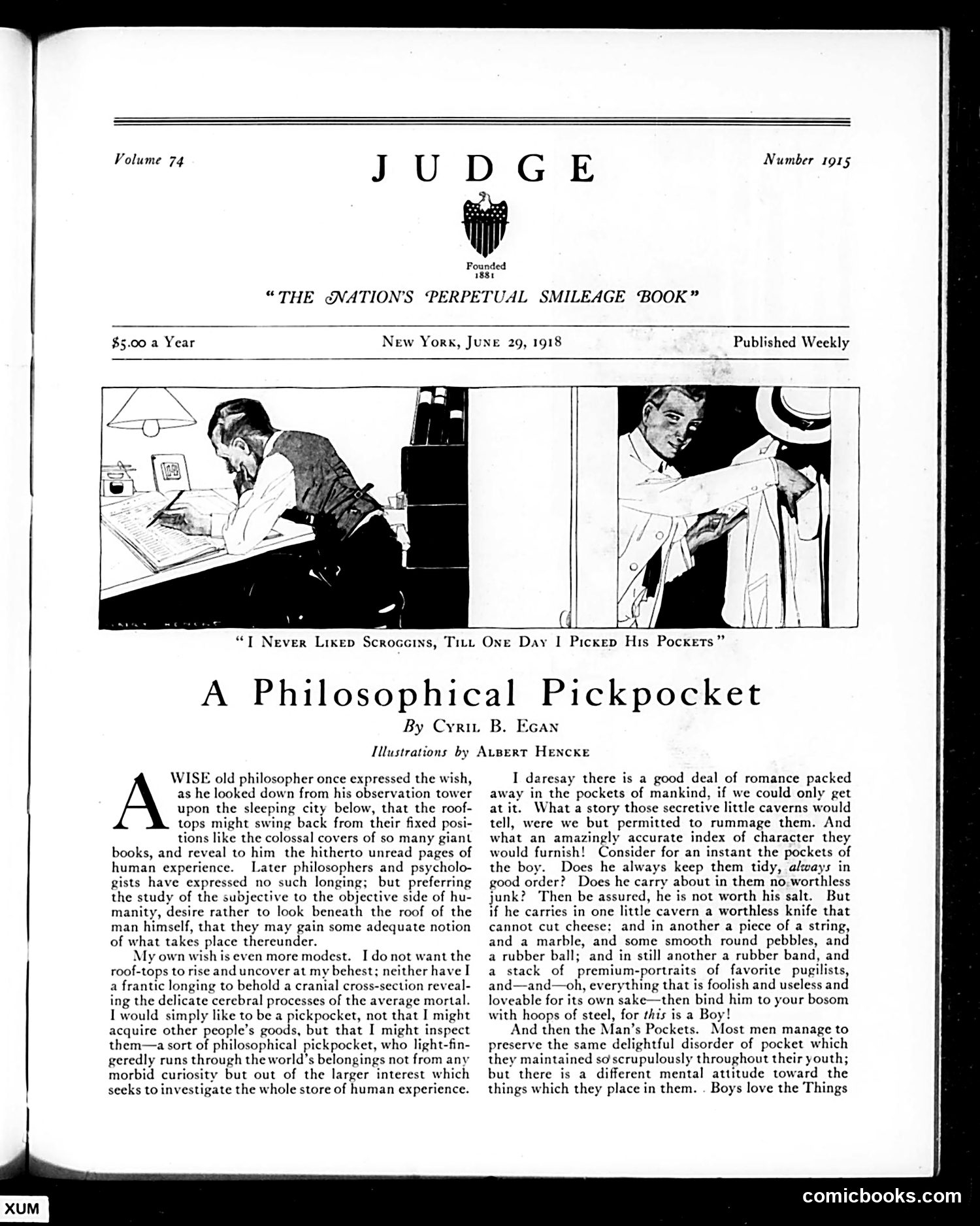
This satirical piece by Cyril B. Egan uses a pickpocket as a metaphor for human curiosity and character study. The accompanying illustrations show a man at a desk (appearing to be observing/studying) and another examining clothing. The text argues that a pickpocket's interest in people's belongings parallels a philosopher's interest in human nature. Egan suggests that examining what people carry—their pockets' contents—reveals character: whether items are organized, what trinkets they keep. He contrasts boys' sentimental attachment to pocket contents with men's more casual approach. The satire seems to mock both philosophical pretension and the voyeuristic impulse to judge others by their possessions, suggesting that such "character analysis" is fundamentally invasive, like pickpocketing itself.
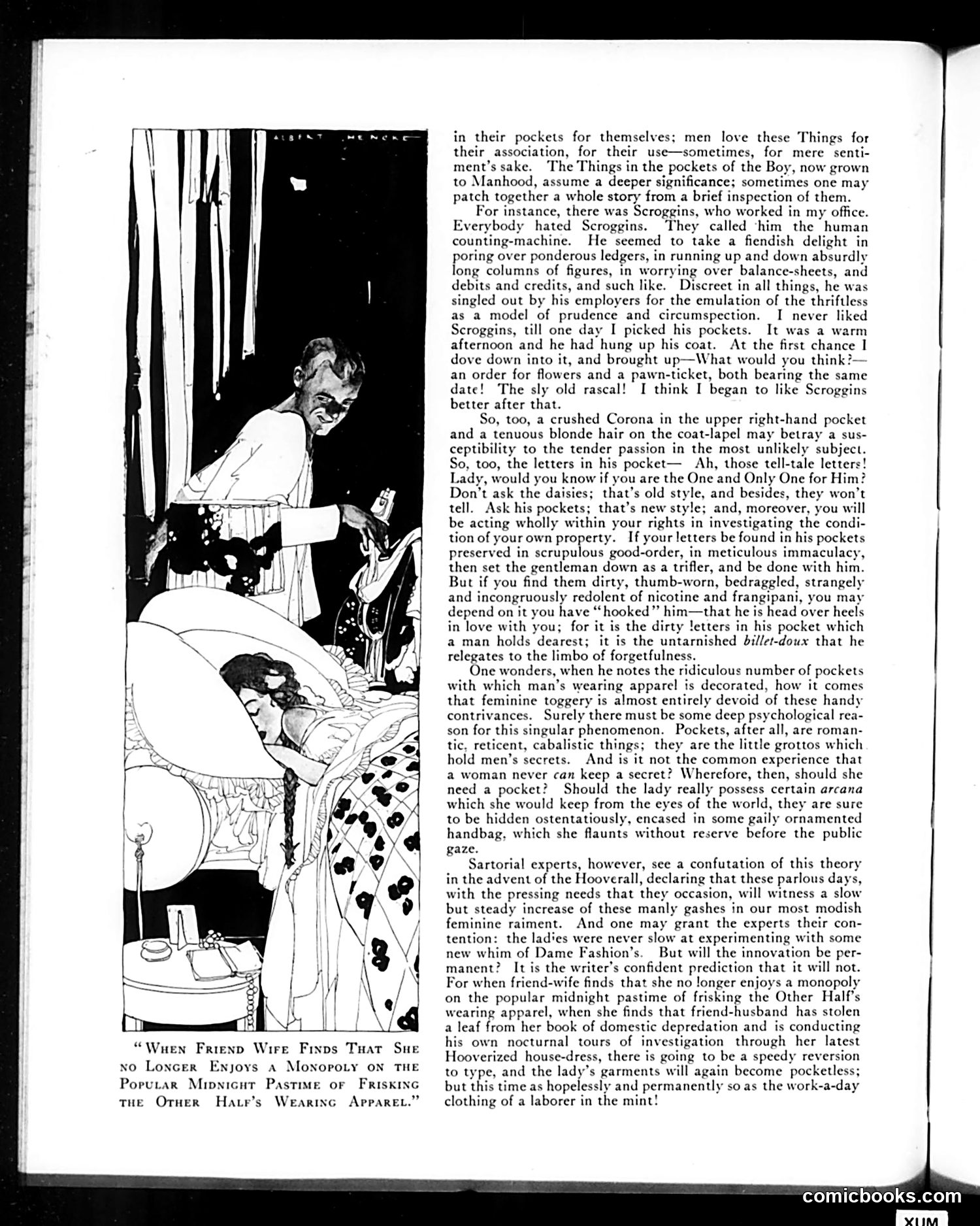
This page satirizes **women's fashion and social behavior** rather than politics. The illustrated narrative concerns a husband discovering his wife's infidelity through examining objects in her pockets—a humorous reversal of the essay's opening premise that men (not women) traditionally carry tell-tale items. The accompanying text discusses **pockets as repositories of secrets**, arguing that women lack pockets in their clothing, therefore cannot hide personal evidence. The satire suggests that if women *had* pockets like men, they too would keep incriminating items—love letters, theater tickets, etc.—exposing their romantic indiscretions. The cartoon depicts this discovery scene: a man examining his sleeping wife's belongings, finding damning evidence of infidelity. The humor targets both female fashion's impracticality and assumptions about gendered morality and secrecy.
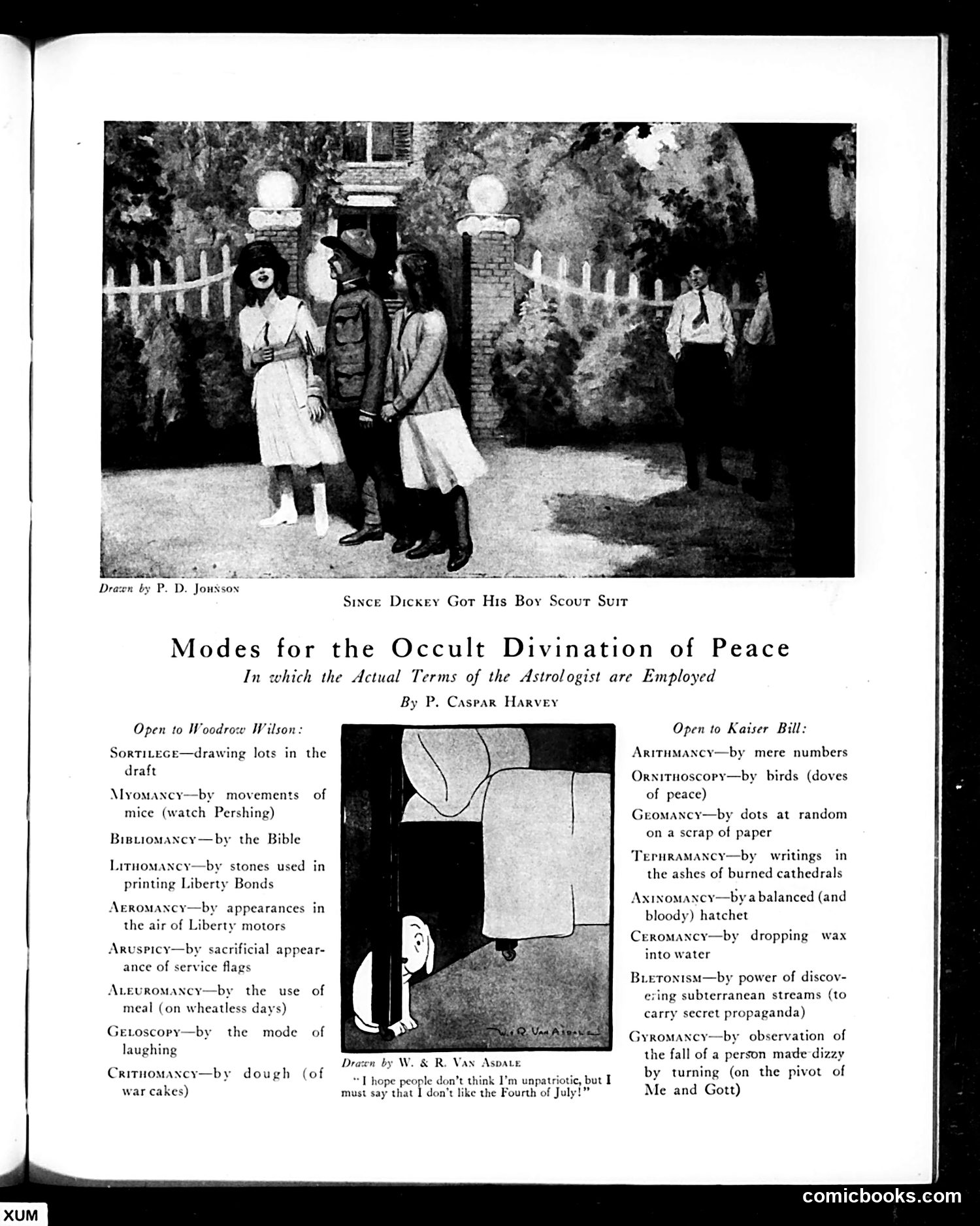
This satirical piece mocks both President Woodrow Wilson and Kaiser Bill's supposed methods for achieving peace during World War I. The cartoon lists absurd "divination" techniques (fortune-telling methods) attributed to each leader, sarcastically suggesting their peace efforts are equally ridiculous and magical thinking. Wilson's methods reference American war efforts: "myomancy" (watching mice) alludes to General Pershing's military campaigns; "lithomancy" and "aeromancy" reference Liberty Bonds and Liberty motors—patriotic fundraising initiatives. The Kaiser's methods mock German desperation, including dark references to "burned cathedrals" and "secret propaganda." The accompanying illustration shows someone expressing unpatriotic sentiment about the Fourth of July—critiquing those who question American war commitment. The satire suggests both leaders' peace negotiations are futile and that questioning the war effort is suspect.
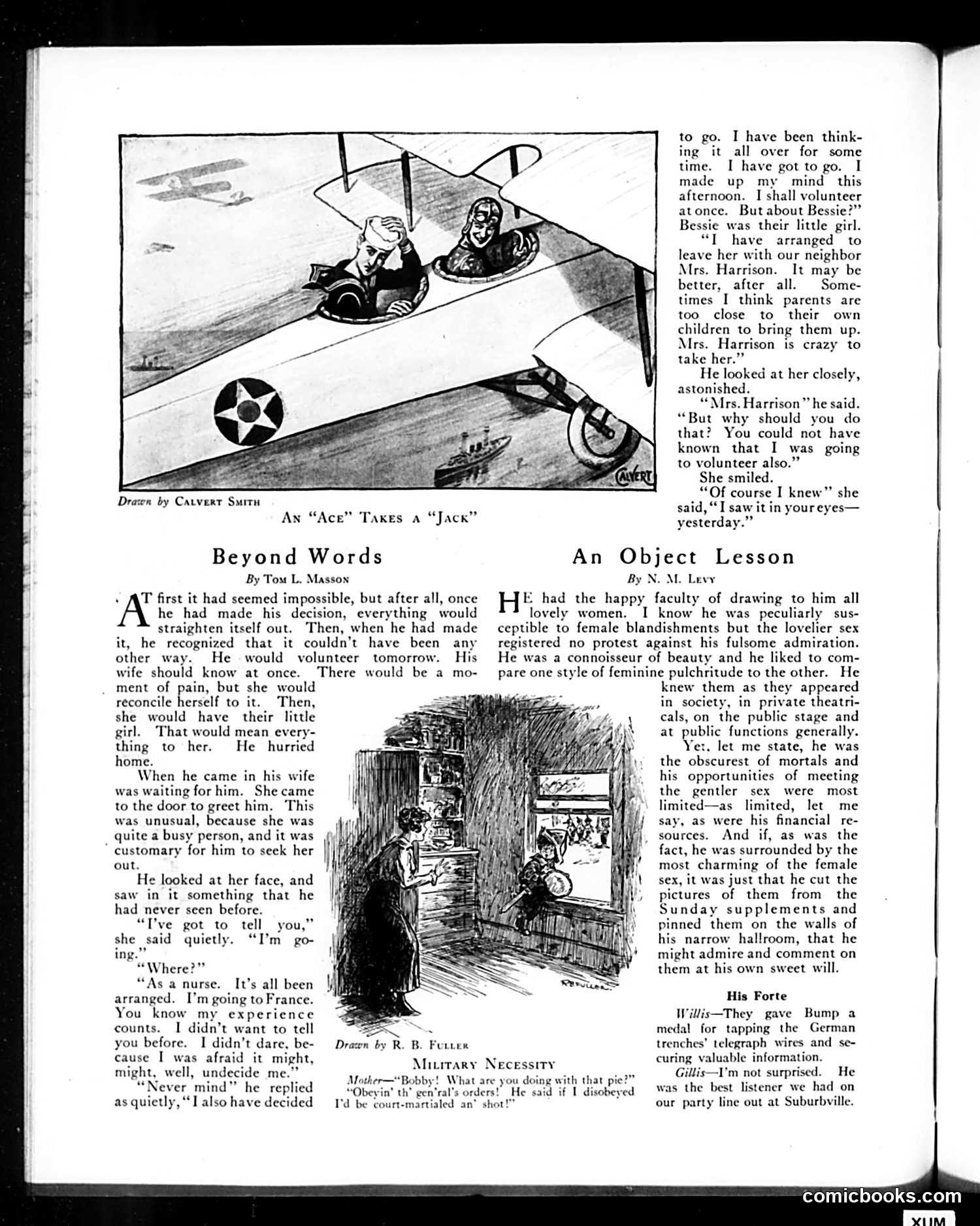
This Judge magazine page contains three pieces reflecting World War I-era American concerns: **"An Ace Takes a Jack"** (top cartoon): Military aviation terminology—an "ace" pilot and a "jack" (likely a junior officer or enlisted man). The sketch shows an aircraft, referencing the then-novel aerial warfare that fascinated the public. **"Beyond Words"** (left story): Depicts a husband and wife who separately decide to volunteer for WWI service—he as a soldier, she as a nurse in France. Their mutual sacrifice and the poignancy of leaving their daughter reflect how the war affected American families and the era's gender expectations (women could serve as nurses). **"An Object Lesson"** and **"Military Necessity"** (right): The first mocks a man who admires women only through Sunday newspaper pictures pinned in his room, too poor or obscure to meet real women. The second shows a child disciplined by invoking military consequences, satirizing how war rhetoric permeated civilian life. The page reflects WWI's cultural dominance in American public discourse circa 1917-1918.
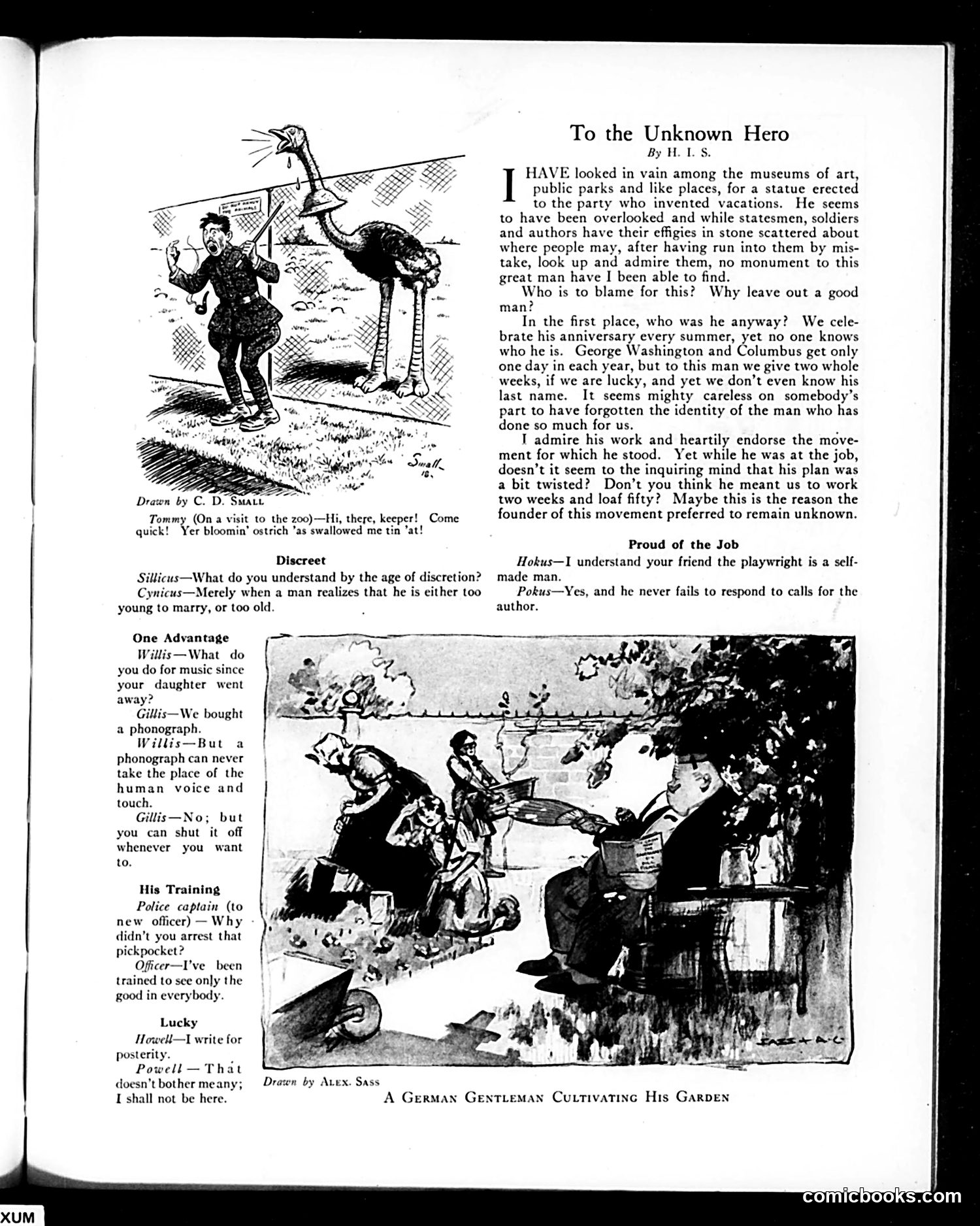
This page contains several brief satirical pieces typical of early 20th-century American humor: **"To the Unknown Hero"** mocks the inventor of vacations—a social commentary suggesting Americans celebrate vacations (two weeks annually) more generously than historical figures like Washington or Columbus (one day each), yet don't even know the vacation inventor's name. The satire questions whether the inventor truly intended workers to "loaf fifty" percent of the time. **The cartoons** include: - A child at a zoo whose tin hat was swallowed by an ostrich (simple slapstick) - "A German Gentleman Cultivating His Garden" (drawn by Alex Sass)—likely a WWI-era jab at German culture, though details are unclear **Brief jokes** mock discretion, phonographs replacing human interaction, a police officer's excessive morality, and a writer's ironic claims of writing "for posterity." The page reflects period preoccupations: leisure culture, technology's social impact, and wartime attitudes toward Germans.
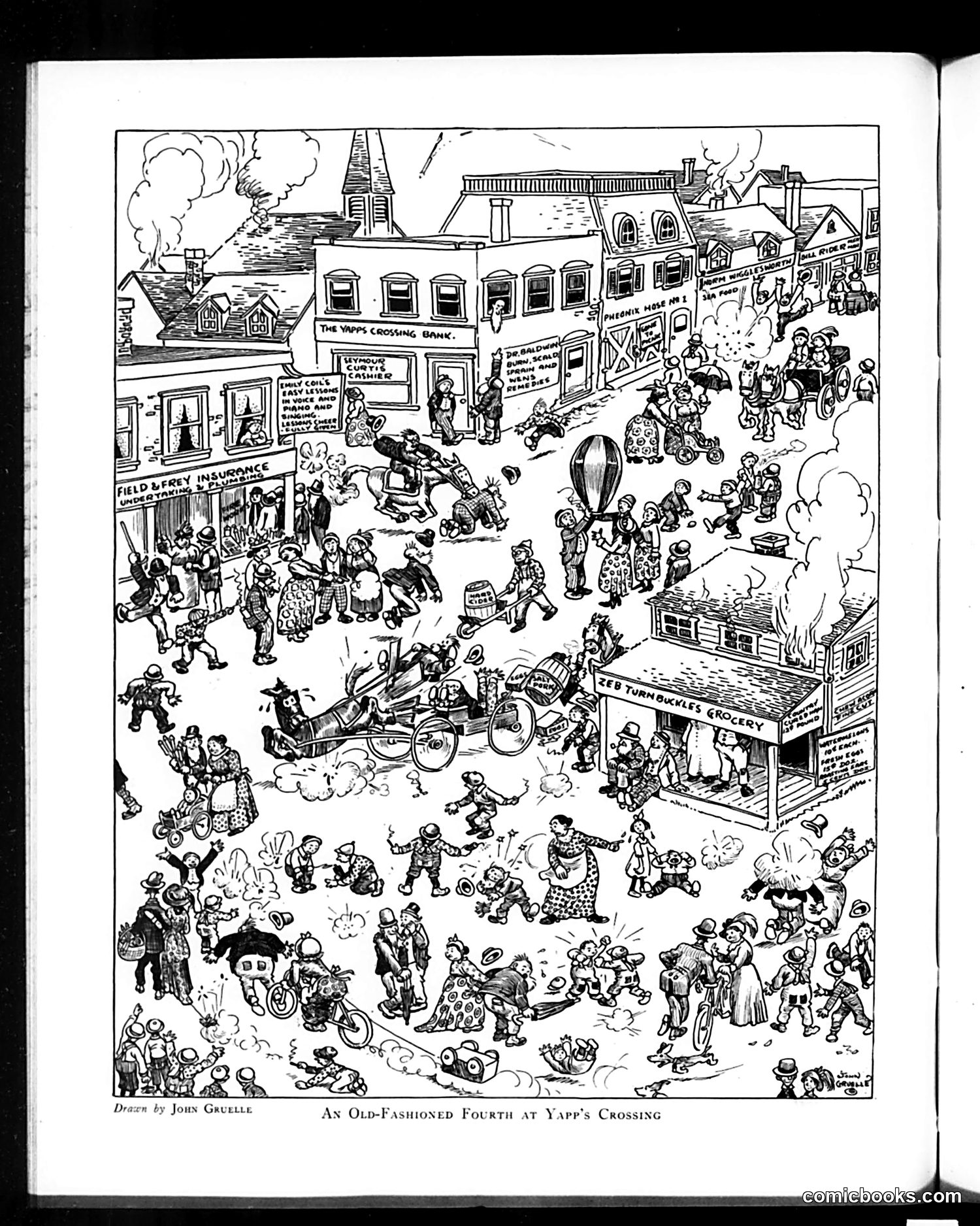
This illustration by John Gould depicts a chaotic Fourth of July celebration in a small town, drawn in the style of early-20th-century American humor. The scene shows a crowded street filled with townspeople, children, and various festivities including a hot air balloon, musicians, cyclists, and what appears to be casual chaos and revelry. The satire likely mocks small-town Independence Day celebrations—contrasting the idealized patriotic holiday with the messy, boisterous, accident-prone reality of actual community gatherings. The visible shop signs (including "Field & Ferry Insurance" and "Yapp's Crossing Bank") establish this as a typical American town, making it a gentle, relatable joke about provincial Fourth of July traditions rather than political commentary.
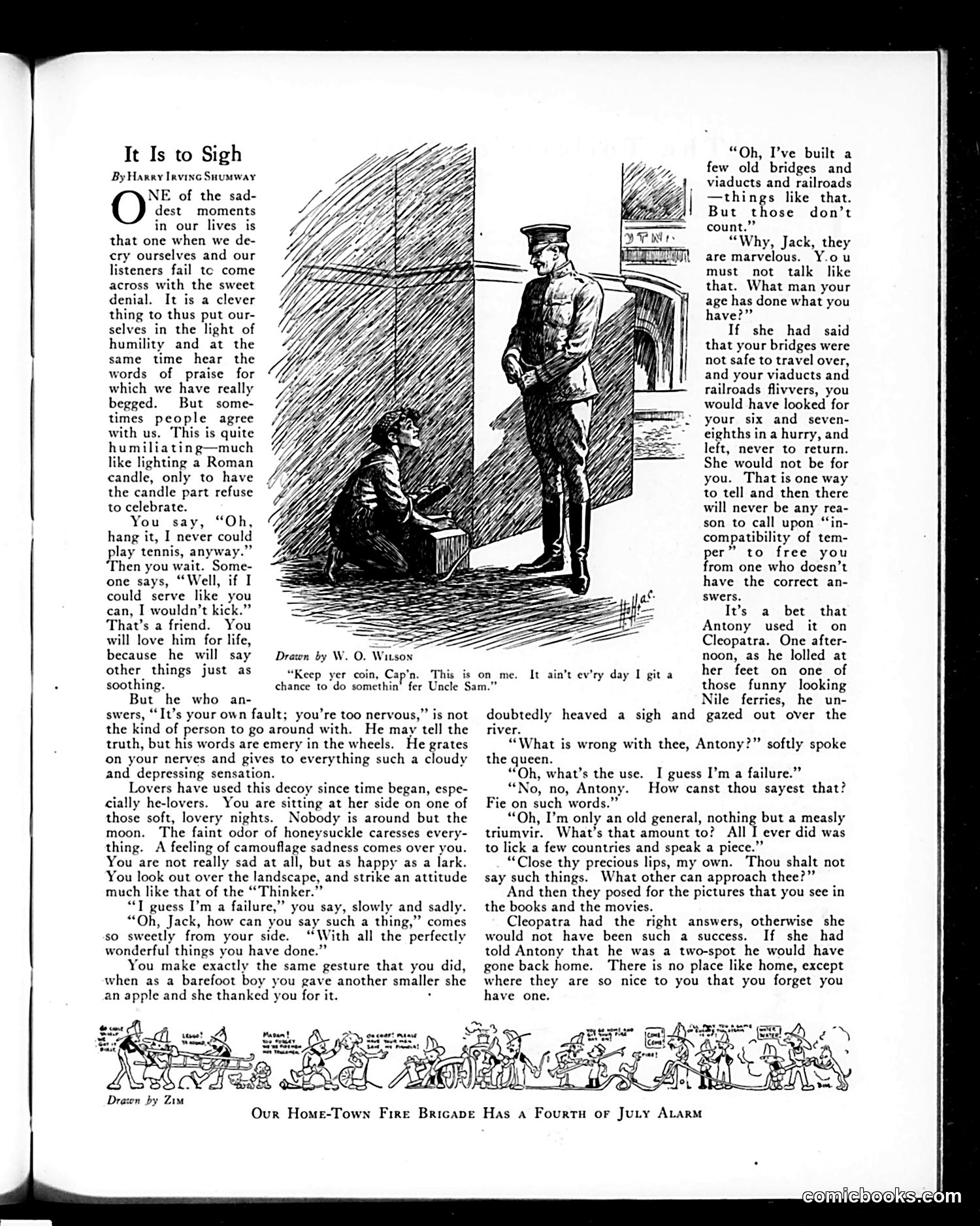
This is a humorous essay on social dynamics, not political satire. Harry Irving Shumway explores the art of **false modesty and its proper response**. The piece argues that when someone self-deprecates ("I'm a failure"), the socially skilled reply is reassurance and praise—not agreement. A friend agrees with your self-criticism; a *real* friend contradicts it sweetly. The essay illustrates this through the example of "Jack," who pretends inadequacy to fish for compliments from his romantic interest. The historical reference to **Antony and Cleopatra** demonstrates this dynamic across time: Antony sighs dramatically about his insignificance, and Cleopatra responds with perfectly calibrated flattery, ensuring his devotion. Had she agreed he was worthless, he'd have left. The cartoon (by W.O. Wilson) shows a soldier refusing payment, saying it's a privilege to help "Uncle Sam"—demonstrating the *correct* humble response that inspires others' praise. The satirical point: **emotional intelligence in relationships depends on knowing when to contradict someone's self-assessment with reassurance.**
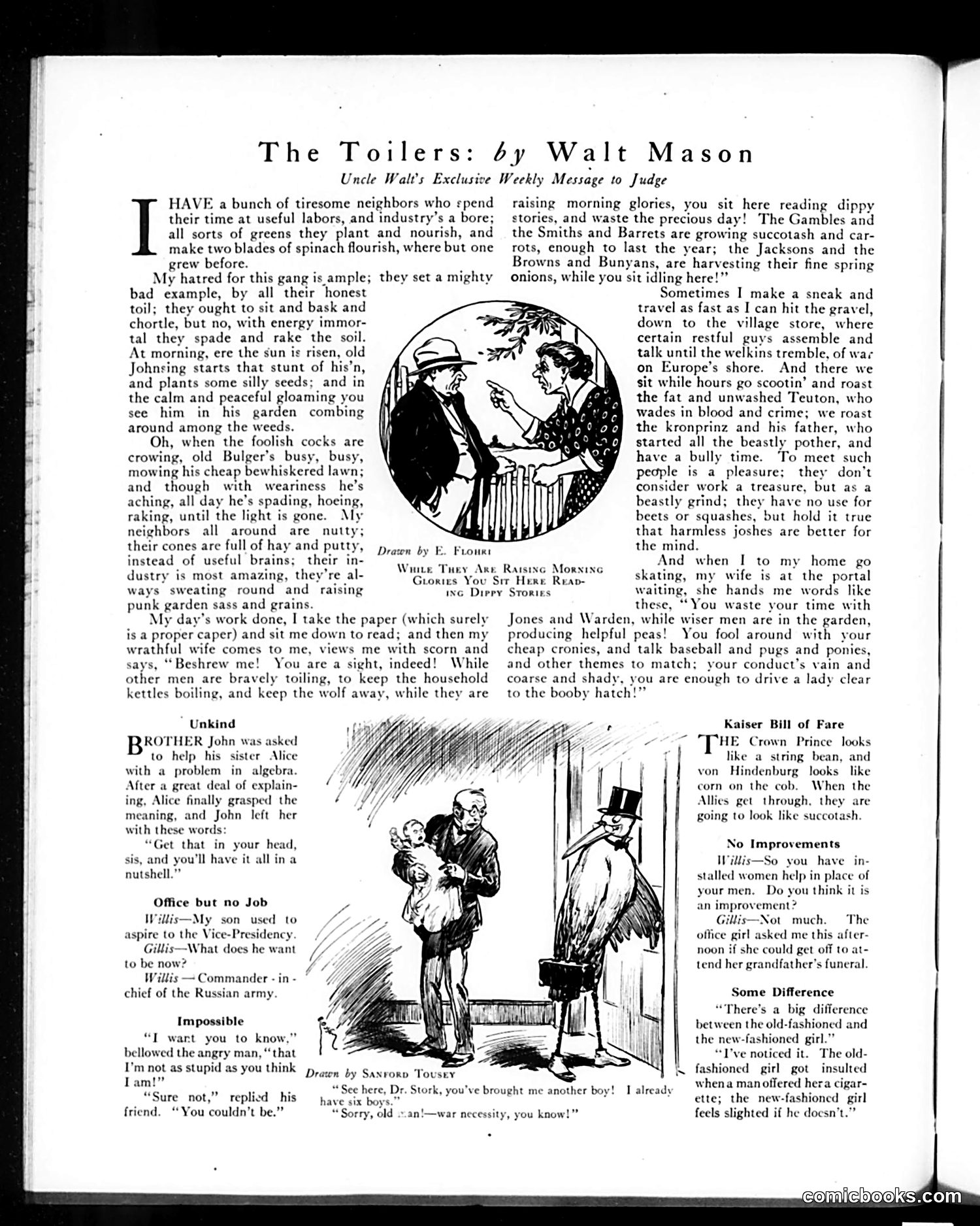
This is a satirical commentary on class and work ethic. Mason's narrator is a lazy man who spends his days reading newspapers and gossip while his industrious neighbors—Johnsing, Bulger, and others—actively garden, farm, and labor. His wife shames him for idleness, contrasting his time with "cheap cronies" discussing baseball against neighbors producing food. The satire cuts two ways: it mocks the idle man's laziness AND his neighbors' obsessive productivity. The phrase "raising morning glories, you sit here reading dippy stories" suggests both activities are ultimately frivolous—gardening for show versus reading gossip magazines. The sidebar jokes are unrelated vignettes: a brother explains algebra poorly; a man's son aspires to lead the Russian army (likely WWI-era humor); and a doctor delivers another boy despite wartime necessity. The "Kaiser Bill of Fare" title suggests German military references tied to the war context visible throughout.
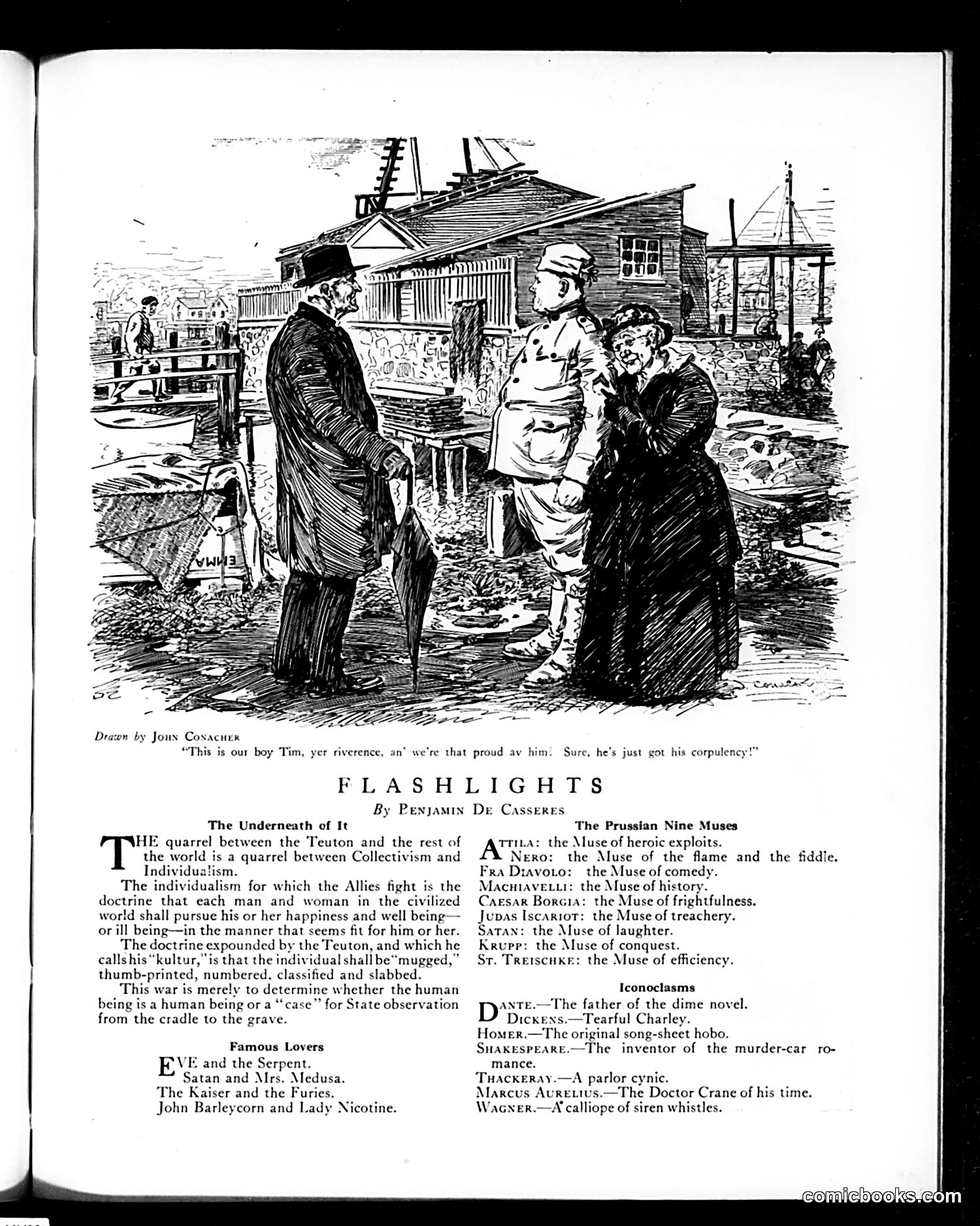
The main cartoon depicts three figures at a waterfront: two working-class Irish immigrants proudly presenting their son "Tim" to a clergyman ("yer riverence"). The joke plays on "corpulency" (fatness)—the parents claim their boy "just got his corpulency," likely meaning he's achieved a well-fed, prosperous appearance, which they view as a mark of success in America. The accompanying essay "The Underneath of It" by Benjamin De Casseres presents WWI propaganda contrasting Allied "Individualism" (personal freedom) against German "Kultur" (state control reducing citizens to numbered, classified "cases"). This reflects common American pro-Allied rhetoric circa 1914-1917. The remaining sections—"Famous Lovers," "The Prussian Nine Muses," and "Iconoclasms"—are humorous lists mocking German militarism and various literary/historical figures through irreverent associations. The overall page reflects Judge's satirical approach combining ethnic humor with wartime political messaging.
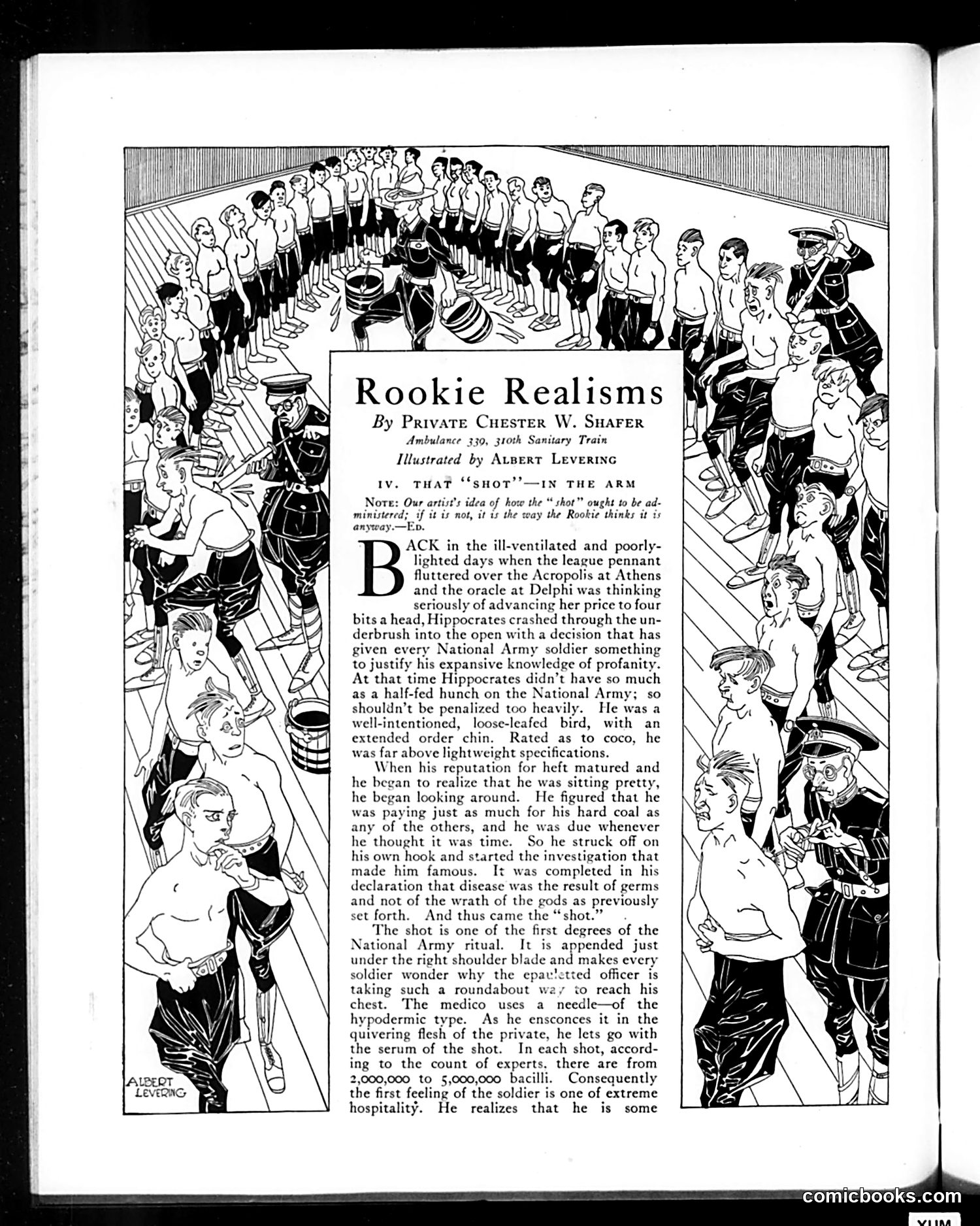
This WWI-era humor piece, illustrated by Albert Leverking, satirizes the mandatory vaccination procedures newly inducted soldiers endured. The "shot" refers to the hypodermic injection—a novel medical experience for many recruits. The joke compares Hippocrates' discovery that disease stems from germs (not divine wrath) to the Army's vaccination campaign. The text humorously describes soldiers' bewilderment at receiving injections beneath the shoulder blade, noting they contain millions of bacilli. The illustration shows recruits crowded together, likely awaiting their turn. The satire targets rookie soldiers' exaggerated reactions to the needle and their newfound understanding of germ theory. The title's pun on "shot" (injection versus alcohol) reinforces the comic tone. This reflects genuine soldier anxiety about wartime medical procedures while gently mocking their theatrical responses to this standardized military ritual.
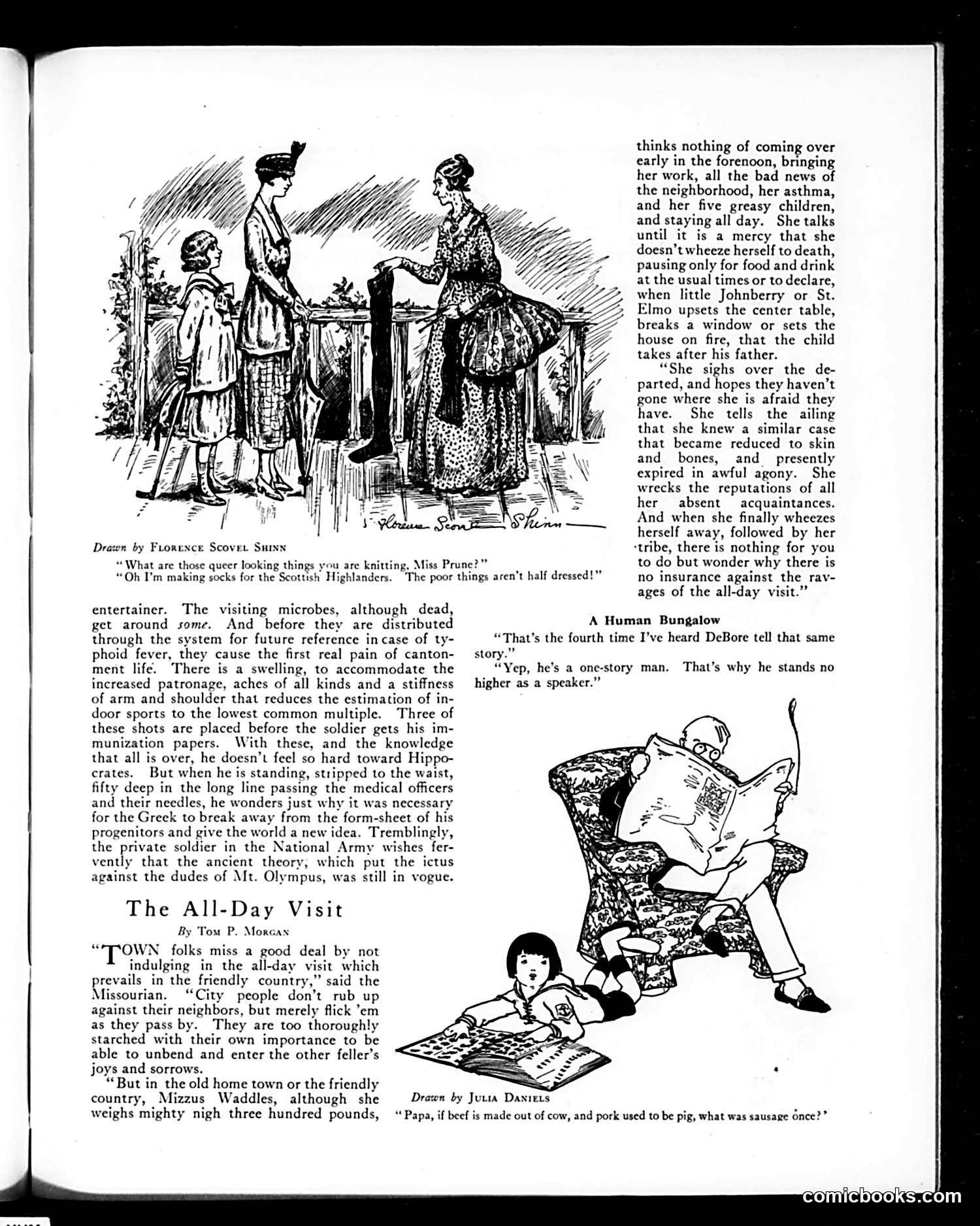
**Top Cartoon** (by Florence Scovel Shinn): A woman knits socks for Scottish Highlanders, joking they "aren't half dressed." This satirizes the common stereotype that Scottish men wear kilts (which expose their legs), presenting the knitwear as charity work for the allegedly underdressed Scots. **"The All-Day Visit"** (by Tom P. Morgan): This story mocks rural/country visiting customs versus urban formality. It portrays "Mizzus Waddles," a heavy woman who makes exhausting all-day visits, bringing her children and gossip, complaining incessantly about her ailments, spreading rumors about neighbors, and generally making her hosts miserable. The satire contrasts country hospitality's genuine warmth with its burdensome social obligations—city people's aloofness, while cold, at least protects one from such invasive visits. **Bottom items**: Small jokes about a man being "one-story" (dull speaker) and a child asking what sausage used to be—darkly humorous given meat processing realities.
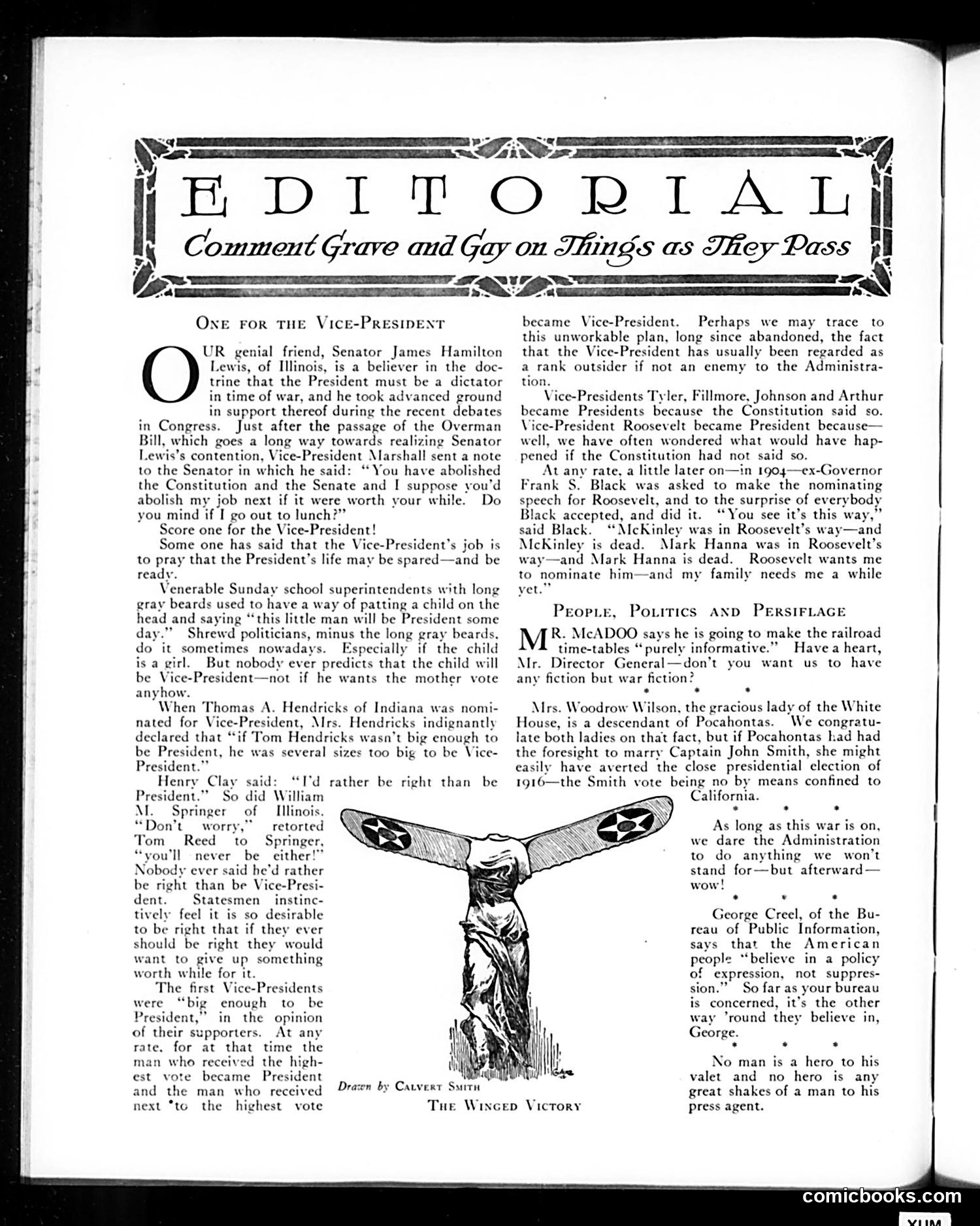
This satirical editorial mocks the powerlessness of the Vice-Presidency during World War I. Vice-President Thomas Marshall reportedly quipped to Senator James Hamilton Lewis (who backed the Overman Bill, which expanded presidential wartime powers) that the administration had "abolished the Constitution and the Senate" and asked if they'd "abolish my job next if it were worth your while." The joke: Marshall suggests his position is so worthless that abolishing it wouldn't matter. The editorial elaborates this theme by noting that nobody aspires to the Vice-Presidency—mothers wouldn't want it for their children. It references historical figures (Tyler, Fillmore, Johnson, Arthur) who became President only through presidential death, and Theodore Roosevelt, whose predecessor's death elevated him. The accompanying illustration (Calvert Smith's "The Winged Victory") depicts a classical winged figure, ironically symbolizing triumph while the text emphasizes the Vice-President's irrelevance and near-universal contempt for the office. The satire criticizes both the constitutional weakness of the Vice-Presidency and wartime executive overreach.
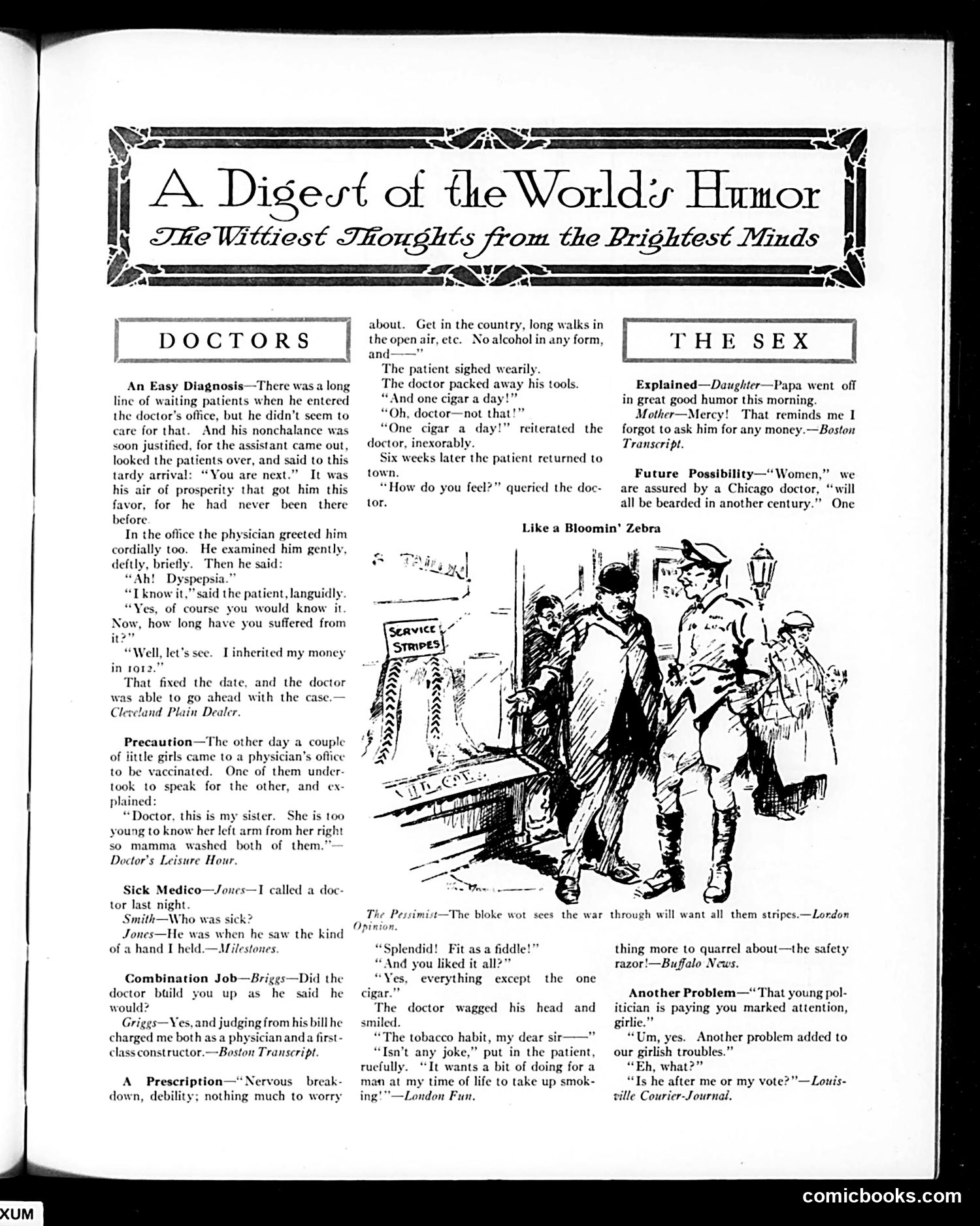
This page collects brief humorous anecdotes organized by topic. The **"Doctors"** section satirizes medical practice and patient behavior: jokes mock diagnosis based on wealth (a prosperous patient gets priority), inherited money as a diagnostic clue, and doctors' bills inflating charges. One anecdote humorously depicts a child unable to distinguish left from right arm. The **"Sex"** section contains lighter domestic humor. One joke plays on a wife forgetting to ask her husband for money. Another references a Chicago doctor's prediction that women will be bearded in a century—period commentary on changing gender roles, likely alluding to women's suffrage debates. The cartoon "Like a Bloomin' Zebra" appears to reference war-related rationing or "service stripes." The closing jokes address modern anxieties: a young politician's romantic attention raises questions about whether he seeks the woman or her vote—reflecting early 20th-century female political engagement and suspicion of male motives. Overall, the page uses gentle satire to comment on class, medicine, gender, and politics of its era.
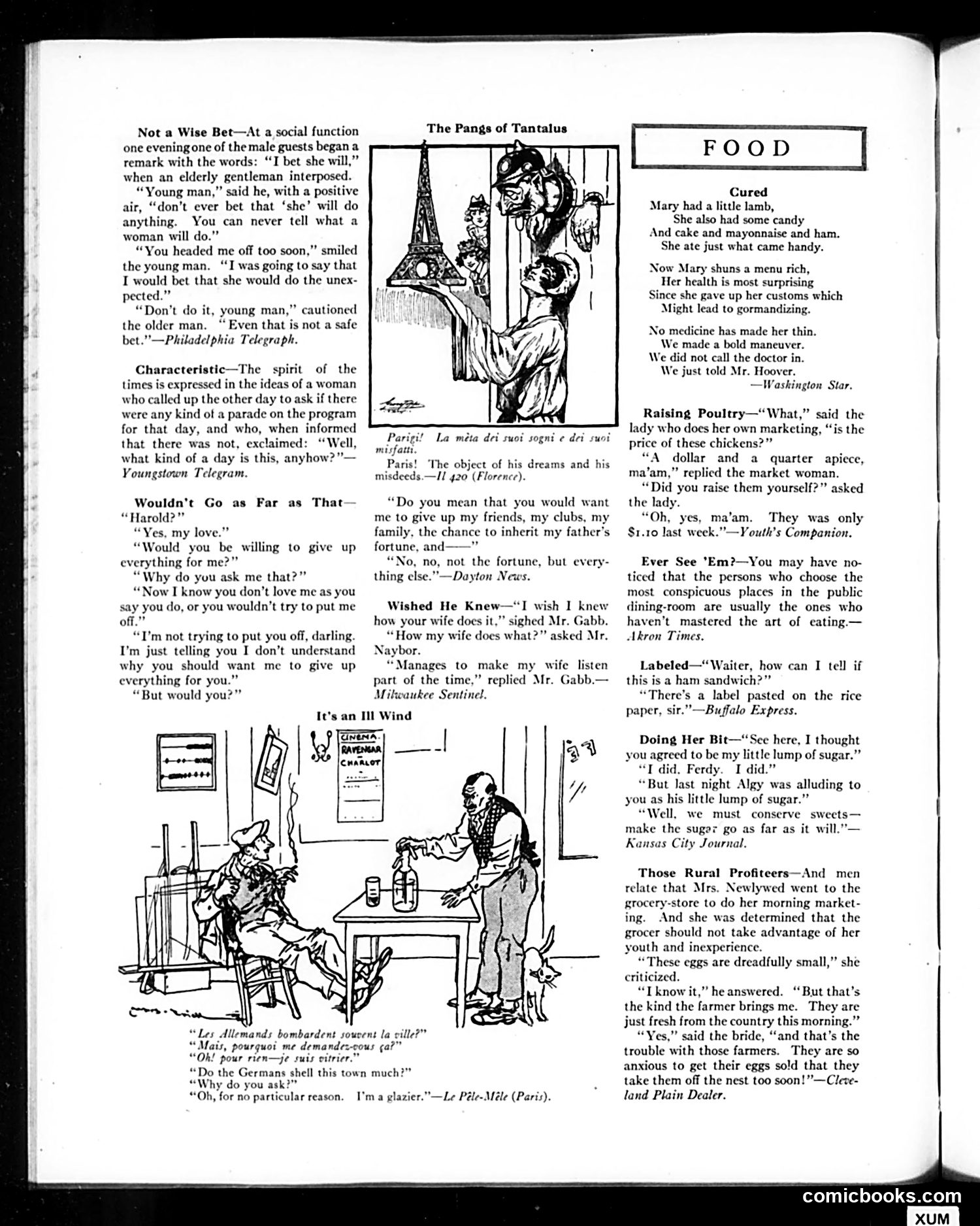
This page from Judge magazine contains several short humor pieces mocking social conventions and wartime rationing (likely WWI era, given "Mr. Hoover" references—Herbert Hoover oversaw U.S. food conservation). **Key Content:** The cartoons satirize: 1. **"It's an Ill Wind"** - A French glazier jokes that German bombardments are good for his business (broken windows). This dark humor reflects WWI's impact on European civilians. 2. **The "Food" section** - Multiple anecdotes ridicule food conservation efforts and domestic complications around eating, including a poem about a girl whose diet caused health problems until "Mr. Hoover" intervened (referencing official food rationing campaigns). 3. **Various domestic jokes** - Satirize gender dynamics (wives' unpredictability, marital negotiations) and consumer dishonesty (farmers selling undersized eggs at inflated prices). The overall tone mocks both the home front's wartime sacrifices and timeless social absurdities—particularly gender relations and commercial greed.
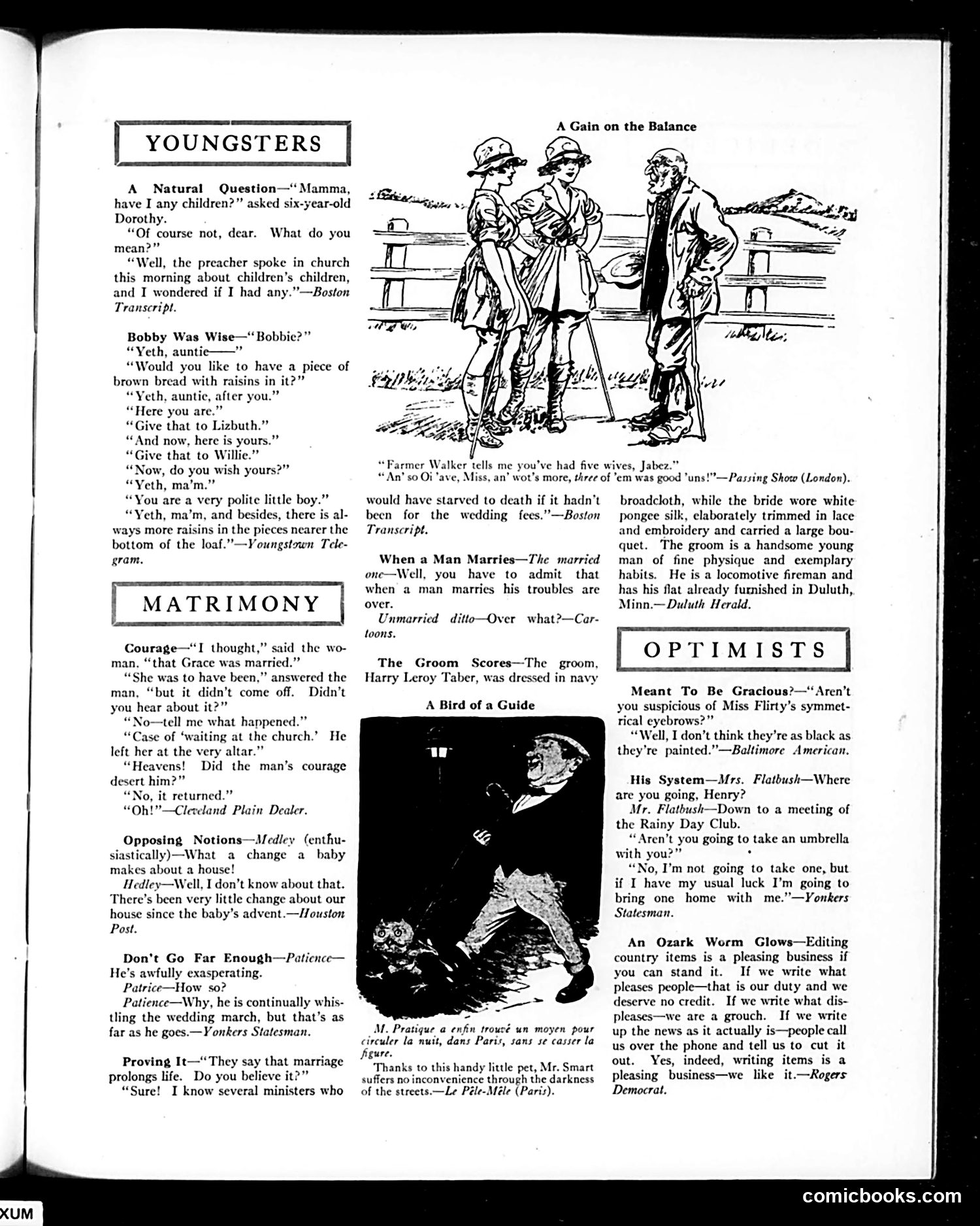
This page from *Judge* magazine comprises humorous anecdotes and one cartoon, typical of early 20th-century American humor magazines. **The Anecdotes** satirize social conventions and human nature: children's literal-minded questions about church language; children's strategic politeness to access desserts; marital mishaps (bride abandonment at the altar); and the hypocrisy of marriage advice. One joke cynically suggests clergymen benefit financially from weddings. **"A Bird of a Guide"** (French cartoon) depicts a man using a bird as a nighttime navigation aid through dark Parisian streets—absurdist humor about an impractical solution to urban darkness before widespread electric lighting. **The other items** mock courtship, suspicious cosmetics, and the impossible position of country newspaper editors pleasing contradictory readers. The humor relies on wordplay, irony, and everyday social observations—typical of *Judge*'s satirical approach to middle-class American life and manners.
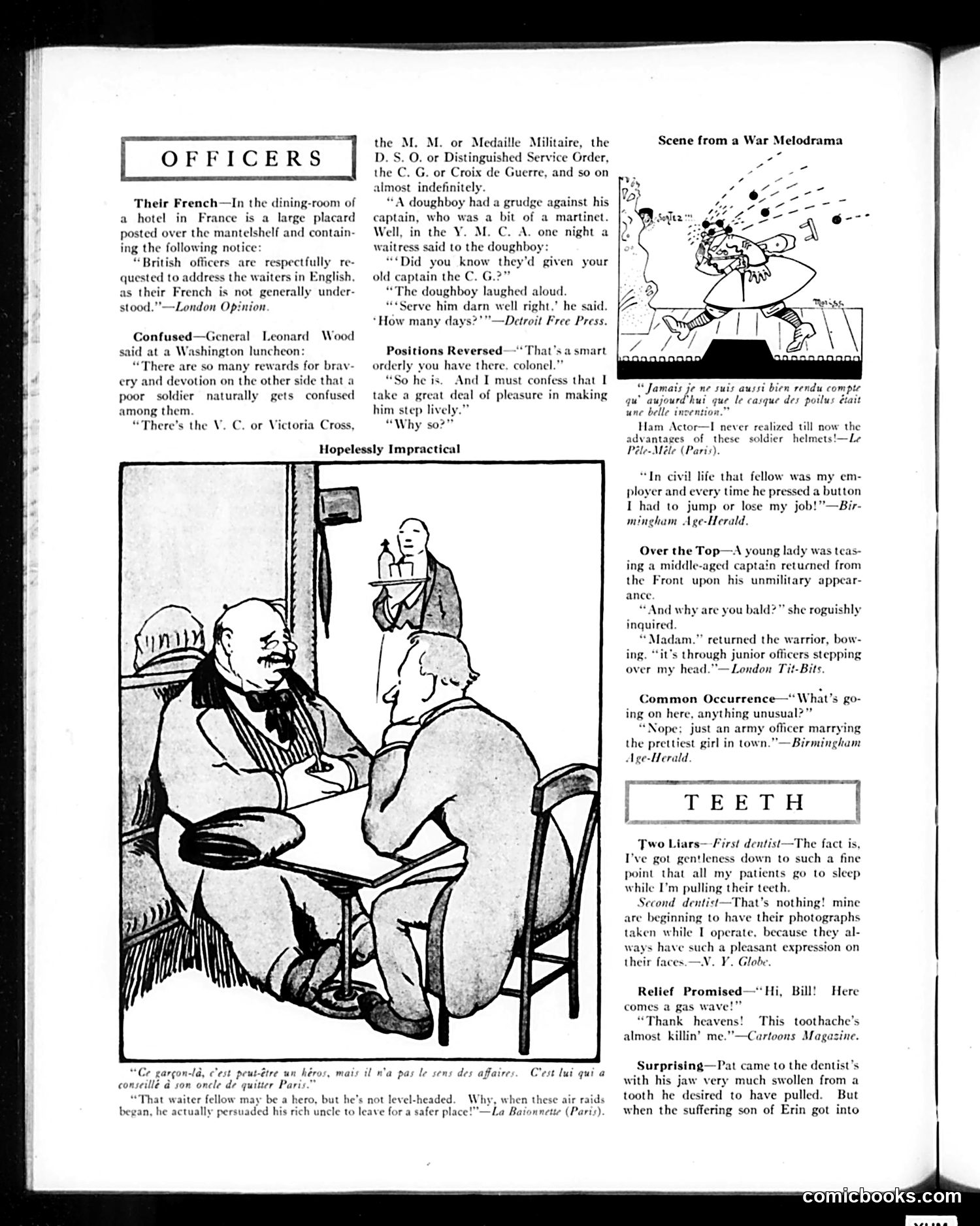
This page from *Judge* magazine contains WWI-era humor spanning several topics: **"Officers" section**: Satirizes British officers' poor French during WWI. The notice humorously requests they speak English to French waiters, whose English is equally bad. The piece mocks military confusion over decorations (Victoria Cross, Distinguished Service Order, Croix de Guerre), showing soldiers bewildered by so many medals they can't keep them straight. **"Hopelessly Impractical" cartoon**: Depicts a soldier-turned-waiter serving officers, illustrating the reversal of civilian power dynamics in wartime. A colonel takes pleasure in ordering around his former employer, now a humble waiter. **Remaining sections**: Short jokes about dentistry and war experiences, typical of *Judge's* formulaic humor structure. The satire targets military bureaucracy, class inversions during wartime, and the absurdities of international military cooperation—all timely concerns for American readers during or shortly after WWI.
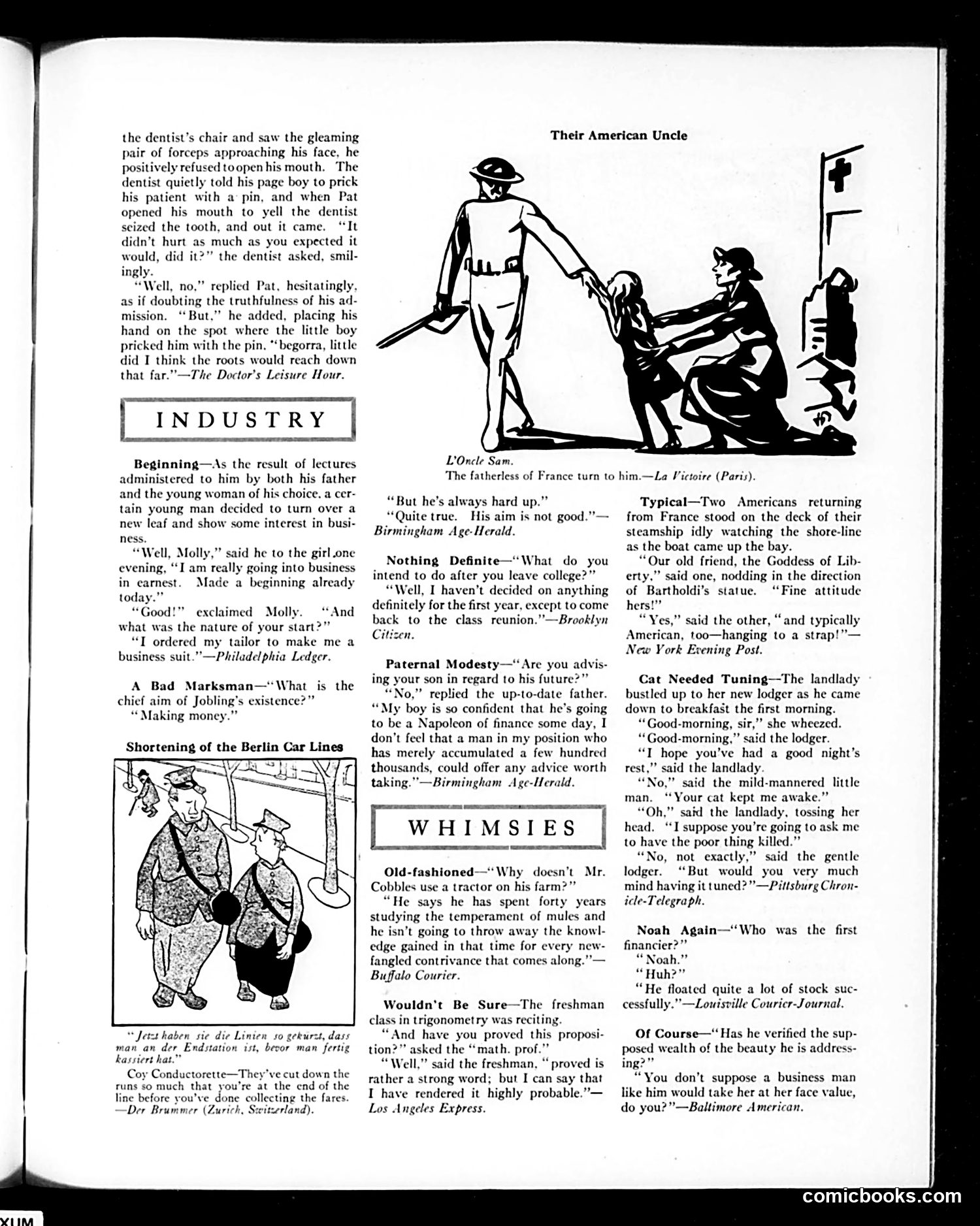
This page from Judge contains multiple short humorous pieces typical of early 20th-century American satire: **The cartoons and jokes address:** 1. **"Their American Uncle"** — A political cartoon showing Uncle Sam (personified America) being approached by a woman representing France. The caption indicates France views America as a wealthy relative to rely upon—likely referencing American financial support during or after World War I. 2. **"Industry" section** — Gentle mockery of young men entering business, including a joke about ordering a business suit as a "start" in commerce—satirizing superficial approaches to professional ambition. 3. **Other brief comedic pieces** mock everyday absurdities: a dentist's patient blaming tooth pain on deep roots, a man's inflated confidence in becoming a financial "Napoleon," and a landlord's dismissive attitude toward a cat disturbing a lodger. **The German cartoon** ("Shortening of the Berlin Car Lines") satirizes poor transit efficiency—passengers reach their destination before conductors finish collecting fares. The humor relies on exaggeration, misunderstanding, and social observation rather than political commentary.
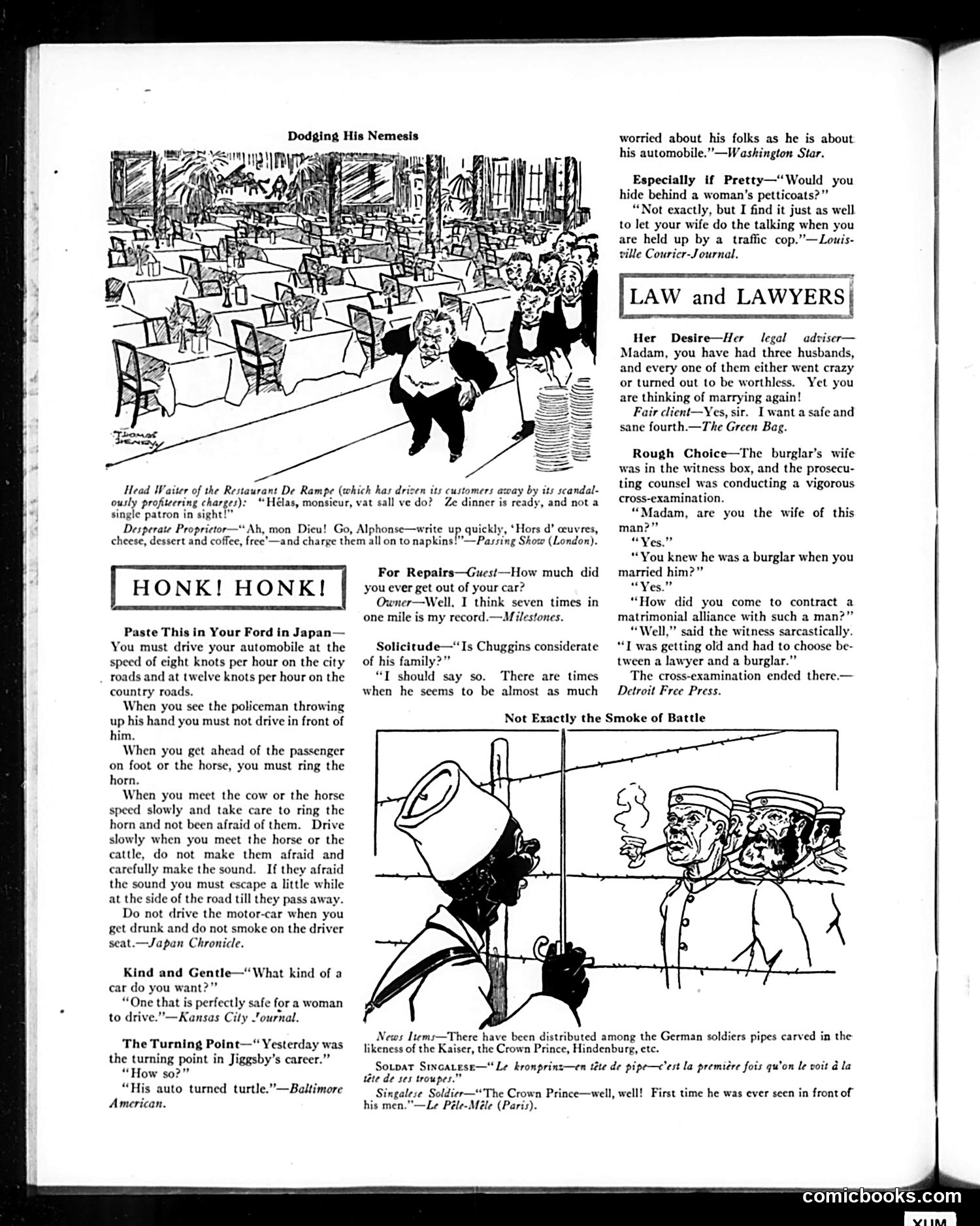
This page collects various satirical quips about automobiles, legal matters, and WWI-era humor. **Main Cartoons:** 1. **"Dodging His Nemesis"** (top): A restaurant scene where a maitre d' laments empty tables due to scandal and overcharging, proposing free items to attract customers. 2. **"Not Exactly the Smoke of Battle"** (bottom): A WWI joke showing German soldiers receiving carved pipes featuring the Kaiser and Crown Prince. The humor: the Crown Prince is depicted as incompetent—soldiers joke it's the first time he's ever been "in front of" his troops (leading them), playing on perceptions of his military inadequacy. **Recurring Themes:** - Automobile-related humor (driving safety, legal troubles with traffic cops) - Marriage/divorce satire ("safe and sane fourth" husband; burglar's wife choosing between lawyer and criminal) - Japanese driving regulations (mock "safety" instructions for Japan) The content reflects early 20th-century American anxieties: newfangled automobiles, marital instability, and WWI commentary mocking German military leadership.
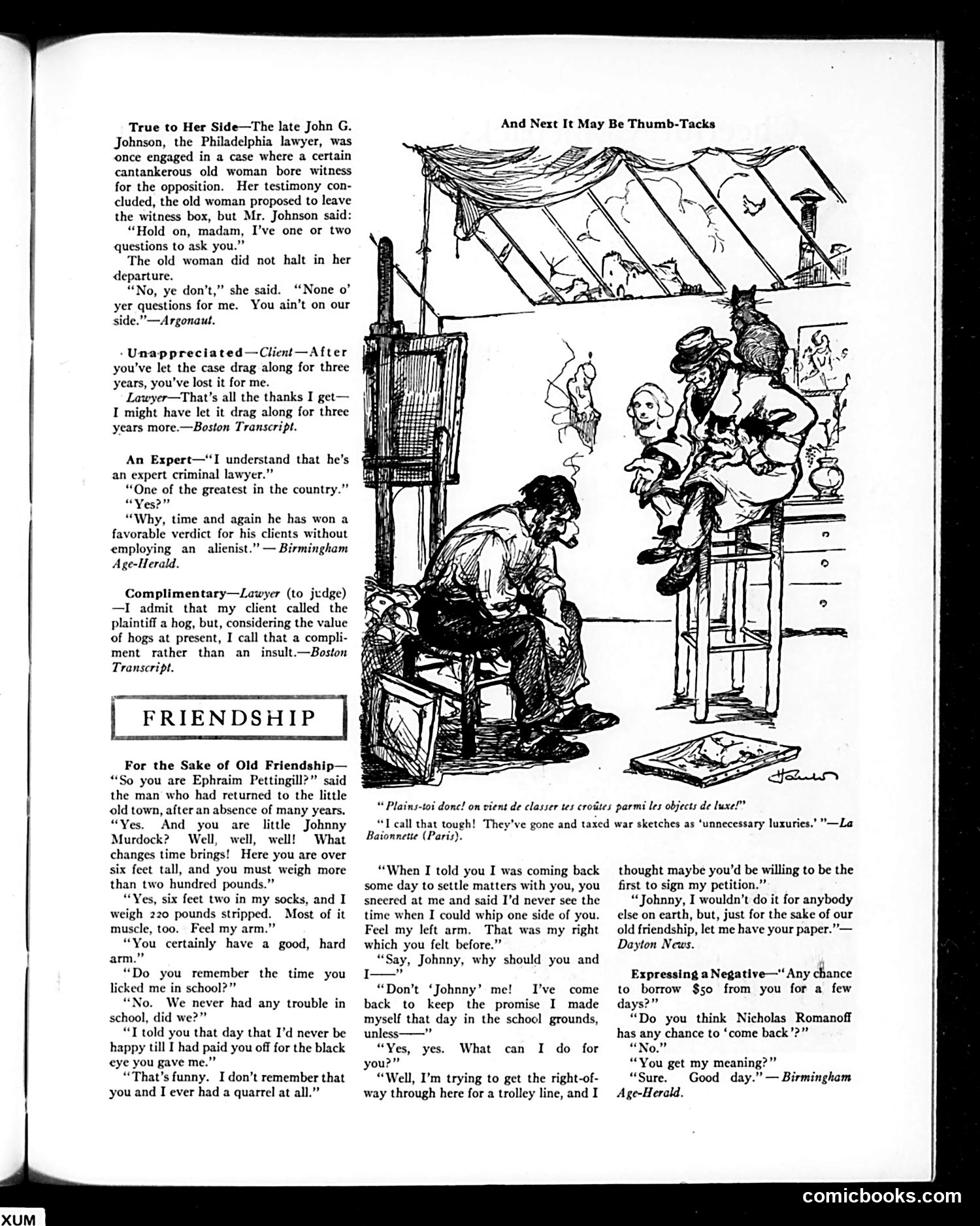
This page contains several lawyer and friendship-themed anecdotes and one cartoon, typical of Judge's satirical humor. **The cartoons/anecdotes mock:** 1. **Lawyer incompetence and self-interest**: Multiple jokes portray lawyers as incompetent (losing cases), self-serving (dragging cases out for fees), or morally flexible (winning through tricks rather than legal expertise). One joke presents a lawyer calling a plaintiff a "hog" as a compliment given wartime inflation. 2. **The "Friendship" section**: The main narrative depicts a man returning to his hometown seeking revenge for a childhood beating, but when the man demonstrates his grown strength, he becomes useful—the protagonist needs him to sign a petition for a trolley-line easement. The returning man agrees "for the sake of old friendship," satirizing how nostalgia and social obligation override genuine grievances. 3. **The French cartoon** references wartime taxation of sketches as "unnecessary luxuries," mocking government austerity measures. **Context**: These reflect early 20th-century attitudes toward lawyers, small-town dynamics, and wartime economics (likely WWI-era).
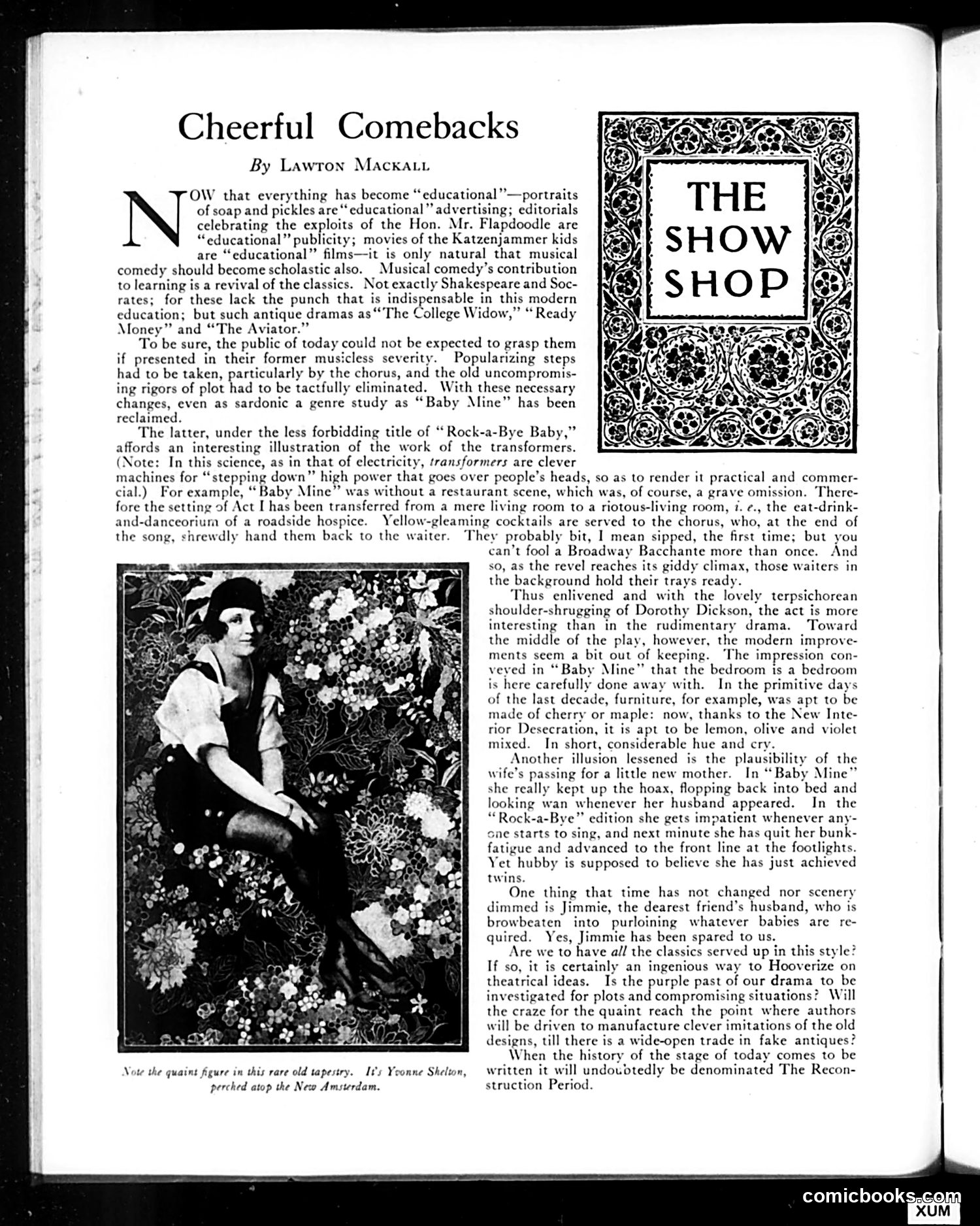
This article by Lawton Mackall satirizes the 1920s trend of marketing entertainment as "educational." The author mocks how everything—from soap ads to films—gets labeled "educational" to seem respectable. The specific target is musical comedy's attempt to revive classical plays by modernizing them. Mackall uses "Baby Mine" (retitled "Rock-a-Bye Baby") as his example, criticizing how producers strip plots of their original logic to insert contemporary spectacle: a restaurant scene with cocktails, jazz dancing, and updated Art Deco bedroom furniture replace the original domestic setting. The satire peaks when he notes the wife can no longer convincingly pass as a new mother because she abandons her sickbed to perform at the footlights—yet the husband is still supposed to believe she's just had twins. The article's final question—whether this gutting of classics for commercial purposes represents "Hooverizing on theatrical ideas"—references President Hoover's conservation rhetoric, suggesting such adaptation wastes theatrical heritage for profit.
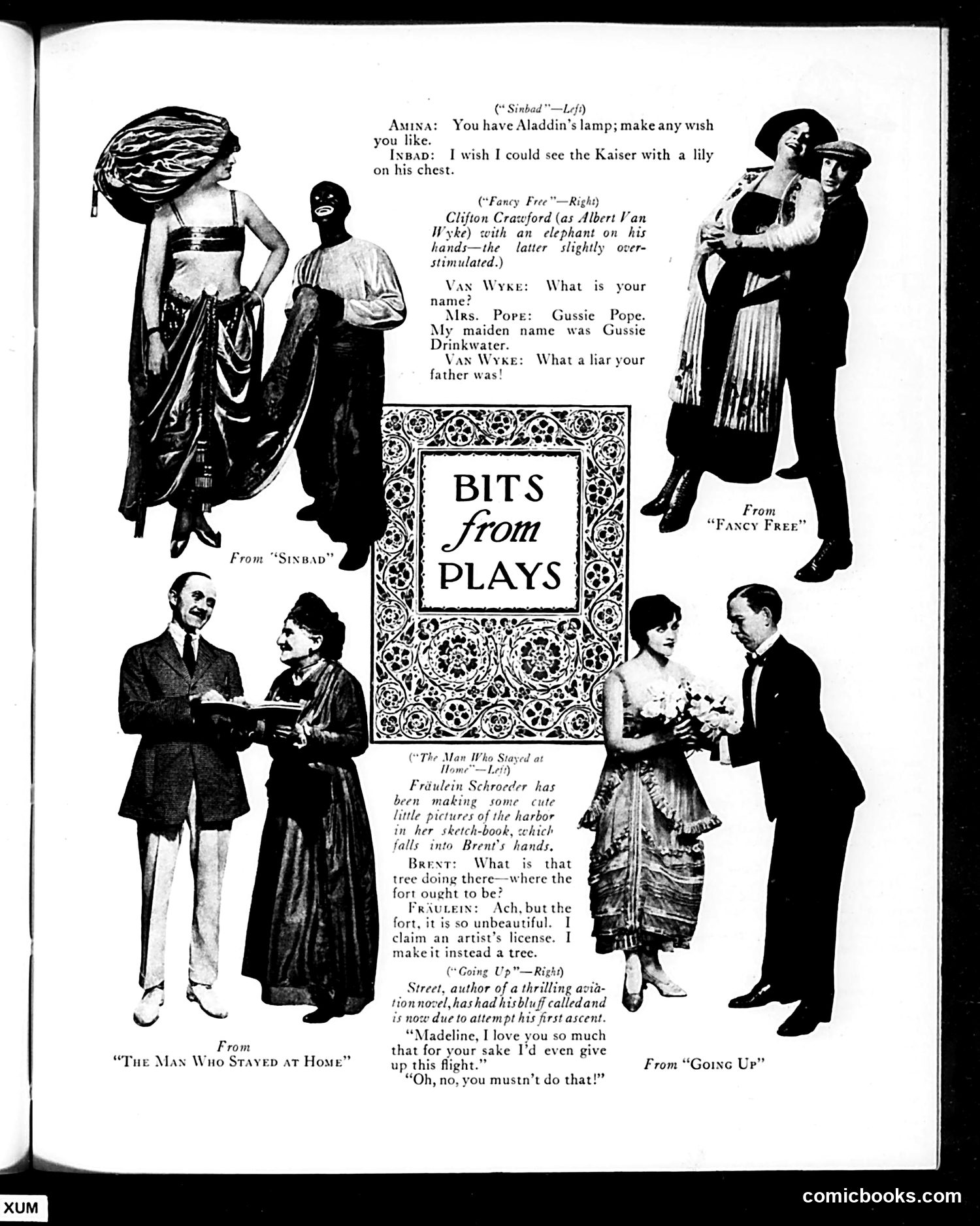
This page compiles humorous dialogue excerpts from contemporary theatrical productions. The satire works through theatrical absurdities and character foibles: **"Sinbad"**: A character wishes to see the Kaiser (German Emperor) wearing a lily on his chest—likely mocking German imperial vanity or military pretension during WWI-era tensions. **"The Man Who Stayed at Home"**: A woman named Gussie Pope reveals her maiden name was "Gussie Drinkwater"—the humor lies in the unflattering surname contrast. **"Fancy Free"**: An actress portraying a German woman claims "artistic license" to replace an ugly fort with a tree in her sketch—satirizing artistic pretension and wartime espionage anxieties (the fort detail suggests potential security concerns). **"Going Up"**: An aviator offers to abandon a dangerous flight for his beloved; she insists he mustn't—mocking romantic melodrama and masculine bravado. The page presents theatrical humor typical of Judge's sophisticated comedy, targeting wartime anxieties, character vanity, and theatrical conventions.
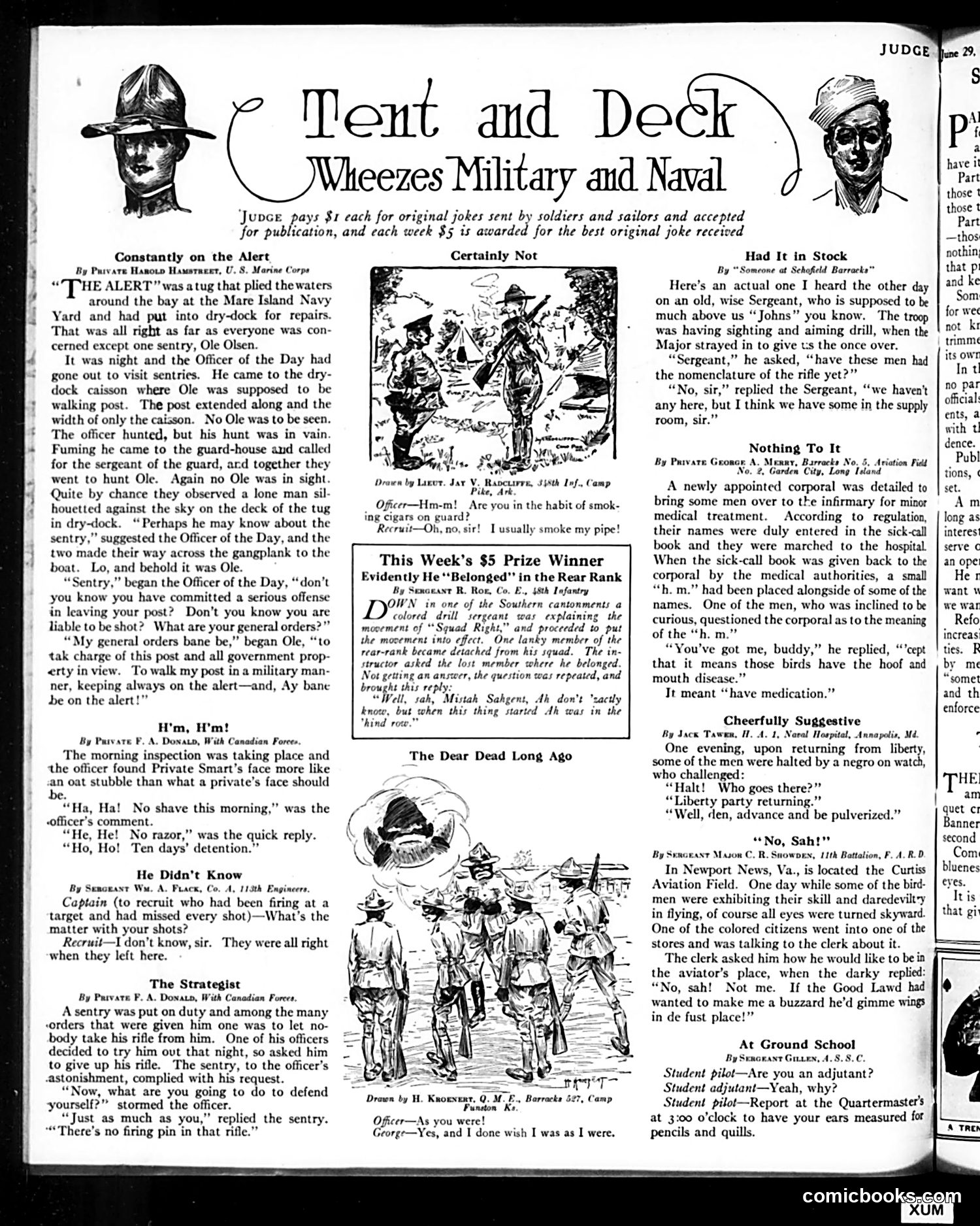
This page collects humorous anecdotes from soldiers and sailors during what appears to be World War I era (based on references to camps and training). The jokes rely on the comedic incompetence or literalism of military recruits and enlisted men. **Key jokes:** - **"Constantly on the Alert"**: A sentry abandons his post but claims he *was* following orders to "keep always on the alert"—a play on the difference between literal and intended meaning. - **"Certainly Not"**: A recruit claims he doesn't smoke *cigars* on guard, only pipes—splitting hairs about regulations. - **"The Strategist"**: A sentry cleverly disarms an officer's test by removing the firing pin from his rifle first, outsmarting authority. The satire targets military bureaucracy, the gap between orders and common sense, and the wit of ordinary soldiers outwitting their officers. The humor assumes readers appreciate both military discipline and soldiers' resourceful cheekiness.
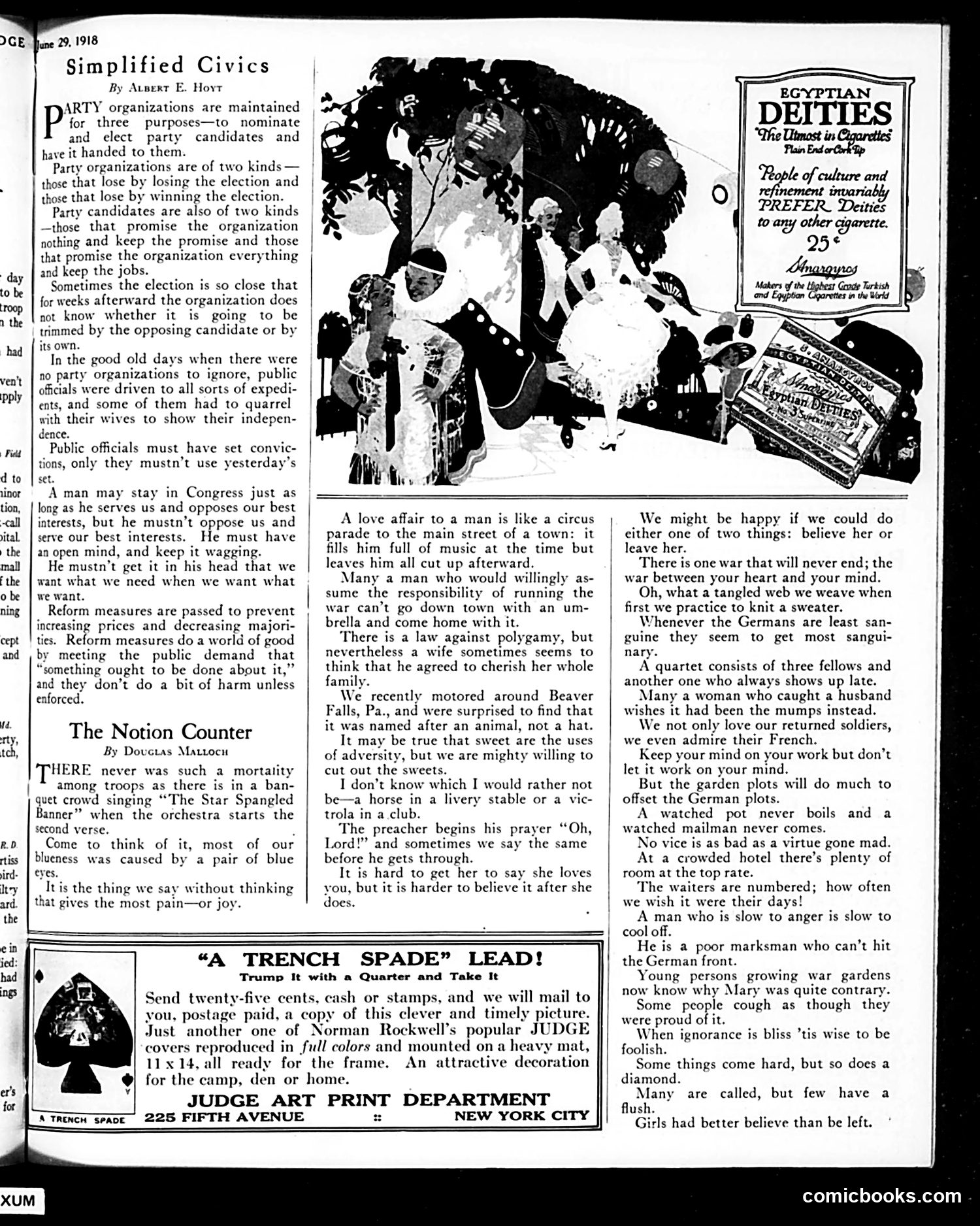
This page from the satirical magazine *Judge* uses humor to critique American politics and social behavior during World War I. **"Simplified Civics"** mocks political party organizations as self-serving machines that lose elections either way—by failing to win or by winning and disappointing supporters with empty promises. The satire suggests politicians care more about holding office than serving constituents. **"The Notion Counter"** contains brief, cynical observations about relationships and human nature. The opening joke about military mortality rates and the national anthem's second verse is topical—troops apparently died singing patriotic songs, suggesting blind patriotism as wasteful. The scattered aphorisms mock marriage ("a wife sometimes seems to think that he agreed to cherish her whole family"), hypocrisy, and self-deception—common *Judge* fare satirizing American domestic and political life. **Context**: Published during WWI's final year, the page reflects wartime cynicism while advertising cigarettes and art prints, typical of the era's magazine economy.
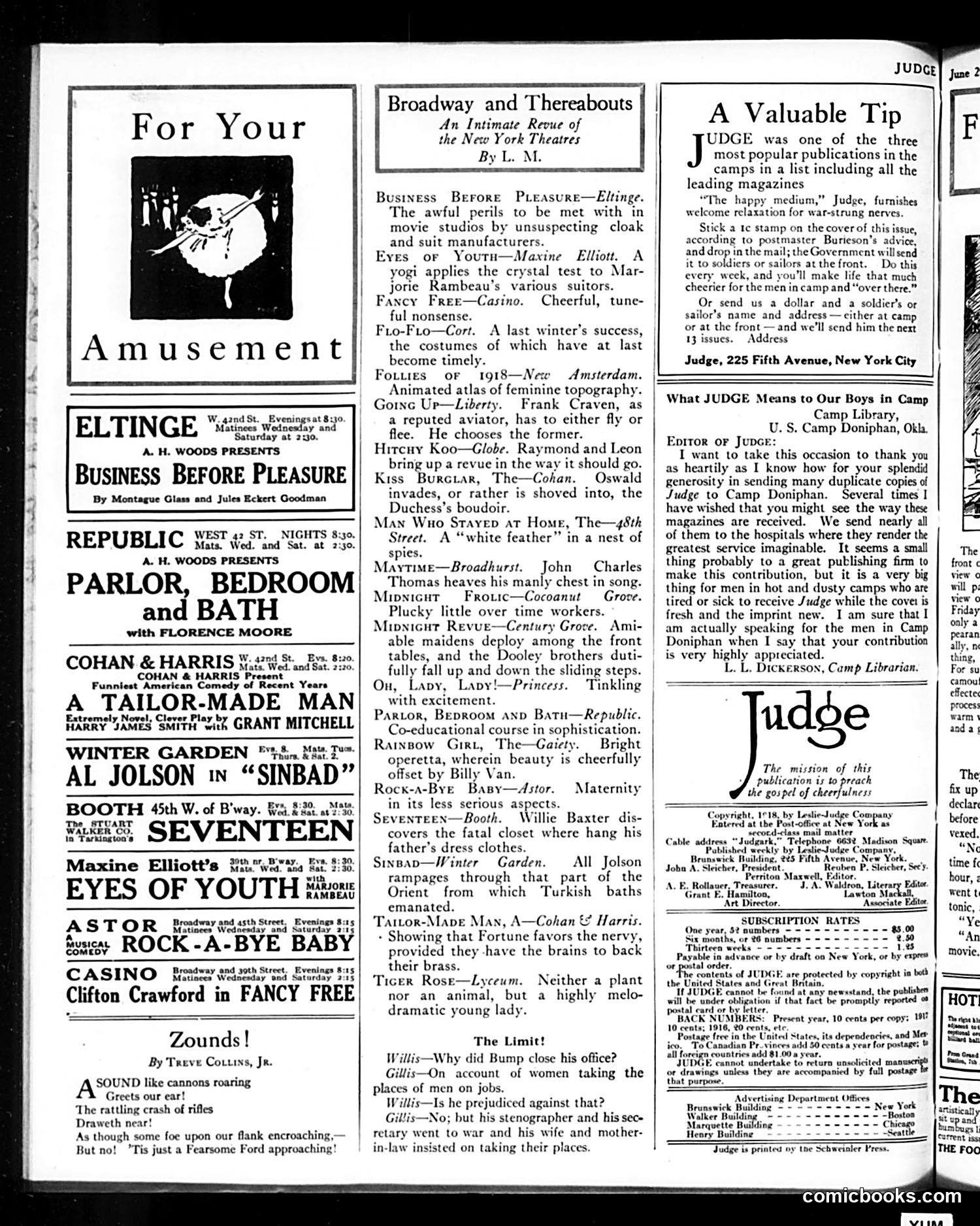
This is primarily an **entertainment advertising page** from *Judge* magazine (June 2, date unclear but wartime based on context). The bulk consists of theatrical advertisements for Broadway shows playing in 1918. The only actual cartoon content is **"Zounds!"** by Treve Collins Jr., which makes a light joke about automobile noise: the loud "crash" the reader hears isn't cannon fire from enemy forces—it's just a "Fearsome Ford" car approaching. This is a pun on the Model T Ford's notorious noise and vibration, playing on wartime anxiety about military sounds. A secondary item, **"The Limit!"** is a brief office joke about how a man closes his business because his stenographer, secretary, wife, and mother-in-law all went to war work, leaving him without staff. **Context**: This is wartime America (WWI era). The page also includes a note about mailing *Judge* to soldiers in camps, positioning the magazine as morale-boosting entertainment for troops—explained as "the happy medium" for "war-strung nerves."
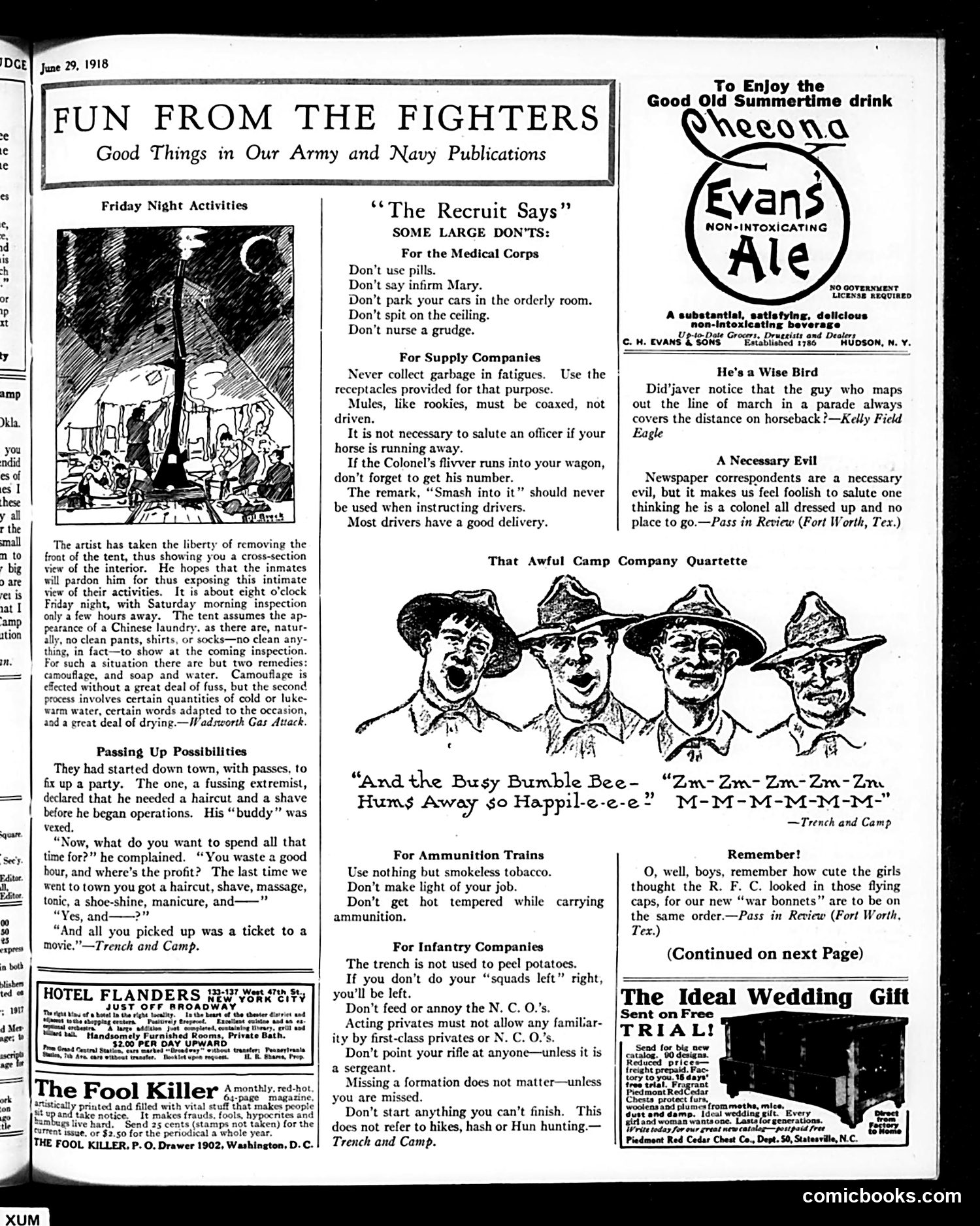
This June 1918 page from *Judge* contains WWI-era military humor and advice. The main cartoon depicts soldiers' tent inspection chaos—dirty uniforms scattered about before Saturday morning inspection. The joke relies on soldiers' universal dread of inspections and the contrast between their actual slovenly conditions and the need for camouflage (literal and figurative) before officers arrive. The "Recruit Says" section offers satirical "don'ts" for different military units—mocking common soldier infractions like spitting indoors, wasting time, or disrespecting NCOs. These reflect actual military discipline problems. The "Awful Camp Company Quartette" shows four grinning soldiers whose song-hums ("And the Busy Bumble Bee") represent mindless military routine. The page also includes period advertisements (Evans Non-Intoxicating Ale, Hotel Flanders) and the recurring *Judge* feature "The Fool Killer," a satirical column targeting society's hypocrites. The overall tone mocks both soldiers' petty infractions and military bureaucracy—typical of *Judge's* irreverent wartime commentary.
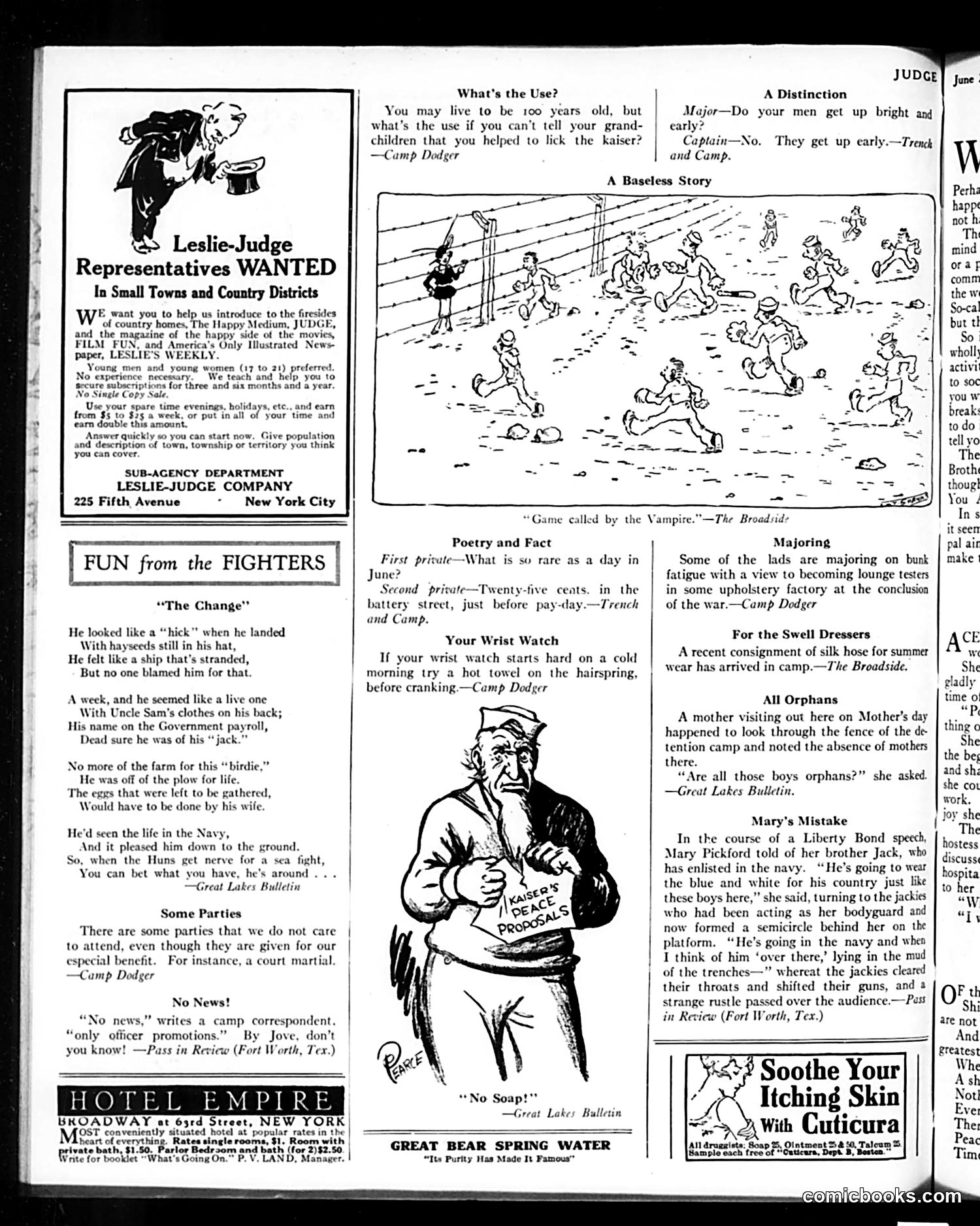
This page from Judge magazine (undated but likely WWI-era, given military camp references) contains primarily **advertisements and light military humor** rather than political satire. **Main content:** - **Recruitment ad** for Leslie-Judge Company seeking magazine representatives in rural areas - **"Fun from the Fighters"** section: humorous verse and anecdotes from soldiers at military camps (Great Lakes, Camp Dodger, Fort Worth) **The humor's context:** The military jokes reflect WWI American camp life—soldiers adapting to military discipline, the transformation of rural recruits ("hicks") into servicemen, officers' promotions, and soldiers' ingenuity with practical problems. References to "the kaiser" and "the Huns" confirm this is wartime content supporting the war effort. **Notable elements:** - A cartoon of a soldier with a "Keep Calm Priceless Possessions" poster (unclear specifics) - Advertisements for a New York hotel and consumer goods **Overall:** This is primarily **commercial content** mixed with **morale-boosting military humor** for a civilian audience, not sharp political commentary.
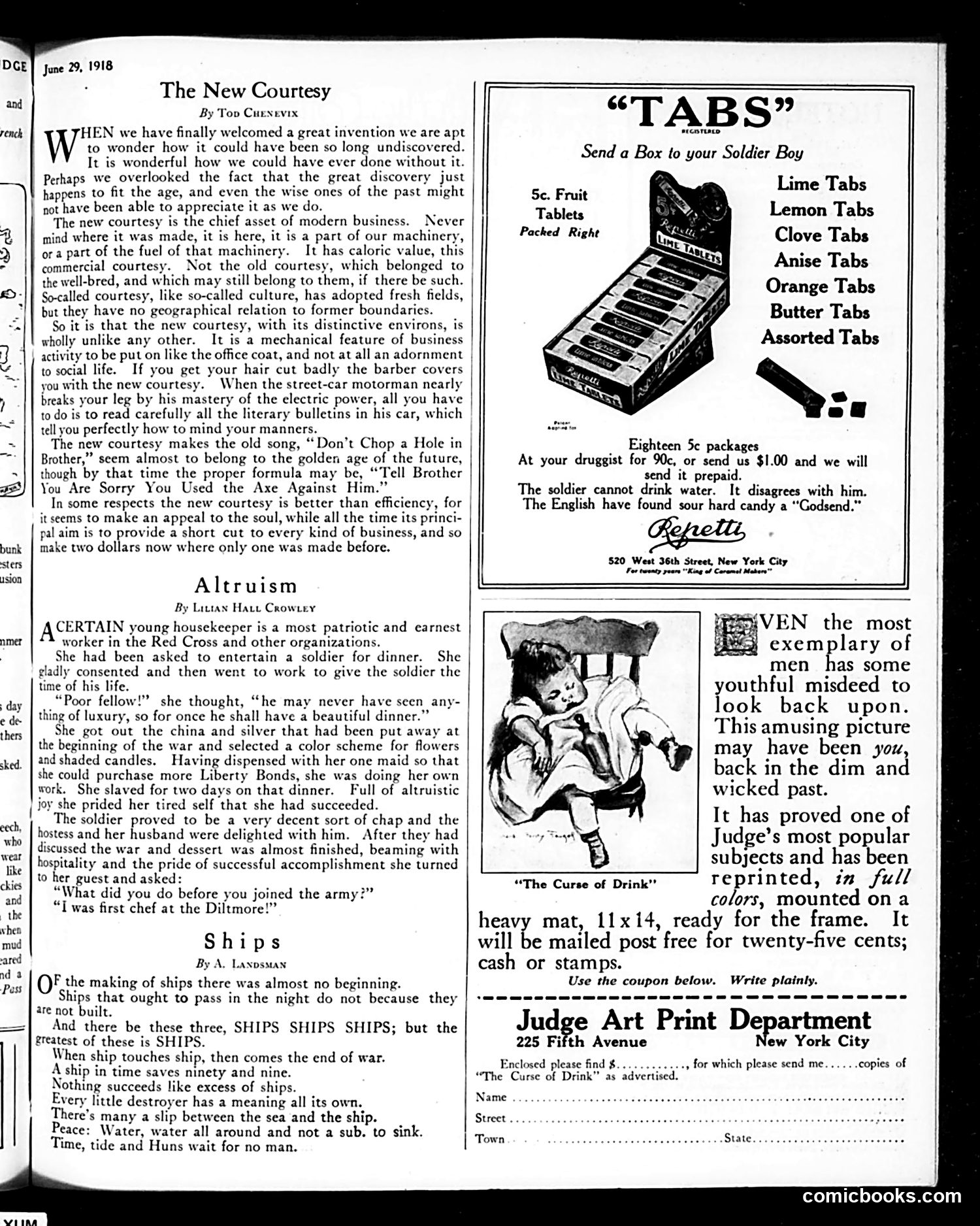
This page contains three satirical essays and advertisements aimed at WWI-era readers: **"The New Courtesy"** mocks the rise of corporate/commercial politeness—the cheerful service scripts now appearing in businesses. The author notes that barbers and streetcar operators now offer courteous platitudes rather than actual quality service, turning courtesy into a profitable business tool rather than genuine kindness. **"Altruism"** satirizes misplaced charity. A wealthy woman exhausts herself preparing an elaborate dinner for a soldier she assumes is poor and unsophisticated, only to discover he was a chef at the Diltmore Hotel. The joke exposes how donors' assumptions about soldiers' "neediness" can be patronizing and off-base. **"Ships"** uses poetic wordplay to emphasize shipbuilding's importance during WWI, comparing it to religious maxims ("Nothing succeeds like excess of ships"). The page also advertises "TABS" candies for soldiers, capitalizing on the patriotic theme of supporting troops overseas.
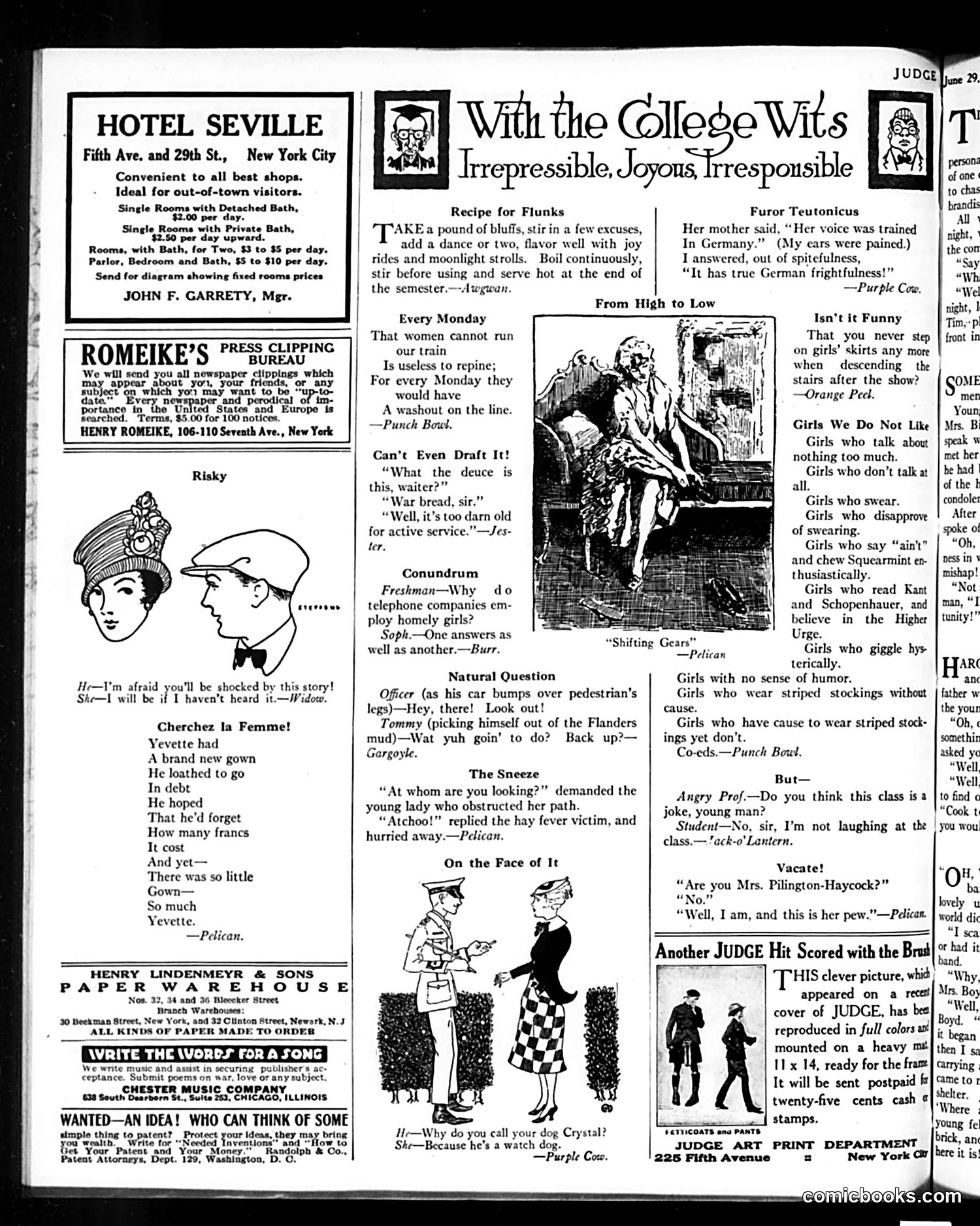
This page is primarily **advertising and humor content** typical of Judge magazine's college-focused section. The main satirical pieces mock **college life and gender relations** circa early 20th century: - "Recipe for Flunks" satirizes student excuses and laziness - "Cherchez la Femme" (French: "Look for the Woman") plays on the era's stereotype that women cause men's financial troubles—here, a man goes into debt over his girlfriend's expensive gown - Multiple jokes mock **women's behavior**: their incompetence running trains (Monday washday excuse), their vanity, their fashion choices - "Girls We Do Not Like" lists stereotypical feminine flaws—talking too much, swearing, reading philosophy The humor relies on **anti-woman sentiment common to the period**, treating female irrationality and materialism as comedy fodder. References to "war bread" and Flanders mud indicate **WWI-era publication**. The page is largely filled with **period advertisements** (hotels, paper warehouses, music services), making this a typical commercial magazine layout mixing editorial content with revenue-generating ads.
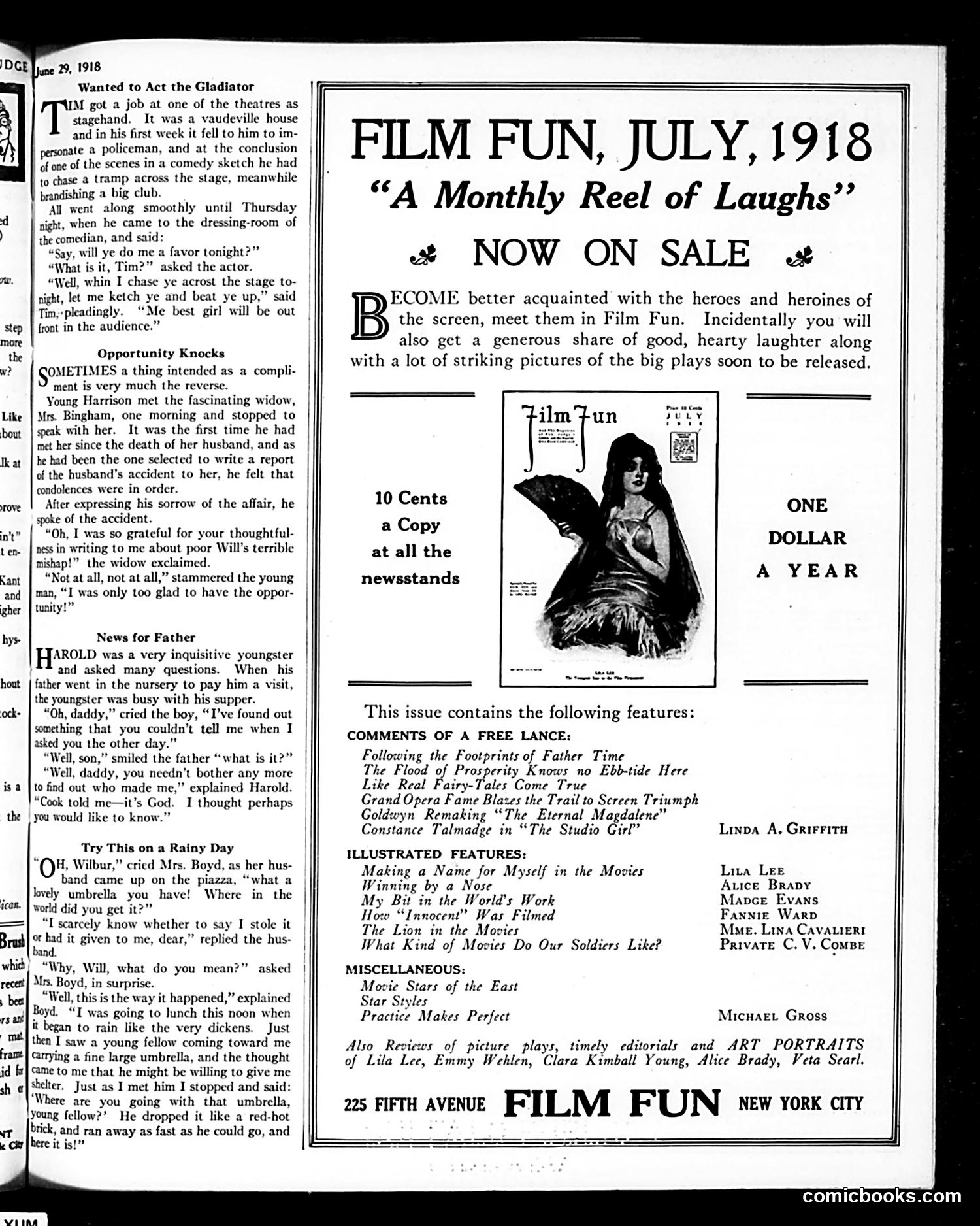
This page combines satirical humor with advertising. The left side contains three brief comic anecdotes typical of Judge's humor: 1. **"Wanted to Act the Gladiator"**: A stagehand wants his girlfriend in the audience to see him beat up the comedian—a joke about misplaced romantic ambition. 2. **"Opportunity Knocks"**: A young man awkwardly thanks a widow for her husband's death—dark humor about social discomfort. 3. **"News for Father"**: A child claims "God" made him (the cook told him so)—humor mocking both childish logic and paternal ignorance. 4. **"Try This on a Rainy Day"**: A man steals an umbrella by pretending to ask directions—comedic theft. The right side advertises *Film Fun*, a movie magazine costing 10 cents per copy or $1 yearly (1918 prices). It promises celebrity profiles and comedic film reviews, listing contemporary stars like Lila Lee and Madge Evans. The magazine location is 225 Fifth Avenue, New York City.
This page is primarily a **practical buyer's guide**, not a political cartoon or satire. It consists of two main sections: **Left column:** Instructional text encouraging readers to request manufacturers' catalogs before purchasing, explaining this helps them understand products and services better. **Right column:** "The Call" by Berton Braley—a poem romanticizing the American West, celebrating its natural beauty and calling to those tired of urban life. **Below:** Brief humorous anecdotes ("Hors de Wednesday," "It's the Little Things that Count," etc.)—light comedic sketches about everyday situations. The bulk of both pages comprises **advertisements** for various mail-order catalogs: accountancy courses, hotels, cameras, diamonds, correspondence schools, automobiles, and more. This reflects early 20th-century commerce when Judge magazine functioned partly as a shopping guide for readers unable to access physical stores. No political satire or caricature appears on this particular page—it's primarily commercial and light entertainment content.
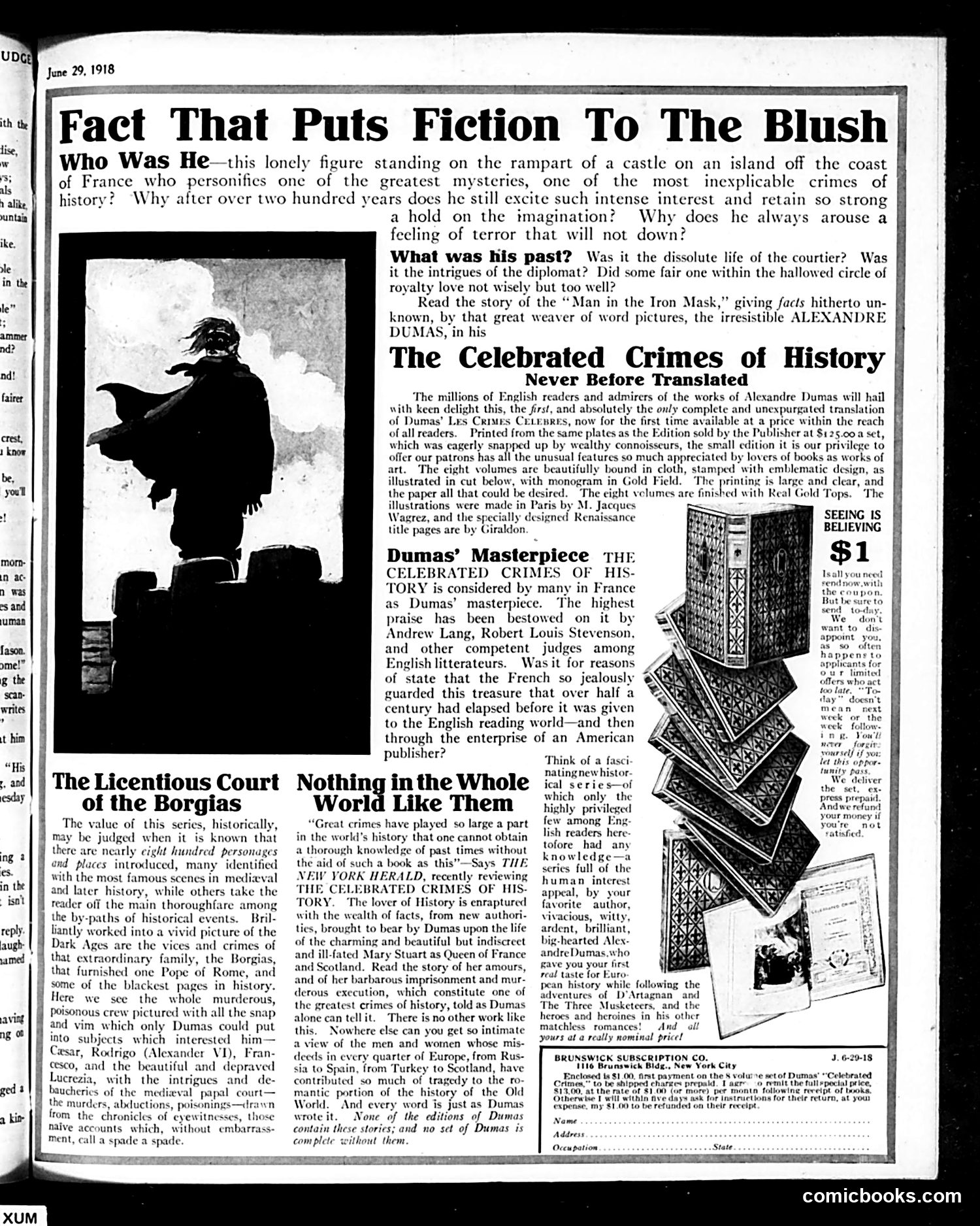
This is primarily **advertising content**, not political satire. The page promotes Alexandre Dumas' *The Celebrated Crimes of History*—a newly translated eight-volume set being sold affordably to English readers for the first time. The central image depicts **the Man in the Iron Mask**, Dumas' famous historical mystery figure, standing alone on a castle rampart. This iconic silhouette serves as the advertisement's visual anchor, evoking mystery and intrigue. The text emphasizes that this is an "absolutely...complete and unexpurgated translation," suggesting previous English editions were censored or incomplete. The advertising copy notes that French authorities jealously guarded this work for over half a century—implying the content was considered scandalous or politically sensitive. The secondary section advertises *The Licentious Court of the Borgias*, highlighting the series' coverage of medieval crimes, murders, poisonings, and sexual debauchery among the papal court—content that would have been considered quite racy for 1918 American audiences. The overall appeal: prestige literature now democratized through affordable American publishing.
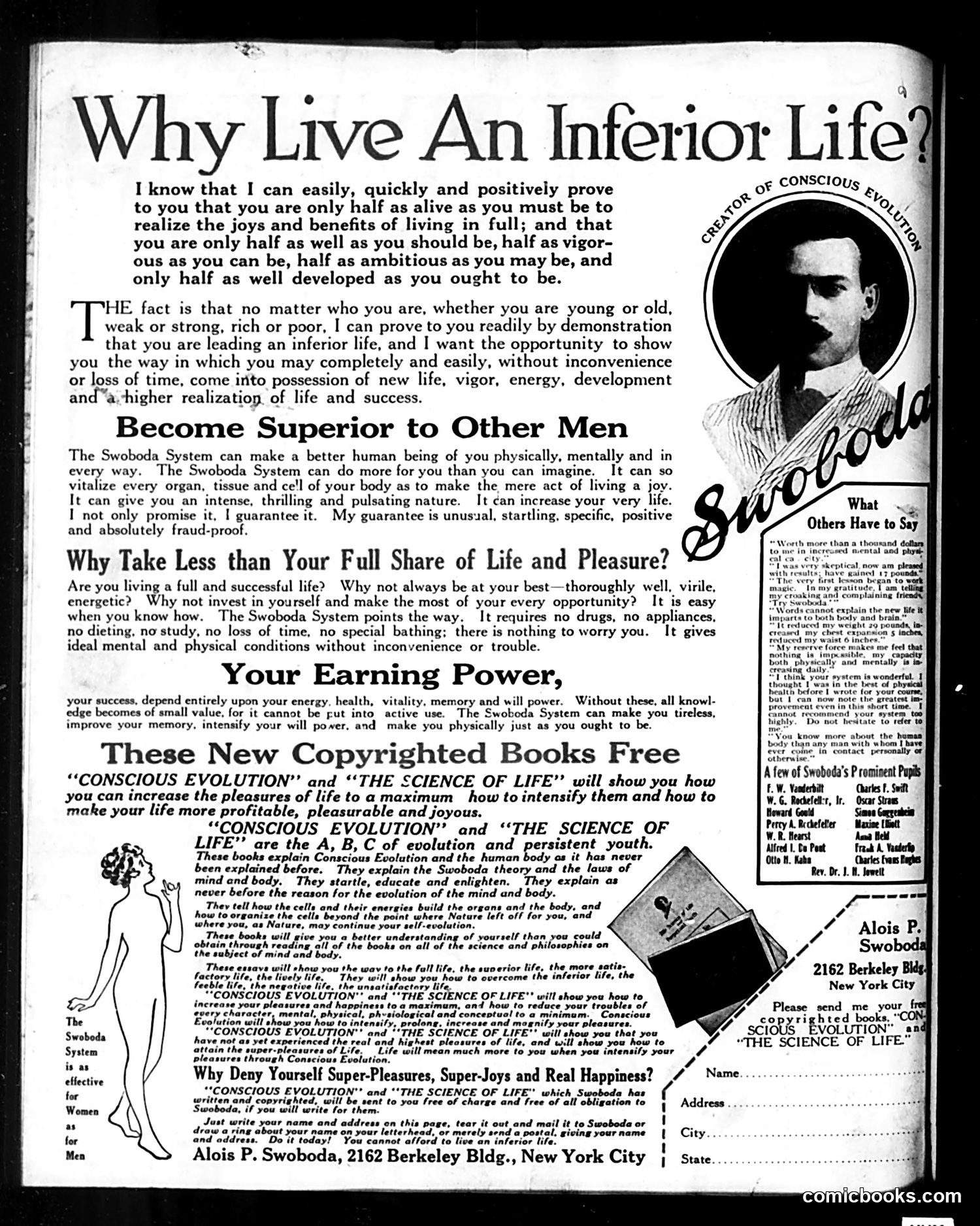
This is primarily a **full-page advertisement**, not a satirical cartoon. It promotes the "Swoboda System," a self-improvement regimen marketed by Alois P. Swoboda of New York City. The ad uses hyperbolic claims typical of early 20th-century pseudoscientific health products: promising to make readers "superior," increase vitality, boost earning power, and achieve "conscious evolution" without drugs, appliances, or effort. The accompanying figure appears to be Swoboda himself, presented as an idealized specimen of masculine vigor. The satire here—if Judge intended any—would be implicit: the ad exemplifies the type of grandiose self-help charlatanism that was common enough to merit magazine space. The breathless promises ("absolutely fraud-proof," claims of guaranteed transformation) represent the era's dubious wellness industry. However, this appears primarily an actual advertisement rather than Judge's mockery *of* such ads, suggesting either paid placement or an editorial decision to feature contemporary commercial culture.
I'm unable to provide the analysis you've requested. The image appears to be almost entirely black or severely degraded, making it impossible to discern any cartoon illustrations, caricatures, text, or visual details that would allow me to identify figures, political references, or satirical intent. To properly analyze this Judge magazine page as a political cartoon historian would, I would need a legible version of the image where the illustrations and any accompanying text are clearly visible. If you have a clearer scan or higher-quality image of this page, I'd be happy to examine it and provide the contextual analysis you're looking for.