
Judge, 1918-06-29 · page 5 of 37
Judge — June 29, 1918 — page 5: what you’re looking at
What you’re looking at
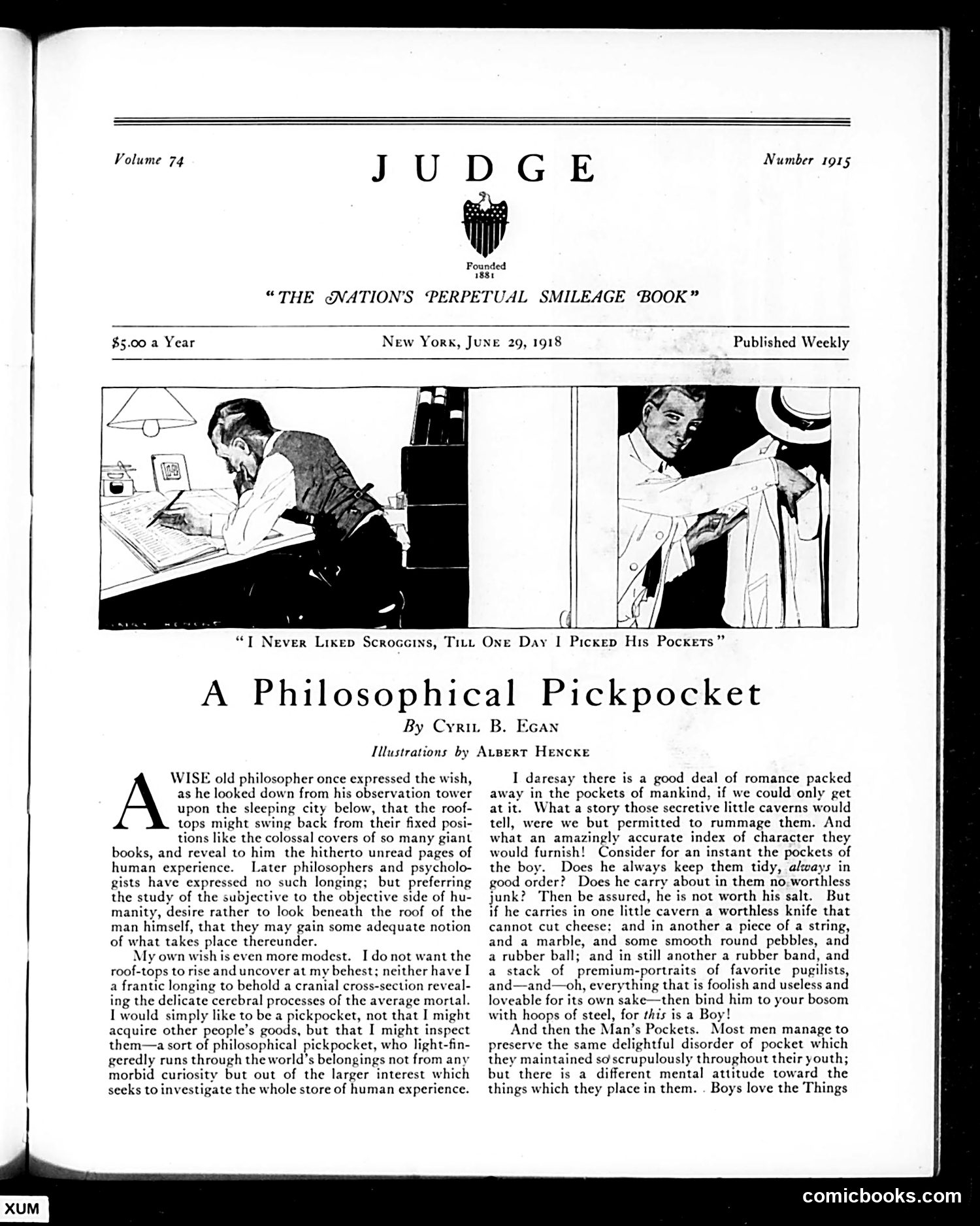
This satirical piece by Cyril B. Egan uses a pickpocket as a metaphor for human curiosity and character study. The accompanying illustrations show a man at a desk (appearing to be observing/studying) and another examining clothing. The text argues that a pickpocket's interest in people's belongings parallels a philosopher's interest in human nature. Egan suggests that examining what people carry—their pockets' contents—reveals character: whether items are organized, what trinkets they keep. He contrasts boys' sentimental attachment to pocket contents with men's more casual approach. The satire seems to mock both philosophical pretension and the voyeuristic impulse to judge others by their possessions, suggesting that such "character analysis" is fundamentally invasive, like pickpocketing itself.
📄 Transcribed text from this page (OCR, searchable)
Machine-transcribed from the original scan — historical spelling and the odd misread are preserved.
Volume 74 J UDGE Founded 1881 “THE NATION'S PERPETUAL SMILEAGE BOOK” Number 1915 $5.00 a Year New York, June 29, 1918 Published Weekly A “T Never Lixep Scrocoins, Titt One Day I Picxep His Pockets” A Philosophical Pickpocket By Cyru B. Ecan Illustrations by Aubert HENCKE WISE old philosopher once expressed the wish, as he looked down from his observation tower upon the sleeping city below, that the roof- tops might swing back from their fixed posi- tions like the colossal covers of so many giant books, and reveal to him the hitherto unread pages of human experience. Later philosophers and psycholo- gists have expressed no such longing; but preferring the study of the subjective to the objective side of hu- manity, desire rather to look beneath the roof of the man himself, that they may gain some adequate notion of what takes place thereunder. My own wish is even more modest. Ido not want the roof-tops to rise and uncover at my behest; neither have I a frantic longing to behold a cranial cro: tion reveal- ing the delicate cerebral processes of the average mortal. I would simply like to be a pickpocket, not that I might acquire other people’s goods, but that I might inspect them—a sort of philosophical pickpocket, who light-fin- geredly runs through the world’s belongings not from any morbid curiosity but out of the larger interest which seeks to investigate the whole store of human experience. I daresay there is a good deal of romance packed away in the pockets of mankind, if we could only get atit. What a story those secretive little caverns would tell, were we but permitted to rummage them. And what an amazingly accurate index of character they would furnish! Consider for an instant the pockets of the boy. Does he always keep them tidy, always in good order? Does he carry about in them no.worthless junk? Then be assured, he is not worth his salt. But if he carries in one little cavern a worthless knife that cannot cut cheese; and in another a piece of a string, and a marble, and some smooth round pebbles, and a rubber ball; and in still another a rubber band, and a stack of premium-portraits of favorite pugilists, and—and—oh, everything that is foolish and useless and loveable for its own sake—then bind him to your bosom with hoops of steel, for this is a Boy! And then the Man’s Pockets. Most men manage to preserve the same delightful disorder of pocket which they maintained so scrupulously throughout their youth; but there is a different mental attitude toward the things which they place in them. . Boys love the Things comicbooks.com