
Judge, 1918-06-29 · page 13 of 37
Judge — June 29, 1918 — page 13: what you’re looking at
What you’re looking at
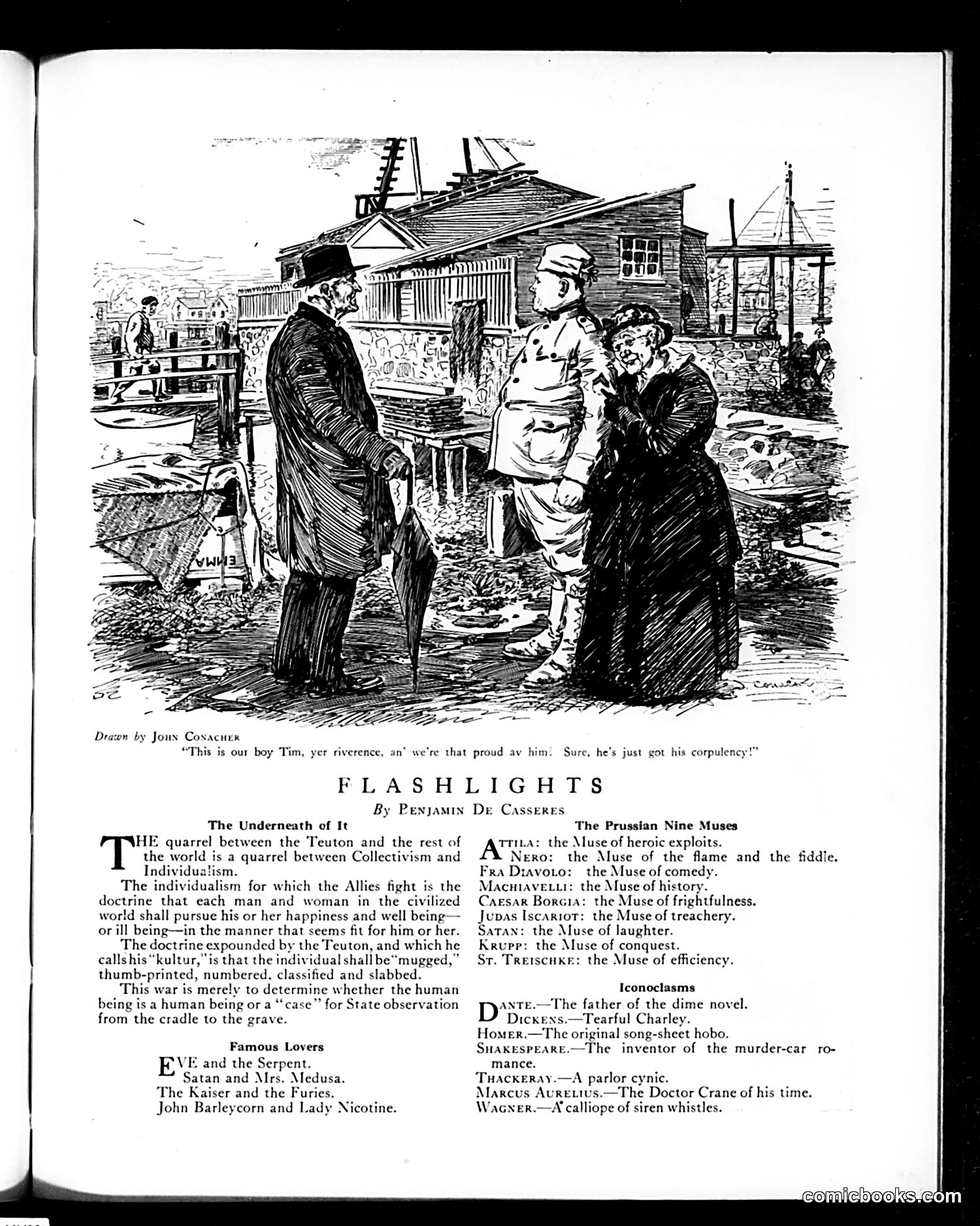
The main cartoon depicts three figures at a waterfront: two working-class Irish immigrants proudly presenting their son "Tim" to a clergyman ("yer riverence"). The joke plays on "corpulency" (fatness)—the parents claim their boy "just got his corpulency," likely meaning he's achieved a well-fed, prosperous appearance, which they view as a mark of success in America. The accompanying essay "The Underneath of It" by Benjamin De Casseres presents WWI propaganda contrasting Allied "Individualism" (personal freedom) against German "Kultur" (state control reducing citizens to numbered, classified "cases"). This reflects common American pro-Allied rhetoric circa 1914-1917. The remaining sections—"Famous Lovers," "The Prussian Nine Muses," and "Iconoclasms"—are humorous lists mocking German militarism and various literary/historical figures through irreverent associations. The overall page reflects Judge's satirical approach combining ethnic humor with wartime political messaging.
📄 Transcribed text from this page (OCR, searchable)
Machine-transcribed from the original scan — historical spelling and the odd misread are preserved.
Drawn by Joux Coxacuer “This is our boy Tim, yer riverence, an’ we're that proud av him. Sure, he’s just got his corpulency!” FLASHLIGHTS By Penjamin De Casseres The Underneath of It HE quarrel between the Teuton and the rest of | the world is a quarrel between Collectivism and Individuatism. The individualism for which the Allies fight is the doctrine that each man and woman in the civilized world shall pursue his or her happiness and well being— or ill being—in the manner that seems fit for him or her. The doctrine expounded by the Teuton, and which he callshis“kultur,” is that the individual shall be“mugged,” thumb-printed, numbered, classified and slabbed. This war is merely to determine whether the human being is a human being or a “case” for State observation from the cradle to the grave. Famous Lovers VE and the Serpent. Satan and Mrs. Medusa. ‘The Kaiser and the Furies. John Barleycorn and Lady The Prussian Nine Muses trita: the Muse of heroic exploits. Nero: the Muse of the flame and the fiddle. Fra Dravoto: the Muse of comedy. Macwiavew he Muse of history. Caesar Boraia: the Muse of frightfulness. Jupas Iscariot: the Muse of treachery. Satan: the Muse of laughter. Krupp: the Muse of conquest. Sr. Tretscuke: the Muse of efficiency. Iconoclasms ~The father of the dime novel. —Tearful Charley. The original song-sheet hobo. SuakespeaRE.—The inventor of the murder-car ro- mance. ‘Tuackeray.—A parlor cynic. Marcus tius.—The Doctor Crane of his time. Wacner.—A calliope of siren whistles.