
Judge, 1918-06-29 · page 6 of 37
Judge — June 29, 1918 — page 6: what you’re looking at
What you’re looking at
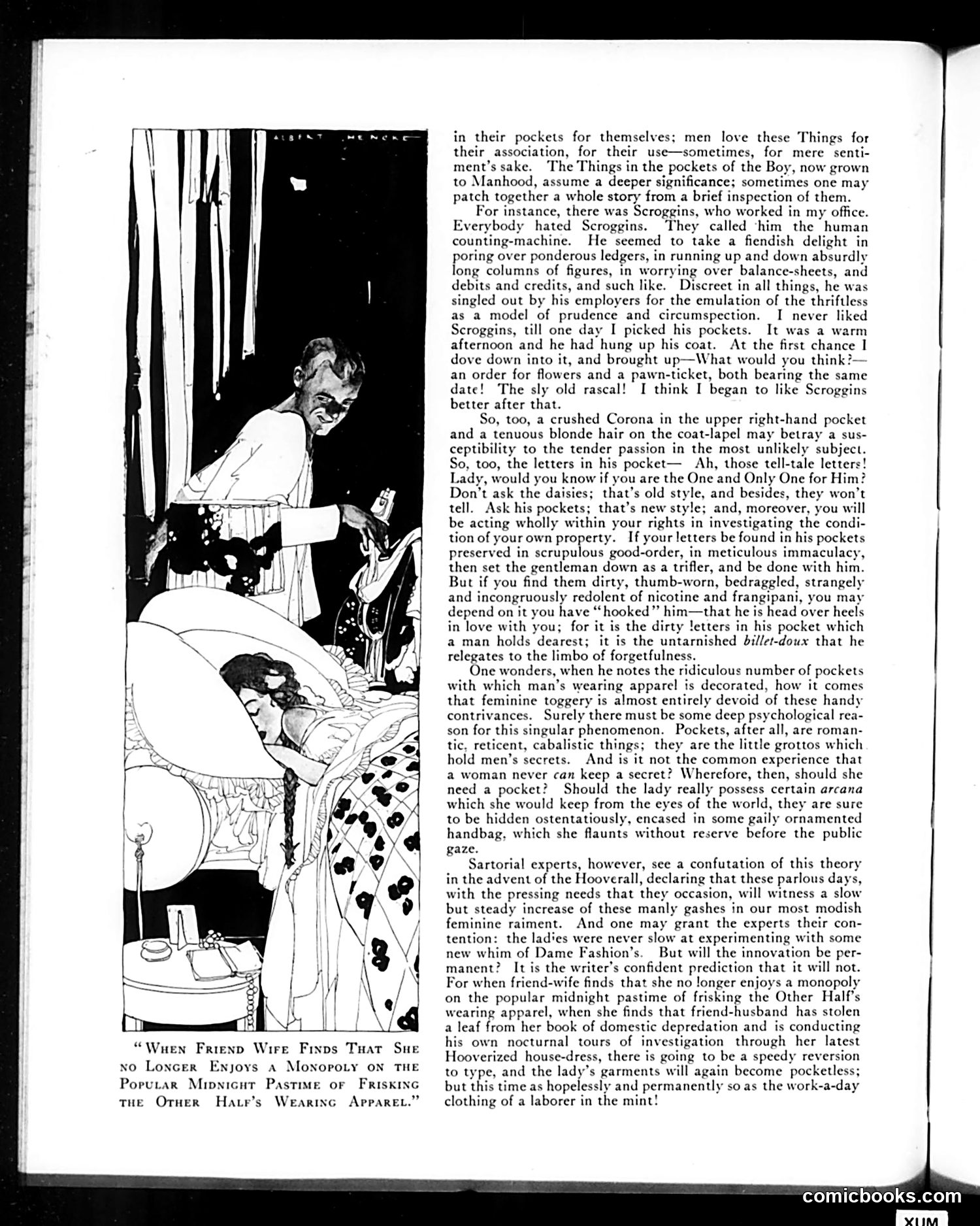
This page satirizes **women's fashion and social behavior** rather than politics. The illustrated narrative concerns a husband discovering his wife's infidelity through examining objects in her pockets—a humorous reversal of the essay's opening premise that men (not women) traditionally carry tell-tale items. The accompanying text discusses **pockets as repositories of secrets**, arguing that women lack pockets in their clothing, therefore cannot hide personal evidence. The satire suggests that if women *had* pockets like men, they too would keep incriminating items—love letters, theater tickets, etc.—exposing their romantic indiscretions. The cartoon depicts this discovery scene: a man examining his sleeping wife's belongings, finding damning evidence of infidelity. The humor targets both female fashion's impracticality and assumptions about gendered morality and secrecy.
📄 Transcribed text from this page (OCR, searchable)
Machine-transcribed from the original scan — historical spelling and the odd misread are preserved.
“Wuen Frrenp Wire Finps Tuat Sue no Loncer E Porutar Mipnicut Pastime oF THe OTHER Hatr’s WEARING sjoys A Monopoty ON THE FriskinG ApPareEL.” in their pockets for themselves; men love these Things for their association, for their use—sometimes, for mere senti- ment’s sake. The Things in the pockets of the Boy, now grown to Manhood, assume a deeper significance; sometimes one may patch together a whole story from a brief inspection of them. For instance, there was Scroggins, who worked in my office. Everybody hated Scroggins. They called ‘him the human counting-machine. He seemed to take a fiendish delight in poring over ponderous ledgers, in running up and down absurdly long columns of figures, in worrying over balance-sheets, and debits and credits, and such like. Discreet in all things, he was singled out by his employers for the emulation of the thriftless as a model of prudence and circumspection. I never liked Scroggins, till one day I picked his pockets. It was a warm afternoon and he had hung up his coat. At the first chance | dove down into it, and brought up—What would you think?- an order for flowers and a pawn-ticket, both bearing the same date! The sly old rascal! I think I began to like Scroggins better after that. So, too, a crushed Corona in the upper right-hand pocket and a tenuous blonde hair on the coat-lapel may betray a sus- ceptibility to the tender passion in the most unlikely subject. So, too, the letters in his pocket— Ah, those tell-tale letters! Lady, would you know if you are the One and Only One for Him? Don’t ask the daisies; that’s old style, and besides, they won’t tell. Ask his pockets; that’s new style; and, moreover, you will be acting wholly within your rights in investigating the condi- tion of your own property. If your letters be found in his pockets preserved in scrupulous good-order, in meticulous immaculacy, then set the gentleman down as a trifler, and be done with him. But if you find them dirty, thumb-worn, bedraggled, strangely and incongruously redolent of nicotine and frangipani, you may depend on it you have “hooked” him—that he is head over heels in love with you; for it is the dirty letters in his pocket which a man holds dearest; it is the untarnished dillet-doux that he relegates to the limbo of forgetfulness. One wonders, when he notes the ridiculous number of pockets with which man’s wearing apparel is decorated, how it comes that feminine toggery is almost entirely devoid of these hand contrivances. Surely there must be some deep psychological rea son for this singular phenomenon. Pockets, after all, are roman- tic, reticent, cabalistic things; they are the little grottos which hold men’s secrets. And is it not the common experience that a woman never can keep a secret? Wherefore, then, should she need a pocket? Should the lady really possess certain arcana which she would keep from the eyes of the world, they are sure to be hidden ostentatiously, encased in some gaily ornamented handbag, which she flaunts without reserve before the public gaze. Sartorial experts, however, see a confutation of this theory in the advent of the Hooverall, declaring that these parlous days, with the pressing needs that they occasion, will witness a slow but steady increase of these manly gashes in our most modish feminine raiment. And one may grant the experts their con- tention: the ladies were never slow at experimenting with some new whim of Dame Fashion’s. But will the innovation be per- manent? It is the writer’s confident prediction that it will not. For when friend-wife finds that she no longer enjoys a monopoly on the popular midnight pastime of frisking the Other Half’s wearing apparel, when she finds that friend-husband has stolen a leaf from her book of domestic depredation and is conducting his own nocturnal tours of investigation through her latest Hooverized house-dress, there is going to be a speedy reversion to type, and the lady’s garments will again become pocketle: but this time as hopelessly and permanently so as the work-a-day clothing of a laborer in the mint! comicbooks.com