
Judge, 1918-06-29 · page 31 of 37
Judge — June 29, 1918 — page 31: what you’re looking at
What you’re looking at
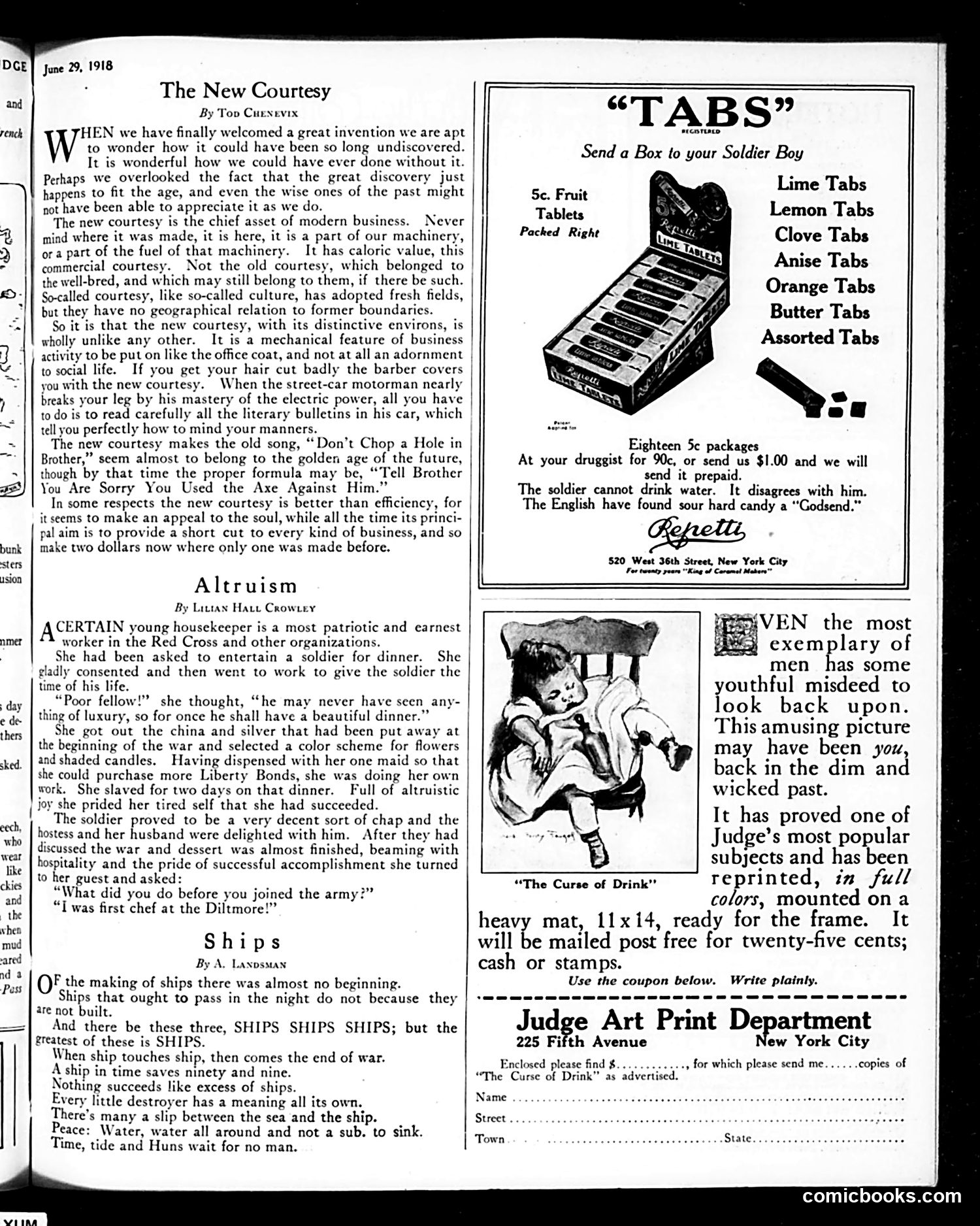
This page contains three satirical essays and advertisements aimed at WWI-era readers: **"The New Courtesy"** mocks the rise of corporate/commercial politeness—the cheerful service scripts now appearing in businesses. The author notes that barbers and streetcar operators now offer courteous platitudes rather than actual quality service, turning courtesy into a profitable business tool rather than genuine kindness. **"Altruism"** satirizes misplaced charity. A wealthy woman exhausts herself preparing an elaborate dinner for a soldier she assumes is poor and unsophisticated, only to discover he was a chef at the Diltmore Hotel. The joke exposes how donors' assumptions about soldiers' "neediness" can be patronizing and off-base. **"Ships"** uses poetic wordplay to emphasize shipbuilding's importance during WWI, comparing it to religious maxims ("Nothing succeeds like excess of ships"). The page also advertises "TABS" candies for soldiers, capitalizing on the patriotic theme of supporting troops overseas.
📄 Transcribed text from this page (OCR, searchable)
Machine-transcribed from the original scan — historical spelling and the odd misread are preserved.
bunk sters usion nmer ; day thers sked. eech, who wear like chies and | the when mud -ared nd 3 Pass June 29, 1918 The New Courtesy By Too Curxevix HEN we have finally welcomed a great invention we are apt to wonder how it could have been so long undiscovered. It is wonderful how we could have ever done without it. | Perhaps we overlooked the fact that the great discovery just happens to fit the age, and even the wise ones of the past might not have been able to appreciate it as we do. The new courtesy is the chief asset of modern business. Never mind where it was made, it is here, it is a part of our machinery, ora part of the fuel of that machinery. It has caloric value, this commercial courtesy. Not the old courtesy, which belonged to the well-bred, and which may still belong to them, if there be such. So-called courtesy, like so-called culture, has adopted fresh fields, but they have no geographical relation to former boundaries. So it is that the new courtesy, with its distinctive environs, is wholly unlike any other. to social life. If you get your hair cut badly the barber covers you with the new courtesy. When the street-car motorman nearly breaks your leg by his mastery of the electric power, all you have to do is to read carefully all the literary bulletins in his car, which tell you perfectly how to mind your manners. The new courtesy makes the old song, “Don’t Chop a Hole in Brother,” seem almost to belong to the golden age of the future, though by that time the proper formula may be, “Tell Brother You Are Sorry You Used the Axe Against Him.” In some respects the new courtesy is better than efficiency, for it seems to make an appeal to the soul, while all the time its princi- pal aim is to provide a short cut to every kind of business, and so make two dollars now where only one was made before. Altruism By Latta Haut Crowrey CERTAIN young housekeeper is a most patriotic and earnest worker in the Red Cross and other organizations. She had been asked to entertain a soldier for dinner. She gladly consented and then went to work to give the soldier the time of his life. “Poor fellow!” she thought, “he may never have seen any- thing of luxury, so for once he shall have a beautiful dinner.” She got out the china and silver that had been put away at the beginning of the war and selected a color scheme for flowers and shaded candles. Having dispensed with her one maid so that she could purchase more Liberty Bonds, she was doing her own work. She slaved for two days on that dinner. Full of altruistic joy she prided her tired self that she had succeeded. The soldier proved to be a very decent sort of chap and the hostess and her husband were delighted with him. After they had discussed the war and dessert was almost finished, beaming with hospitality and the pride of successful accomplishment she turned to her guest and asked: “What did you do before you joined the army?” I was first chef at the Diltmore!” Ships By A, Laxpsman F the making of ships there was almost no beginning. Ships that ought to pass in the night do not because they are not built. And there be these three, SHIPS SHIPS SHIPS; but the Rreatest of these is SHIPS. When ship touches ship, then comes the end of war. A ship in time saves ninety and nine. Nothing succeeds like excess of ships. Every little destroyer has a meaning all its own. There’s many a slip between the sea and the ship. Peace: Water, water all around and not a sub. to sink. Time, tide and Huns wait for no man. It is a mechanical feature of business | activity to be put on like the office coat, and not at all an adornment | “TABS” seoriae Send a Box to your Soldier Boy Lime Tabs Lemon Tabs Clove Tabs Anise Tabs Orange Tabs Butter Tabs Assorted Tabs Se. Fruit Tablets Packed Right e . of Eighteen 5¢ packages At your druggist for 90c, or send us $1.00 and we will send it prepaid. The soldier cannot drink water. It disagrees with him. The English have found sour hard candy a “Godsend.” Repetts, 520 West 36th Street, New York City Fee twenty youre “King of Caramel Mabore™ LEESIVEN the most exemplary of men_ has some youthful misdeed to look back upon. This amusing picture may have been you, back in the dim and wicked past. tere proved ence! udge’s most popular niece and has been reprinted, in full colors, mounted on a heavy mat, 11x14, ready for the frame. It will be mailed post free for twenty-five cents; cash or stamps. Use the coupon below. Write plainly. Judge Art Print Department 225 Fifth Avenue lew York City Enclosed please find $............, for which please send me...... copies of “The Curse of Drink” as advertised. “The Curse of Drink” Name Street . . Town comicbooks.com