
Judge, 1918-06-29 · page 16 of 37
Judge — June 29, 1918 — page 16: what you’re looking at
What you’re looking at
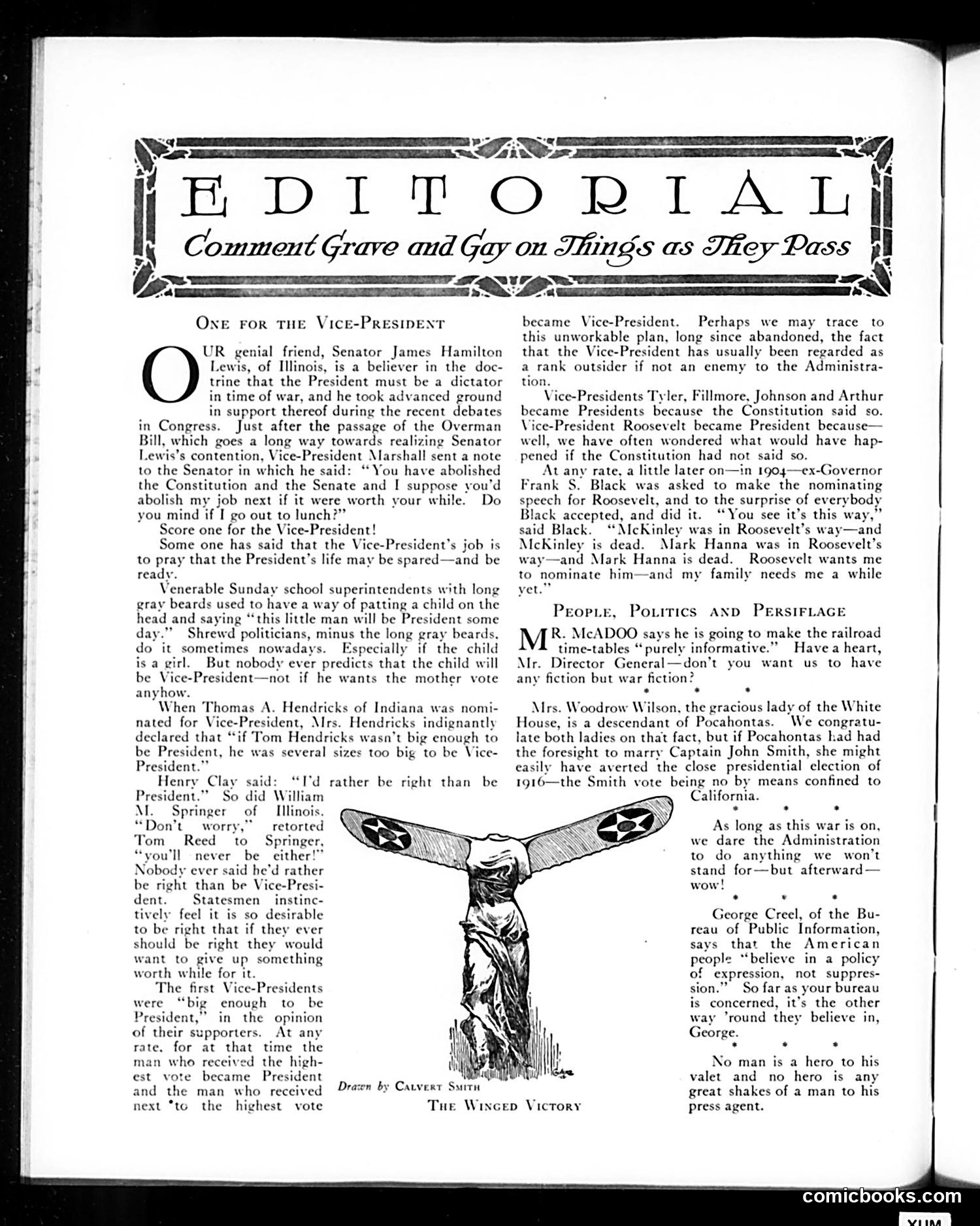
This satirical editorial mocks the powerlessness of the Vice-Presidency during World War I. Vice-President Thomas Marshall reportedly quipped to Senator James Hamilton Lewis (who backed the Overman Bill, which expanded presidential wartime powers) that the administration had "abolished the Constitution and the Senate" and asked if they'd "abolish my job next if it were worth your while." The joke: Marshall suggests his position is so worthless that abolishing it wouldn't matter. The editorial elaborates this theme by noting that nobody aspires to the Vice-Presidency—mothers wouldn't want it for their children. It references historical figures (Tyler, Fillmore, Johnson, Arthur) who became President only through presidential death, and Theodore Roosevelt, whose predecessor's death elevated him. The accompanying illustration (Calvert Smith's "The Winged Victory") depicts a classical winged figure, ironically symbolizing triumph while the text emphasizes the Vice-President's irrelevance and near-universal contempt for the office. The satire criticizes both the constitutional weakness of the Vice-Presidency and wartime executive overreach.
📄 Transcribed text from this page (OCR, searchable)
Machine-transcribed from the original scan — historical spelling and the odd misread are preserved.
y | One For THE VicE-PRESIDENT UR genial friend, Senator James Hamilton Lewis, of Illinois, is a believer in the doc- trine that the President must be a dictator in time of war, and he took advanced ground in support thereof during the recent debates in Congress. Just after the passage of the Overman Bill, which goes a long way towards realizing Senator Lewis’s contention, Vice-President Marshall sent a note to the Senator in which he said: “You have abolished the Constitution and the Senate and I suppose you'd abolish my job next if it were worth your while. Do you mind if I go out to lunch?” Score one for the Vice-President! Some one has said that the Vice-President’s job is to pray that the President’s life may be spared—and be ready. Venerable Sunday school superintendents with long gray beards used to have a way of patting a child on the head and saying “this little man will be President some day Shrewd politicians, minus the long gray beards, do it sometimes nowadays. ally if the child is a girl. But nobody ever predicts that the child will be Vice-President—not if he wants the mother vote anyhow. When Thomas A. Hendricks of Indiana was nomi- nated for Vice-President, Mrs. Hendricks indignantly declared that “if Tom Hendricks wasn’t big enough to be President, he was several sizes too big to be Vice- President.” Henry Clay said: “I'd rather be right than be President.” So did William M. Springer of _ Illinois. “Don’t worry,” retorted Tom Reed to Springer, “you'll never be cither!” Nobody ever said he'd rather be right than be Vice-Presi- Statesmen _instinc- feel it is so desirable to be right that if they ever should be right they would want to give up something worth while for it. The first Vice-Presidents were “big enough to be President,” in the opinion of their supporters. At any rate, for at that time the man who received the high- est vote became President and the man who received next *to the highest vote Drazen by Catvert Ssitn Tue Wixcep Victory sar EDITODIALS Comment Grave and Geo ou Things as They Pass | xl became Vice-President. Perhaps we may trace to this unworkable plan, long since abandoned, the fact that the Vice-President has usually been regarded as a rank outsider if not an enemy to the Administra- tion. Vice-Presidents Tyler, Fillmore, Johnson and Arthur became Presidents because the Constitution said so. Vice-President Roosevelt became President because— well, we have often wondered what would have hap- pened if the Constitution had not said so. At any rate, a little later on—in 1904—ex-Governor Frank S. Black was asked to make the nominating speech for Roosevelt, and to the surprise of everybody Black accepted, and did it. “You see it’s this way,” said Black. ‘McKinley was in Roosevelt’s way—and McKinley is dead. Mark Hanna was in Roosevelt's way—and Mark Hanna is dead. Roosevelt wants me to nominate him—and my family needs me a while vet. Peopie, Pouitics AND PERSIFLAGE M R. McADOO says he is going to make the railroad time-tables “purely informative.” Have a heart, Director General—don’t you want us to have fiction but war fiction? Mr. Mrs. Woodrow Wilson, the gracious lady of the White House, is a descendant of Pocahontas. We congratu- late both ladies on that fact, but if Pocahontas had had the foresight to marry Captain John Smith, she might easily have averted the close presidential election of 1916—the Smith vote being no by means confined to California. * . . As long as this war is on, we dare the Administration to do anything we won't stand for—but afterward — wow! . . * George Creel, of the Bu- reau of Public Information, says that the American people “believe in a policy of expression, not suppres- sion.” So far as your bureau is concerned, it’s the other way ‘round they believe in, George. . * * No man is a hero to his valet and no hero is any great shakes of a man to his Press agent. comicbooks.com