
Judge, 1918-06-29 · page 9 of 37
Judge — June 29, 1918 — page 9: what you’re looking at
What you’re looking at
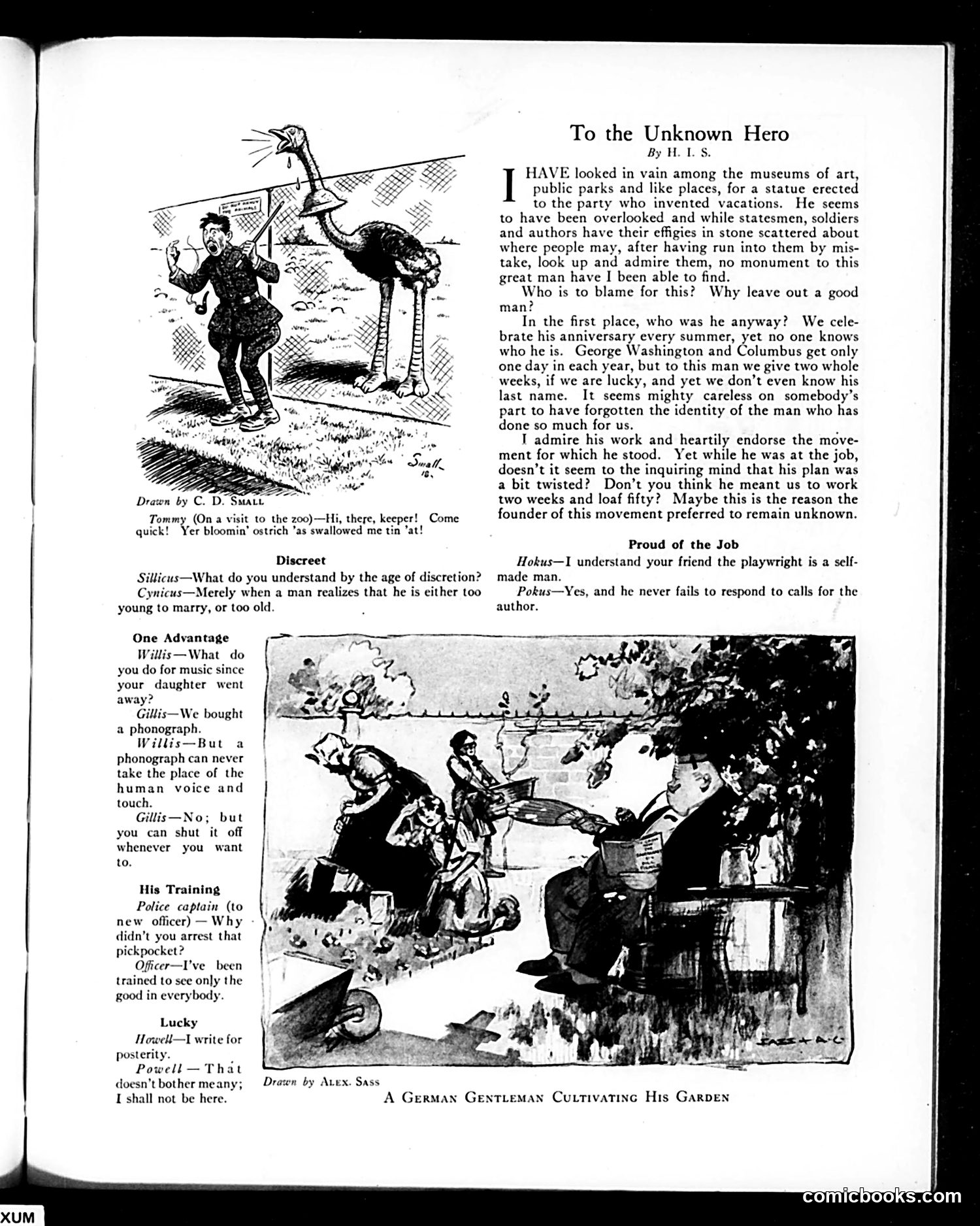
This page contains several brief satirical pieces typical of early 20th-century American humor: **"To the Unknown Hero"** mocks the inventor of vacations—a social commentary suggesting Americans celebrate vacations (two weeks annually) more generously than historical figures like Washington or Columbus (one day each), yet don't even know the vacation inventor's name. The satire questions whether the inventor truly intended workers to "loaf fifty" percent of the time. **The cartoons** include: - A child at a zoo whose tin hat was swallowed by an ostrich (simple slapstick) - "A German Gentleman Cultivating His Garden" (drawn by Alex Sass)—likely a WWI-era jab at German culture, though details are unclear **Brief jokes** mock discretion, phonographs replacing human interaction, a police officer's excessive morality, and a writer's ironic claims of writing "for posterity." The page reflects period preoccupations: leisure culture, technology's social impact, and wartime attitudes toward Germans.
📄 Transcribed text from this page (OCR, searchable)
Machine-transcribed from the original scan — historical spelling and the odd misread are preserved.
XUM ae Drawn by C. D. Tommy (On a visit to the 200)—Hi, there, keeper! Come quick! Yer bloomin’ ostrich ’as swallowed me tin ‘at! Discreet Sillicus—What do you understand by the age of discretion? Cynicus—Merely when a man realizes that he is either too young to marry, or too old. To the Unknown Hero By HOLS. HAVE looked in vain among the museums of art, I public parks and like places, for a statue erected to the party who invented vacations. He seems to have been overlooked and while statesmen, soldiers and authors have their effigies in stone scattered about where people may, after having run into them by mis- take, look up and admire them, no monument to this great man have I been able to find. Who is to blame for this?) Why leave out a good man? In the first place, who was he anyway? We cele- brate his anniversary every summer, yet no one knows who he is. George Washington and Columbus get only one day in each year, but to this man we give two whole weeks, if we are lucky, and yet we don’t even know his last name. It seems mighty careless on somebody’s part to have forgotten the identity of the man who has done so much for us. 3 I admire his work and heartily endorse the move- ment for which he stood. Yet while he was at the job, doesn’t it seem to the inquiring mind that his plan was a bit twisted? Don’t you think he meant us to work two weeks and loaf fifty? Maybe this is the reason the founder of this movement preferred to remain unknown. Proud of the Job Hokus—I understand your friend the playwright is a self- made man. Pokus—Yes, and he never fails to respond to calls for the author. One Advantage Willis—What do you do for mus nce your daughter went away? Gillis—We bought a phonograph. Willis—But a phonograph can never take the place of the human voice and touch. Gillis—No; but you can shut it off whenever you want to. His Training Police captain (to new officer) — Why didn’t you arrest that pickpocket? Officer—I’ve been trained to see only the good in everybody. Lucky Howell—I write for posterity Powell — That doesn’t bother meany; — Drawn by Avex. Sass I shall not be here. A German Gentteman Cuttivatinc His Garpen