
Judge, 1918-06-29 · page 11 of 37
Judge — June 29, 1918 — page 11: what you’re looking at
What you’re looking at
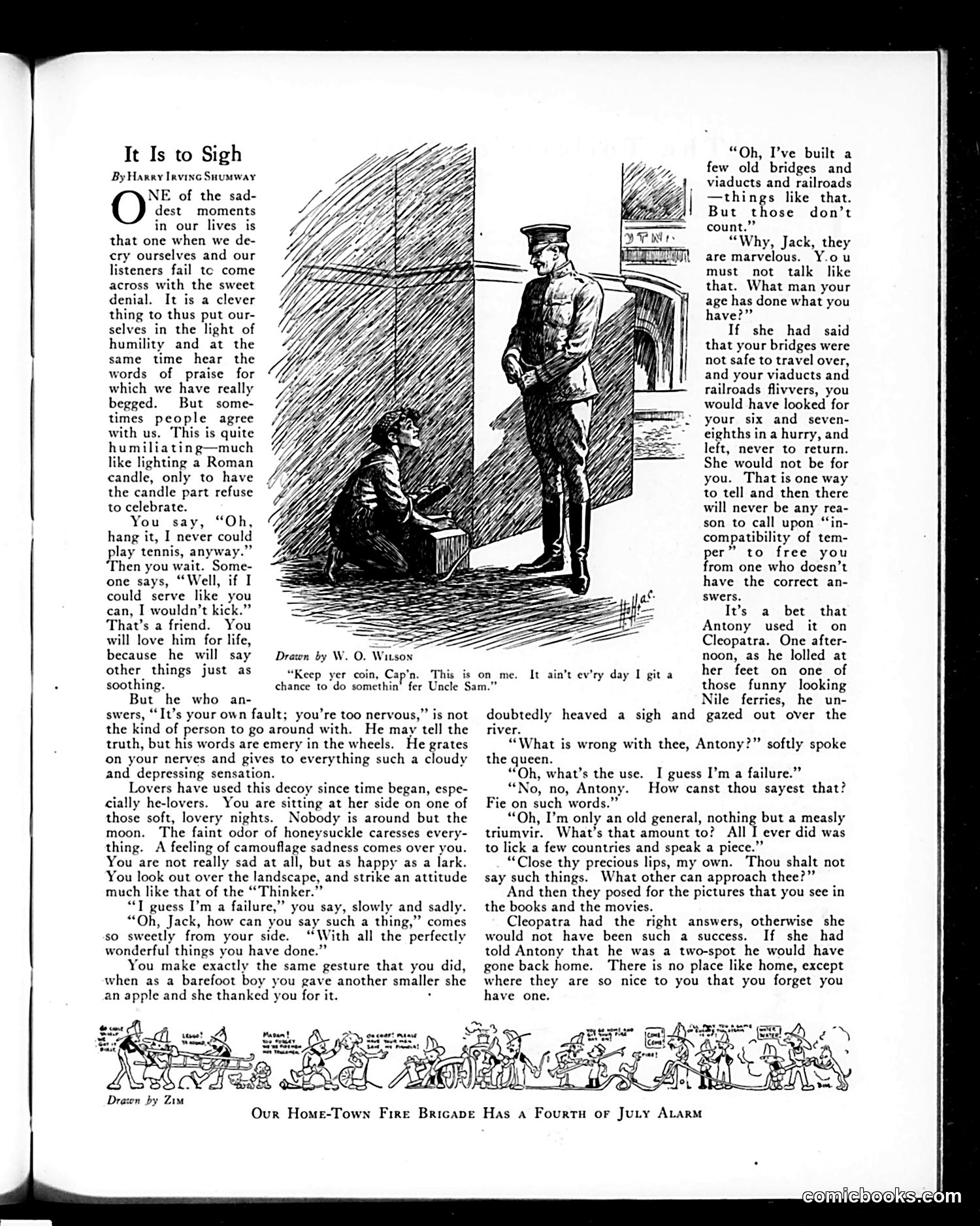
This is a humorous essay on social dynamics, not political satire. Harry Irving Shumway explores the art of **false modesty and its proper response**. The piece argues that when someone self-deprecates ("I'm a failure"), the socially skilled reply is reassurance and praise—not agreement. A friend agrees with your self-criticism; a *real* friend contradicts it sweetly. The essay illustrates this through the example of "Jack," who pretends inadequacy to fish for compliments from his romantic interest. The historical reference to **Antony and Cleopatra** demonstrates this dynamic across time: Antony sighs dramatically about his insignificance, and Cleopatra responds with perfectly calibrated flattery, ensuring his devotion. Had she agreed he was worthless, he'd have left. The cartoon (by W.O. Wilson) shows a soldier refusing payment, saying it's a privilege to help "Uncle Sam"—demonstrating the *correct* humble response that inspires others' praise. The satirical point: **emotional intelligence in relationships depends on knowing when to contradict someone's self-assessment with reassurance.**
📄 Transcribed text from this page (OCR, searchable)
Machine-transcribed from the original scan — historical spelling and the odd misread are preserved.
It Is to Sigh By Harny Invinc Suumway NE of the sad- dest moments in our lives is that one when we de- cry ourselves and our listeners fail te come across with the sweet denial. It is a clever thing to thus put our- selves in the light of humility and at the same time hear the words of praise for which we have really begged. But some- times people agree with us. This is quite humiliating—much like lighting a Roman candle, only to have the candle part refuse to celebrate. You say, “Oh, hang it, I never could play tennis, anyway.” ‘Then you wait. Some- one says, “Well, if I could serve like you can, I wouldn’t kick.” That’s a friend. You will love him for life, because he will say other things just as soothing. But he who an- swers, “It’s your own fault; you’re too nervous,” is not the kind of person to go around with. He may tell the truth, but his words are emery in the wheels. He grates on your nerves and gives to everything such a cloudy and depressing sensation. Lovers have used this decoy since time began, espe- cially he-lovers. You are sitting at her side on one of those soft, lovery nights. Nobody is around but the moon. The faint odor of honeysuckle caresses every- thing. A feeling of camouflage sadness comes over you. You are not really sad at all, but as happy as a lark. You look out over the landscape, and strike an attitude much like that of the “Thinker.” “T guess I’m a failure,” you say, slowly and sadly. “Oh, Jack, how can you say such a thing,” comes so sweetly from your side. ‘With all the perfectly wonderful things you have done.” You make exactly the same gesture that you did, when as a barefoot boy you gave another smaller she an apple and she thanked you for it. ¢ Drawn by W. O. Witson “Keep yer coin, Cap'n. ‘This is on me. It ain't ev'ry day I git a chance to do somethin’ fer Uncle Sam.” Our Home-Town Fire Bricape Has a Fourtu or Juty ALARM “Oh, I’ve built a few old bridges and viaducts and railroads —things like that. But those don’t count.” “Why, Jack, they are marvelous. Y.ou must not talk like that. What man your age has done what you have?” If she had said that your bridges were not safe to travel over, and your viaducts and railroads flivvers, you would have looked for your six and seven- eighths in a hurry, and left, never to return. She would not be for you. That is one way to tell and then there will never be any rea- son to call upon “in- compatibility of tem- per” to free you from one who doesn’t have the correct an- swers. It’s a bet that Antony used it on Cleopatra. One after- noon, as he lolled at her feet on one of those funny looking Nile ferries, he un- doubtedly heaved a sigh and gazed out over the river. “What is wrong with thee, Antony?” softly spoke the queen. “Oh, what’s the use. I guess I’m a failure.” “No, no, Antony. How canst thou sayest that? Fie on such words.” “Oh, I’m only an old general, nothing but a measly triumvir. What’s that amount to? All I ever did was to lick a few countries and speak a piece.” “Close thy precious lips, my own. Thou shalt not say such things. What other can approach thee?” And then they posed for the pictures that you see in the books and the movies. Cleopatra had the right answers, otherwise she would not have been such a success. If she had told Antony that he was a two-spot he would have gone back home. There is no place like home, except where they are so nice to you that you forget you have one. BRD L ae \