
Judge, 1918-06-29 · page 18 of 37
Judge — June 29, 1918 — page 18: what you’re looking at
What you’re looking at
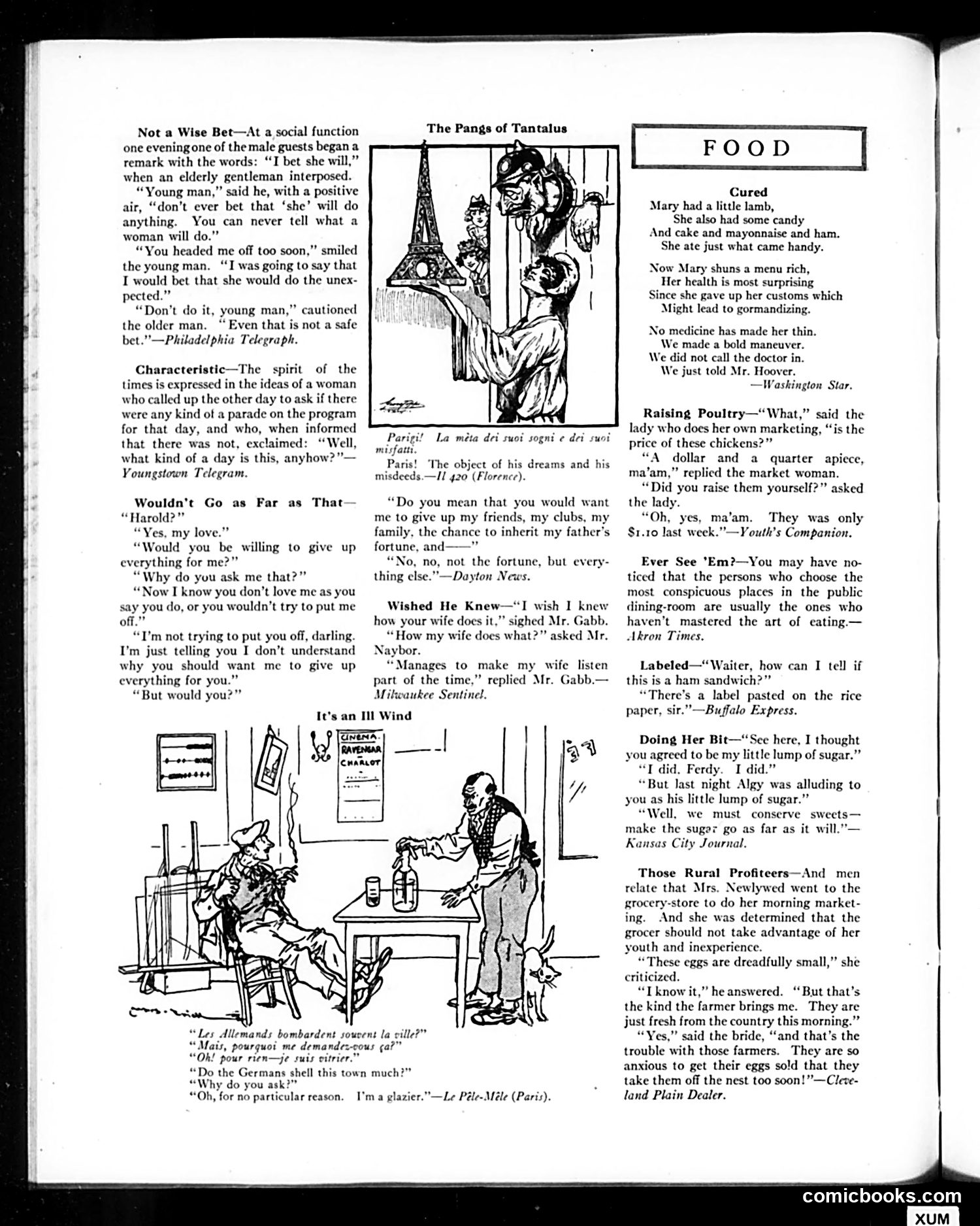
This page from Judge magazine contains several short humor pieces mocking social conventions and wartime rationing (likely WWI era, given "Mr. Hoover" references—Herbert Hoover oversaw U.S. food conservation). **Key Content:** The cartoons satirize: 1. **"It's an Ill Wind"** - A French glazier jokes that German bombardments are good for his business (broken windows). This dark humor reflects WWI's impact on European civilians. 2. **The "Food" section** - Multiple anecdotes ridicule food conservation efforts and domestic complications around eating, including a poem about a girl whose diet caused health problems until "Mr. Hoover" intervened (referencing official food rationing campaigns). 3. **Various domestic jokes** - Satirize gender dynamics (wives' unpredictability, marital negotiations) and consumer dishonesty (farmers selling undersized eggs at inflated prices). The overall tone mocks both the home front's wartime sacrifices and timeless social absurdities—particularly gender relations and commercial greed.
📄 Transcribed text from this page (OCR, searchable)
Machine-transcribed from the original scan — historical spelling and the odd misread are preserved.
Not a Wise Bet—At a social function one evening one of the male guests began a remark with the words: “I bet she will,” when an elderly gentleman interposed. “Young man,” said he, with a positive air, “don’t ever bet that ‘she’ will do anything. You can never tell what a woman will do.” “You headed me off too soon,” smiled the young man. “I was going to say that I would bet that she would do the unex- pected.” “Don’t do it, young man,” cautioned the older man. “ Even that is not a safe bet.”—Philadelphia Telegraph. Characteristic—The spirit of the times is expressed in the ideas of a woman who called up the other day to ask if there were any kind of a parade on the program for that day, and who, when informed that there was not, exclaimed: ‘Well, what kind of a day is this, anyhow?”— Youngstown Telegram. Wouldn't Go as Far as That “Harold?” “Yes, my love.” “Would you be willing to give up everything for me?” Why do you ask me that?” “Now I know you don’t love me as you say you do, or you wouldn’t try to put me off “I’m not trying to put you off, darling. I’m just telling you I don’t understand why you should want me to give up everything for you.” “But would you?” The Pangs of Tantalus Parigi! La méta dei suoi sogni e dei suoi misfatti. Paris! ‘The object of his dreams and his misdeeds.—Il 420 (Florence). “Do you mean that you would want me to give up my friends, my clubs, my family, the chance to inherit my father’s fortune, and——” “No, no, not the fortune, but every- thing else.”—Dayton News. Wished He Knew—“I wish I knew how your wife does it,” sighed Mr. Gabb. “How my wife does what?” asked Mr. bor. “Manages to make my wife listen part of the time,” replied Mr. Gabb.— Mikwaukee Sentinel. N: It's an Ill Wind “Les Allemands bombardent souvent la ville?” “Mais, pourquoi me demander-cous ¢a?” “Oh! pour rien—je suis vitrier.” lar reason. I'ma glazier.” —Le Péle-Méle (Paris). ell this town much?” FOOD Cured Mary had a little lamb, She also had some candy And cake and mayonnaise and ham. She ate just what came handy. Now Mary shuns a menu rich, Her health is most surprising Since she gave up her customs which Might lead to gormandizing. No medicine has made her thin. We made a bold maneuver. We did not call the doctor in. We just told Mr. Hoover. —Washington Star. Raising Poultry—“What,” said the lady who does her own marketing, “is the price of these chickens?” “A dollar and a quarter apiece, ma’am,” replied the market woman. “Did you raise them yourself?” asked the lady. “Oh, yes, ma’am. They was only $1.10 last week.” —Youth’s Companion. Ever See ‘Em?—You may have no- ticed that the persons who choose the most conspicuous places in the public dining-room are usually the ones who haven’t mastered the art of ecating.— lkron Times. Labeled—“ Waiter, how can I tell if this is a ham sandwich?” “There’s a label pasted on the rice paper, sir.”—Buffalo Express. Doing Her Bit—“Sce here, I thought you agreed to be my little lump of sugar.” “T did. Ferdy. I did.” “But last night Algy was alluding to you as his little lump of sugar.” “Well, we must conserve sweets— make the sugar go as far as it will.”— Kansas City Journal. Those Rural Profiteers—And men relate that Mrs. Newlywed went to the grocery-store to do her morning market- ing. And she was determined that the grocer should not take advantage of her youth and inexperience. “These eggs are dreadfully small,” she criticized. “Tknow it,” he answered. “But that’s the kind the farmer brings me. They are just fresh from the country this morning.”” “Yes,” said the bride, “and that's the trouble with those farmers. They are so anxious to get their eggs sold that they take them off the nest too soon!” —Cleve- land Plain Dealer. comicbooks.com