
Judge, 1918-06-29 · page 24 of 37
Judge — June 29, 1918 — page 24: what you’re looking at
What you’re looking at
This article by Lawton Mackall satirizes the 1920s trend of marketing entertainment as "educational." The author mocks how everything—from soap ads to films—gets labeled "educational" to seem respectable. The specific target is musical comedy's attempt to revive classical plays by modernizing them. Mackall uses "Baby Mine" (retitled "Rock-a-Bye Baby") as his example, criticizing how producers strip plots of their original logic to insert contemporary spectacle: a restaurant scene with cocktails, jazz dancing, and updated Art Deco bedroom furniture replace the original domestic setting. The satire peaks when he notes the wife can no longer convincingly pass as a new mother because she abandons her sickbed to perform at the footlights—yet the husband is still supposed to believe she's just had twins. The article's final question—whether this gutting of classics for commercial purposes represents "Hooverizing on theatrical ideas"—references President Hoover's conservation rhetoric, suggesting such adaptation wastes theatrical heritage for profit.
📄 Transcribed text from this page (OCR, searchable)
Machine-transcribed from the original scan — historical spelling and the odd misread are preserved.
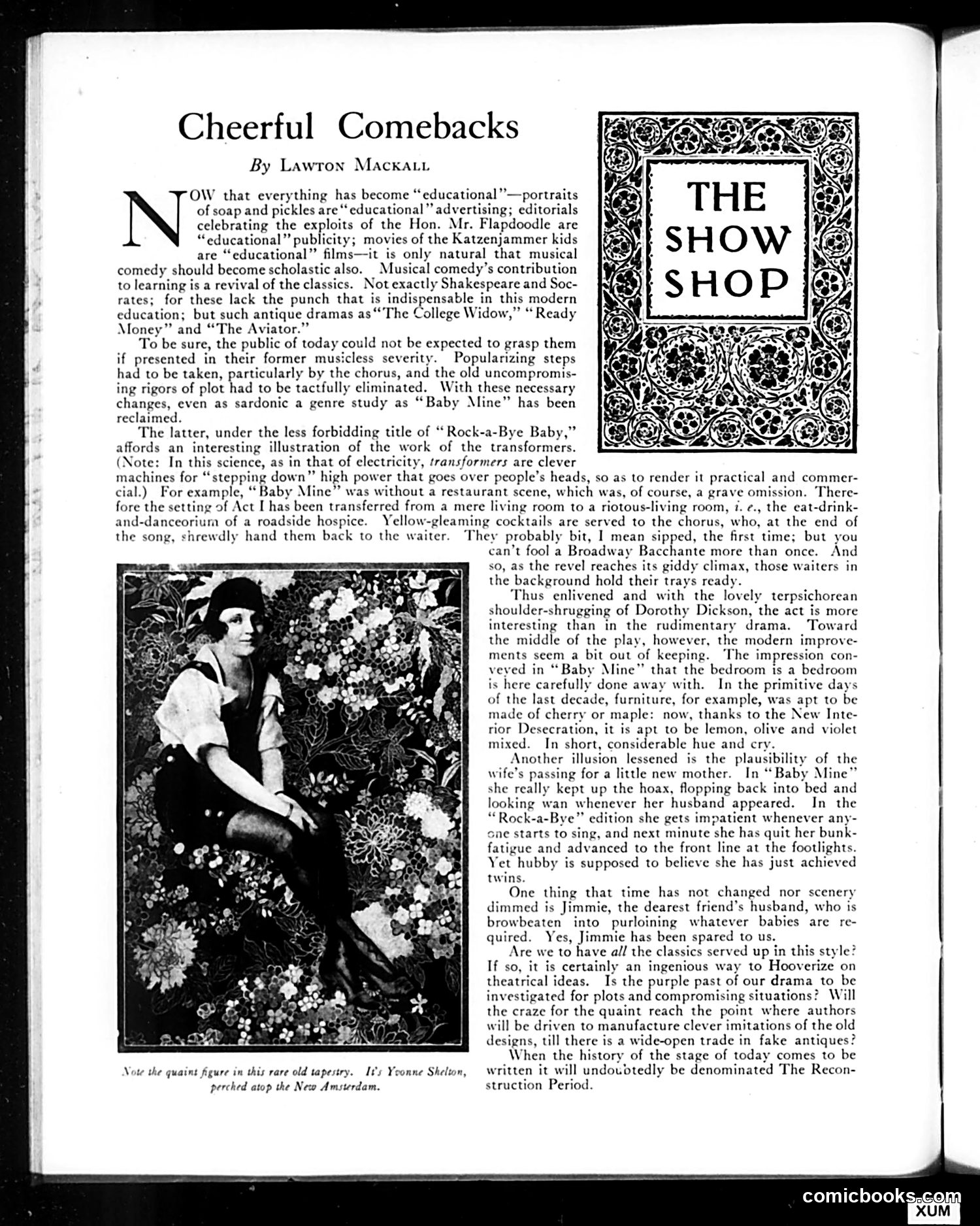
Cheerful Comebacks By Lawton Macka.u OW that everything has become “educational”’—portraits of soap and pickles are “educational” advertising; editorials celebrating the exploits of the Hon. Mr. Flapdoodle are “educational” publicity; movies of the Katzenjammer are “educational” films—it is only natural that musical comedy should become scholastic also. Musical comedy’s contribution to learning is a revival of the classics. Not exactly Shakespeare and Soc- rates; for these lack the punch that is indispensable in this modern education; but such antique dramas as “The College Widow,” “ Ready Money” and “The Aviator.” To be sure, the public of today could not be expected to grasp them if presented in their former musicless severity. Popularizing steps had to be taken, particularly by the chorus, and the old uncompromis- ing rigors of plot had to be tactfully eliminated. With these necessary changes, even as sardonic a genre study as “Baby Mine” has been reclaimed. The latter, under the less forbidding title of “ Rock-a-Bye Baby,” affords an interesting illustration of the work of the transformers. (Note: In this science, as in that of electricity, transformers are clever machines for “stepping down” high power that goes over people’s heads, so as to render it practical and commer- cial.) For example, “Baby Mine” was without a restaurant scene, which was, of course, a grave omission. There- fore the setting of Act I has been transferred from a mere living room to a riotous-living room, 7. ¢., the eat-drink- and-danceorium of a roadside hospice. Yellow-gleaming cocktails are served to the chorus, who, at the end of the song, shrewdly hand them back to the waiter. They probably bit, I mean sipped, the first time; but you can’t fool a Broadway Bacchante more than once. And so, as the revel reaches its giddy climax, those waiters in the background hold their trays ready. ‘Thus enlivened and with the lovely terpsichorean shoulder-shrugging of Dorothy Dickson, the act is more interesting than in the rudimentary drama. Toward the middle of the play, however, the modern improve- ments seem a bit out of keeping. ‘The impression con- veyed in “Baby Mine” that the bedroom ts a bedroom is here carefully done away with. In the primitive days of the last decade, furniture, for example, was apt to be made of cherry or maple: now, thanks to the New Inte- rior Desecration, it is apt to be lemon, olive and violet mixed. In short, considerable hue and cry. Another illusion lessened is the plausibility of the wife’s passing for a little new mother. In “Baby Mine” she really kept up the hoax, flopping back into bed and looking wan whenever her husband appeared. In the “Rock-a-Bye” edition she s impatient whenever any- one starts to sing, and next minute she has quit her bunk- fatigue and advanced to the front line at the footlights. Yet hubby is supposed to believe she has just achieved twins. One thing that time has not changed nor scenery dimmed is Jimmie, the dearest friend’s husband, who is browbeaten into purloining whatever babies are re- quired. Yes, Jimmie has been spared to us. Are we to have all the classics served up in this style? If so, it is certainly an ingenious way to Hooverize on theatrical ideas. Is the purple past of our drama to be investigated for plots and compromising situations? Will the craze for the quaint reach the point where authors will be driven to manufacture clever imitations of the old designs, till there is a wide-open trade in fake antiques? When the history of the stage of today comes to be Vote the quaint figure in this rare old tapestry. It's Yoonne Shelton, written it will undoudtedly be denominated The Recon- perched atop the New Amsterdam. struction Period.