
Judge, 1918-06-29 · page 19 of 37
Judge — June 29, 1918 — page 19: what you’re looking at
What you’re looking at
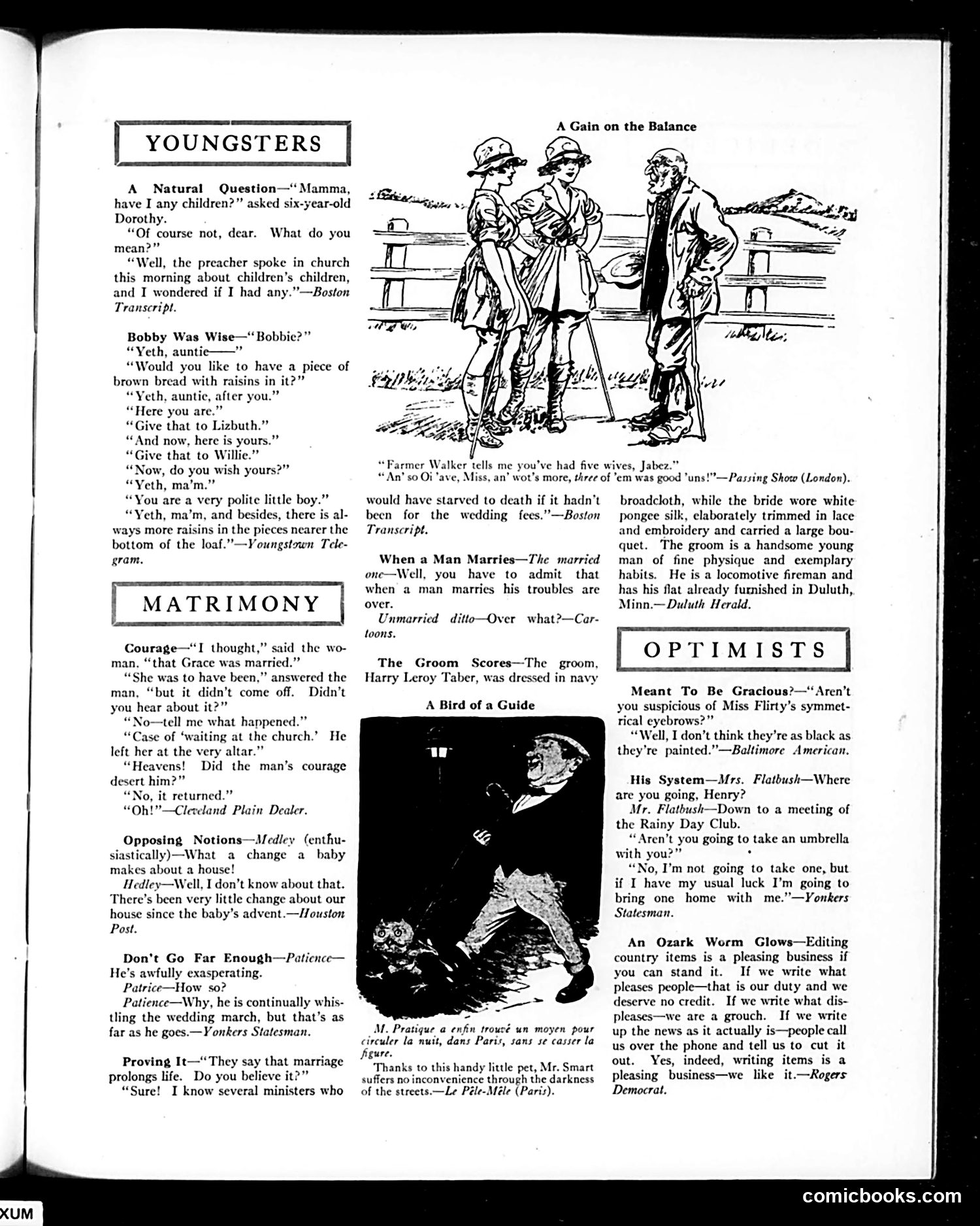
This page from *Judge* magazine comprises humorous anecdotes and one cartoon, typical of early 20th-century American humor magazines. **The Anecdotes** satirize social conventions and human nature: children's literal-minded questions about church language; children's strategic politeness to access desserts; marital mishaps (bride abandonment at the altar); and the hypocrisy of marriage advice. One joke cynically suggests clergymen benefit financially from weddings. **"A Bird of a Guide"** (French cartoon) depicts a man using a bird as a nighttime navigation aid through dark Parisian streets—absurdist humor about an impractical solution to urban darkness before widespread electric lighting. **The other items** mock courtship, suspicious cosmetics, and the impossible position of country newspaper editors pleasing contradictory readers. The humor relies on wordplay, irony, and everyday social observations—typical of *Judge*'s satirical approach to middle-class American life and manners.
📄 Transcribed text from this page (OCR, searchable)
Machine-transcribed from the original scan — historical spelling and the odd misread are preserved.
XUM = YOUNGSTERS A Natural Question— Mamma, have I any children?” asked six-year-old Dorothy. “Of course not, dear. What do you mean?” “Well, the preacher spoke in church this morning about children’s children, and I wondered if I had any.”—Boston Transcript. Bobby Was Wise—‘Bobbic?” “Yeth, auntie—” “Would you like to have a piece of brown bread with raisins in it?” “Yeth, auntie, after you.” “Here you are.” “Give that to Lizbuth.” “And now, here is yours.” “Give that to Willie.” “Now, do you wish yours?” “Yeth, ma’m.” “You are a very polite little boy.” “Yeth, ma’m, and besides, there is al- ways more raisins in the pieces nearer the bottom of the loaf.”—Youngstown Tele- gram. MATRIMONY | Courage—“I thought,” said the wo- man, “that Grace was married.” “She was to have been,” answered the man, “but it didn’t come off. Didn't you hear about it?” “No—tell me what happened.” “Case of ‘waiting at the church.’ He left her at the very altar.” “Heavens! Did the man’s courage desert him?” “No, it returned.” “Oh!”—Cleveland Plain Dealer. Opposing Notions—Medley (enthu- siastically—What a change a baby makes about a house! Hedley—Well, I don’t know about that. There’s been very little change about our house since the baby’s advent.—Houston Post. Don't Go Far Enough—Patience— He’s awfully exasperating. Patrice—How so? Patience—Why, he is continually whis- tling the wedding march, but that’s as far as he goes.—Yonkers Statesman. Proving It— They say that marriage prolongs life. Do you believe it?” “Sure! I know several ministers who A Gain on the Balance would have starved to death if it hadn’t been for the wedding fees.”—Boston Transcript. When a Man Marries—The married one—Well, you have to admit that when a man marries his troubles are over. Unmarried ditto—Over what?—Car- toons. The Groom Scores—The groom, Harry Leroy Taber, was dressed in navy A Bird of a Guide M. Pratique @ enfin troucé un moyen pour circuler la nuit, dans Paris, sans se casser la figure. Thanks to this handy little pet, Mr. Smart suffers no inconvenience through the darkness of the streets.—Le Péle-Méle (Paris). rmer Walker tells me you've had five wives, Jabez.” * so Oi ‘ave, Miss, an’ wot's more, three of "em was good ’uns!""—Passing Show (London). broadcloth, while the bride wore white pongce silk, elaborately trimmed in lace and embroidery and carried a large bou- quet. The groom is a handsome young man of fine physique and exemplary habits. He is a locomotive fireman and has his flat already furnished in Duluth,. Minn.—Duluth Herald. Meant To Be Gracious?—‘‘Aren’t you suspicious of Miss Flirty’ rical eyebrows?” “Well, I don’t think they’re as black as. they're painted.”—Baltimore American. 'S symmet- His System—Mrs. Flatbush—Where are you going, Henry? Mr. Flatbush—Down to a meeting of the Rainy Day Club. “Aren’t you going to take an umbrella with you: : “No, I’m not going to take one, but if I have my usual luck I’m going to bring one home with me.”—VYonkers Statesman. An Ozark Worm Glows—Editing country items is a pleasing business if you can stand it. If we write what pleases people—that is our duty and we deserve no credit. If we write what dis- pleases—we are a grouch. If we write up the news as it actually is—people call us over the phone and tell us to cut it out. Yes, indeed, writing items is a pleasing business—we like it.—Rogers Democrat. comicbooks.com