
A complete issue · 36 pages · 1918
Judge — May 18, 1918
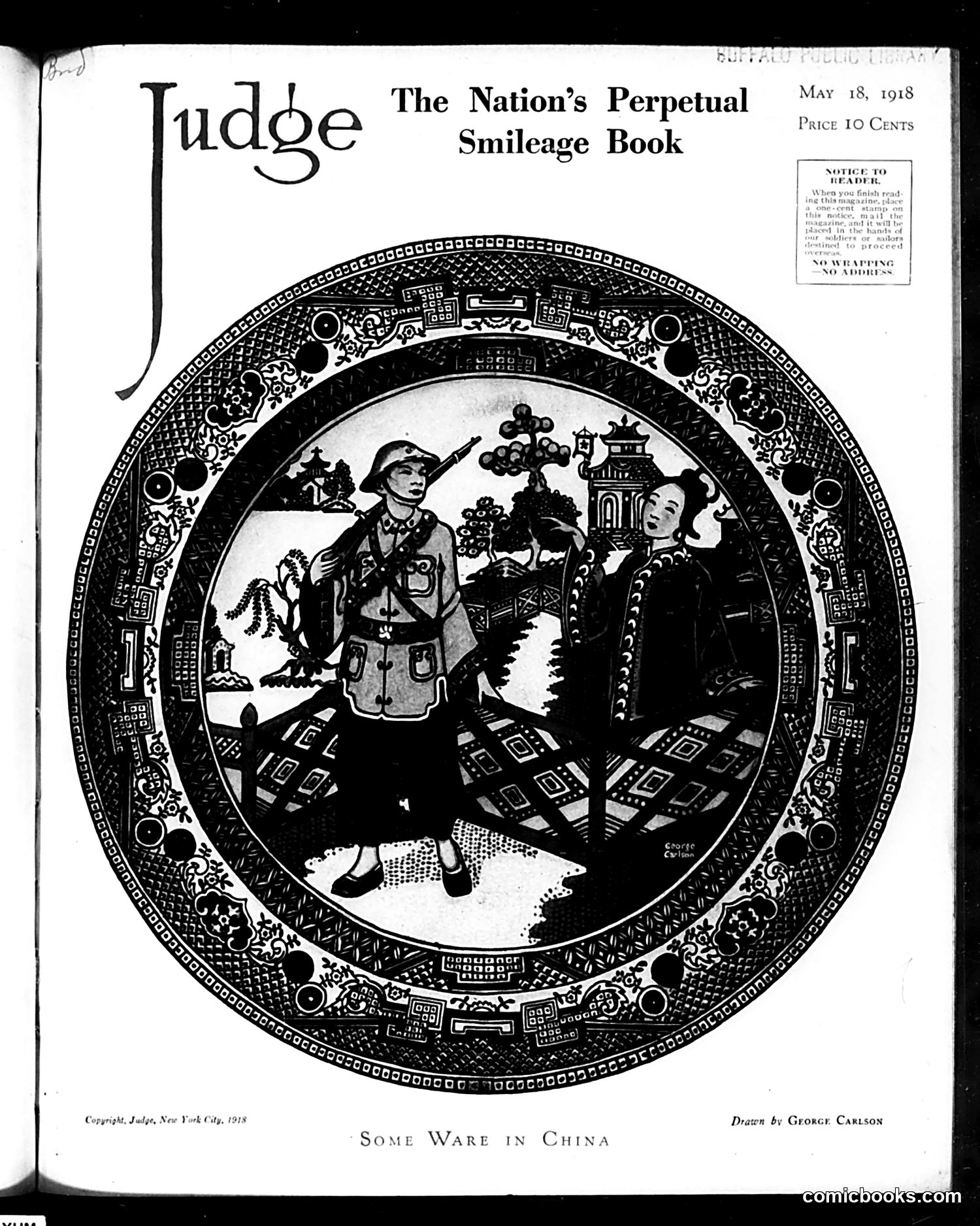
This satirical cartoon depicts what appears to be American diplomatic or military figures in an ornate Chinese setting, drawn by George Carlson. The title "Some Ware in China" is a pun on "ware" (goods/merchandise). The specific identities of the figures remain unclear from the image alone, though their military uniforms and formal dress suggest high-ranking officials. The elaborate Chinese decorative border and pagoda architecture frame what appears to be commentary on American involvement or interests in China during World War I. Without additional context about concurrent diplomatic events in May 1918, the precise satirical target—whether criticizing American imperial ambitions, specific negotiations, or military decisions regarding China—cannot be definitively determined from the visual evidence alone.
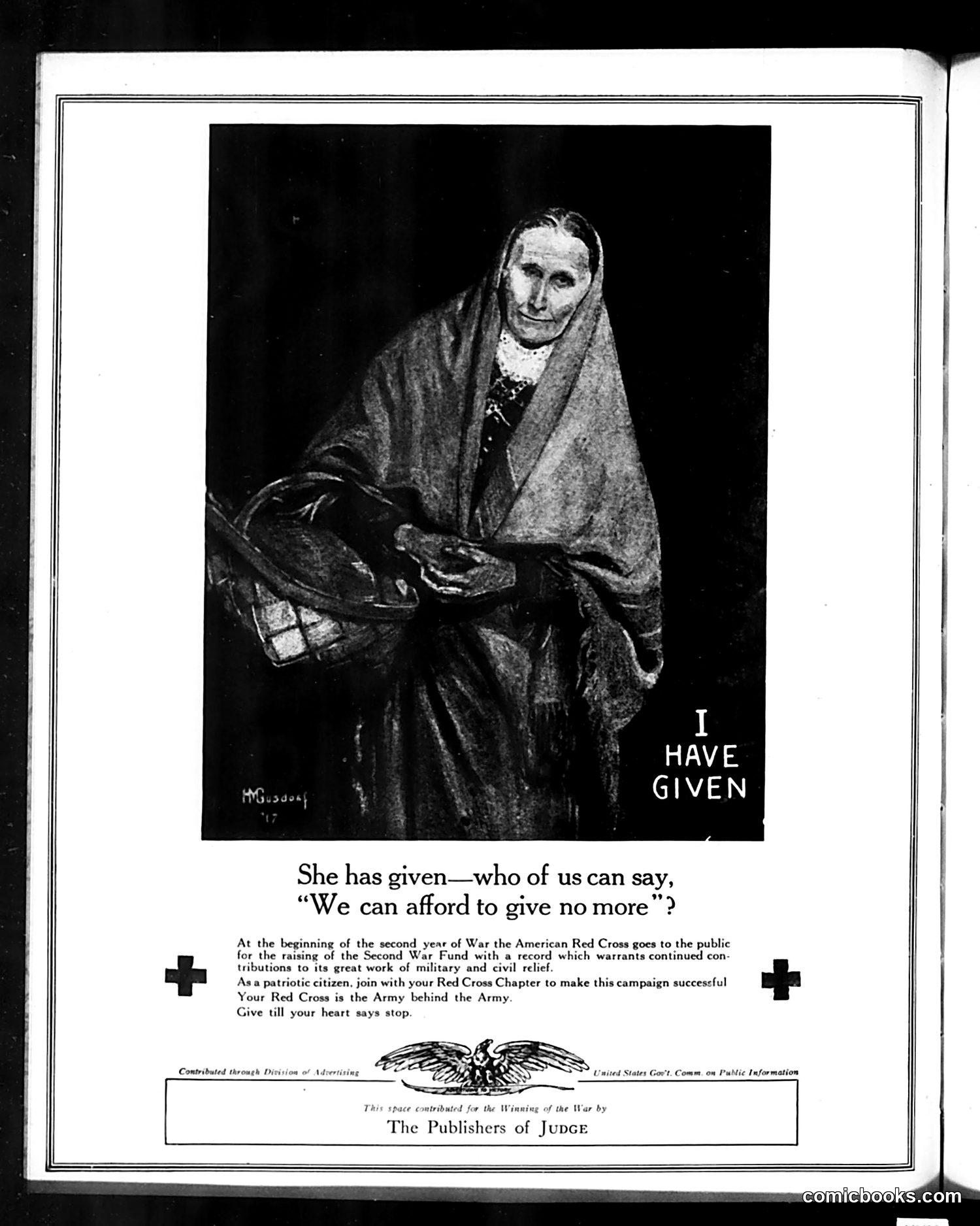
This is a Red Cross fundraising advertisement rather than satire. It depicts an elderly woman in a headscarf holding fabric, with the caption "I HAVE GIVEN" and the question "She has given—who of us can say, 'We can afford to give no more'?" The image appeals to patriotic duty during wartime by contrasting the woman's sacrifice with readers' relative comfort. The text indicates this ran during the "second year of War" (likely WWI, given Judge's publication period) for the "Second War Fund." The appeal works through implied shame: if this elderly woman has already given, what excuse do wealthy Americans have? The message frames charitable giving as a moral obligation tied to national defense and military relief.
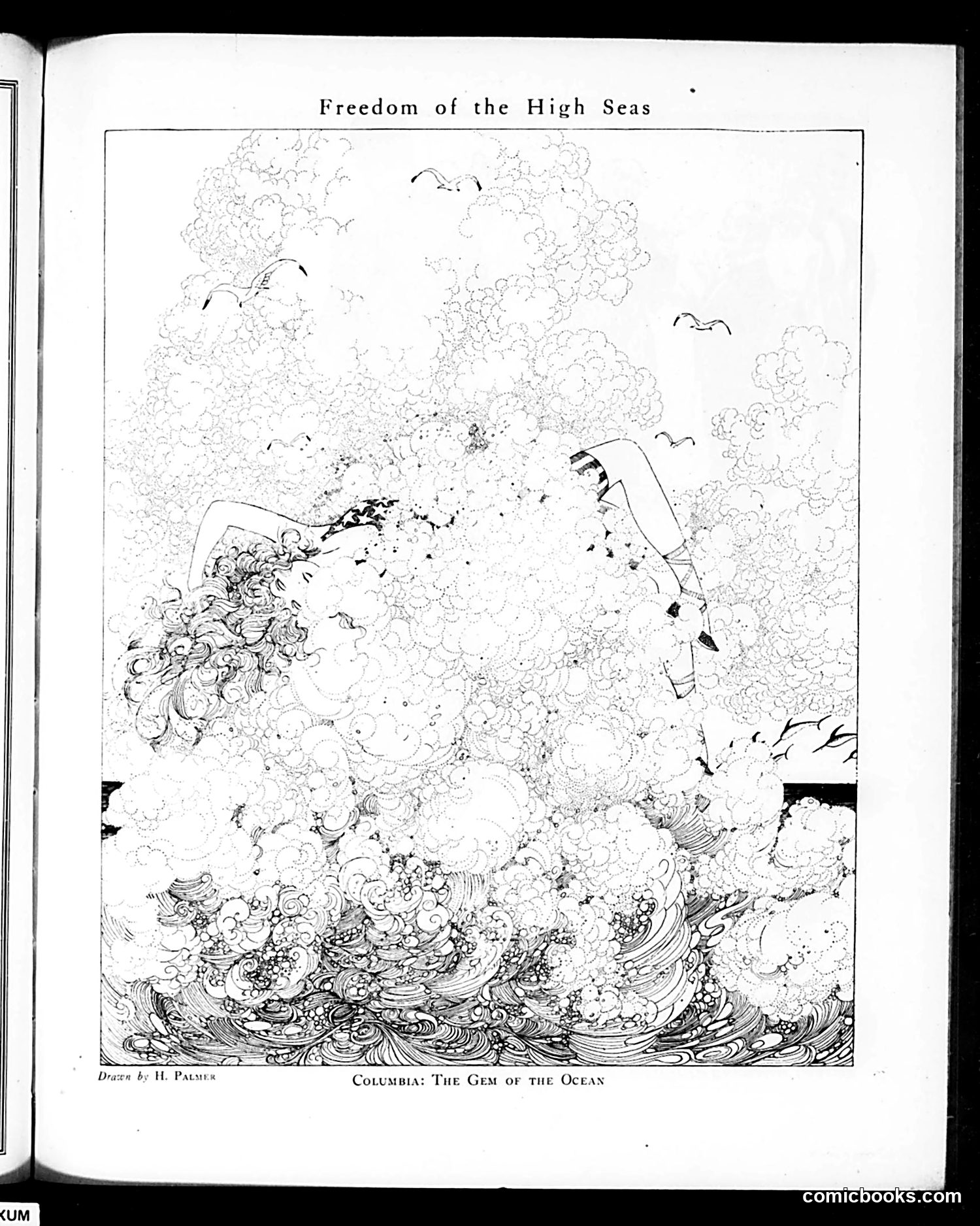
This illustration satirizes American naval power and maritime dominance. "Columbia" (the female personification of America, identifiable by her classical pose and flowing garments on the left) appears triumphant amid churning ocean waves. The intricate wave patterns and swirling imagery emphasize naval strength and control of waterways. The title references America's assertion of maritime rights—likely alluding to debates over naval freedom and international waters during the late 19th or early 20th century. The artist H. Palmer depicts this as patriotic celebration, with Columbia dominating the seas as the nation's symbol of power and independence. The detailed wave work suggests both the beauty and force of American oceanic authority.
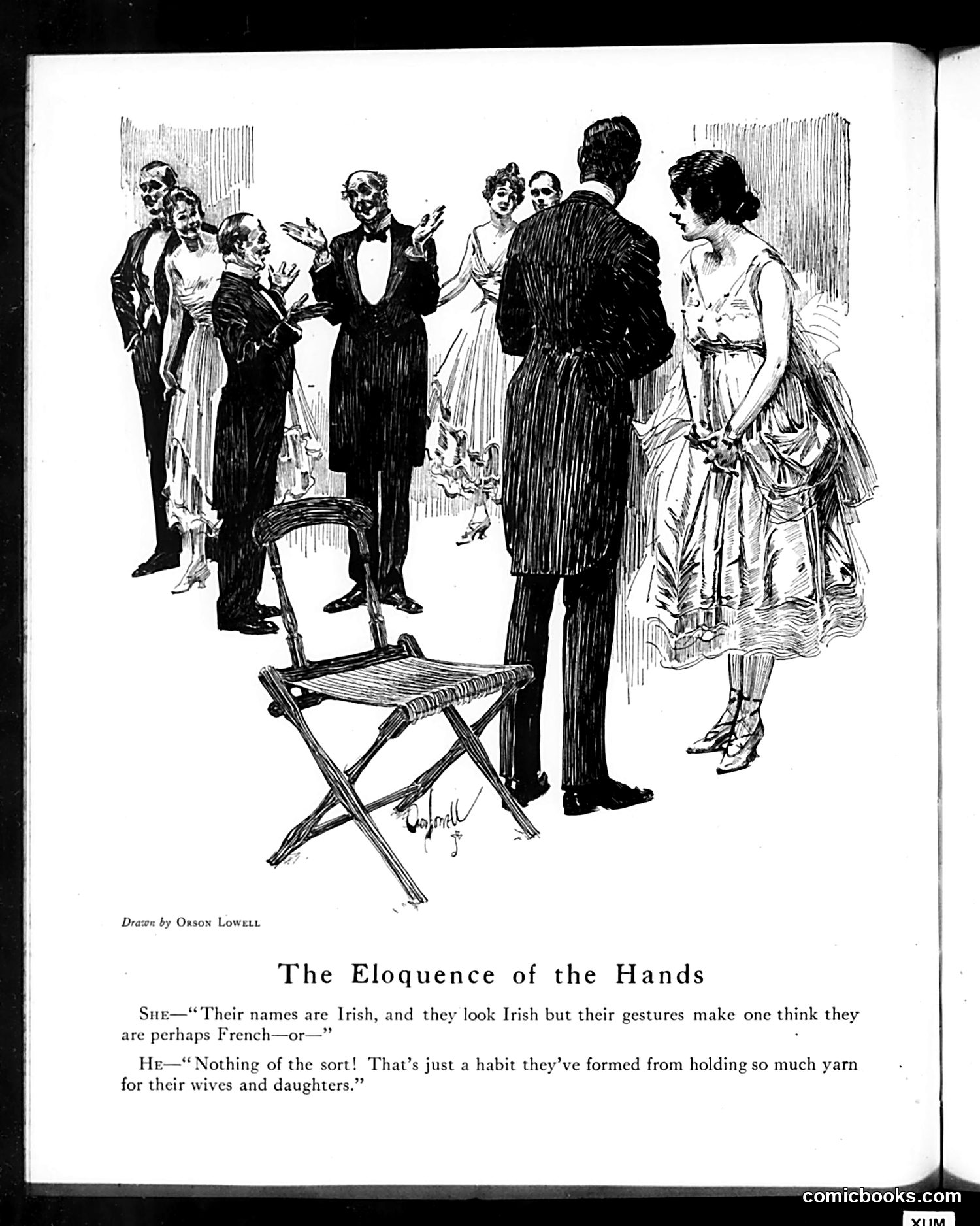
This cartoon by Orson Lowell satirizes Irish immigrants through ethnic stereotyping. The dialogue suggests that Irish people's expressive hand gestures—which the woman initially mistakes for French mannerisms—actually stem from a practical habit: "holding so much yarn for their wives and daughters." The joke relies on a double stereotype: first, that Irish immigrants are visibly foreign or "French" in manner; second, that Irish women spend excessive time on domestic yarn work (knitting, spinning), causing the men to develop characteristic hand positions from assisting them. Published in *Judge*, a satirical magazine, this reflects early 20th-century American attitudes toward Irish immigrants, portraying them as ethnically distinct and their domestic practices as comically foreign to mainstream American society.
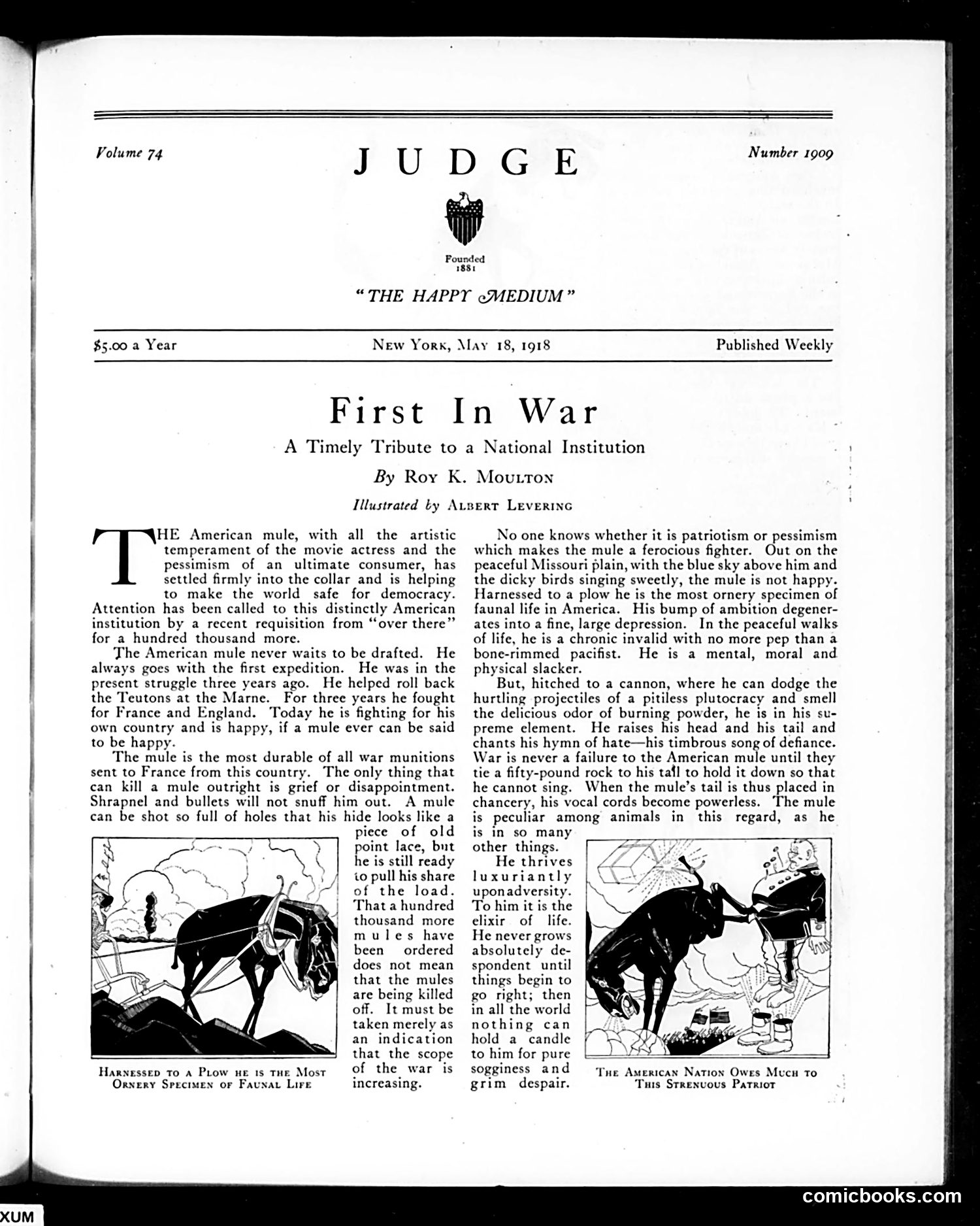
This article by Roy K. Moulton praises the American mule's service during World War I. The text portrays the mule as a patriotic, stoic workhorse—"the most durable of all war munitions"—that endures hardship without complaint while serving the military effort. The two illustrations show mules in wartime conditions: one harnessed to a plow, the other carrying supplies amid battlefield debris. The caption "The American Nation Owes Much to This Strenuous Patriot" ironically elevates the mule to patriotic status. Published in 1918, this appears a sincere (if whimsical) tribute to an unglamorous but essential military animal. The satire lies in treating a pack animal with the reverence typically reserved for human soldiers—gentle mockery that simultaneously acknowledges the mule's genuine contribution to the war effort.
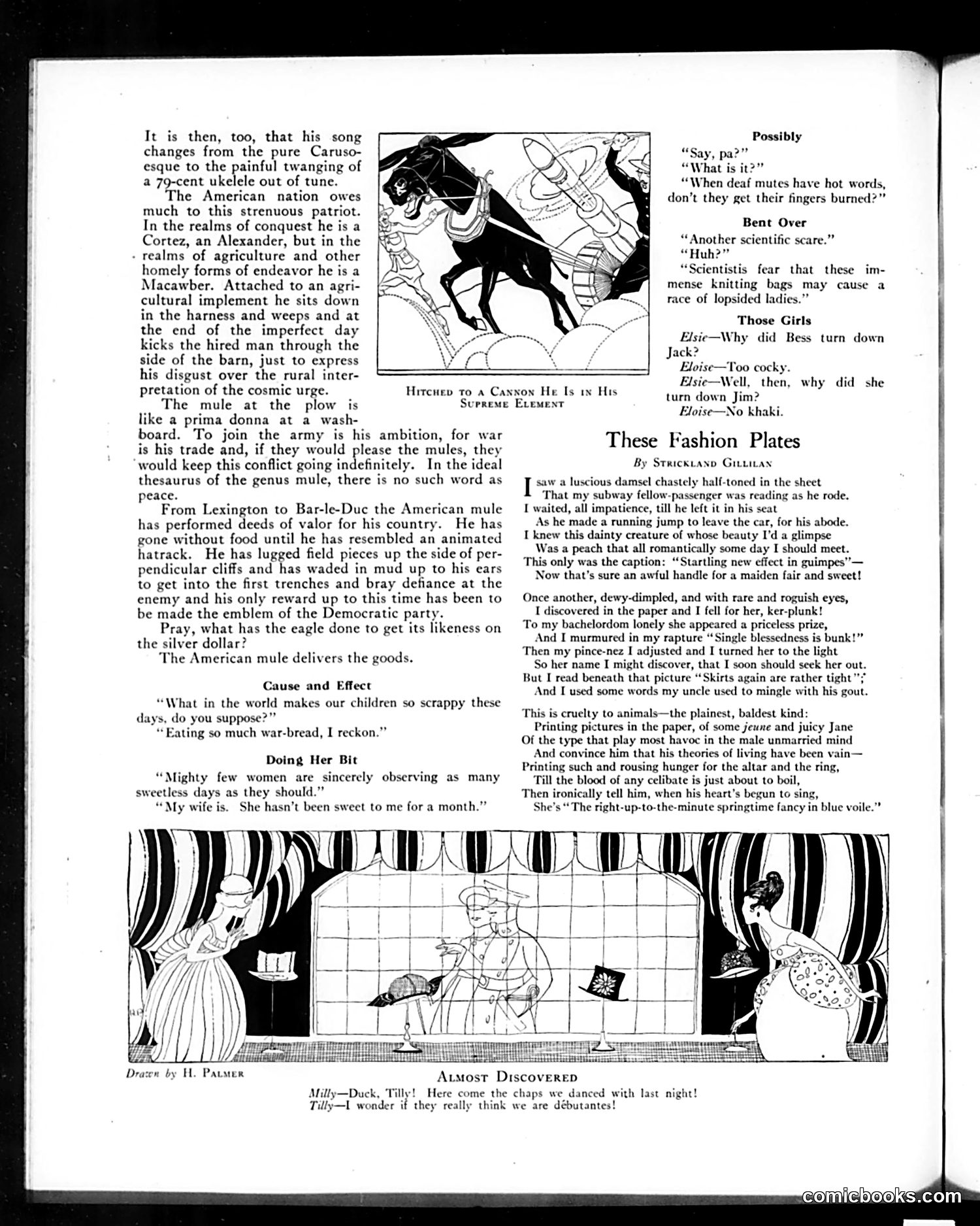
This page contains three distinct sections: **Top cartoon**: Shows a mule hitched to a cannon, captioned "Hitched to a Cannon He Is in His Supreme Element." The accompanying text satirizes American mules' role in military transport during what appears to be World War I, praising their indispensability to the war effort while humorously noting their stubbornness and the soldiers' frustrations with them. **"These Fashion Plates"**: A poem by Strickland Gillilan mocking sentimental depictions of women in magazines—critiquing how publications romanticize female subjects while using images to sell products. **Bottom cartoon**: Titled "Almost Discovered," drawn by H. Palmer, shows a couple dancing, with the caption suggesting they narrowly avoided being seen by others. It's a mild social humor piece about discretion.
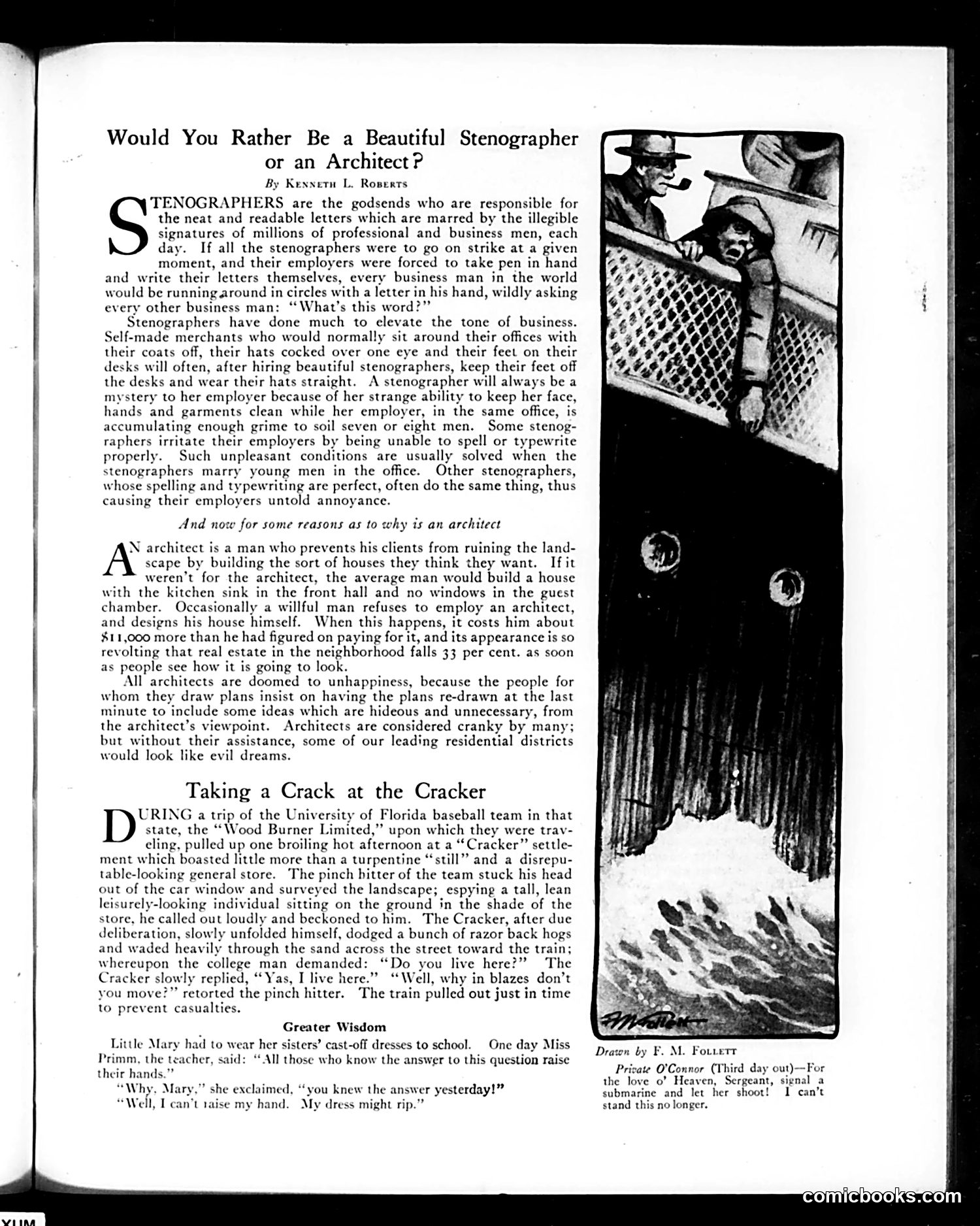
This page contains three satirical pieces mocking professional stereotypes of the era: **"Beautiful Stenographer or Architect"**: A tongue-in-cheek comparison. Stenographers are praised for elevating business standards—their mere presence causes slovenly businessmen to keep feet off desks and wear hats straight. Yet they're also portrayed as mysteriously clean while surrounded by grime. The architect section mocks their profession as inherently frustrating: they prevent clients from building disasters (kitchens in front halls), but clients always demand unwanted revisions anyway, making architects perpetually unhappy. **"Taking a Crack at the Cracker"**: A condescending anecdote mocking rural Florida "Crackers" (poor white rural Southerners). A university baseball player questions why a leisurely local doesn't move away, implying rural life is undesirable. The joke portrays the rural man as slow-moving and unsophisticated, with the punchline suggesting the college athlete barely escapes confrontation. **"Greater Wisdom"**: A brief joke about a poor child in hand-me-downs. The magazine's satire targets professional vanity and rural/class stereotypes common to early 20th-century humor.
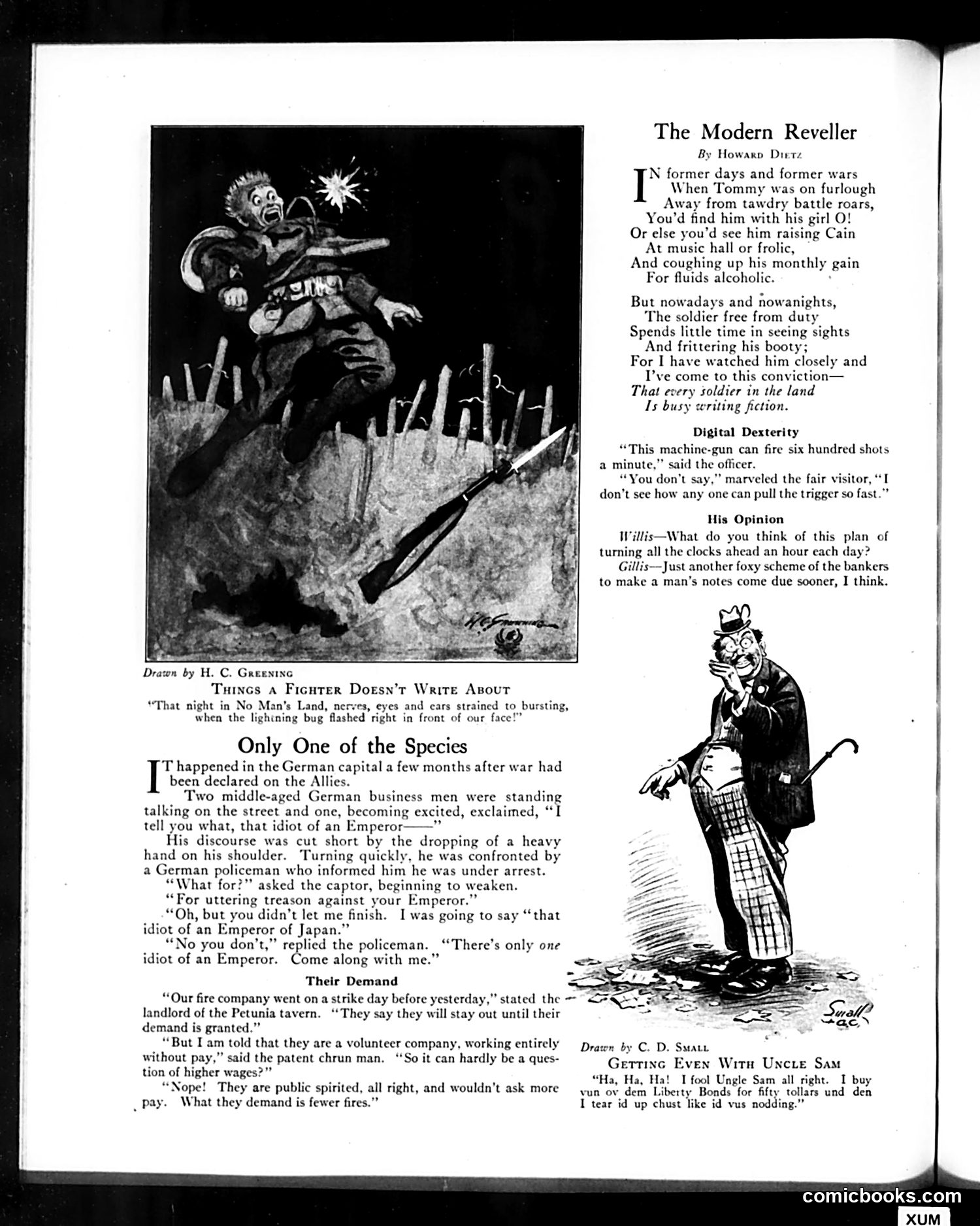
This page contains multiple satirical pieces from WWI-era America: **"The Modern Reveller"** (poem by Howard Dietz): Contrasts soldiers' leisure activities before and during WWI. Historically, off-duty soldiers visited music halls and drank; now they're constantly writing—likely referring to soldiers writing letters home, perhaps exaggerated for comic effect. **"Digital Dexterity"**: A joke about a woman marveling at machine-gun speed, seemingly unable to comprehend mechanical rapid-fire (she thinks manual trigger-pulling achieves it). **"His Opinion"**: A joke about daylight saving time (appearing to be a wartime measure), with a working-class character ("Gillis") suspiciously viewing it as a banker's scheme to make debts due sooner. **"Only One of the Species"**: Satirizes German authoritarianism. A man arrested for *beginning* to criticize the Kaiser learns Germany permits criticizing only foreign emperors—implying totalitarian suppression of dissent. **"Their Demand"**: A volunteer fire company strikes for "fewer fires" rather than pay—absurdist humor about unreasonable demands.
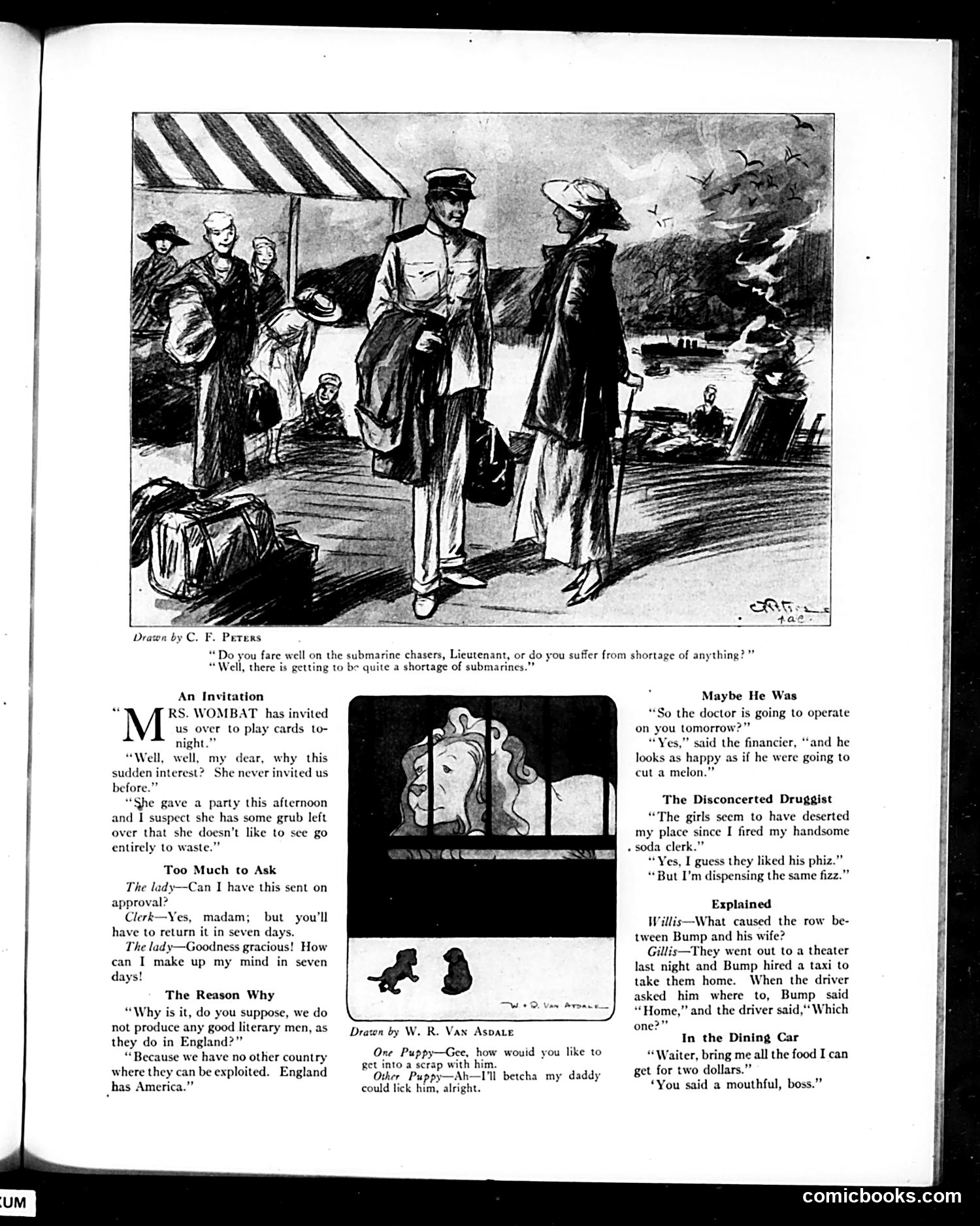
This page collects several short jokes and one political cartoon, typical of Judge's satirical format. **Top Cartoon:** A WWI-era scene showing a naval officer discussing submarine chasers. The joke's punch line—"there is getting to be quite a shortage of submarines"—celebrates American naval success against German U-boats, implying they're being destroyed faster than replaced. **Other Jokes:** Varied domestic humor including: - A woman inviting friends specifically to use leftover party food - A shop clerk's strict rental return policy - A quip about why America lacks great writers (unlike England, which "exploits" American talent) - A druggist losing female customers after firing his handsome clerk - A financier comparing surgery to financial "cutting" (possibly referencing stock manipulation) - A taxi driver's joke about marital discord The page reflects early 20th-century American concerns: WWI optimism, consumerism, gender dynamics, and financial satire. Most humor relies on wordplay and social observation rather than overt political commentary.
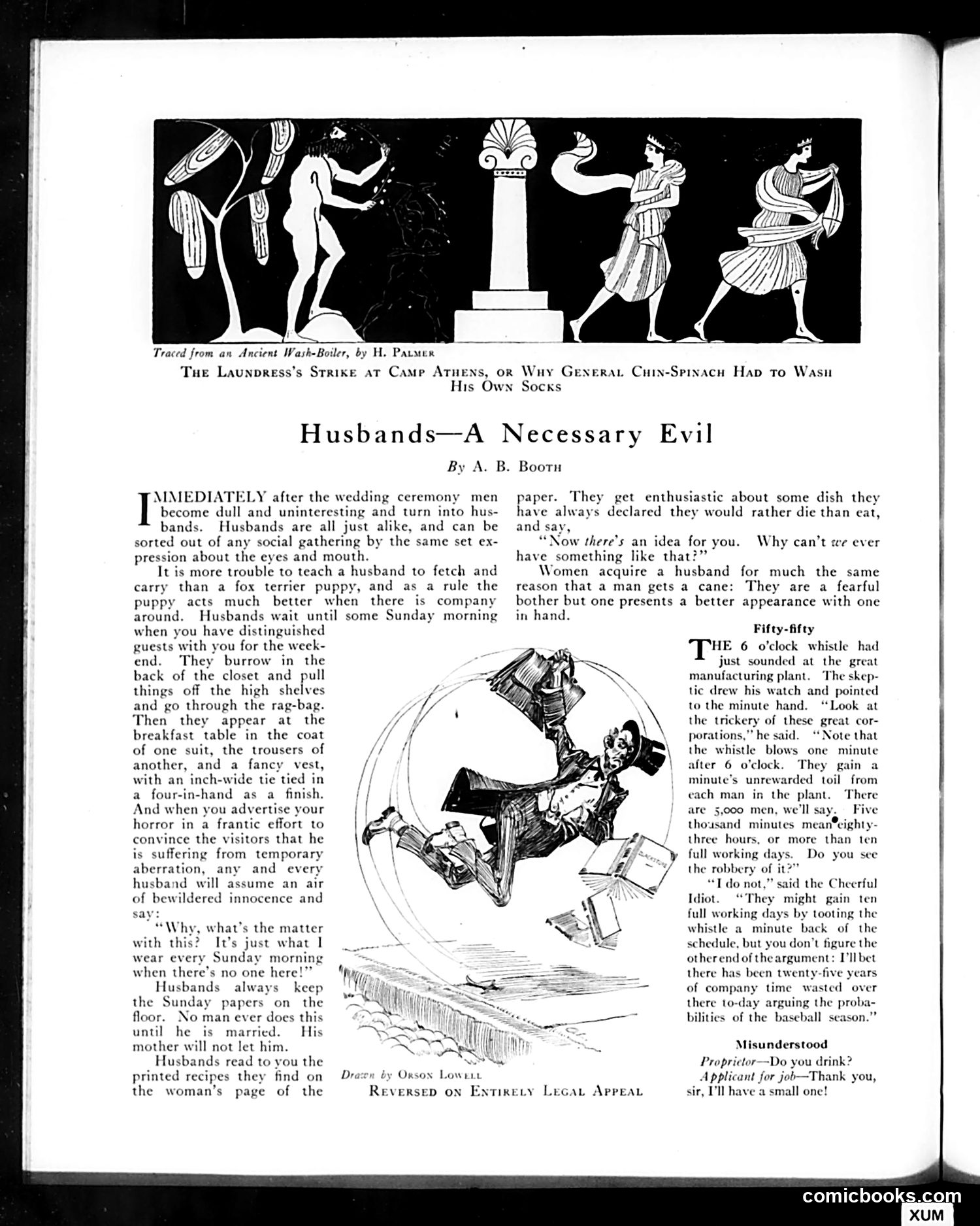
This satirical article by A. B. Booth mocks married men as uniformly dull and incompetent. The author compares husbands unfavorably to dogs, claiming they're harder to train than puppies and embarrass their wives by appearing at social gatherings in mismatched clothing, unable to explain themselves coherently. The piece ridicules husbands' domestic incompetence—leaving newspapers on floors (something their mothers wouldn't tolerate), reading recipes aloud from women's pages—while suggesting wives tolerate them primarily for appearance's sake, like carrying a fashionable cane. The accompanying cartoons and anecdotes continue this theme. "Reversed on Entirely Legal Appeal" shows a man being ejected from a building. A lower joke ("Misunderstood") plays on a job applicant mishearing an alcohol question as an offer. The top illustration references classical Greek imagery ironically, contrasting dignified ancient culture with modern domestic squabbling.
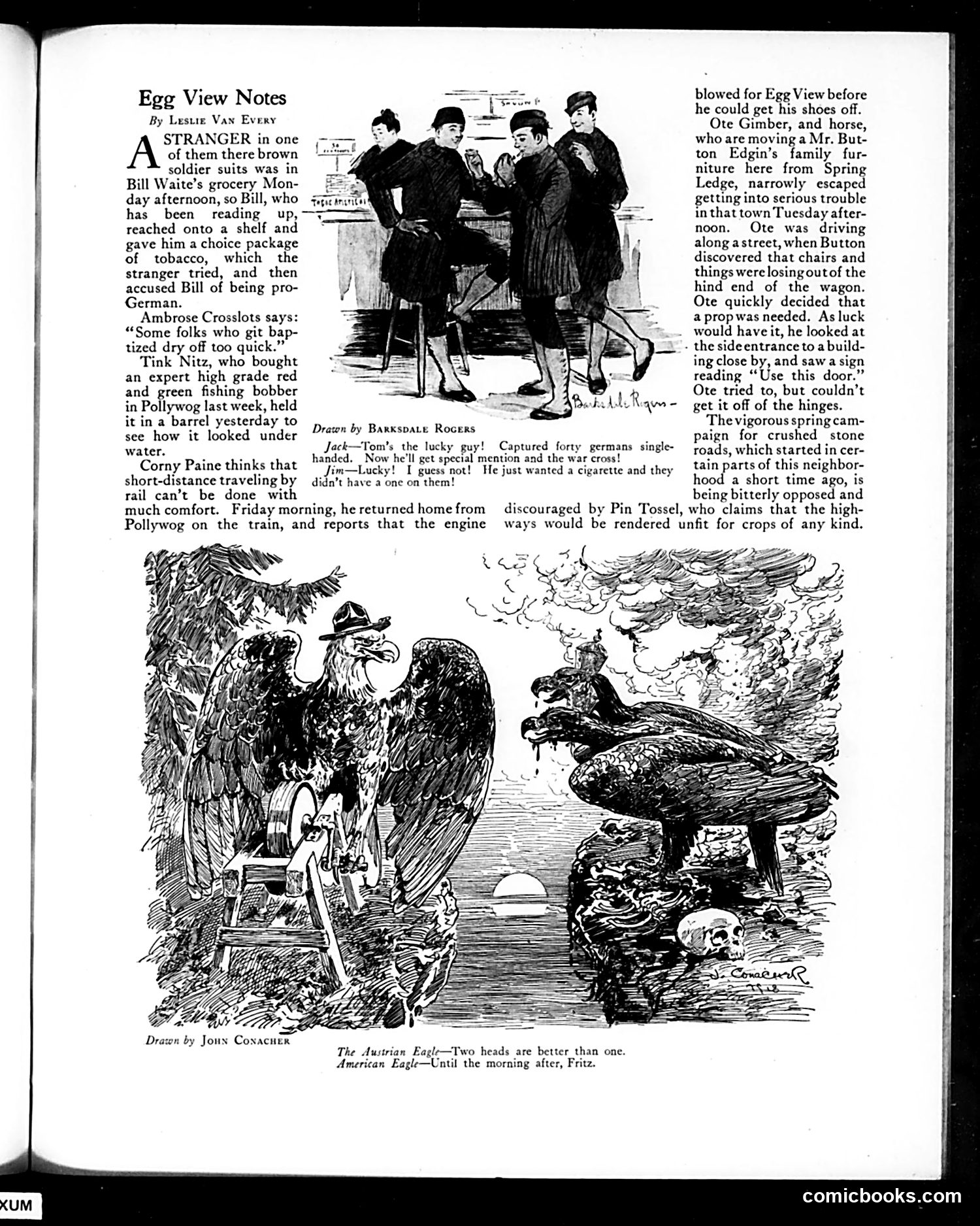
This is a humor column with two distinct elements: **Upper section:** Anecdotal jokes about small-town characters. The opening story satirizes WWI-era paranoia: a stranger in a soldier uniform accuses grocer Bill Waite of being "pro-German" merely for offering tobacco—mocking the hysteria and suspicion surrounding German sympathizers during the war. **Lower cartoon:** Political commentary on the war. It depicts an Austrian and American eagle in dialogue. The Austrian boasts of capturing forty Germans single-handedly, expecting military honors. The American replies sardonically that the Austrian probably just wanted a cigarette and found none on the captured soldiers—mocking Austria-Hungary's exaggerated war claims and suggesting their soldiers lack basic supplies. The overall page reflects 1918-era American attitudes: domestic paranoia about German sympathizers alongside skepticism of allied nations' military propaganda.
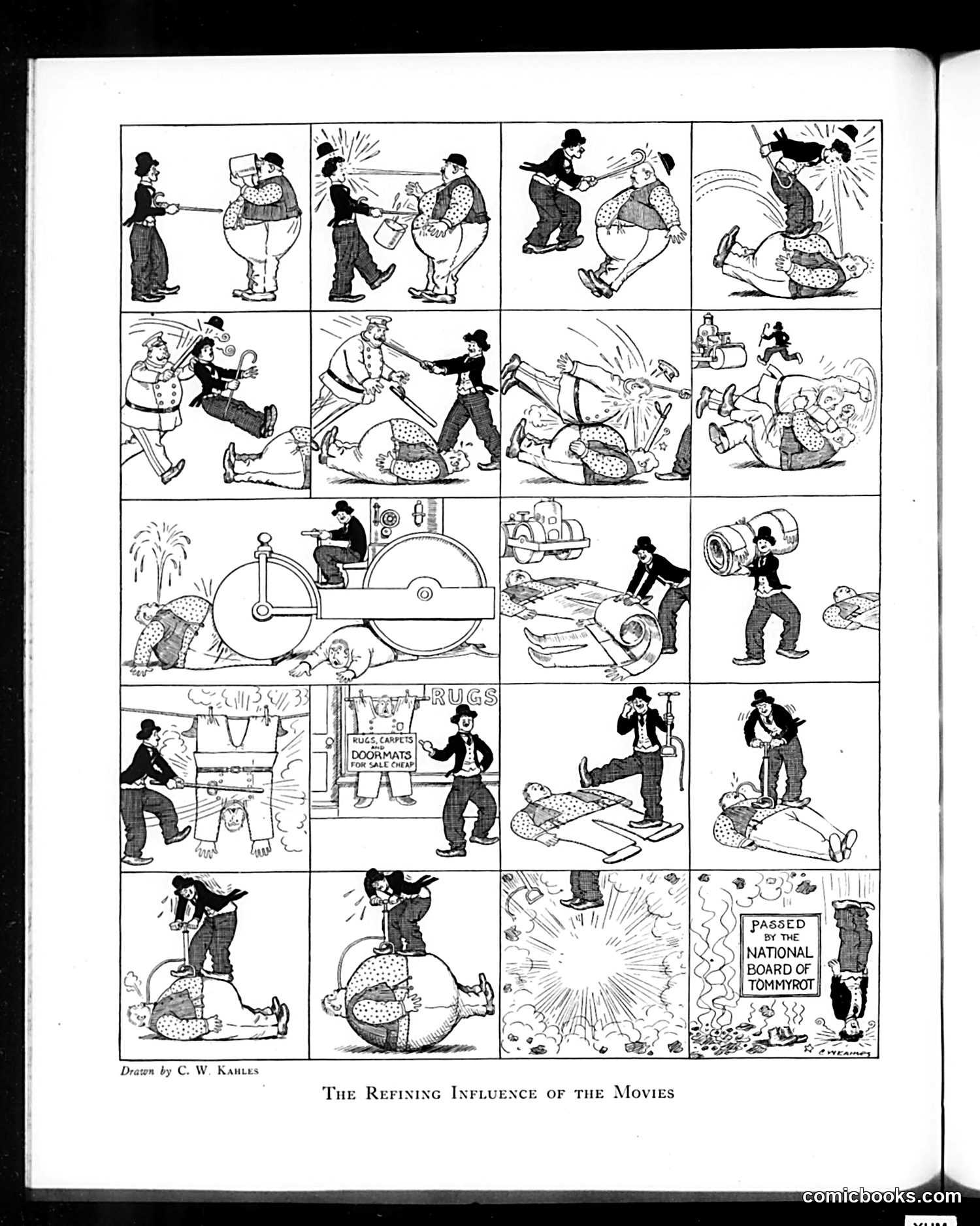
This satirical cartoon by C.W. Kahles critiques early cinema's moral impact. The title is ironic—the sequential panels show a man being progressively corrupted by movie-watching, not refined. The narrative depicts: a gentleman viewing films, then gradually adopting increasingly violent and criminal behaviors mimicked from screen—fighting, stealing, vandalism, and eventually explosive destruction. A final panel shows official disapproval via "Passed by the National Board of Tommyrot," mocking film censorship boards as ineffectual. The satire targets two concerns: cinema's perceived influence on viewers' behavior and the inadequacy of early film rating systems. The cartoon reflects 1910s-1920s anxieties about movies corrupting audiences, particularly young people, despite claims of moral oversight.
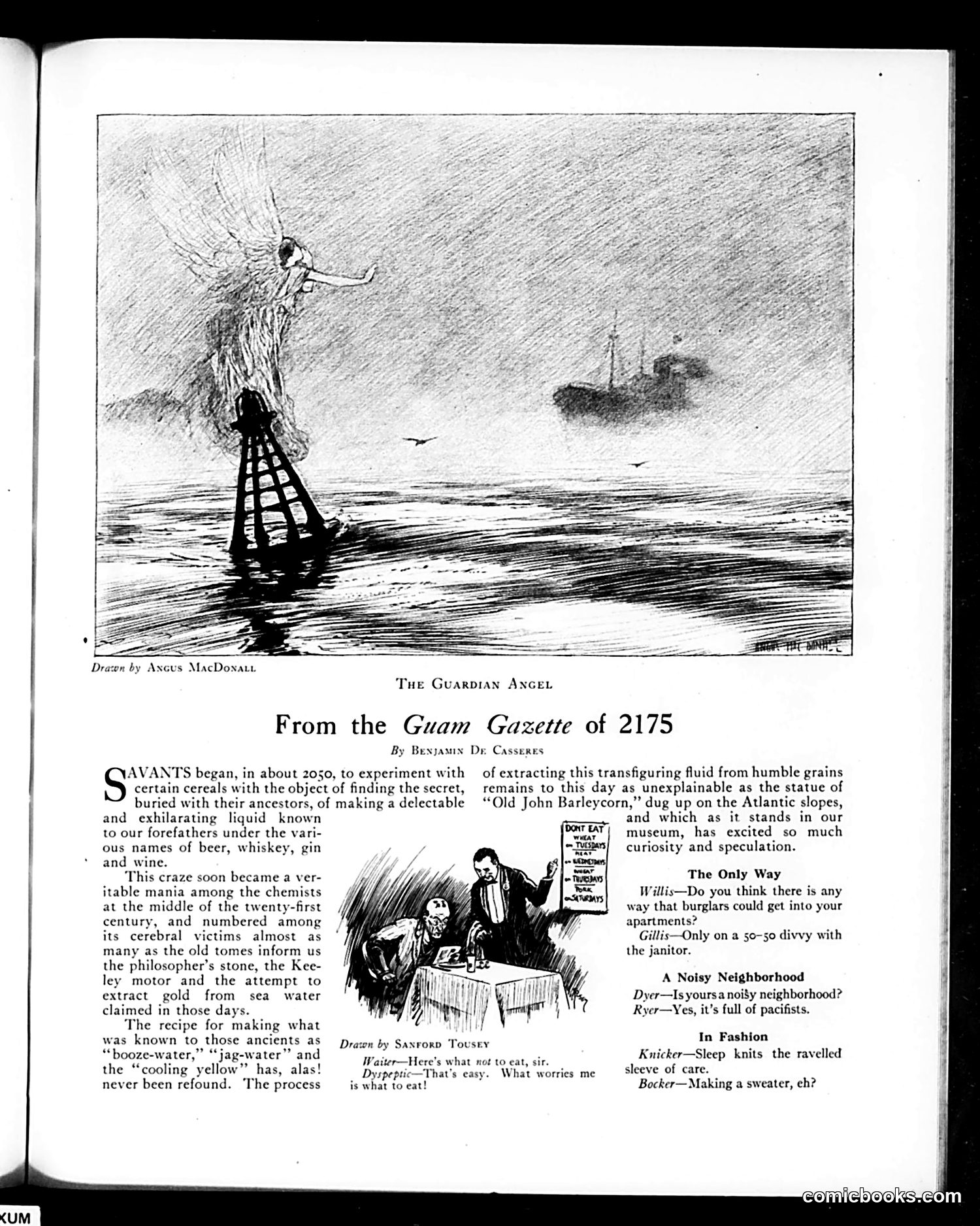
**Main Illustration**: A futuristic sketch showing a lighthouse or beacon on a rocky shore with a ship in stormy waters. The title references a "Guam Gazette of 2175," establishing a science-fiction premise. **Text Content**: A satirical story imagining that 22nd-century chemists have forgotten how to make alcohol, despite extensive 21st-century attempts. It humorously compares this failed quest to other historical obsessions (philosopher's stone, perpetual motion) as absurd pursuits that distracted many people. **Brief Jokes Below**: Several short humorous exchanges, including: - A quip about apartment burglary requiring "50-50" with the janitor (corruption) - A "pacifists" joke (meaning noisy people, playing on the word) - Wordplay about knitting and Shakespeare The page satirizes both futuristic speculation and contemporary vices, using alcohol-making as its vehicle for comedy about human folly.
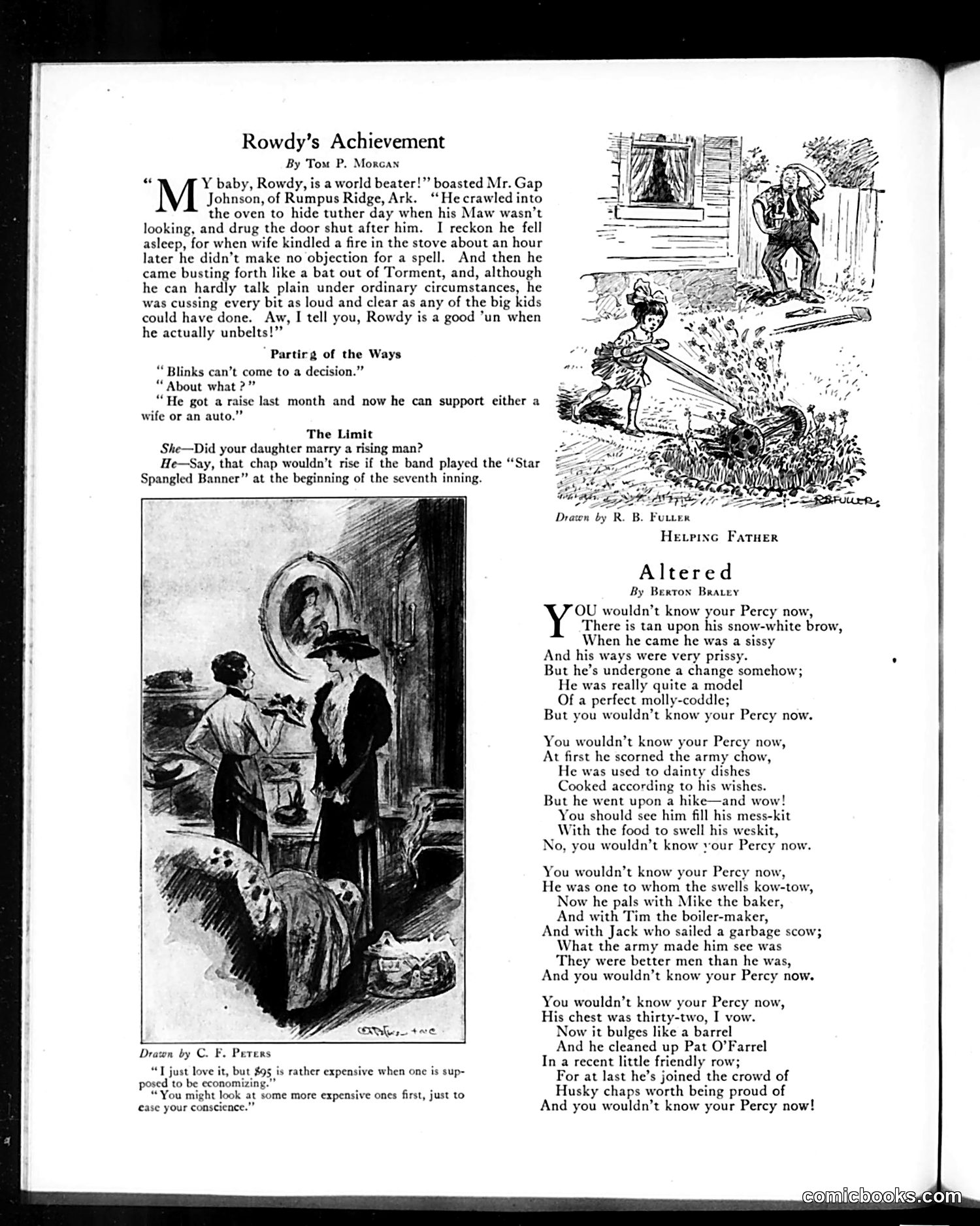
This page contains several short humorous pieces typical of Judge magazine's satirical humor: **"Rowdy's Achievement"**: A folksy anecdote about a frontier child's toughness—he allegedly slept through a fire in the stove and emerged cursing like the older kids. It's rural Americana humor, celebrating rough-and-tumble frontier resilience. **"Parting of the Ways"** and **"The Limit"**: Brief one-liners poking fun at middle-class anxieties: Blinks can't choose between a wife and automobile (satirizing consumerism); the daughter married an unambitious man. **"Altered"** (the song): The main satirical piece. "Percy" transforms from an effete, pampered wealthy boy into a masculine soldier through military service. He gains a tan, eats heartily, befriends working-class men (bakers, boiler-makers), and develops physical strength. The satire celebrates how military service "masculinizes" and democratizes privileged young men, teaching them the value of working-class manhood and physical toughness—reflecting early-20th-century American anxieties about upper-class softness and militarism's "character-building" benefits.
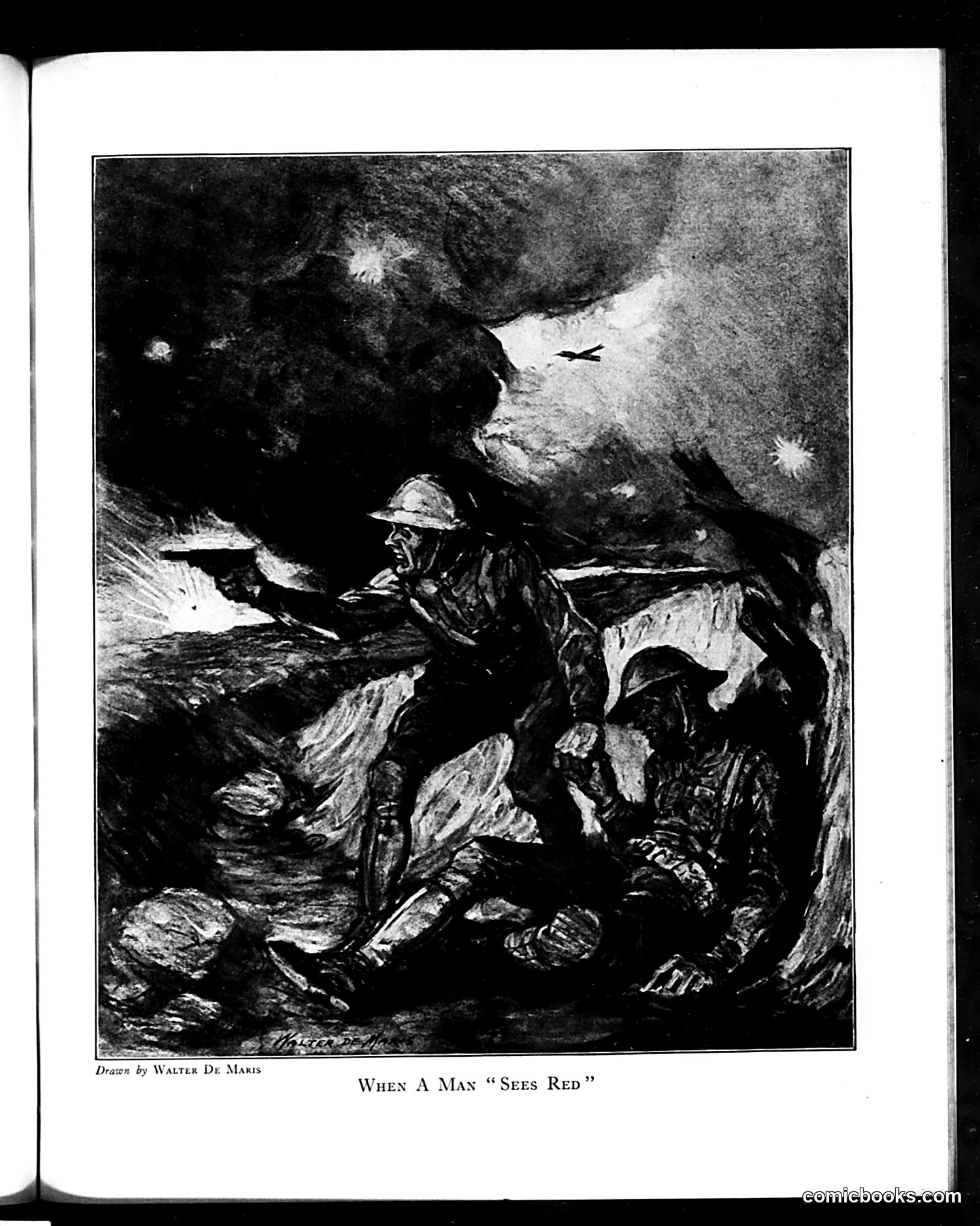
This drawing by Walter De Maris illustrates the idiom "seeing red" — meaning to become enraged or lose one's temper. The image depicts a soldier in a military helmet in what appears to be a trench or battlefield, surrounded by explosions and chaos. His posture and the dramatic composition suggest intense anger or fury in combat conditions. The cartoon likely comments on soldiers' psychological states during warfare, particularly how combat conditions provoke extreme emotional responses. The title plays on the literal phrase while the wartime imagery grounds it in contemporary WWI-era reality, when Judge magazine frequently addressed military themes. The artwork emphasizes how violent circumstances fuel human rage and aggression.
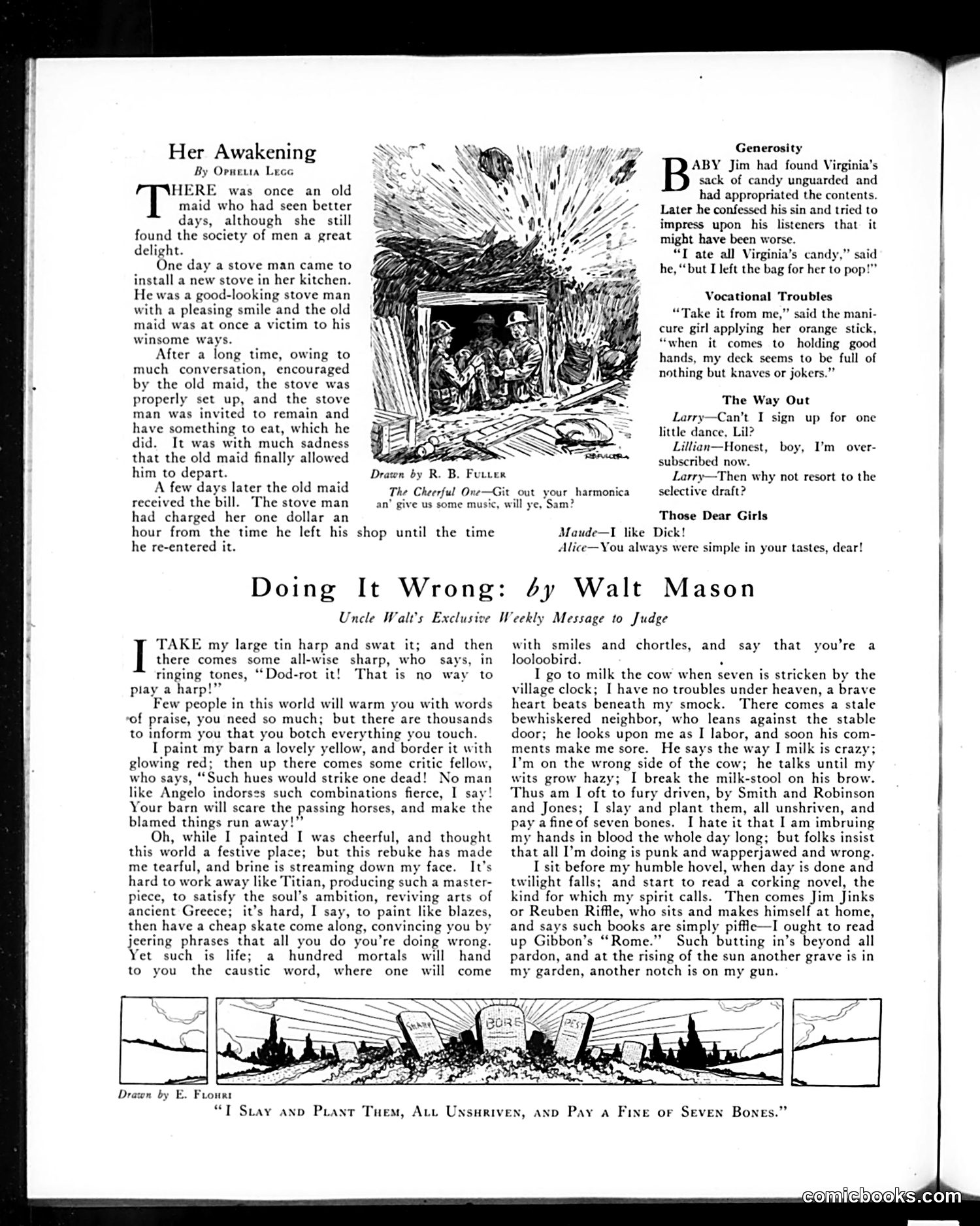
This page contains three short humorous stories and Walt Mason's satirical column, all targeting common social frustrations of the era. **"Her Awakening"** mocks naive older unmarried women. An elderly spinster, starved for male attention, entertains a charming stove installer, only to discover he's charged her by the hour for his entire workday—a joke about romantic vulnerability and financial exploitation. **The brief anecdotes** satirize social hypocrisy: a child's self-serving generosity ("I left the bag"), a manicure girl's workplace frustrations (card-game metaphors), and wartime dating pressures (the "selective draft"). **Mason's "Doing It Wrong"** is the page's main satirical essay, complaining about chronic fault-finding. Using vivid examples—a barn painted in bold colors, milking a cow—Mason satirizes the universal human tendency to criticize others' work while offering no constructive help. The column captures early-20th-century frustration with constant, petty criticism from neighbors and acquaintances. The humor relies on relatable domestic scenarios and mild social critique rather than political commentary.
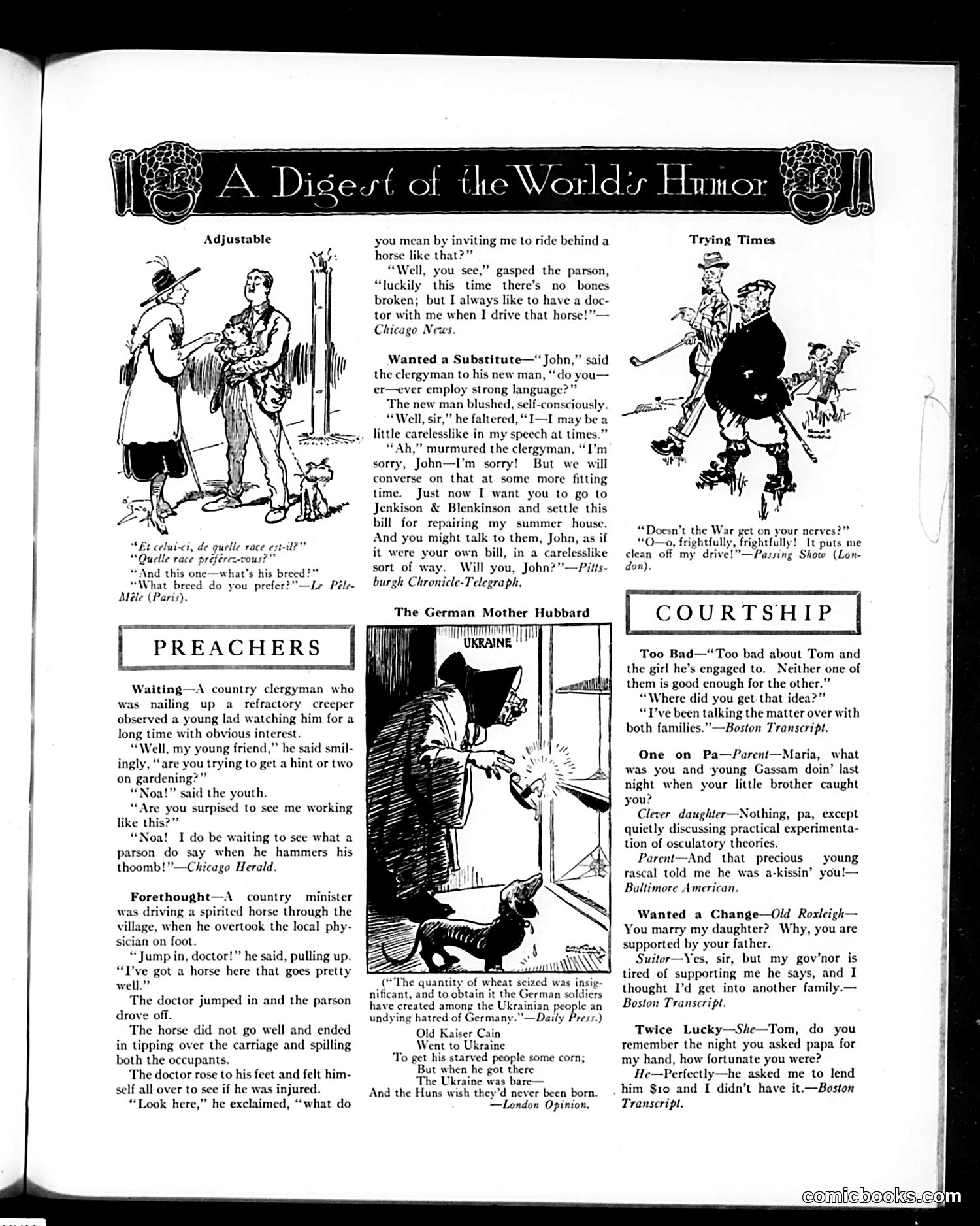
This page collects brief humorous anecdotes organized by topic. The **"Preachers"** section features three jokes satirizing clergy: one mocks a parson's naiveté about human nature (expecting a boy to be interested in gardening), another plays on a minister's poor horse-handling skills, and a third shows a clergyman hypocritically asking his employee to use crude language on his behalf—reversing his stated moral standards. **"The German Mother Hubbard"** is a WWI-era political cartoon criticizing German occupation of Ukraine. It depicts Kaiser Wilhelm as a thief stealing grain from starving Ukrainians, creating lasting resentment. The accompanying poem uses the "Old King Cole" format to mock German military ruthlessness. **"Courtship"** contains lightweight romantic humor about engagements and dating—a woman's parents disapproving of both sides, a daughter euphemistically describing kissing as "osculation theory," and a suitor hoping to escape his father's financial support by marrying into another family. These are period pieces reflecting early 20th-century humor standards and WWI attitudes toward Germany.
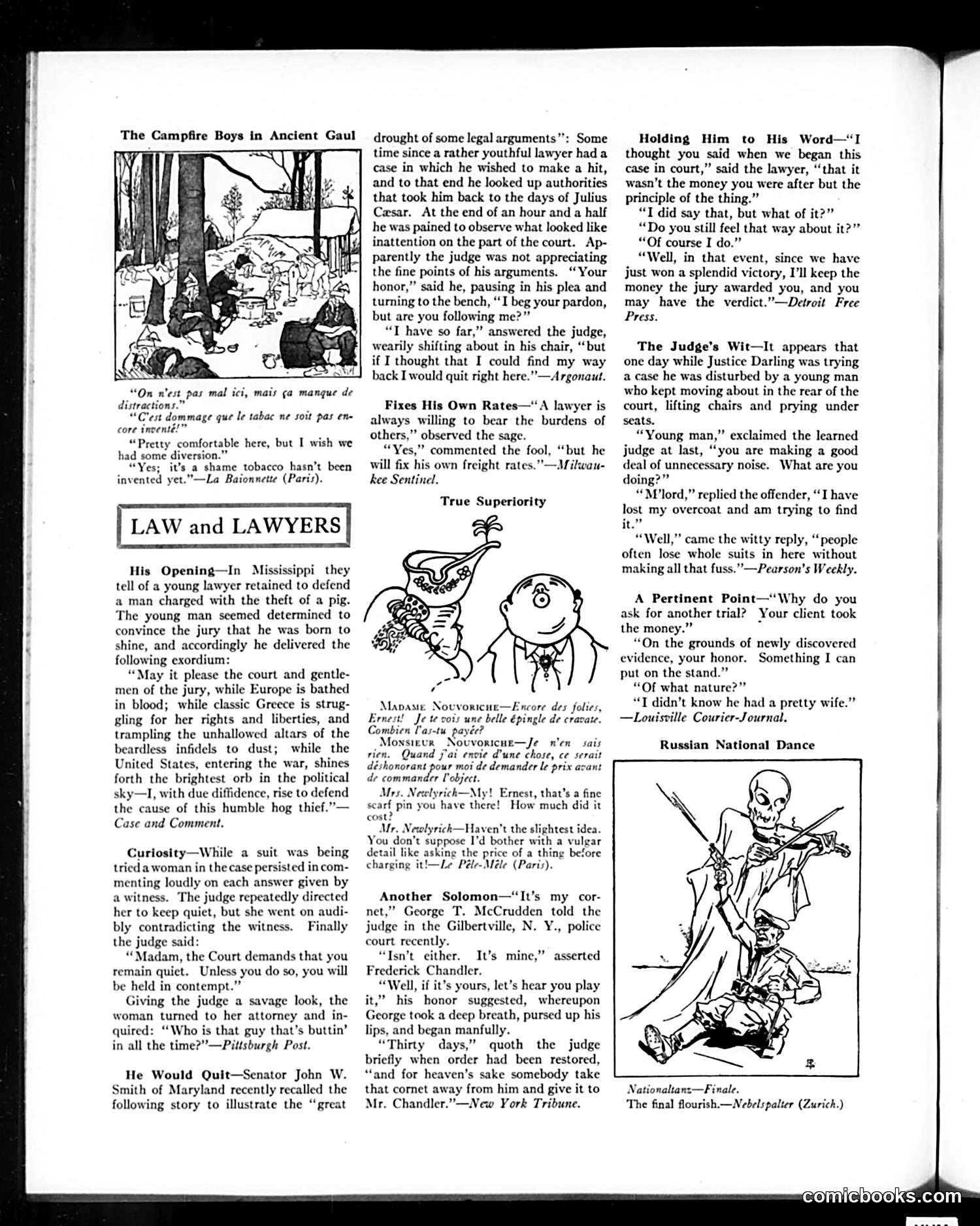
This Judge magazine page contains humor pieces about lawyers and the law, plus a cartoon strip about "Campfire Boys in Ancient Gaul." **The main cartoon** (top left) depicts Boy Scouts in Roman Gaul complaining about lack of entertainment and missing tobacco—anachronistic humor playing on these modern conveniences existing in ancient times. **The "Law and Lawyers" section** collects brief humorous anecdotes mocking lawyers and judges: - A young lawyer's grandiose opening statement defending a pig theft case, inflating its importance with references to European war and classical Greece - A woman's contempt for court proceedings - Jokes about lawyers' inflated billing practices - A judge awarding a disputed cornet to whoever can play it best (Solomon-like wisdom) **The satire targets** lawyer pomposity, verbose courtroom arguments disconnected from simple facts, and judicial incompetence. The pieces suggest lawyers deliberately obscure cases with grandiloquence and overcharge clients. The page also includes a small cartoon mocking wealthy nouveaux-riches who refuse to ask prices before purchasing—implying vulgar materialism and financial irresponsibility among the newly rich.
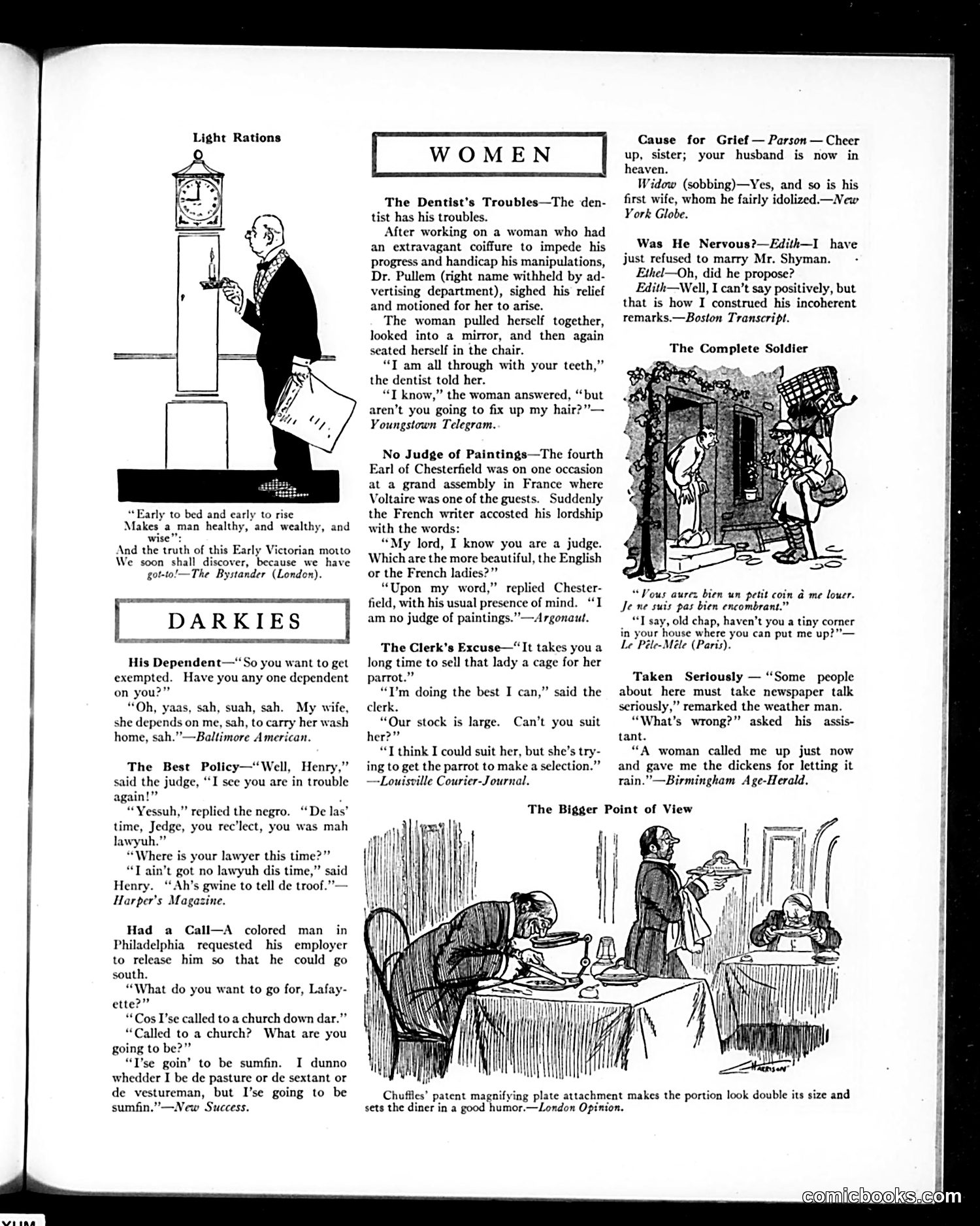
This is a humor miscellany page featuring short jokes and anecdotes rather than political cartoons. The content reflects early 20th-century American attitudes: **"Darkies" section**: Contains three dialect jokes about African Americans seeking exemptions, legal representation, and church positions. These rely on racist stereotypes and broken speech patterns common to the era's "humor." **Other jokes** include: a dentist frustrated by a woman's elaborate hairstyle interfering with dental work; an anecdote about the Earl of Chesterfield diplomatically deflecting a question about female beauty by claiming he's "no judge of paintings"; and various domestic/marital humor. **"The Complete Soldier" illustration** shows soldiers, likely referencing WWI-era service obligations. **"The Bigger Point of View" cartoon** depicts a magnifying plate making food appear larger to improve dining enjoyment—a visual pun on perspective. The page exemplifies Judge's mix of observational humor, social commentary on gender roles, and the deeply racist content that characterized mainstream American publications of this period.
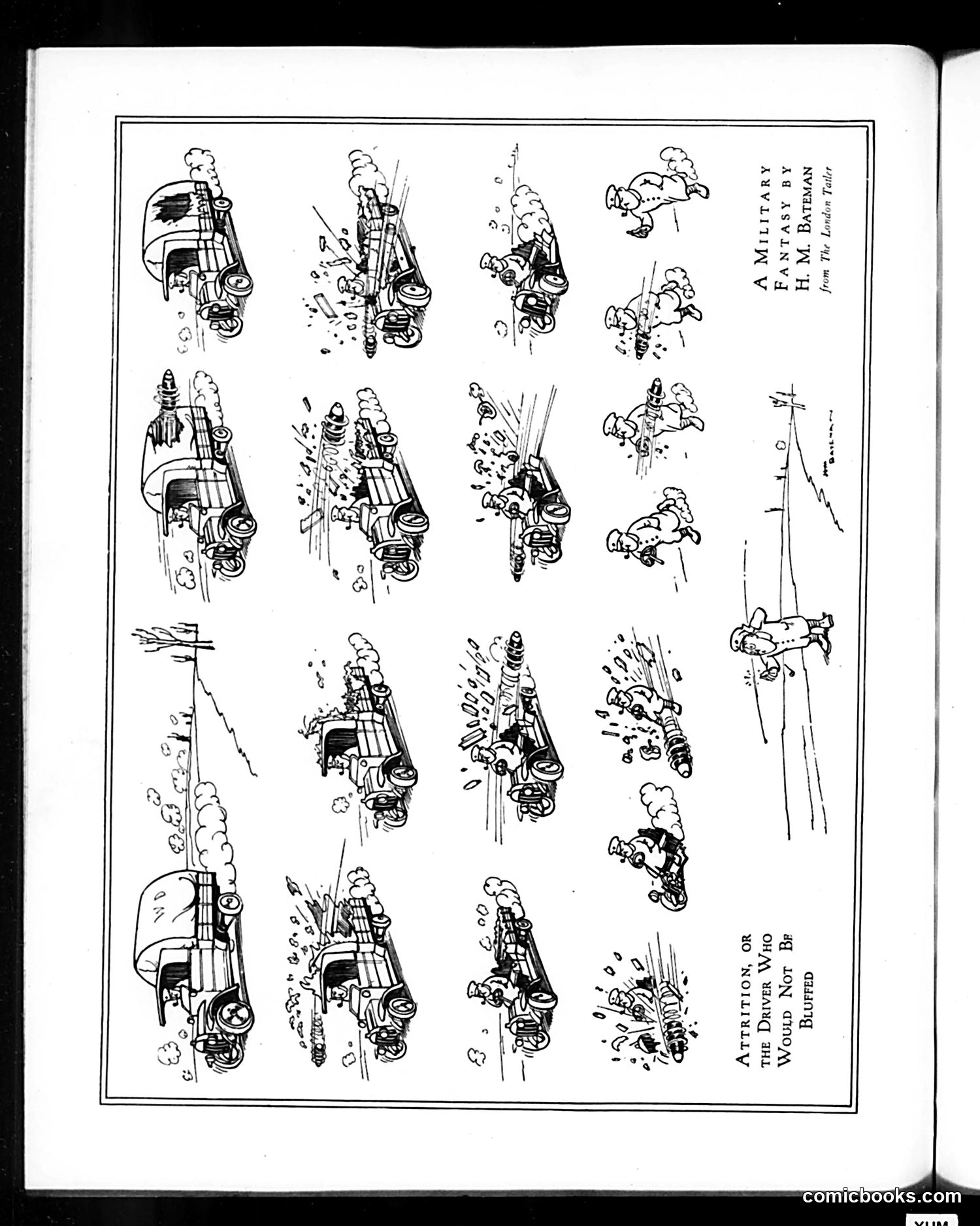
I cannot reliably interpret this page. While the image shows what appears to be a sequential comic strip featuring a character on a motorcycle or similar vehicle in various situations—with action, crashes, and comedic poses—the OCR text is severely corrupted and unreadable, making it impossible to identify the specific satire, political references, or joke. The title visible reads "A MILITARY FANTASY BY FANTASY BY H. M. BATEMAN From *The London Mail*" and credits an "ATTRIBUTOR" at the bottom, but without legible text explaining the narrative or context, I cannot accurately explain what modern readers are missing about this cartoon's meaning or target.
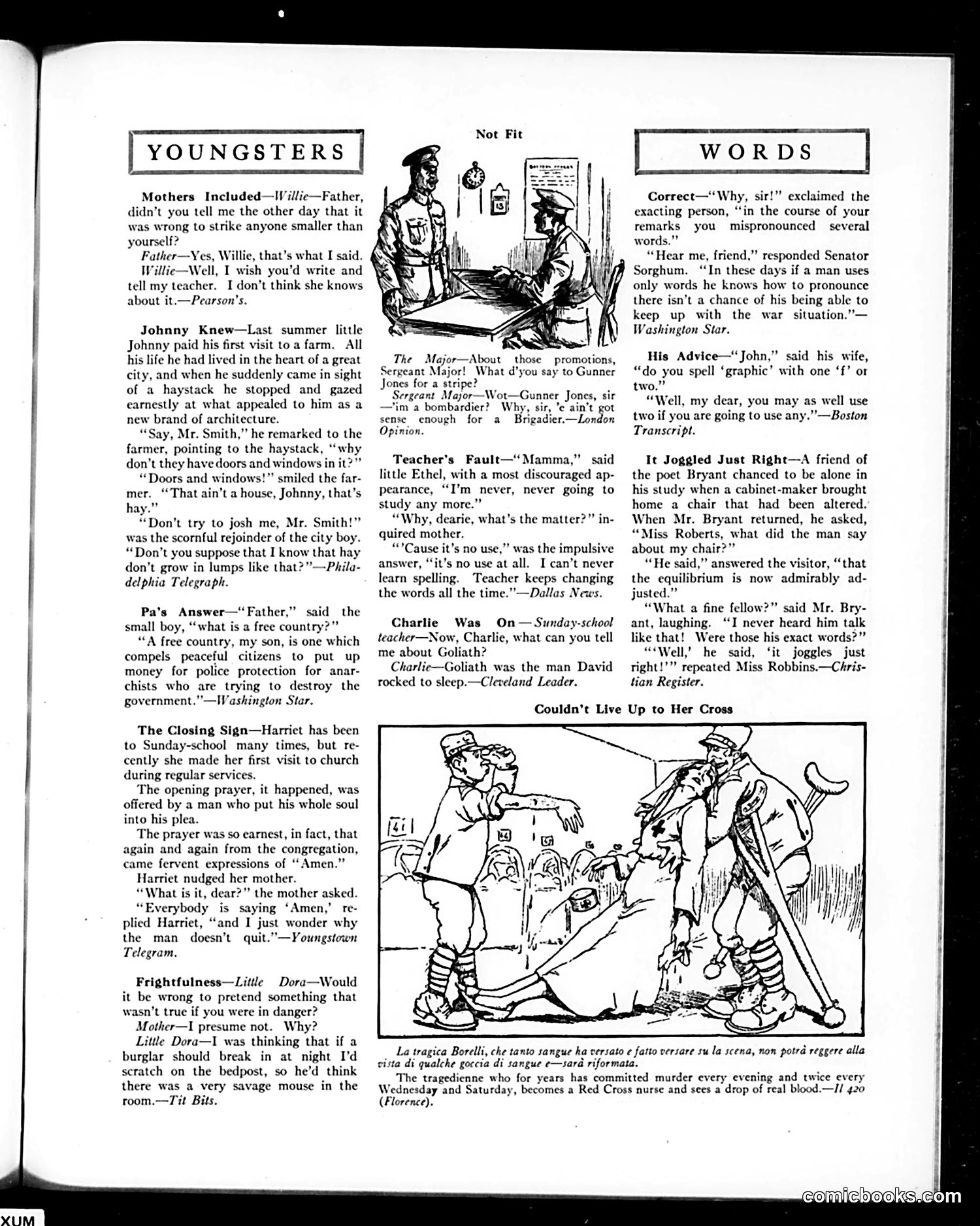
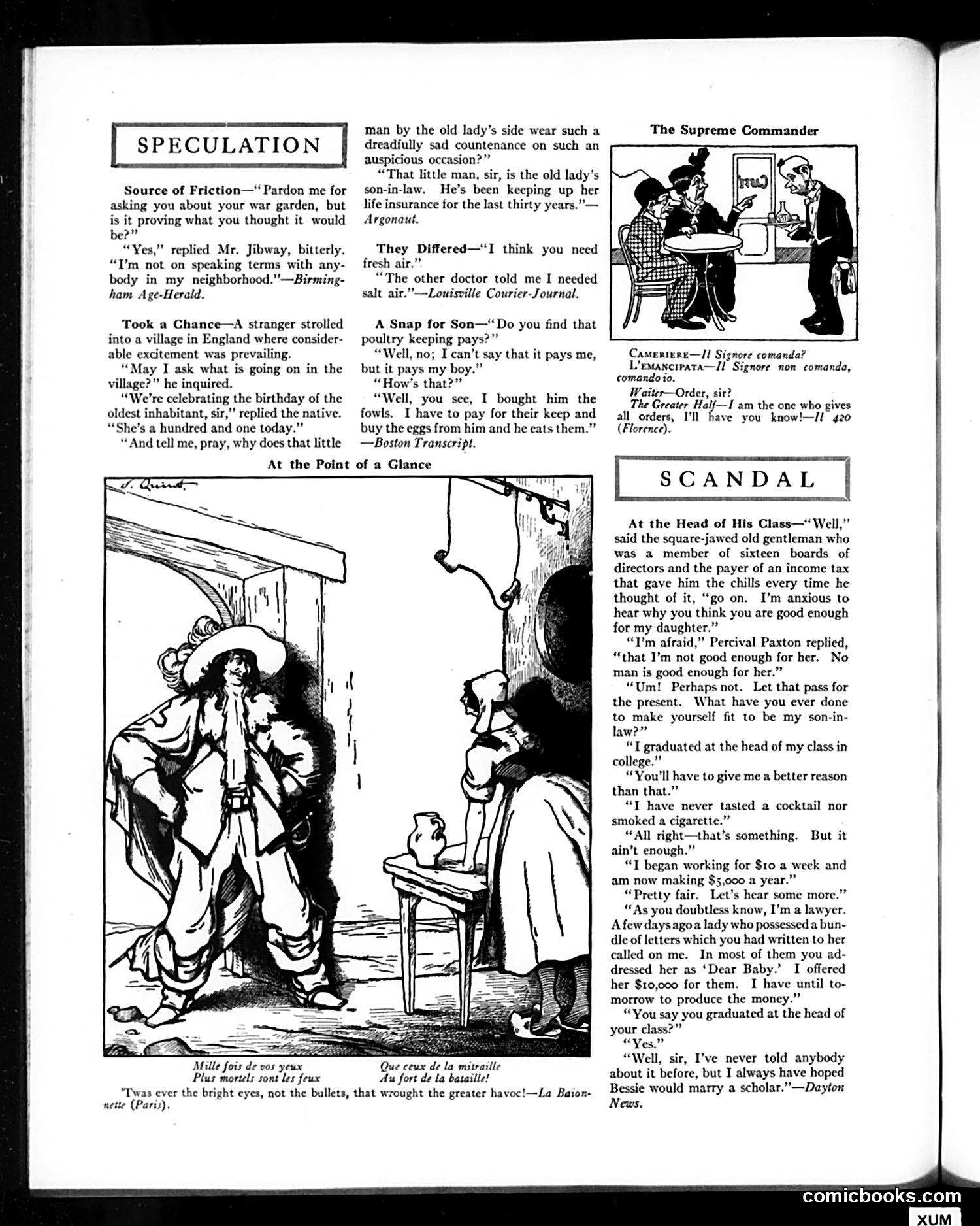
This page contains several brief satirical pieces and cartoons typical of early-20th-century American humor magazines. **"Speculation" section**: Short anecdotes mocking various social situations—a neighbor feud over war gardens, a son-in-law burdened by his mother-in-law's life insurance, and conflicting medical advice. The humor relies on ironic twists and domestic frustrations. **"At the Point of a Glance"**: A sentimental illustration with French captions romanticizing women's eyes as more destructive than bullets during warfare—typical period gallantry dressed as wartime commentary. **"The Supreme Commander"**: A cartoon depicting gender dynamics, where a woman (labeled "L'emancipata"—"The Emancipated Woman") asserts she, not her male companion, gives the orders. This satirizes early feminist movements and changing domestic power structures. **"Scandal"**: A lengthy joke where a wealthy father initially rejects a suitor despite impressive credentials (education, sobriety, financial success), but ultimately approves once learning the suitor recovered compromising love letters the father had written. The satire targets wealthy hypocrisy and moral double standards.
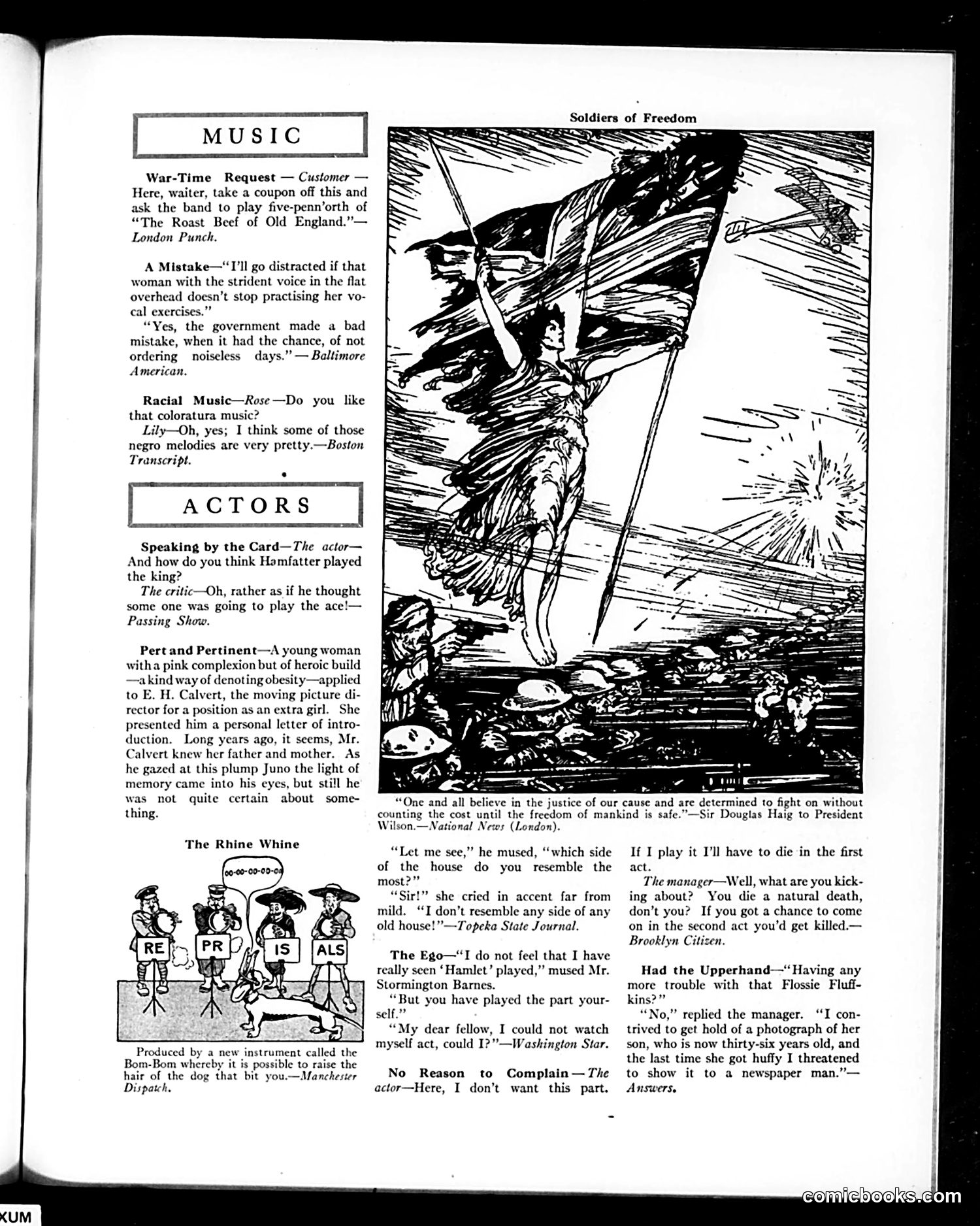
This page contains **humor sections** (Music, Actors) plus a **propaganda woodcut** titled "Soldiers of Freedom." **The woodcut** depicts a soldier charging forward with bayonet fixed. The caption quotes British General Douglas Haig justifying continued warfare without counting casualties—a stark contrast to the brutal image. This is **WWI-era propaganda**, likely meant to stir patriotic fervor, though the juxtaposition of Haig's confident rhetoric with the violent imagery creates an ironic effect about war's human cost. **The joke sections** are lighter fare: quips about opera singing, acting incompetence, and theatrical egos—typical Judge humor aimed at educated urban readers. One joke mocks an actress trying to get a film role by invoking an old family connection; another jokes that dying onstage in Act One is preferable to getting killed in Act Two (dark wartime humor). The page reflects Judge's dual function: satirical commentary mixed with entertainment, published during WWI when American attitudes toward the war were still shifting.
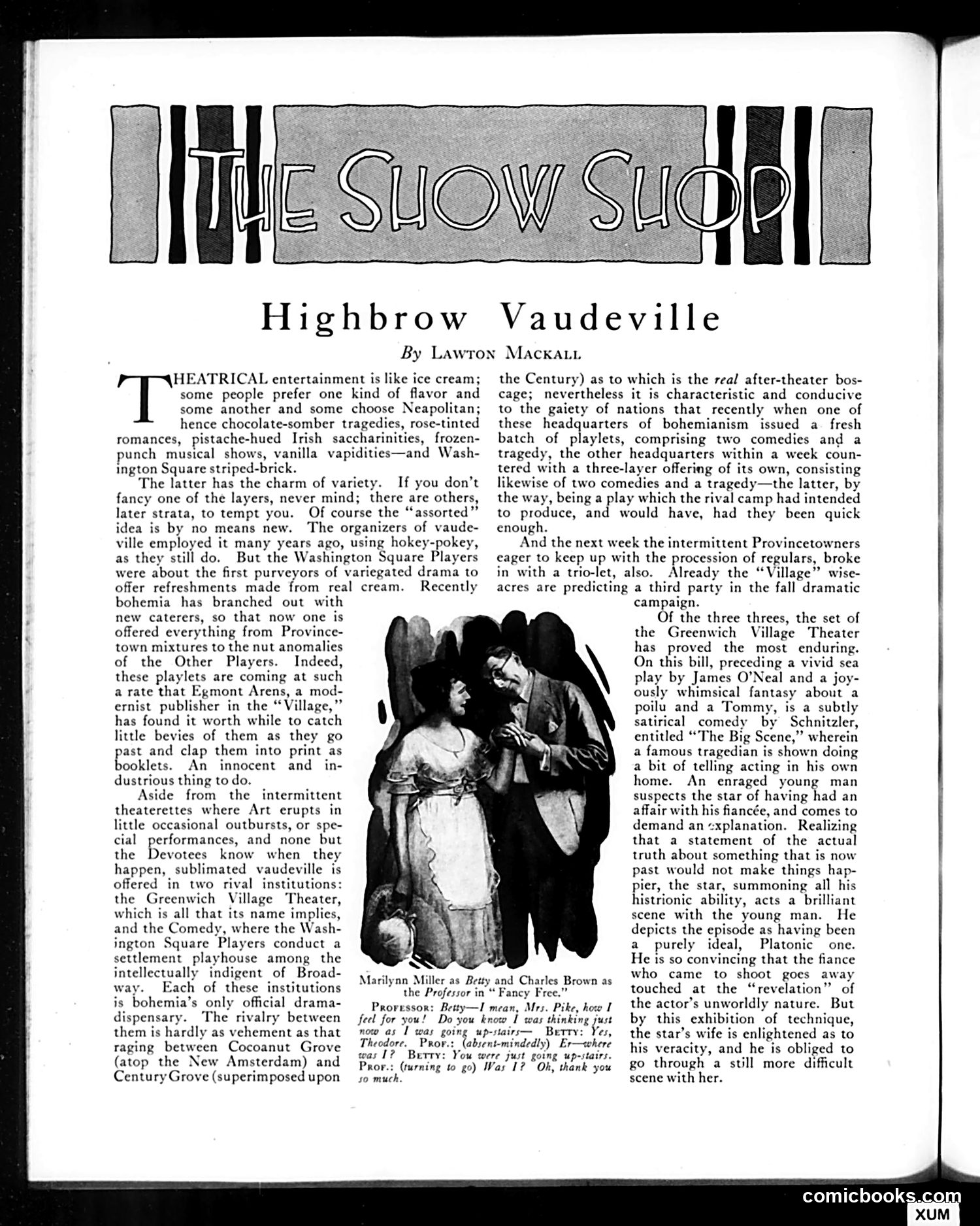
This article satirizes New York's competing bohemian theater venues in Greenwich Village. The author compares theatrical entertainment to ice cream flavors, explaining that different theaters cater to different tastes—from serious drama to light comedy. The piece mocks the rivalry between two establishments: the **Greenwich Village Theater** and the **Comedy** (run by the Washington Square Players). When one theater produces a three-play bill (two comedies and a tragedy), the other immediately counters with an identical format, competing desperately for audiences of "intellectually indigent" theatergoers on Broadway. The photograph shows actors from a production at one of these venues, illustrating the "settlement playhouse" culture being satirized. The satire's point: bohemian theater, despite artistic pretensions, operates like commercial vaudeville—mere fashion-following competition rather than genuine artistic vision.
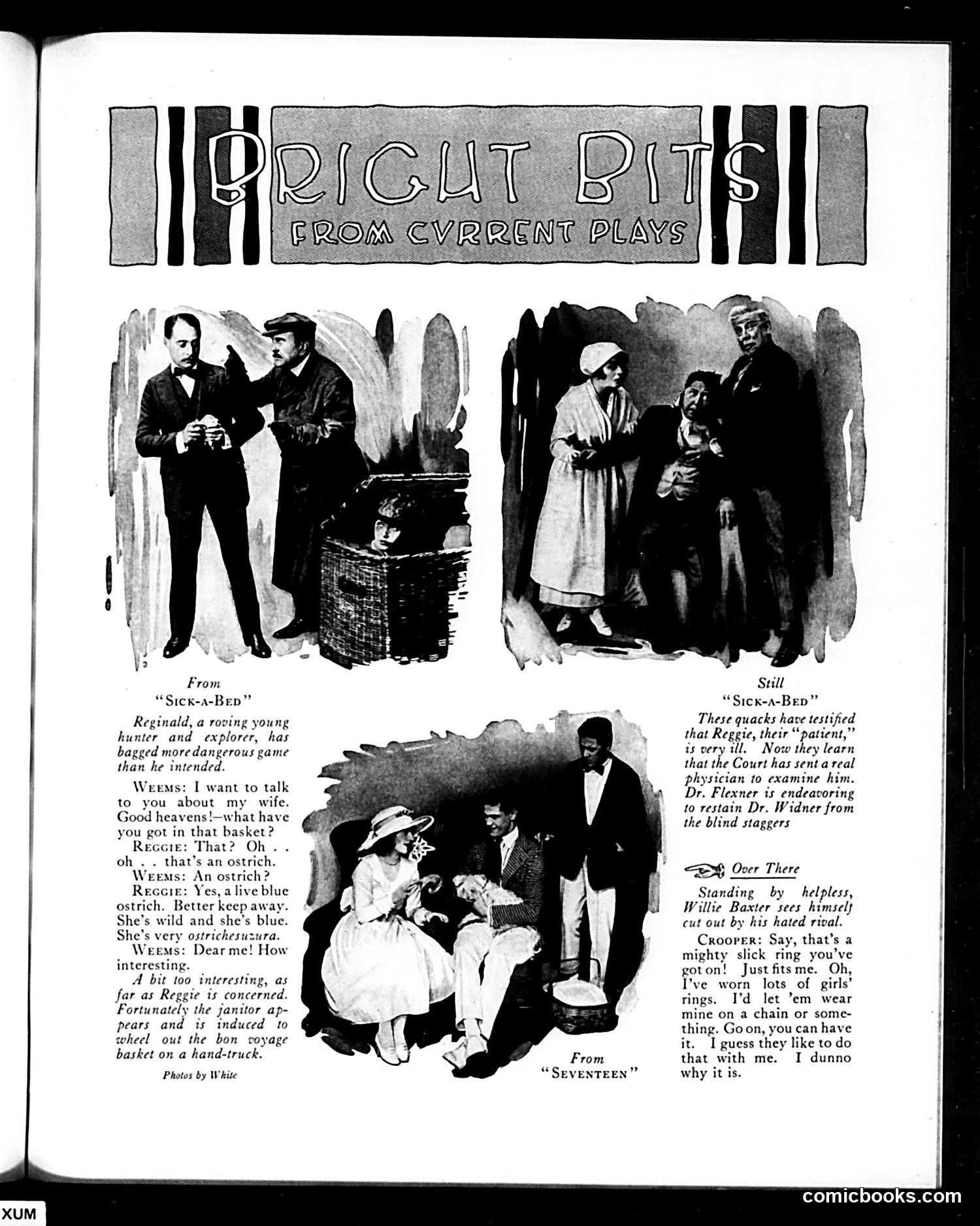
This page excerpts comedic scenes from three theatrical productions. The top two scenes are from "Sick-a-Bed," depicting farce involving a character named Reggie who has brought a live ostrich into someone's home—creating domestic chaos when a man named Weems tries to discuss his wife. The joke relies on the absurdity of the situation and double entendre (the ostrich being "wild and she's blue"). The bottom scene is from "Seventeen," showing a young man named Willie Baxter apparently losing romantic attention to a rival. A character brags about wearing girls' rings casually, implying casual romantic conquests. These appear to be light comedic vignettes designed to showcase humorous theatrical moments for Judge's readers—showcasing popular stage comedy rather than political satire. The humor is domestic and romantic rather than satirical.
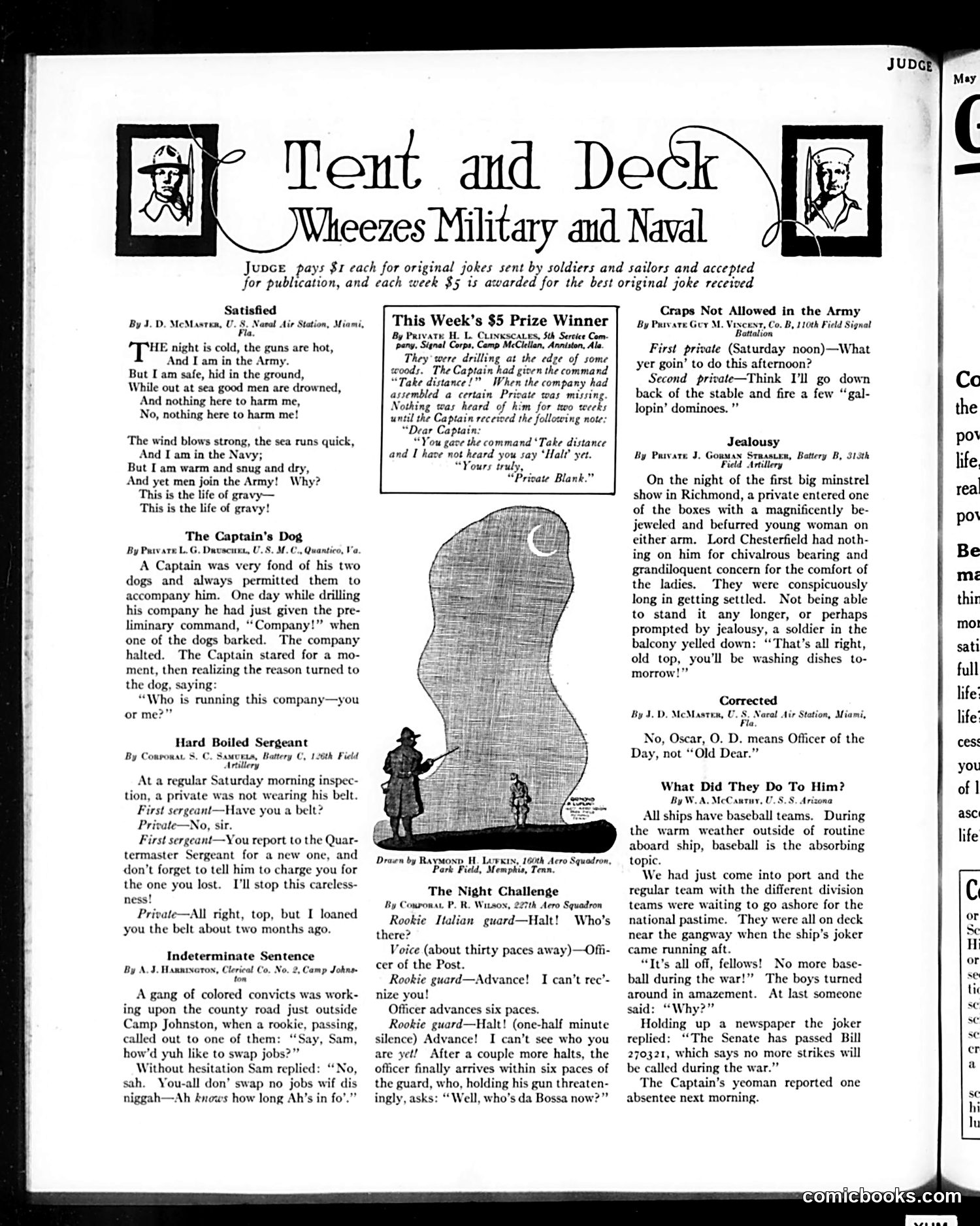
This is a humor section of *Judge* magazine featuring jokes submitted by soldiers and sailors during World War I. The content reflects military life's absurdities and contrasts. **Key themes:** - **"Satisfied"**: Compares the comfort of Army ground duty versus Navy service, ironic given men voluntarily choose the Army - **"The Captain's Dog"**: A commanding officer responds to his dog's bark as if it were a soldier's command—absurd military hierarchy - **"Hard Boiled Sergeant"**: A private cleverly reminds his sergeant he loaned him a belt weeks ago when ordered to replace a missing one - **"The Night Challenge"**: An inexperienced Italian-American rookie guard repeatedly halts an approaching officer, ultimately questioning who has authority ("who's da Bossa now?")—mocking raw recruits and ethnic stereotypes - **"Craps Not Allowed"**: References illegal gambling ("gallopin' dominoes") on base The humor exploits military incompetence, confusion, and rule-breaking, reflecting soldiers' perspectives on institutional absurdity during wartime.
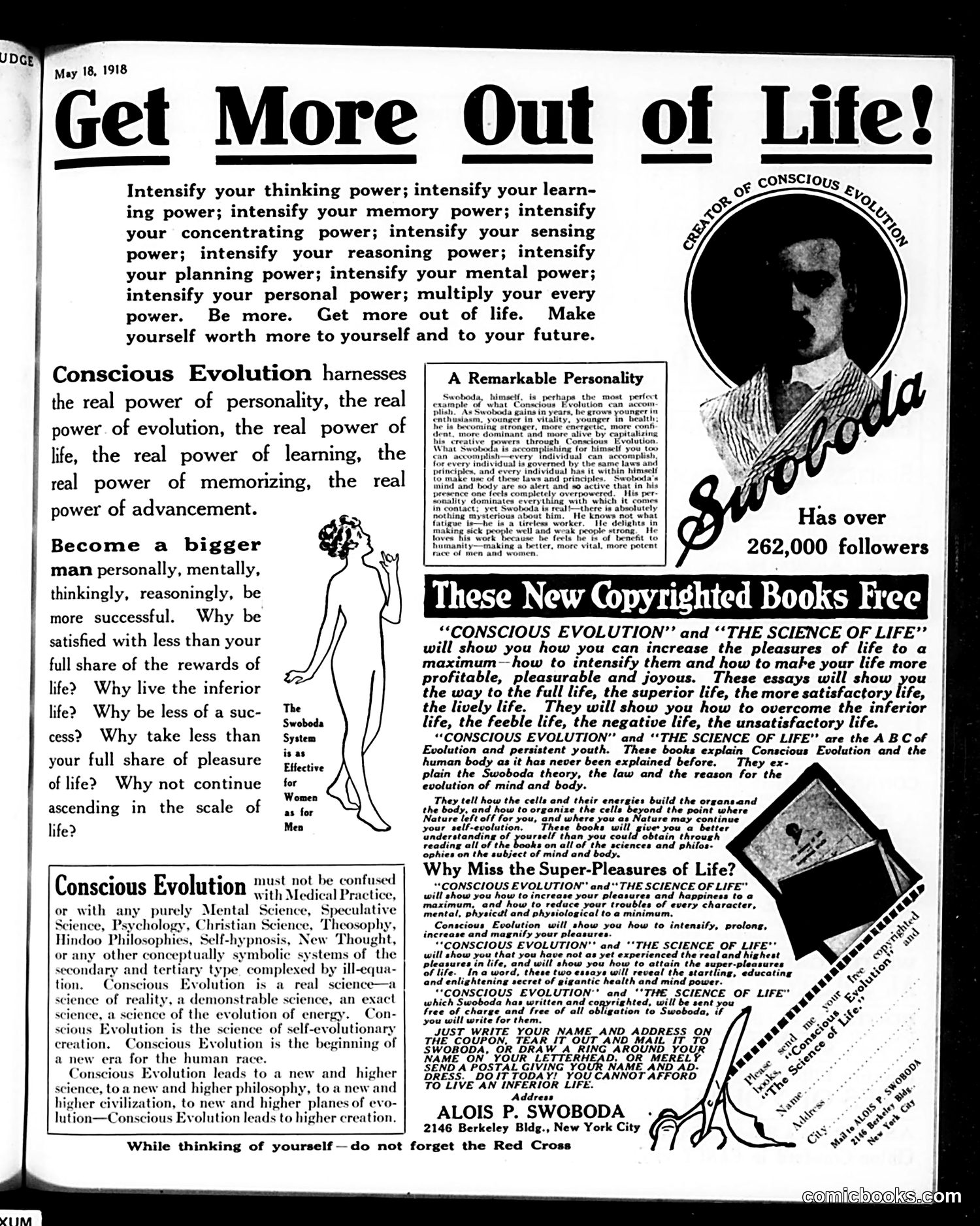
This is primarily **advertisement rather than satire**—a full-page promotion for Alois P. Swoboda's self-improvement system called "Conscious Evolution." Swoboda was a real early-20th-century figure who marketed a pseudo-scientific self-help philosophy. The page promotes his copyrighted books promising to unlock human potential through intensifying mental powers, increase life's pleasures, and achieve superior personal evolution. The content reflects era-typical self-help rhetoric: exhortations to "become a bigger man," rejections of inferior living, and appeals to personal ambition. The illustration shows a muscular figure—visualizing the physical/mental transformation promised. A small note at bottom reads "While thinking of yourself—do not forget the Red Cross," a patriotic reminder relevant to 1918 (WWI context), suggesting even personal advancement shouldn't eclipse wartime charitable duty. This represents genuine advertising, not satirical commentary—Judge carried commercial promotions alongside editorial content.
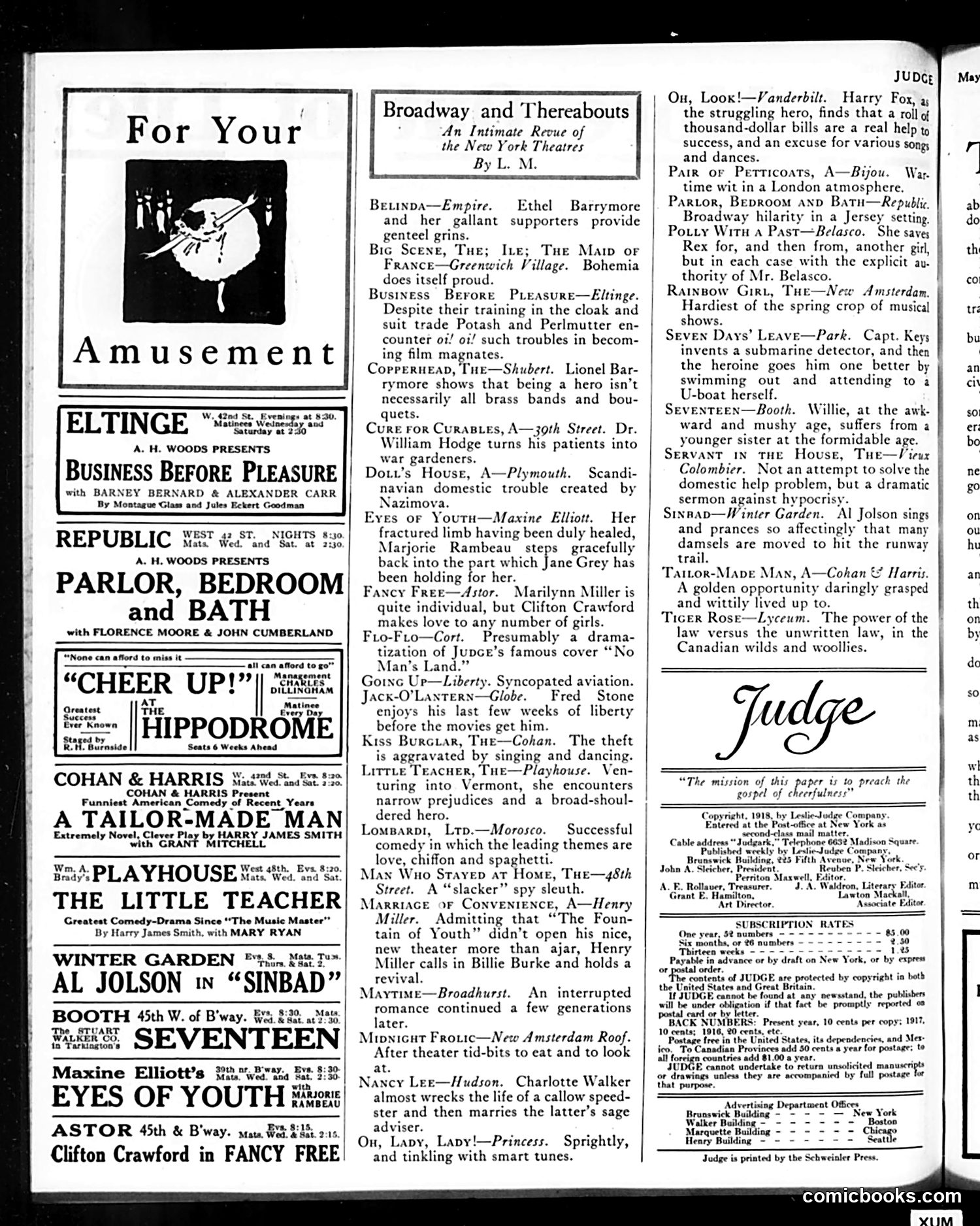
This is primarily a **theater advertising and review page** from Judge magazine, a major American satirical publication. The left side features paid advertisements for Broadway shows (typical for magazines of this era), while the right side contains brief, witty capsule reviews of current New York theatrical productions. The reviews use **sharp, dismissive humor** characteristic of Judge's style. For example, "Business Before Pleasure" notes the protagonists encounter "oi! oi!" troubles becoming film magnates (mocking Yiddish-inflected speech), while "Copperhead" quips that being a hero "isn't necessarily all brass bands and bouquets." The tone is **urbane and sometimes condescending**, reflecting early-20th-century theater criticism. References to plots and performers (like Ethel Barrymore, Al Jolson, Clifton Crawford) would have been immediately recognizable to Judge's educated, theater-going audience. The small cartoon in the upper left ("For Your Amusement") appears decorative rather than satirical.
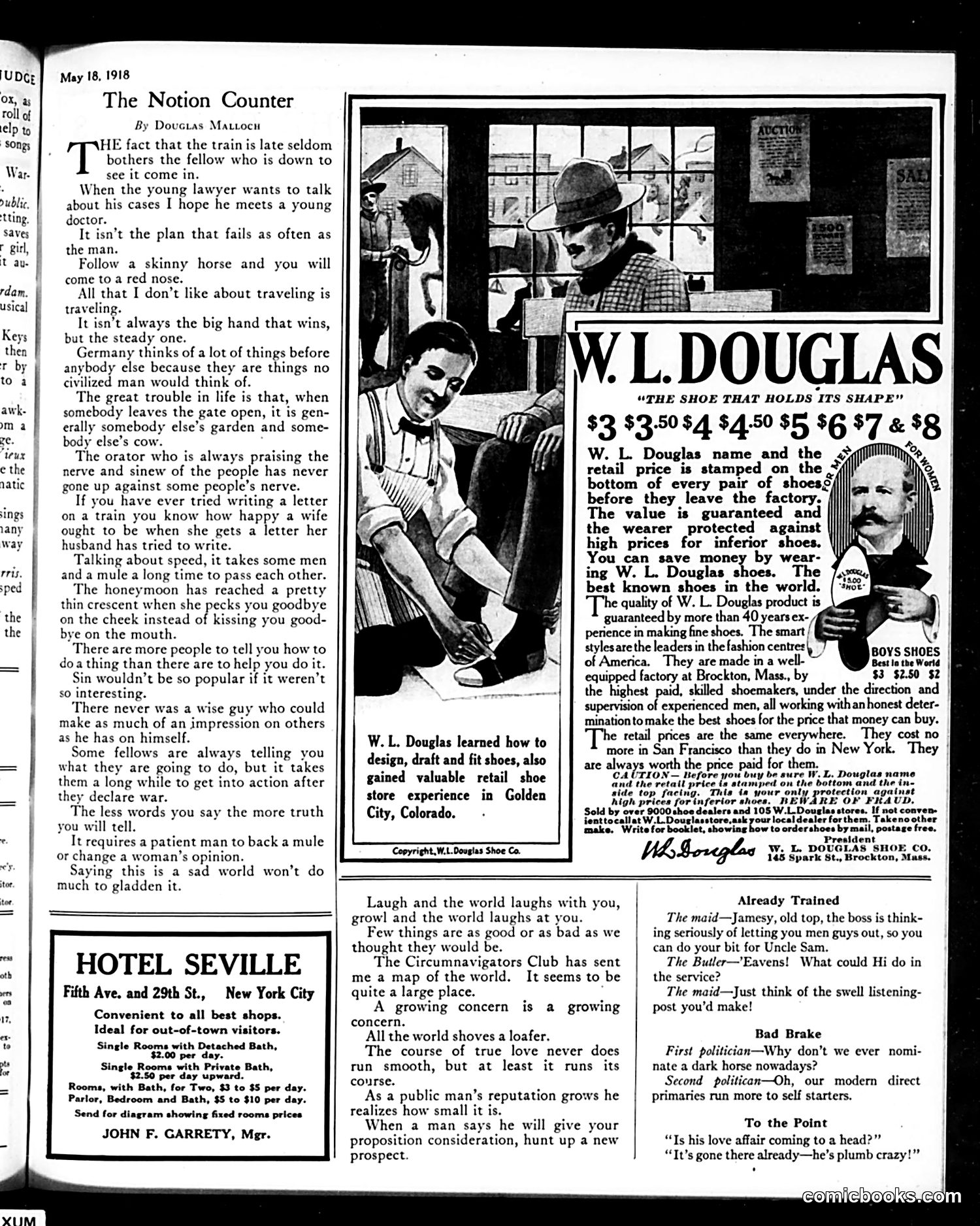
This page contains a satirical column by Douglas Malloch titled "The Notion Counter"—a collection of cynical observations about human nature disguised as homespun wisdom. Published during World War I, several aphorisms reference contemporary concerns: one critiques German militarism ("Germany thinks of a lot of things before anybody else because they are things no civilized man would think of"), while another mocks delay and procrastination as obstacles to action, possibly alluding to wartime mobilization anxieties. The humor relies on paradox and ironic reversal—praising restraint over bombast, steady effort over grand plans. The column occupies the left side; the right features a large W.L. Douglas shoe advertisement. The juxtaposition is typical of Judge's format: serious social commentary paired with commercial messaging.
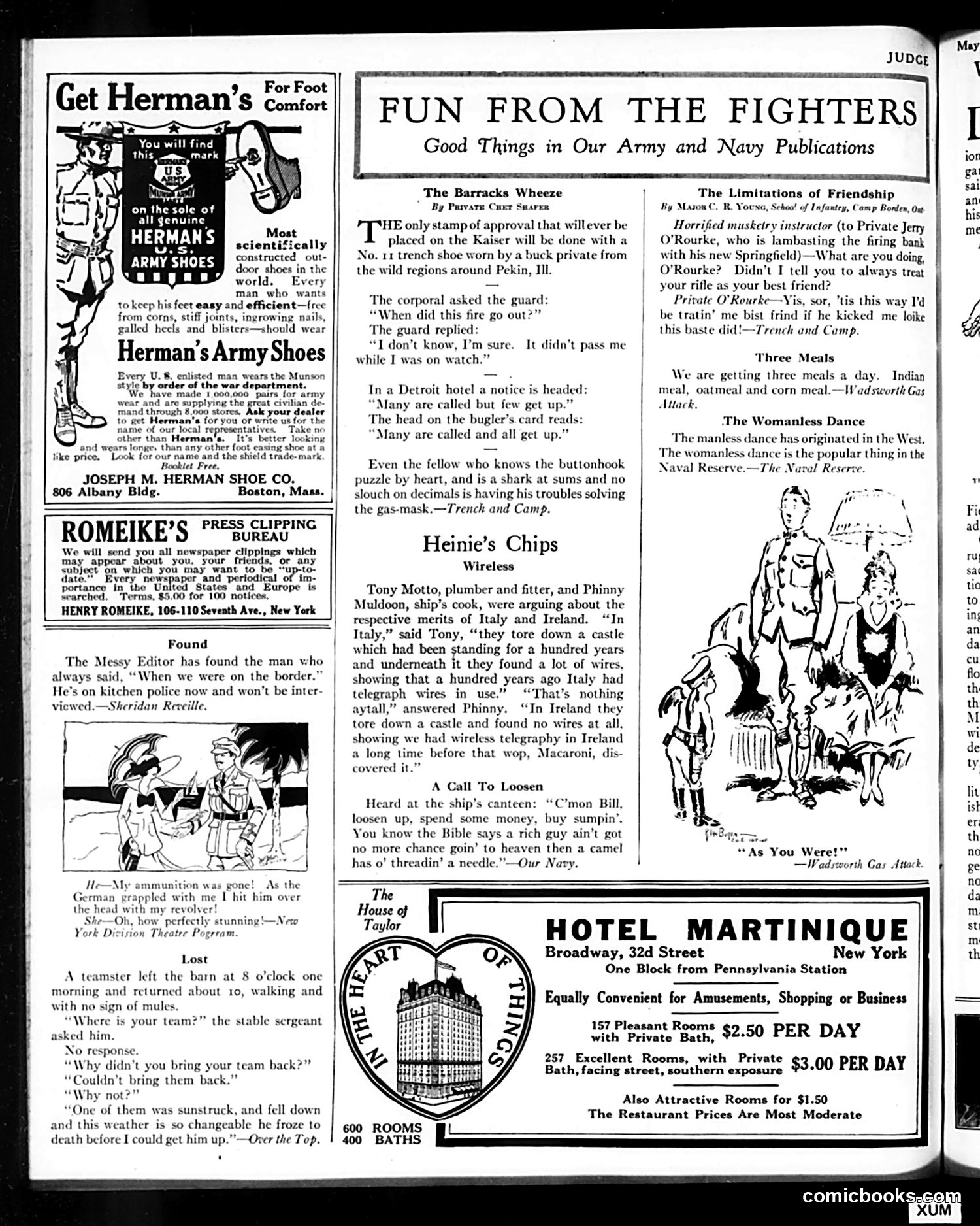
This page primarily contains **advertising and military humor** rather than political satire. The content reflects WWI-era Army and Navy life. **Main Elements:** 1. **Herman's Army Shoes advertisement**: Promotes officially-issued Munson-style boots to soldiers, emphasizing durability for military use. 2. **Military humor sections** ("Fun from the Fighters"): These are reprinted jokes from Army and Navy publications, including: - A corporal/guard exchange about a fire going out - A Detroit hotel notice about bugler duties - A wireless telegraphy joke contrasting Italian and Irish technological claims - A canteen conversation about spending money 3. **Supporting advertisements**: Romeike's Press Clipping Bureau and Hotel Martinique NYC **Historical Context**: The jokes reference trench warfare ("gas-mask," "Pekin"), suggesting this is from WWI era. The humor is gentle barracks comedy rather than sharp satire—largely puns and misunderstandings. "Heinie" (German slang) appears in section titles, reflecting wartime terminology. The page captures how mainstream American magazines used soldier-sourced humor to maintain morale and connection with military life during wartime.
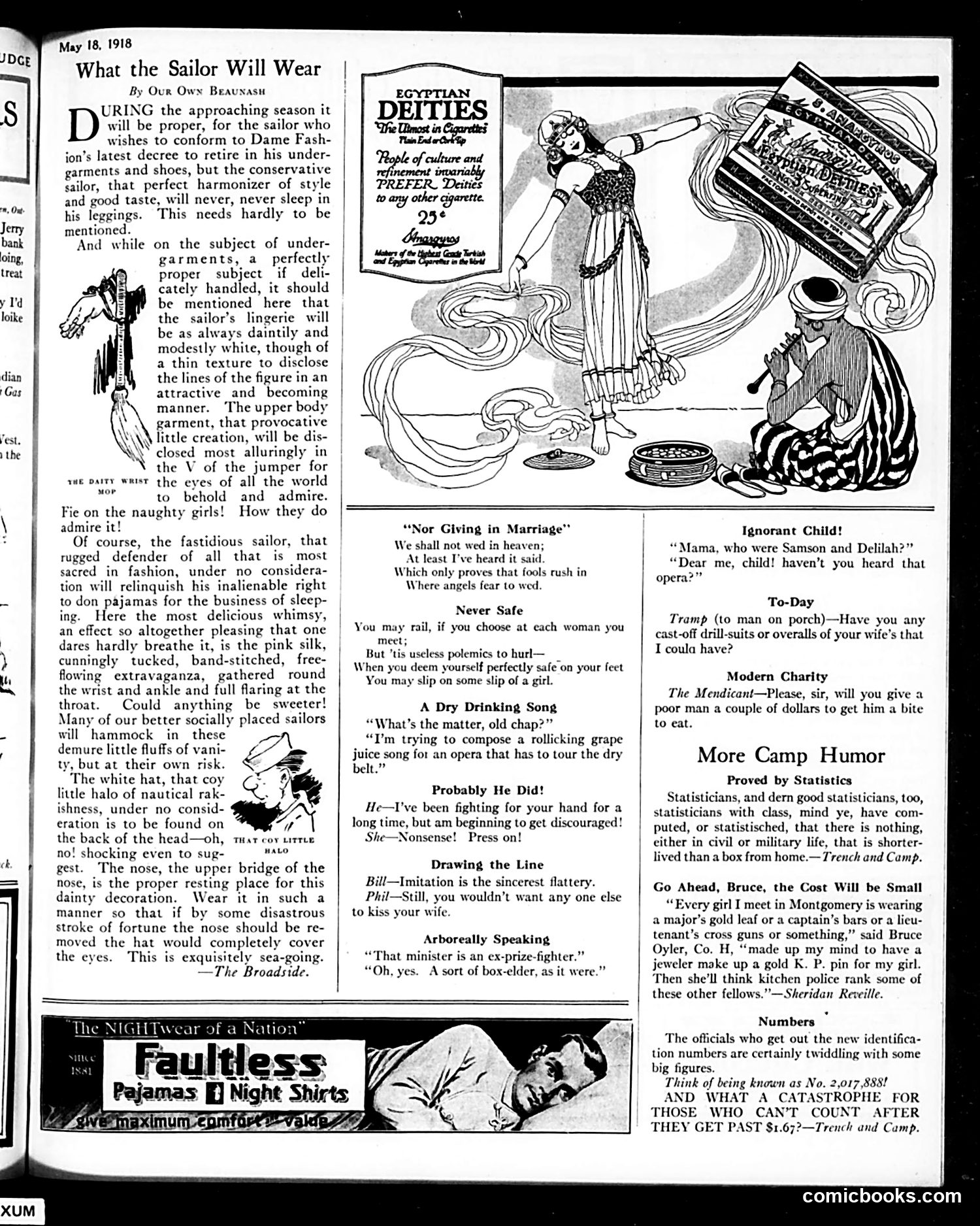
This page satirizes wartime fashion decrees and military propriety during World War I. The main article mockingly describes absurdly specific undergarment regulations supposedly mandated for sailors—notably the "V" neckline displaying the chest and elaborate pink silk pajamas—while maintaining they must wear leggings to bed and position their white hat precisely on the nose bridge. The satire targets the military's obsession with uniform codes and appearance standards, exaggerating them to ridiculous extremes. By presenting these trivial dress rules in solemn, overly ornate language, the author mocks both military rigidity and fashion arbiters' pretensions. The surrounding content includes typical Judge humor: relationship quips ("Never Safe," "Drawing the Line") and camp jokes about wartime life. A Faultless Pajamas advertisement appears at bottom—likely placed ironically given the article's pajama emphasis. The overall effect satirizes how institutions weaponize conformity while simultaneously poking fun at sailors' vanity and society's class-conscious fashion obsession during wartime.
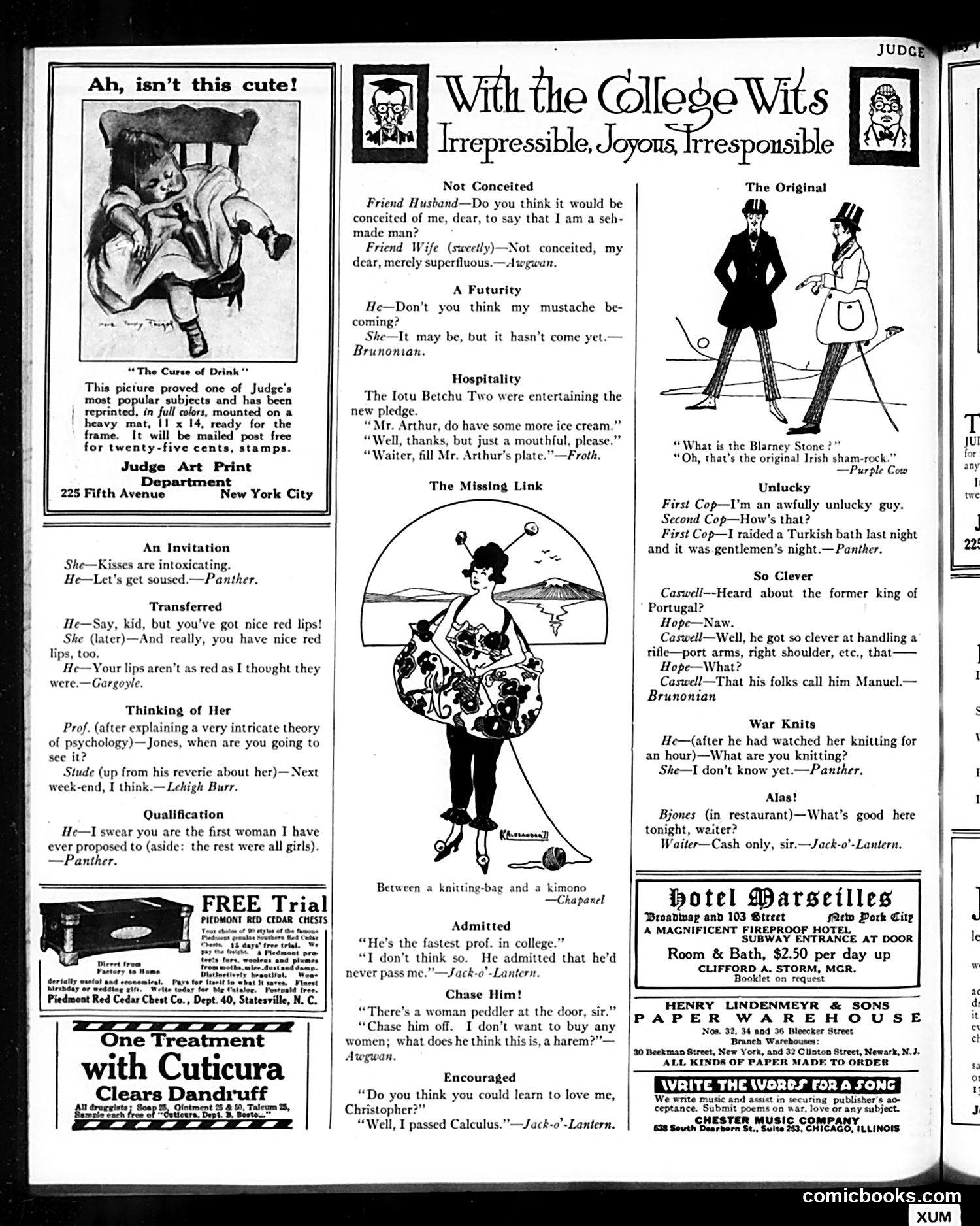
This page from *Judge* magazine compiles humorous one-liners and brief jokes sourced from college publications (indicated by attributions like "Brunonian," "Lehigh Burr," "Froth," and "Jack-o'-Lantern"). The humor reflects early 20th-century college life and gender dynamics. Jokes target: romantic misunderstandings between men and women; students distracted by romance from academics; courtship conventions (the "Qualification" joke mocks men claiming to be self-made); and contemporary references like the former Portuguese king Manuel II (known for military incompetence—the "port arms" pun). "The Missing Link" cartoon depicts a woman as literally between "knitting-bag and kimono"—mocking women's domestic stereotypes and fascination with exoticized Asian fashion. The page reflects *Judge's* target audience: educated, college-adjacent urban readers amused by collegiate wit, flirtation humor, and gentle mockery of both sexes' romantic follies. The advertising for cedar chests, hotels, and music publishing reinforces this affluent demographic.
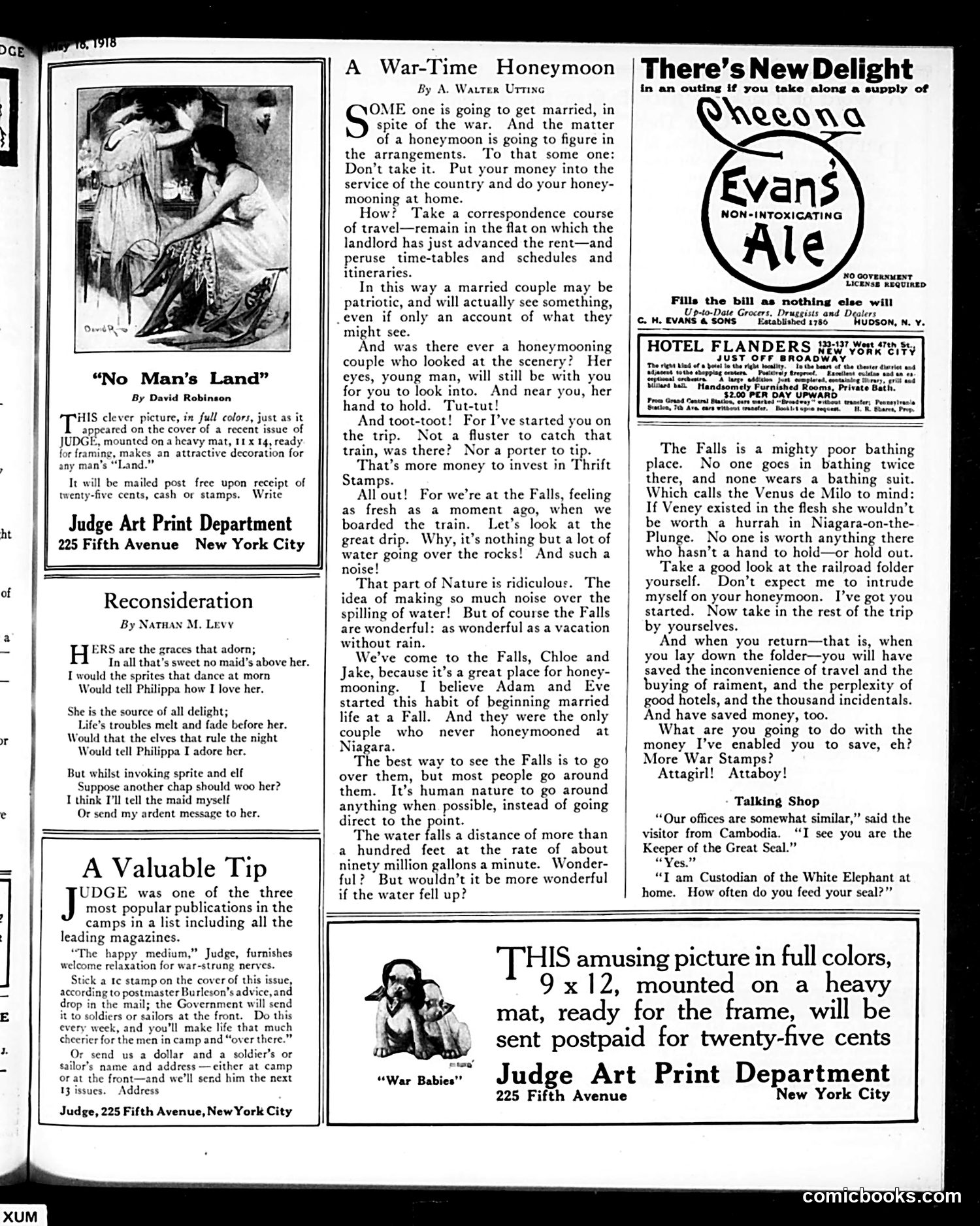
This page contains wartime-era satirical content and advertising. The main article, "A War-Time Honeymoon" by A. Walter Utting, sarcastically discourages newlyweds from taking expensive honeymoons during World War I. Instead of traveling to Niagara Falls, the author advocates staying home and investing money in war bonds ("Thrift Stamps"), mocking the idea of sightseeing when resources should serve the war effort. The tone suggests patriotic duty should override romantic celebration. The poem "Reconsideration" is a light romantic verse about declaring love. A sidebar titled "A Valuable Tip" encourages readers to mail the magazine to soldiers at the front, leveraging patriotic sentiment for circulation. Advertisements promote Judge art prints and Shecona Evans ale (marked "non-intoxicating"). The page reflects 1918 American anxieties about civilian sacrifice during WWI and the contemporary push for financial patriotism.
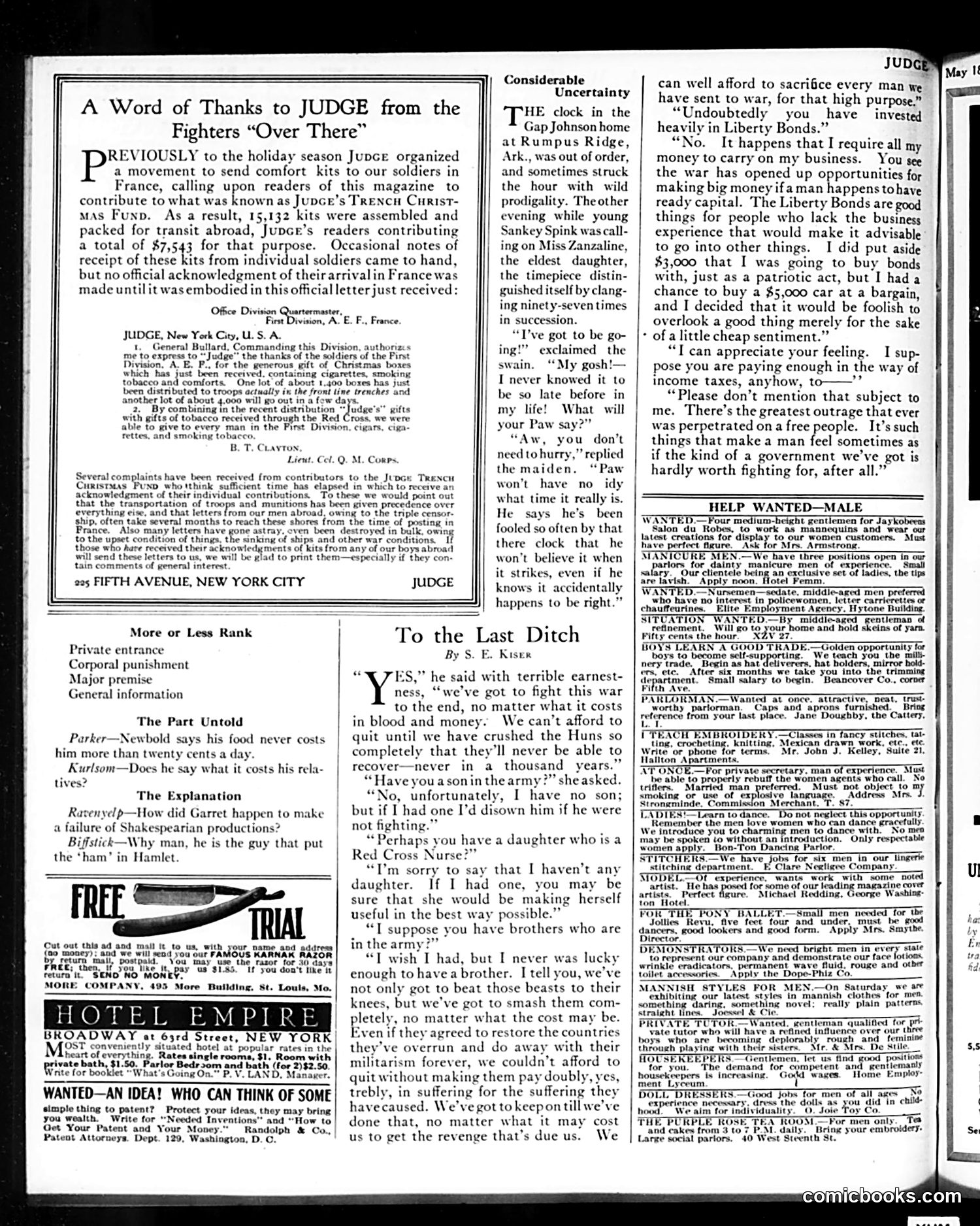
This page consists primarily of **letters and administrative content** rather than political cartoons. The main item is a **thank-you letter** from General Bullard (First Division commander in France) acknowledging Judge magazine's "Trench Christmas Fund"—a 1917-18 charitable drive that collected 15,132 comfort kits for American soldiers in World War I. The page includes a **satirical dialogue** titled "Considerable Uncertainty" mocking wealthy businessmen who claim patriotic support for Liberty Bonds (war bonds) while prioritizing personal profit. A character refuses to buy bonds, choosing instead to purchase a $5,000 automobile, then complains about income taxes—the joke being that self-interested profiteers won't sacrifice for the war effort. The rest consists of **classified advertisements** and minor humor pieces typical of Judge's format. **Context for modern readers**: This reflects WWI-era American jingoism and class tensions—wealthy citizens were expected to demonstrate patriotism through bond purchases and charitable giving, making public refusal to do so scandalous.
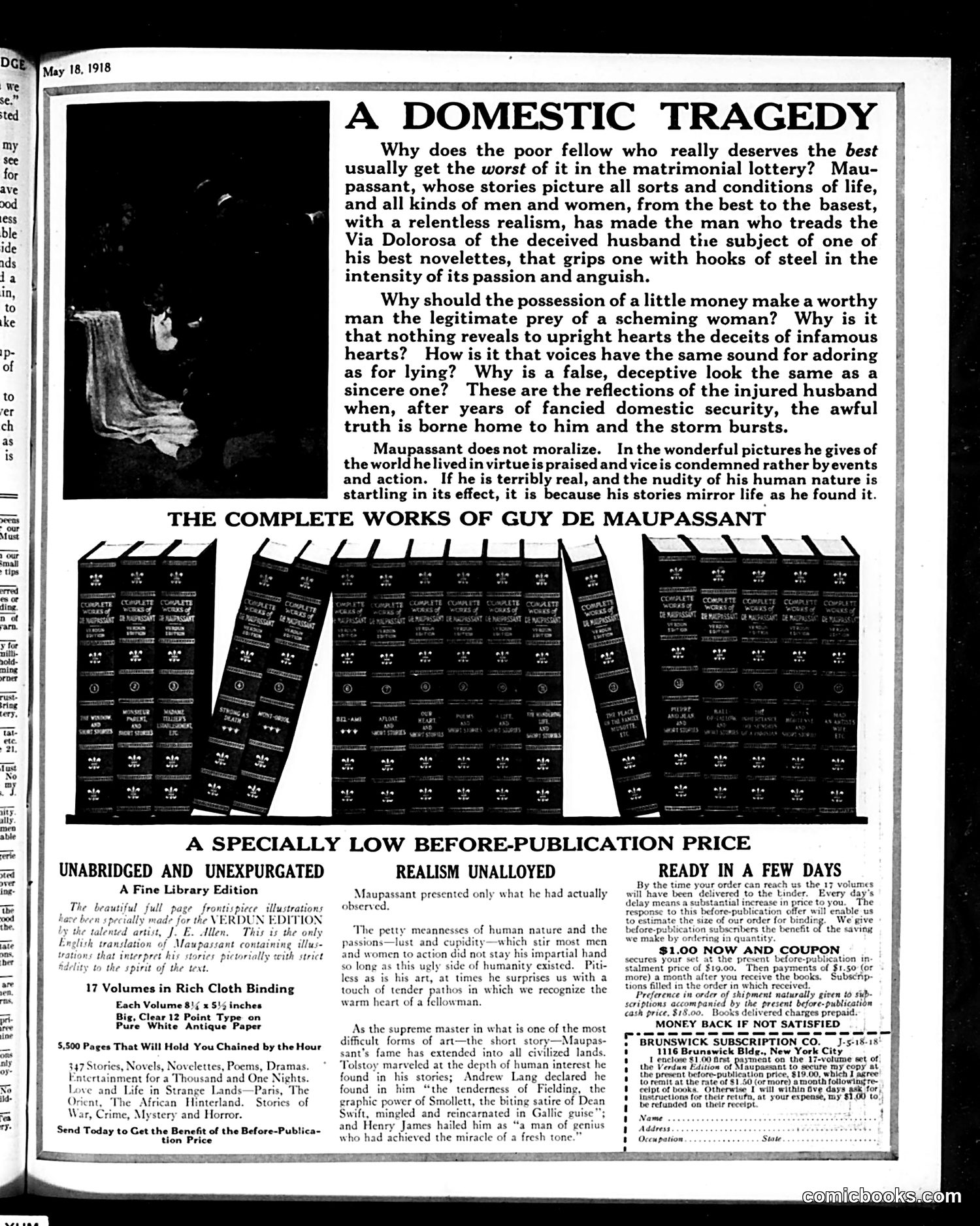
This page is primarily a **book advertisement** for a complete works edition of Guy de Maupassant, the French writer, published May 18, 1918. The left side features a dramatic illustration accompanying promotional text about Maupassant's stories, particularly emphasizing his unflinching depiction of "the deceived husband"—a recurring theme in his work. The text poses rhetorical questions about why worthy men become victims of scheming women and deception in marriage. The central and lower sections showcase the 17-volume deluxe edition, highlighting its "unabridged and unexpurgated" nature—significant because Maupassant's realistic treatment of human sexuality and moral ambiguity was often censored. The ad emphasizes "realism unalloyed" and notes his influence on major writers like Tolstoy and Henry James. This is a **sales pitch**, not satire. The "tragedy" framing serves the marketing strategy by promising emotionally gripping content about marital betrayal and human nature's darker aspects—precisely Maupassant's appeal to educated readers of this era.
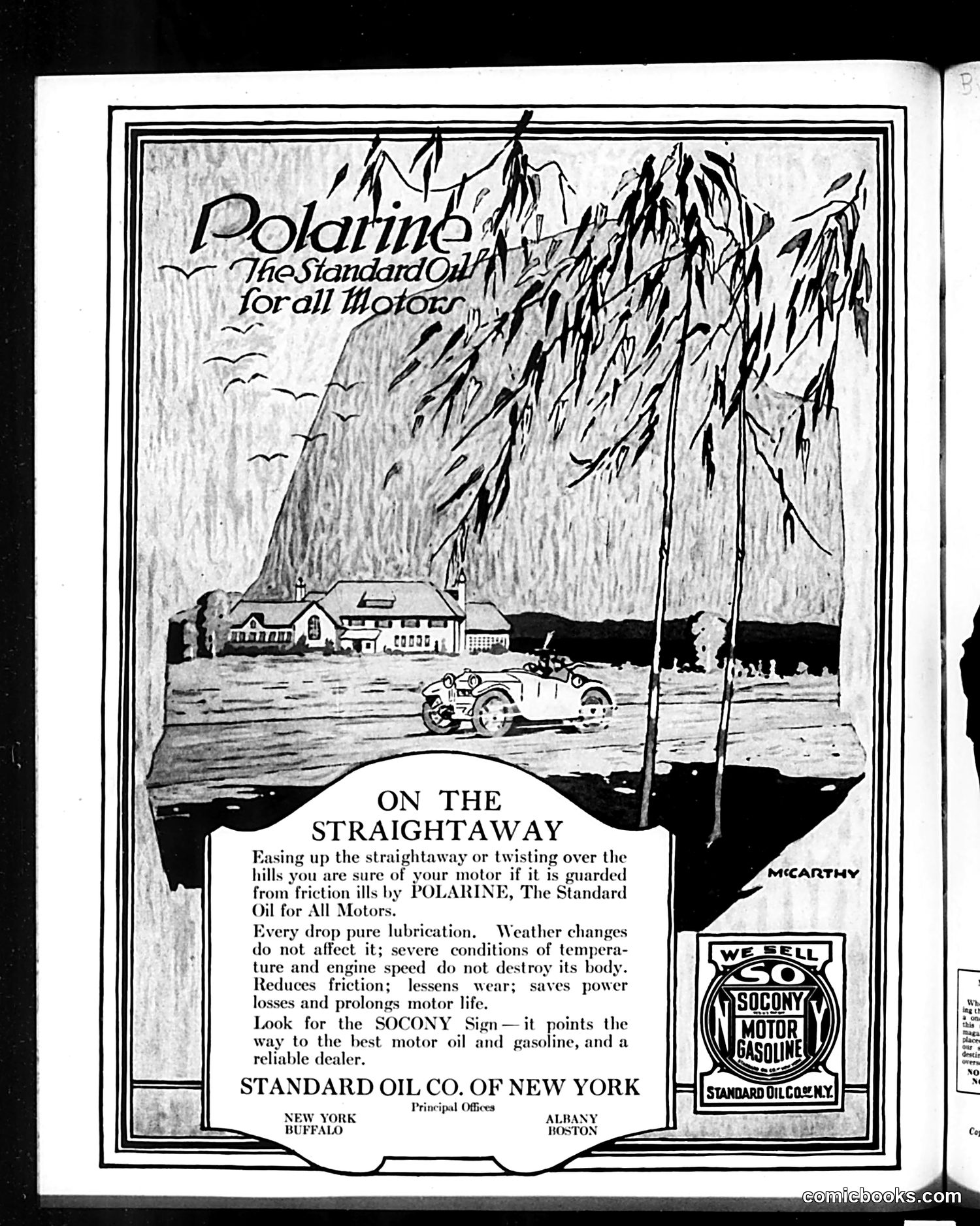
This is a **Standard Oil Company advertisement**, not political satire or a cartoon. It promotes Polarine motor oil—claiming it protects engines from "friction ills" under various driving conditions and temperatures. The illustration by "McCarthy" shows a vintage automobile on a country road near a house, emphasizing reliability for both highway and hill driving. The "SOCONY Sign" refers to Standard Oil Company of New York's retail locations. This appears in *Judge*, a satirical magazine, but functions purely as a paid advertisement using lifestyle imagery common to 1920s auto marketing. The humor, if any exists, lies in the earnest sales pitch rather than political commentary.