
Judge, 1918-05-18 · page 7 of 36
Judge — May 18, 1918 — page 7: what you’re looking at
What you’re looking at
This page contains three satirical pieces mocking professional stereotypes of the era: **"Beautiful Stenographer or Architect"**: A tongue-in-cheek comparison. Stenographers are praised for elevating business standards—their mere presence causes slovenly businessmen to keep feet off desks and wear hats straight. Yet they're also portrayed as mysteriously clean while surrounded by grime. The architect section mocks their profession as inherently frustrating: they prevent clients from building disasters (kitchens in front halls), but clients always demand unwanted revisions anyway, making architects perpetually unhappy. **"Taking a Crack at the Cracker"**: A condescending anecdote mocking rural Florida "Crackers" (poor white rural Southerners). A university baseball player questions why a leisurely local doesn't move away, implying rural life is undesirable. The joke portrays the rural man as slow-moving and unsophisticated, with the punchline suggesting the college athlete barely escapes confrontation. **"Greater Wisdom"**: A brief joke about a poor child in hand-me-downs. The magazine's satire targets professional vanity and rural/class stereotypes common to early 20th-century humor.
📄 Transcribed text from this page (OCR, searchable)
Machine-transcribed from the original scan — historical spelling and the odd misread are preserved.
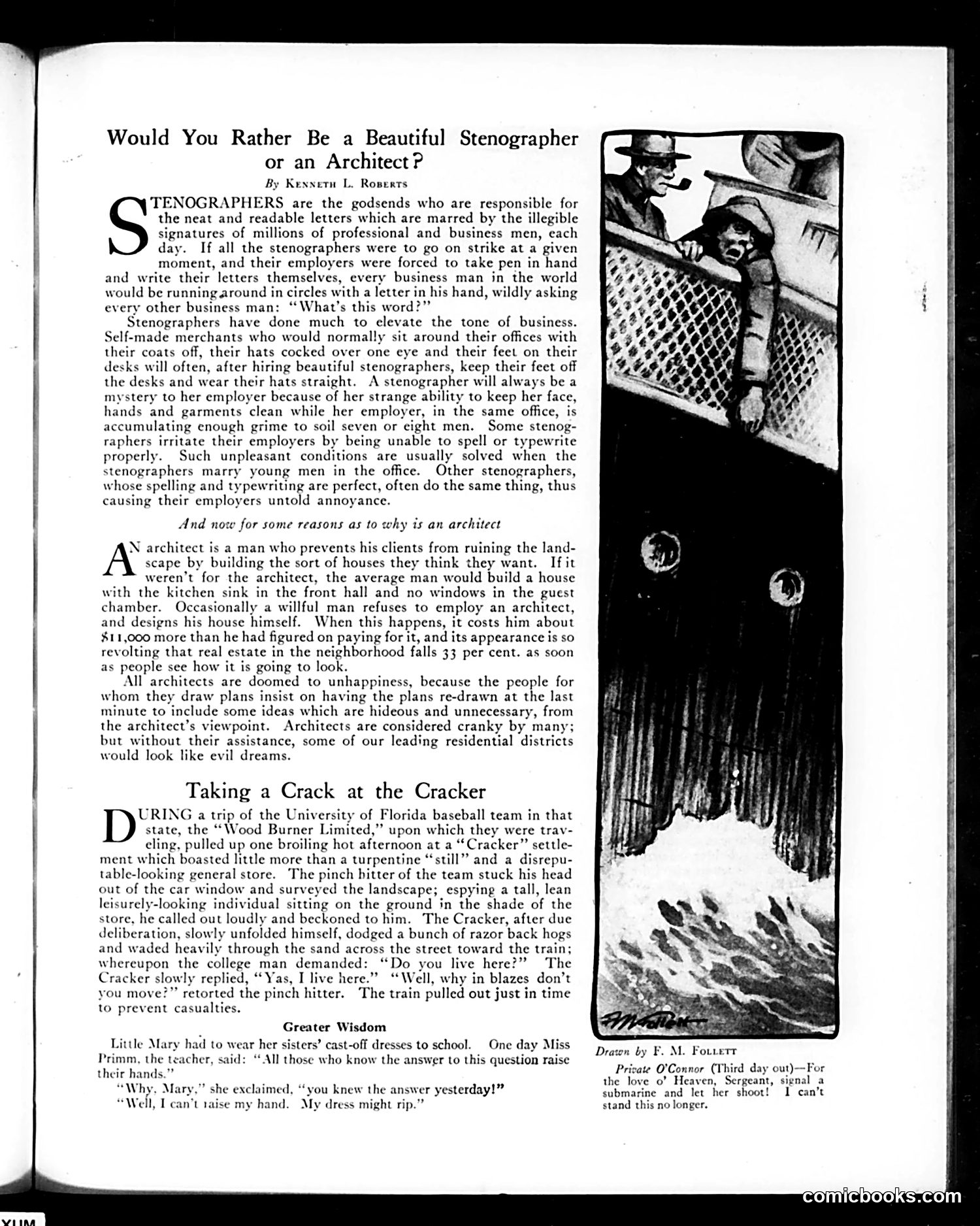
| | | | | | | Would You Rather Be a Beautiful Stenographer or an Architect P By Kexsetu L. Rosents TENOGRAPHERS are the godsends who are responsible for the neat and readable letters which are marred by the illegible signatures of millions of professional and business men, each day. If all the stenographers were to go on strike at a given moment, and their employers were forced to take pen in hand and write their letters themselves, every business man in the world would be running around in circles with a letter in his hand, wildly asking every other business man: ‘‘What’s this word?” Stenographers have done much to elevate the tone of business. Self-made merchants who would normally sit around their offices with their coats off, their hats cocked over one eye and their feet on their desks will often, after hiring beautiful stenographers, keep their feet off the desks and wear their hats straight. A stenographer will always be a mystery to her employer because of her strange ability to keep her face, ands and garments clean while her employer, in the same office, is accumulating enough grime to soil seven or eight men. Some stenog- raphers irritate their employers by being unable to spell or typewrite properly. Such unpleasant conditions are usually solved when the stenographers marry young men in the office. Other stenographers, whose spelling and typewriting are perfect, often do the same thing, thus causing their employers untold annoyance. And now for some reasons as to why is an architect N architect is a man who prevents his clients from ruining the land- ape by building the sort of houses they think they want. If it weren’t for the architect, the average man would build a house with the kitchen sink in the front hall and no windows in the guest chamber. Occasionally a willful man refuses to employ an architect, and designs his house himself. When this happens, it costs him about $11,000 more than he had figured on paying for it, and its appearance is so revolting that real estate in the neighborhood falls 33 per cent. as soon as people see how it is going to look. All architects are doomed to unhappiness, because the people for whom they draw plans insist on having the plans re-drawn at the last minute to include some ideas which are hideous and unnecessary, from the architect’s viewpoint. Architects are considered cranky by many; but without their assistance, some of our leading residential districts would look like evil dreams. Taking a Crack at the Cracker URING a trip of the University of Florida baseball team in that state, the “Wood Burner Limited,” upon which they were trav- eling, pulled up one broiling hot afternoon at a “Cracker” settle- ment which boasted little more than a turpentine “still” and a disrepu- table-looking general store. The pinch bitter of the team stuck his head out of the car window and surveyed the landscape; espying a tall, lean leisurely-looking individual sitting on the ground in the shade of the store, he called out loudly and beckoned to him. The Cracker, after due deliberation, slowly unfolded himself, dodged a bunch of razor back hogs and waded heavily through the sand across the street toward the train; whereupon the college man demanded: “Do you live here?” The Cracker slowly replied, “Yas, I live here.” “Well, why in blazes don’t you move?” retorted the pinch hitter. The train pulled out just in time to prevent casualties. Greater Wisdom Little Mary had to wear her sisters’ cast-off dresses to school. One day Miss Primm, the her, said: ‘All those who know the answer to this question raise their hands. “Why, Mary,” she exclaimed, “you knew the answer yesterday!” “Well, [can’t raise my hand. My dress might rip.” Drawn by F. M. Fouvett Pri te O'Connor (Third day out)—For the love o” Heaven, Sergeant, signal a submarine and let her shoot! stand this no longer. I can’t