
Judge, 1918-05-18 · page 21 of 36
Judge — May 18, 1918 — page 21: what you’re looking at
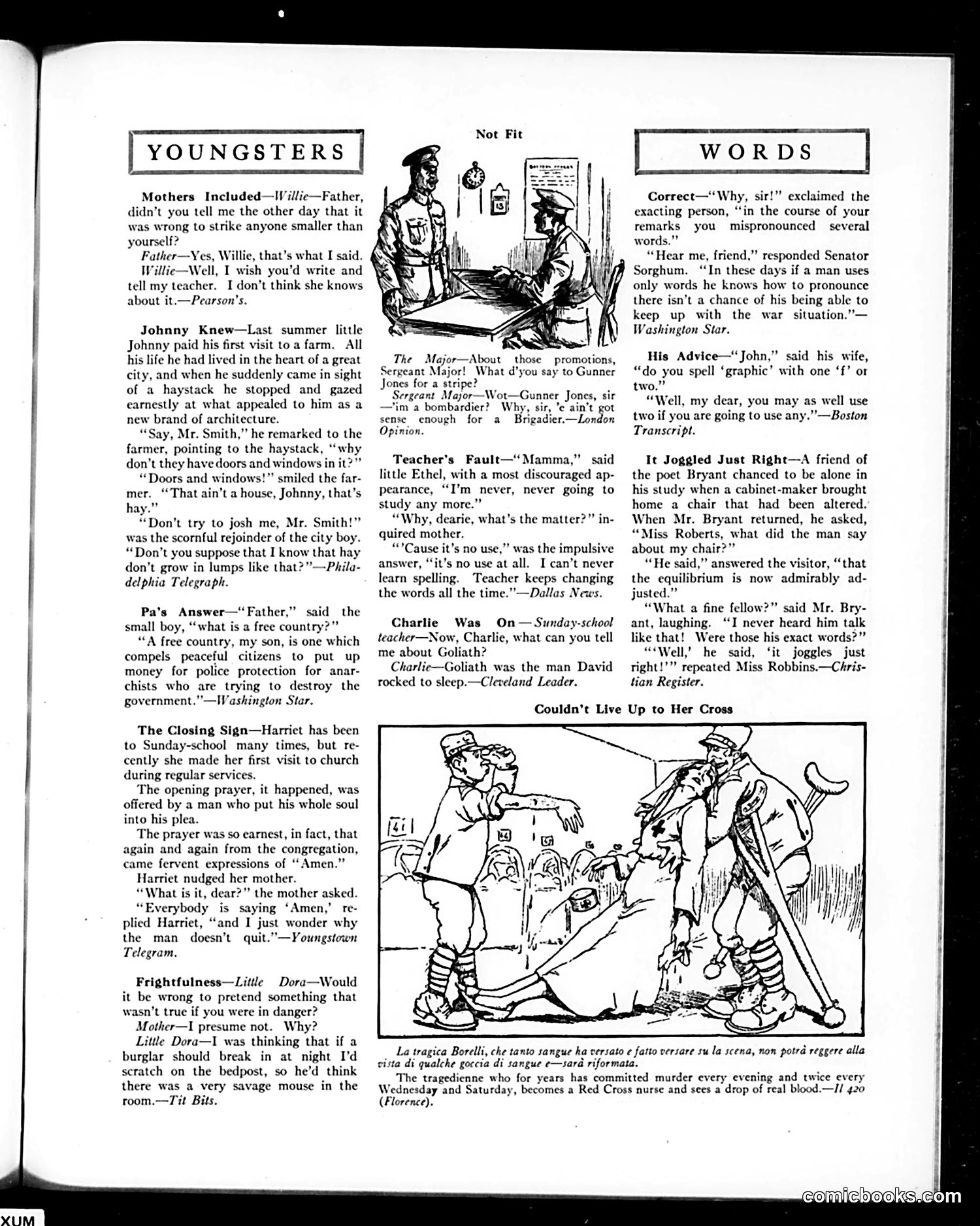
A restored page from Judge, 1918-05-18. Page through the whole issue in the reader above.
📄 Transcribed text from this page (OCR, searchable)
Machine-transcribed from the original scan — historical spelling and the odd misread are preserved.
XLIM | YOUNGSTERS | Mothers Included—IWillie—Father, didn’t you tell me the other day that it was wrong to strike anyone smaller than yourself? Father—Yes, Willie, that’s what I said. Willie—Well, I wish you'd write and tell my teacher. I don’t think she knows about it.—Pearson’s. Johnny Knew—Last summer little Johnny paid his first visit to a farm. All his life he had lived in the heart of a great city, and when he suddenly came in sight of a haystack he stopped and gazed earnestly at what appealed to him as a new brand of architecture. “Say, Mr. Smith,” he remarked to the farmer, pointing to the haystack, “why don’t they have doors and windows in it?” “Doors and windows!” smiled the far- mer. “That ain’t a house, Johnny, that’s hay.” “Don't try to josh me, Mr. Smith!” was the scornful rejoinder of the city boy. “Don’t you suppose that I know that hay don’t grow in lumps like that?”—Phila- delphia Telegraph. Pa’s Answer—“Father,” said the small boy, “what is a free country?” “A free country, my son, is one which compels peaceful citizens to put up money for police protection for anar- chists who are trying to destroy the government.” —IWashington Star. The Closing Sign—Harrict has been to Sunday-school many times, but re- cently she made her first visit to church during regular services. The opening prayer, it happened, was offered by a man who put his whole soul into his plea. The prayer was so earnest, in fact, that again and again from the congregation, came fervent expressions of “Amen.” Harriet nudged her mother. “What is it, dear?” the mother asked. “Everybody is saying ‘Amen,’ re- plied Harriet, “and I just wonder why the man doesn’t quit.”—Youngstown Telegram. Frightfulness—Little Dora—Would it be wrong to pretend something that wasn’t true if you were in danger? Mother—I presume not. Why? Little Dora—I was thinking that if a burglar should break in at night I’d scratch on the bedpost, so he’d think there was a very savage mouse in the room, Bits. Not Fit Tke Major—About those promotions, Sergeant Major! What d’you say to Gunner Jones for a stripe? Sergeant Major—Wot—Gunner Jones, sir —im'a bombardier? Why, sir, ’e ain't’ got sense enough for a Brigadier.—London Opinion. Teacher's Fault—‘‘Mamma,”’ said little Ethel, with a most discouraged ap- pearance, “I’m never, never going to study any more.” “Why, dearie, what’s the matter?” in- quired mother. “Cause it’s no use,” was the impulsive answer, “it’s no use at all. I can’t never learn spelling. Teacher keeps changing the words all the time.” —Dallas News. Charlie Was On— Sunday-school teacher—Now, Charlie, what can you tell me about Goliath? Charlie—Goliath was the man David rocked to sleep.—Cleveland Leader. Correct—“Why, sir!” exclaimed the exacting person, “in the course of your remarks you mispronounced _ several words.” “Hear me, friend,” responded Senator f Sorghum. ‘In these days if a man uses only words he knows how to pronounce there isn’t a chance of his being able to keep up with the war situation.”— Washington Star. His Advice—“ John,” said his wife, “do you spell ‘graphic’ with one ‘f’ or two.”” “Well, my dear, you may as well use two if you are going to use any.”"—Boston Transcript. It Joggled Just Right—A friend of the poet Bryant chanced to be alone in his study when a cabinet-maker brought home a chair that had been altered. When Mr. Bryant returned, he asked, “Miss Roberts, what did the man say about my chair?” “He said,” answered the visitor, “that the equilibrium is now admirably ad- justed.” “What a fine fellow?” said Mr. Bry- ant, laughing. “I never heard him talk like that! Were those his exact words?” “Well,’ he said, ‘it joggles just right!’” repeated Miss Robbins.—Chris- tian Register. Couldn’t Live Up to Her Cross La tragica Borelli, che tanto sangue ha versato e fatto versare su la scena, non potra reggere alla vista di qualche goccia di sangue e—sard riformata. ‘The tragedienne who for years has committed murder every evening and twice every Wednesday and Saturday, becomes a Red Cross nurse and sees a drop of real blood.—I/ 420 (Florence).