
Judge, 1918-05-18 · page 23 of 36
Judge — May 18, 1918 — page 23: what you’re looking at
What you’re looking at
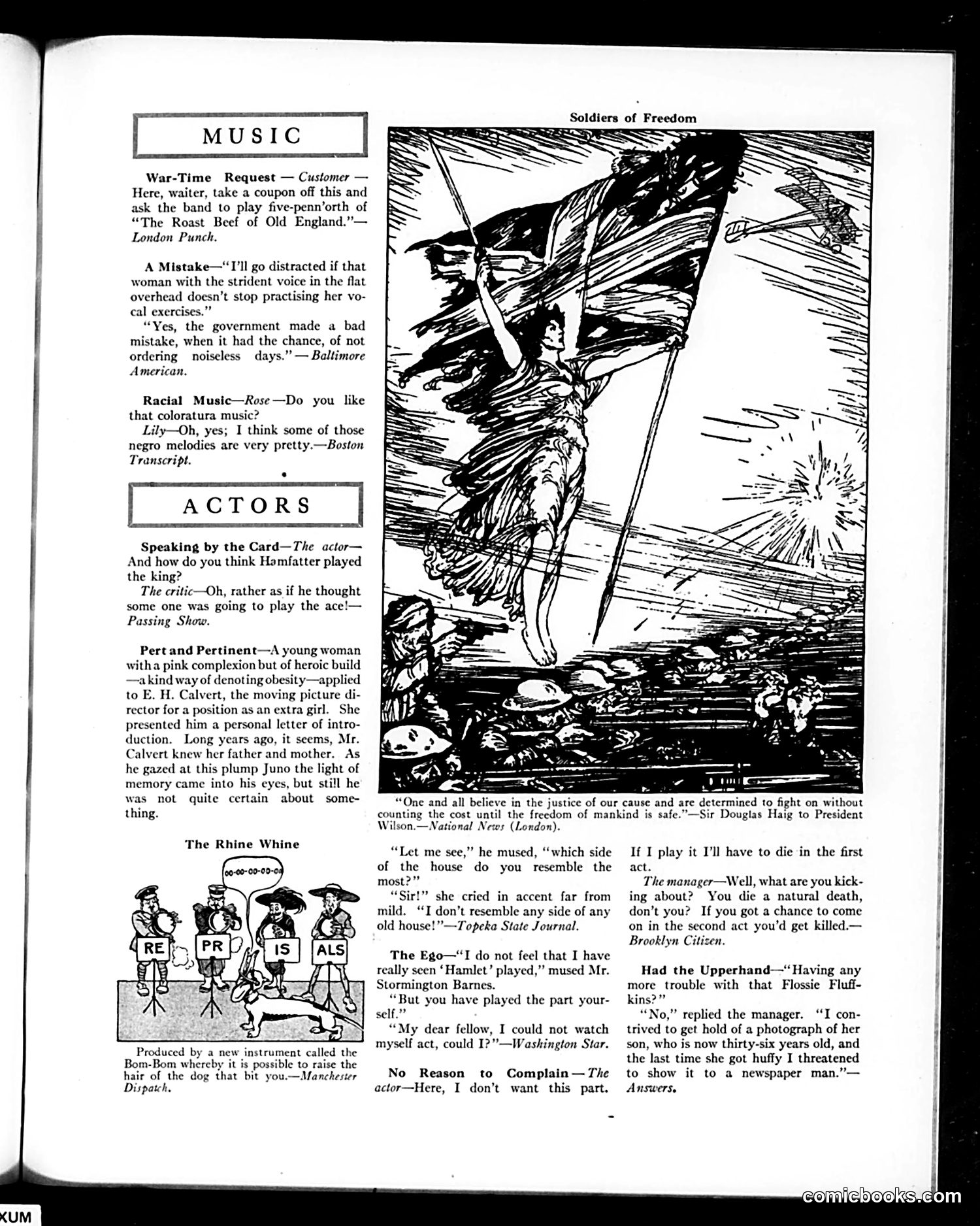
This page contains **humor sections** (Music, Actors) plus a **propaganda woodcut** titled "Soldiers of Freedom." **The woodcut** depicts a soldier charging forward with bayonet fixed. The caption quotes British General Douglas Haig justifying continued warfare without counting casualties—a stark contrast to the brutal image. This is **WWI-era propaganda**, likely meant to stir patriotic fervor, though the juxtaposition of Haig's confident rhetoric with the violent imagery creates an ironic effect about war's human cost. **The joke sections** are lighter fare: quips about opera singing, acting incompetence, and theatrical egos—typical Judge humor aimed at educated urban readers. One joke mocks an actress trying to get a film role by invoking an old family connection; another jokes that dying onstage in Act One is preferable to getting killed in Act Two (dark wartime humor). The page reflects Judge's dual function: satirical commentary mixed with entertainment, published during WWI when American attitudes toward the war were still shifting.
📄 Transcribed text from this page (OCR, searchable)
Machine-transcribed from the original scan — historical spelling and the odd misread are preserved.
KUM MUSIC War-Time Request — Customer — Here, waiter, take a coupon off this and ask the band to play five-penn’orth of “The Roast Beef of Old England.”— London Punch. A Mistake—‘“I’ll go distracted if that woman with the strident voice in the flat overhead doesn’t stop practising her vo- cal exercises.” “Yes, the government made a bad mistake, when it had the chance, of not ordering noiseless days.” — Baltimore American. Racial Music—Rose—Do you like that coloratura music? Lily—Oh, yes; I think some of those negro melodies are very pretty.—Boston Transcript. . | ACTORS Speaking by the Card—The actor— And how do you think Hamfatter played the king? The critic—Oh, rather as if he thought some one was going to play the ace!— Passing Show. Pert and Pertinent—A young woman witha pink complexion but of heroic build ind way of denoting obesity—applied to E. H. Calvert, the moving picture di- rector for a position as an extra girl. She presented him a personal letter of intro- duction. Long years ago, it seems, Mr. Calvert knew her father and mother. As he gazed at this plump Juno the light of memory came into his eyes, but still he was not quite certain about some- thing. The Rhine Whine Produced by a new instrument called the Bom-Bom whereby it is possible to raise the hair of the dog that bit you.—Manchester Dispatch. Soldiers of Freedom ~ re “One and all believe in the justice of our cause and a) counting the cost until the freedom of mankind is safe.”—Sir Douglas Haig to President Wilson.—National News (London). “Let me see,” he mused, “which side of the house do you resemble the most?” “Sirl” she cried in accent far from mild. “I don’t resemble any side of any old house!”"—Topeka State Journal. The Ego—‘TI do not feel that I have really seen ‘Hamlet’ played,” mused Mr. Stormington Barnes. “But you have played the part your- My dear fellow, I could not watch myself act, could 1?”—Washington Star. No Reason to Complain— The actor—Here, I don’t want this part. If I play it I'll have to die in the first act. The manager—Well, what are you kick- ing about? You die a natural death, don’t you? If you got a chance to come on in the second act you'd get killed.— Brooklyn Citizen. Had the Upperhand—“ Having any more trouble with that Flossie Flufi- No,” replied the manager. “I con- trived to get hold of a photograph of her son, who is now thirty-six years old, and the last time she got huffy I threatened to show it to a newspaper man.”— Answers.