
Judge, 1918-05-18 · page 24 of 36
Judge — May 18, 1918 — page 24: what you’re looking at
What you’re looking at
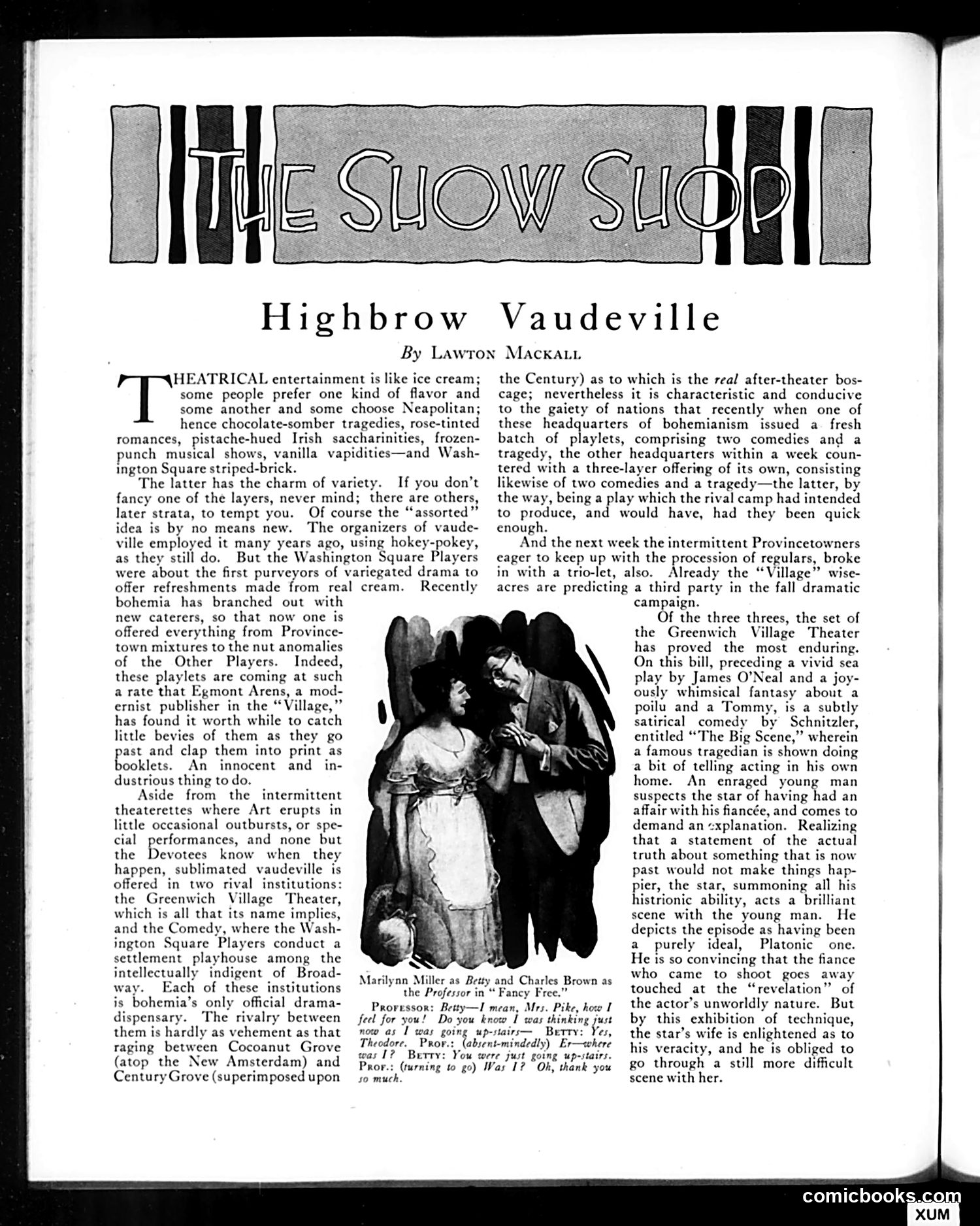
This article satirizes New York's competing bohemian theater venues in Greenwich Village. The author compares theatrical entertainment to ice cream flavors, explaining that different theaters cater to different tastes—from serious drama to light comedy. The piece mocks the rivalry between two establishments: the **Greenwich Village Theater** and the **Comedy** (run by the Washington Square Players). When one theater produces a three-play bill (two comedies and a tragedy), the other immediately counters with an identical format, competing desperately for audiences of "intellectually indigent" theatergoers on Broadway. The photograph shows actors from a production at one of these venues, illustrating the "settlement playhouse" culture being satirized. The satire's point: bohemian theater, despite artistic pretensions, operates like commercial vaudeville—mere fashion-following competition rather than genuine artistic vision.
📄 Transcribed text from this page (OCR, searchable)
Machine-transcribed from the original scan — historical spelling and the odd misread are preserved.
Highbrow HEATRICAL entertainment is like ice cream; some people prefer one kind of flavor and some another and some choose Neapolitan; hence chocolate-somber tragedies, rose-tinted romances, pistache-hued Irish saccharinities, frozen- punch musical shows, vanilla vapidities—and Wash- ington Square striped-brick. The latter has the charm of variety. If you don’t fancy one of the layers, never mind; there are others, later strata, to tempt you. Of course the “assorted” idea is by no means new. The organizers of vaude- ville employed it many years ago, using hokey-pokey, as they still do. But the Washington Square Players were about the first purveyors of variegated drama to Recently offer refreshments made from real cream. bohemia has branched out with new caterers, so that now one is offered everything from Province- town mixtures to the nut anomalies of the Other Players. Indeed, these playlets are coming at such a rate that Egmont Arens, a mod- ernist publisher in the “Village,” has found it worth while to catch little bevies of them as they go past and clap them into print as booklets. An innocent and in- dustrious thing to do. Aside from the intermittent theaterettes where Art erupts in little occasional outbursts, or spe- cial performances, and none but the Devotees know when they happen, sublimated vaudeville offered in two rival institutions: the Greenwich Village Theater, which is all that its name implies, and the Comedy, where the Wash- ington Square Players conduct a settlement playhouse among the intellectually indigent of Broad- way. Each of these institutions is bohemia’s only official drama- dispensary them i raging between Cocoanut Grove Theodore: v0! (atop the New Amsterdam) and Pyo LARS CenturyGrove (superimposed upon — so much. Marilynn Miller as Be By Lawron Mackau. and Charles Brown as the Professor in“ Fancy Free.” Proresson: Betty—I mean, Mrs. Pike, The rivalry between feel for you! Do you kn: hardly as vehement as that "0% as I was going it? ‘absen You si A g (turning to go) Was. 1? Oh, thank you 0 through a still more difficult Vaudeville the Century) as to which is the real after-theater bos- cage; nevertheless it is characteristic and conducive to the gaiety of nations that recently when one of these headquarters of bohemianism issued a. fresh batch of playlets, comprising two comedies and a tragedy, the other headquarters within a week coun- tered with a three-layer offering of its own, consisting likewise of two comedies and a tragedy—the latter, by the way, being a play which the rival camp had intended to produce, and would have, had they been quick enough. And the next week the intermittent Provincetowners eager to keep up with the procession of regulars, broke in with a trio-let, also. Already the “Village” wise- acres are predicting a third party in the fall dramatic campaign. Of the three threes, the set of the Greenwich Village Theater has proved the most enduring. On this bill, preceding a vivid sea play by James O'Neal and a joy- ously whimsical fantasy about a poilu and a Tommy, is a subtly satirical comedy by Schnitzler, entitled “The Big Scene,” wherein a famous tragedian is shown doing a bit of telling acting in his own home. An enraged young man suspects the star of having had an affair with his fiancée, and comes to demand an <xplanation. Realizing that a statement of the actual truth about something that is now past would not make things hap- pier, the star, summoning all his histrionic ability, acts a brilliant scene with the young man. He depicts the episode as having been a purely ideal, Platonic one. He is so convincing that the fiance who came to shoot goes away touched at the “revelation” of the actor’s unworldly nature. But by this exhibition of technique, the star’s wife is enlightened as to his veracity, and he is obliged to tmindedly) "Eoin bing up-stairs. scene with her. comicbooks.com