
Judge, 1918-05-18 · page 5 of 36
Judge — May 18, 1918 — page 5: what you’re looking at
What you’re looking at
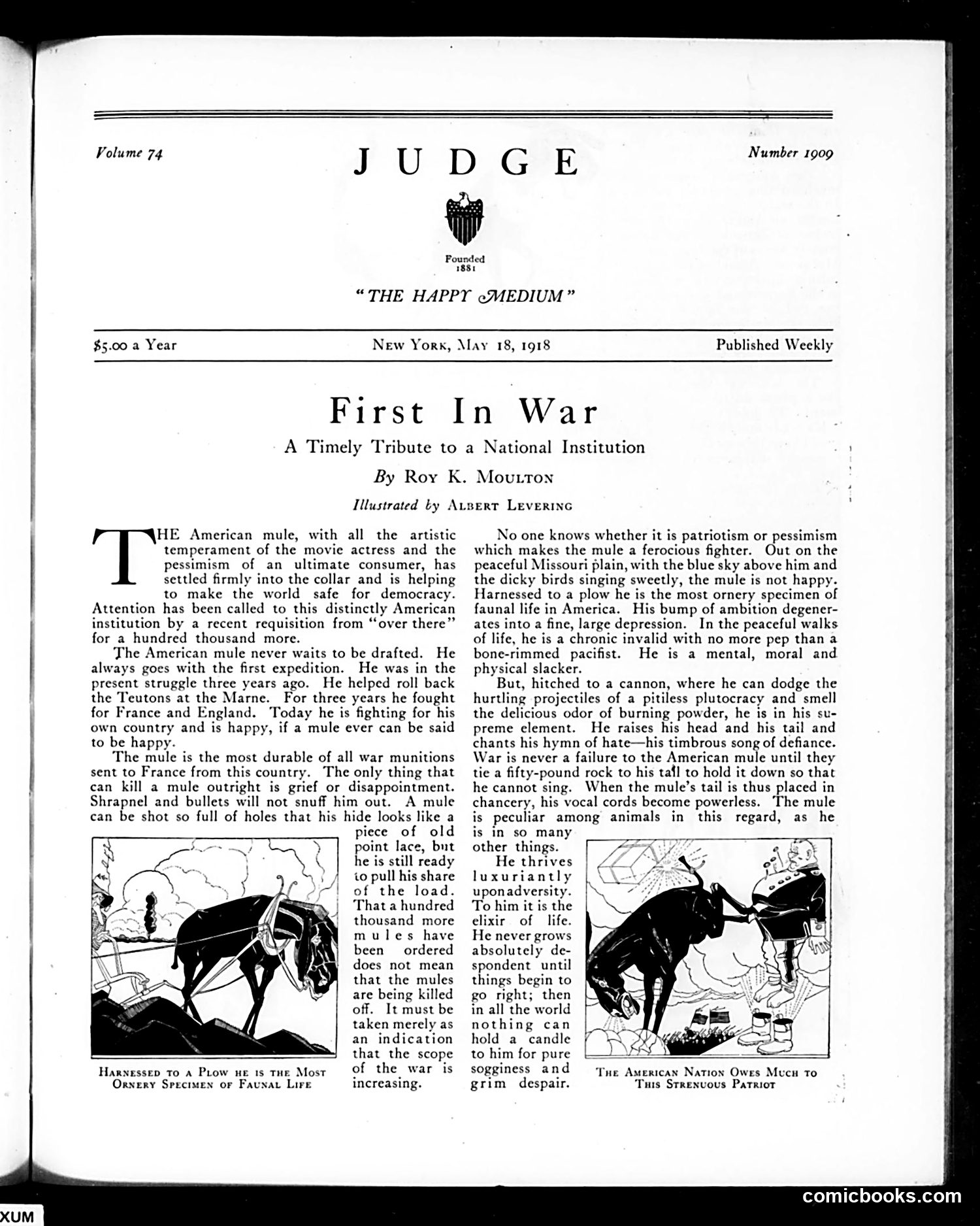
This article by Roy K. Moulton praises the American mule's service during World War I. The text portrays the mule as a patriotic, stoic workhorse—"the most durable of all war munitions"—that endures hardship without complaint while serving the military effort. The two illustrations show mules in wartime conditions: one harnessed to a plow, the other carrying supplies amid battlefield debris. The caption "The American Nation Owes Much to This Strenuous Patriot" ironically elevates the mule to patriotic status. Published in 1918, this appears a sincere (if whimsical) tribute to an unglamorous but essential military animal. The satire lies in treating a pack animal with the reverence typically reserved for human soldiers—gentle mockery that simultaneously acknowledges the mule's genuine contribution to the war effort.
📄 Transcribed text from this page (OCR, searchable)
Machine-transcribed from the original scan — historical spelling and the odd misread are preserved.
Volume 74 Pounded 1881 Number 1909 “THE HAPPY eMEDIUM” $5.00 a Year First In New York, May 18, 1918 Published Weekly War A Timely Tribute to a National Institution By Roy K. Mouton Illustrated by Avert Leverinc HE American mule, with all the artistic temperament of the movie actress and the pessimism of an ultimate consumer, has settled firmly into the collar and is helping to make the world safe for democracy. Attention has been called to this distinctly American institution by a recent requisition from “over there” for a hundred thousand more. The American mule never waits to be drafted. He always goes with the first expedition. He was in the present struggle three years ago. He helped roll back the Teutons at the Marne. For three years he fought for France and England. Today he is fighting for his own country and is happy, if a mule ever can be said to be happy. The mule is the most durable of all war munitions sent to France from this country. The only thing that can kill a mule outright is grief or disappointment. Shrapnel and bullets will not snuff him out. A mule can be shot so full of holes that his hide looks like a piece of old point lace, but he is still ready to pull his share of the load. That a hundred thousand more mules have been ordered does not mean that the mules are being killed off. It must be taken merely as an indication that the scope of the war is increasing. Harnessep To A Prow ue 1s THe Most Orxery Specisen or Faunat Lire No one knows whether it is patriotism or pessimism which makes the mule a ferocious fighter. Out on the peaceful Missouri plain, with the blue sky above him and the dicky birds singing sweetly, the mule is not happy. Harnessed to a plow he is the most ornery specimen of faunal life in America. His bump of ambition degener- ates into a fine, large depression. In the peaceful walks of life, he is a chronic invalid with no more pep than a bone-rimmed pacifist. He is a mental, moral and physical slacker. But, hitched to a cannon, where he can dodge the hurtling projectiles of a pitiless plutocracy and smell the delicious odor of burning powder, he is in his su- preme clement. He raises his head and his tail and chants his hymn of hate—his timbrous song of defiance. War is never a failure to the American mule until they tie a fifty-pound rock to his tafl to hold it down so that he cannot sing. When the mule’s tail is thus placed in chancery, his vocal cords become powerless. The mule is peculiar among animals in this regard, as he is In sO many other things. He thrives luxuriantly uponadversity. To him it is the elixir of life. He never grows absolutely de- spondent until things begin to go right; then in all the world nothing can hold a candle to him for pure sogginess and grim despair. ‘Tne American Nation Owes Mucu to Tuts Strexvous Patriot comicbooks.com