
A complete issue · 36 pages · 1918
Judge — February 16, 1918
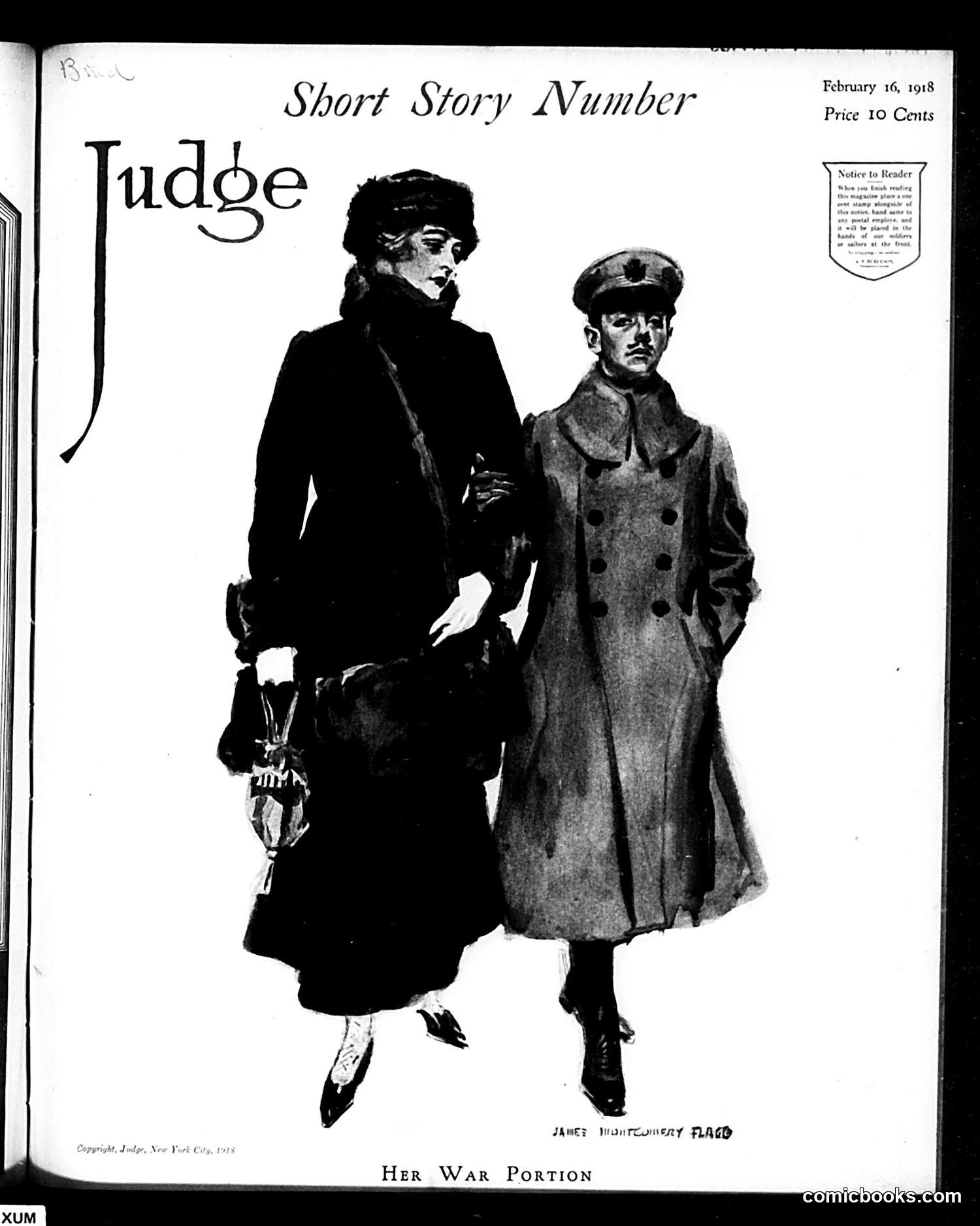
This illustration by James Montgomery Flagg depicts two women in World War I-era coats and hats. The title "Her War Portion" suggests commentary on women's roles during wartime. The figure on the left wears an elegant black coat with fur trim and carries a fashionable handbag, while the figure on the right wears a simpler gray coat. The contrast likely satirizes class differences in how women experienced WWI's hardships—wealthy women versus working-class women facing rationing, labor shortages, and economic sacrifice. Published during America's active involvement in WWI (1917-1918), this cartoon appears to critique unequal burden-sharing during wartime, suggesting that privileged women maintained luxury while ordinary women endured genuine deprivation and hardship.
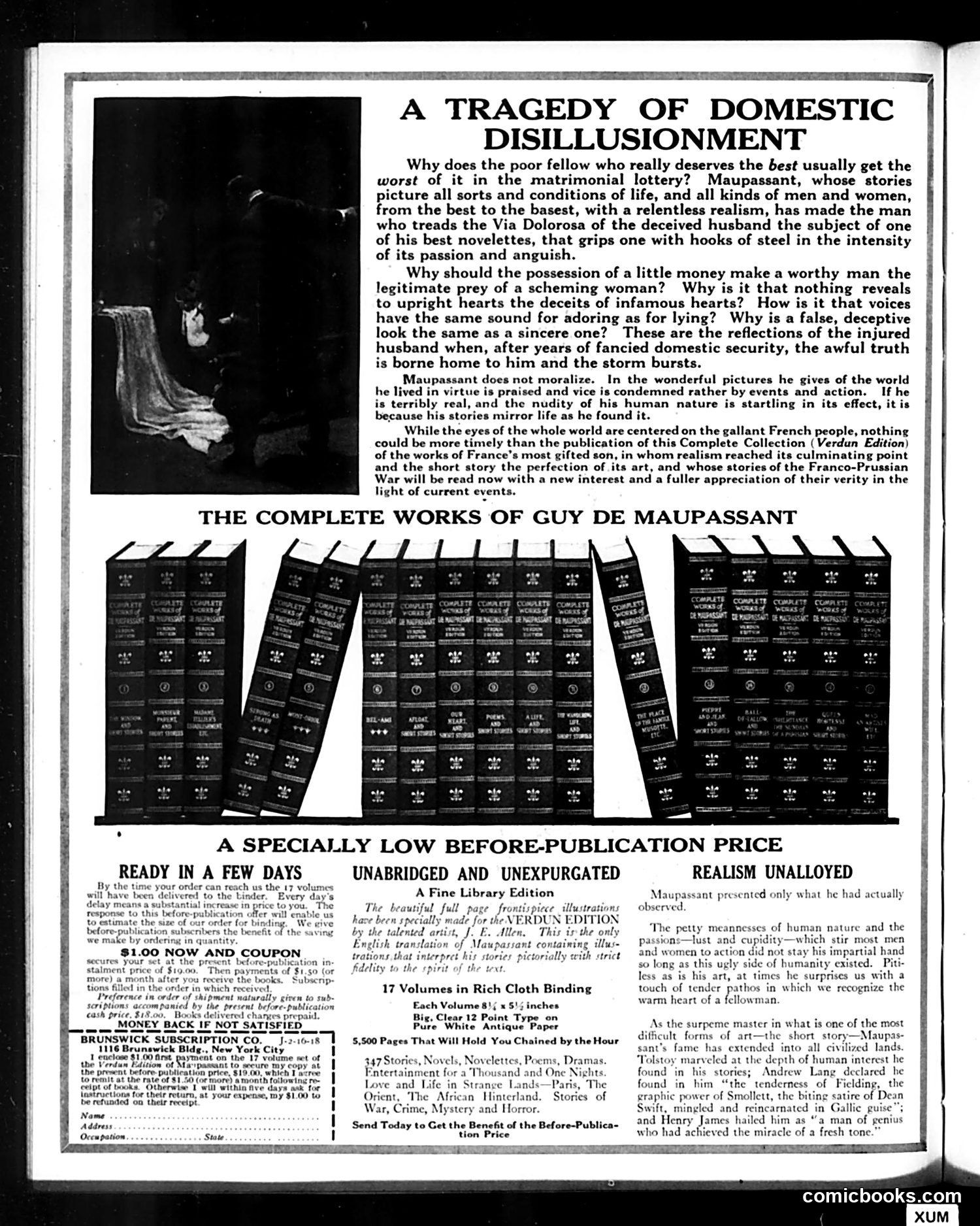
This page is primarily **advertising**, not political satire. It promotes "The Complete Works of Guy de Maupassant" — a newly available collected edition of the French author's stories. The top section features an article titled "A Tragedy of Domestic Disillusionment," which appears to be editorial content discussing Maupassant's realistic portrayal of marriage, deception, and human nature. The text praises his unflinching depiction of vice and virtue "by events and action" rather than moral judgment. The bulk of the page showcases the book set itself—displayed as stacked volumes in decorative binding—alongside subscription details and pricing information. A coupon allows readers to order at a "specially low before-publication price." This represents **turn-of-century book marketing** rather than political commentary.
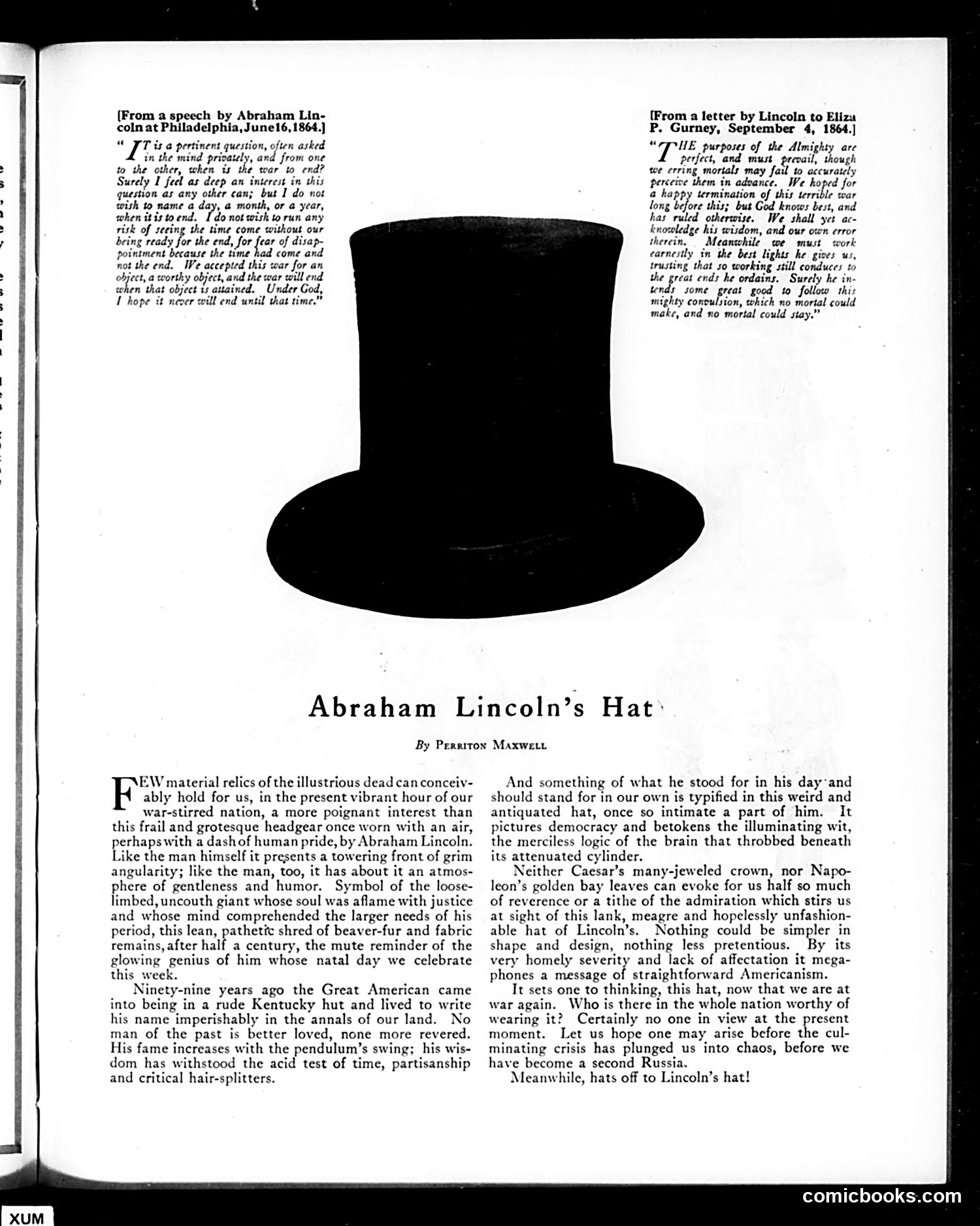
This page from *Judge* magazine features an article by Perriton Maxwell about Abraham Lincoln's tall stovepipe hat, presented as a historical relic worthy of reverence. The text celebrates Lincoln as an American icon whose "wisdom has withstood the acid test of time" and whose legacy grows stronger with decades. The article frames the hat symbolically—as representing Lincoln's character: "simplicity," "homely severity," and "lack of affectation." The author contrasts it favorably with grandiose symbols like Caesar's crown or Napoleon's laurels, suggesting American democracy values humble authenticity over ornate power. The piece appears written during a period of national crisis (possibly WWI era, given references to "chaos"), using Lincoln's enduring memory to inspire contemporary Americans facing turbulent times.
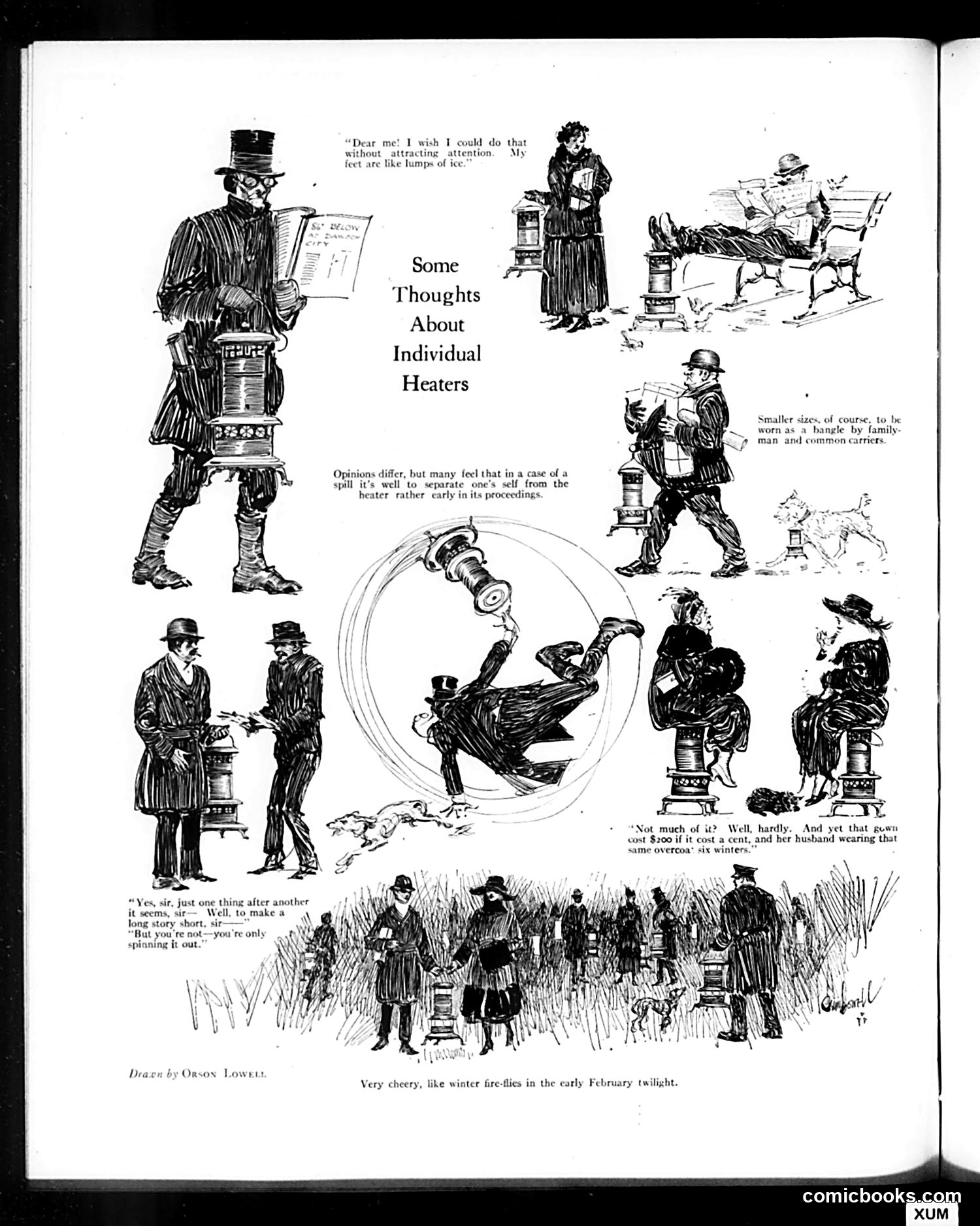
This page satirizes the practice of using portable individual heating stoves in homes and offices during winter. The cartoonist (Orson Lowell) depicts various scenarios where people attempt to use separate small heaters rather than central heating systems. The humor mocks the inefficiency and social awkwardness: people huddled separately around individual heaters, the expense ("Well, hardly. And yet that $300 if it cost a cent, and her husband wearing that same overcoat all six winters"), and the absurdity of trying to heat oneself rather than the space ("just one thing after another it seems...Well, to make a long story short—But you're not—you're only spinning it out"). The final image of families gathered around individual heaters in a field suggests the ultimate ridiculousness of this approach to winter warmth.
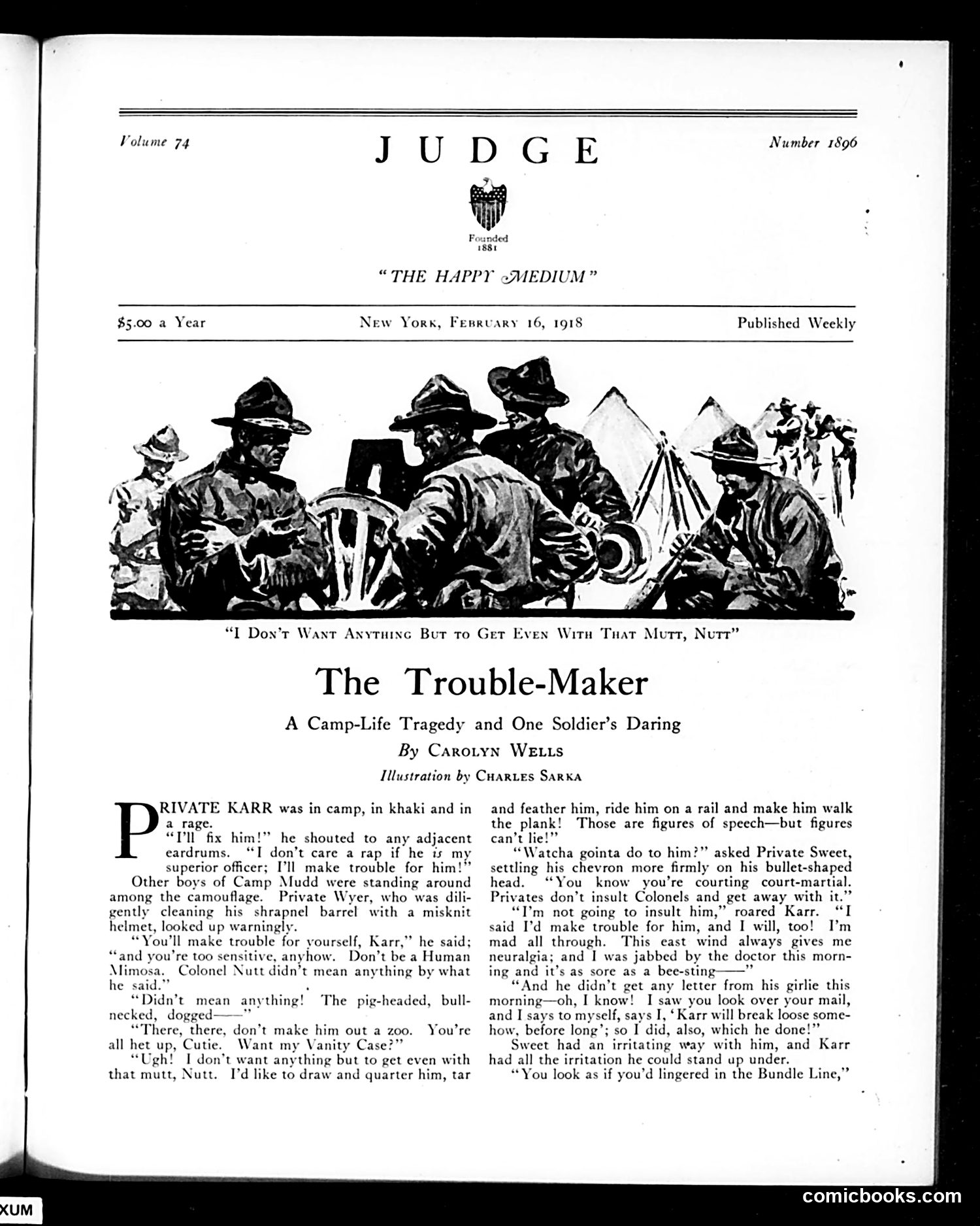
This is a short story rather than political satire. The illustration shows soldiers in a military camp during World War I (evident from the 1918 date and khaki uniforms). The narrative concerns Private Karr, described as a disruptive soldier who antagonizes his fellow troops and officers through insubordination and troublemaking. The dialogue reveals camp tensions: Karr insults commanding officers, refuses orders, and provokes fights with privates Sweet and Wyer. The story appears to be a morality tale about military discipline, depicting how one soldier's refusal to follow protocol and respect rank creates chaos in camp life. The illustration's caption—"I Don't Want Anything But to Get Even With That Mutt, Nutt"—suggests personal vendettas driving the conflict.
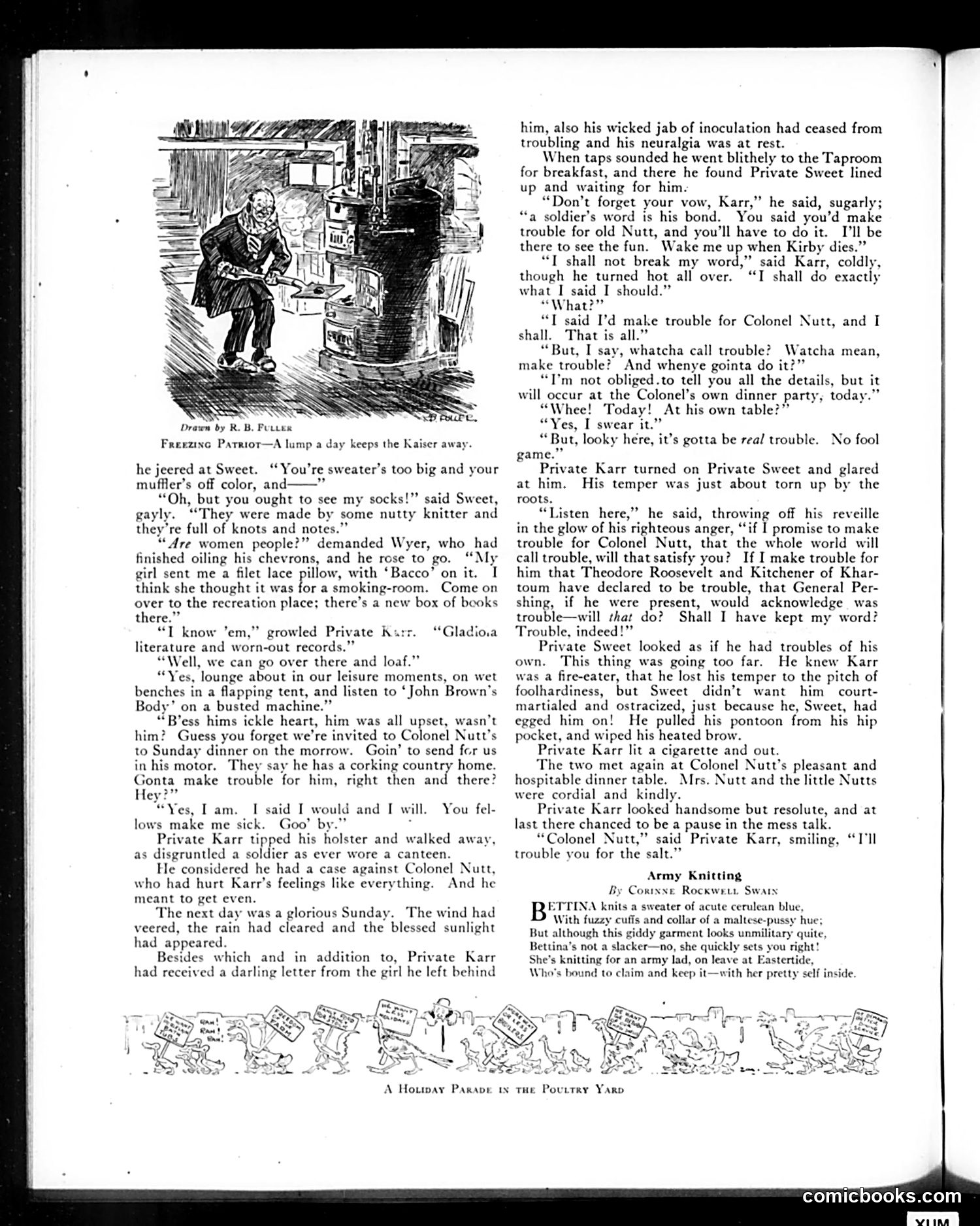
This page combines a serialized story and separate article. The main narrative depicts a conflict between Private Karr and Private Sweet over a promise to cause trouble for Colonel Nutt at a dinner party. The story appears to be light military humor involving soldiers and their officer, with dialogue emphasizing honor and a soldier's word. The separate section titled "Army Knitting" features Bettina, who knits a sweater for soldiers. The accompanying illustration shows a woman knitting. The cartoon at the bottom, "A Holiday Parade in the Poultry Yard," appears to be humorous animal content unrelated to the main story. Without clearer political references or identifiable caricatures, the primary appeal seems to be domestic wartime humor and patriotic content rather than sharp political satire.
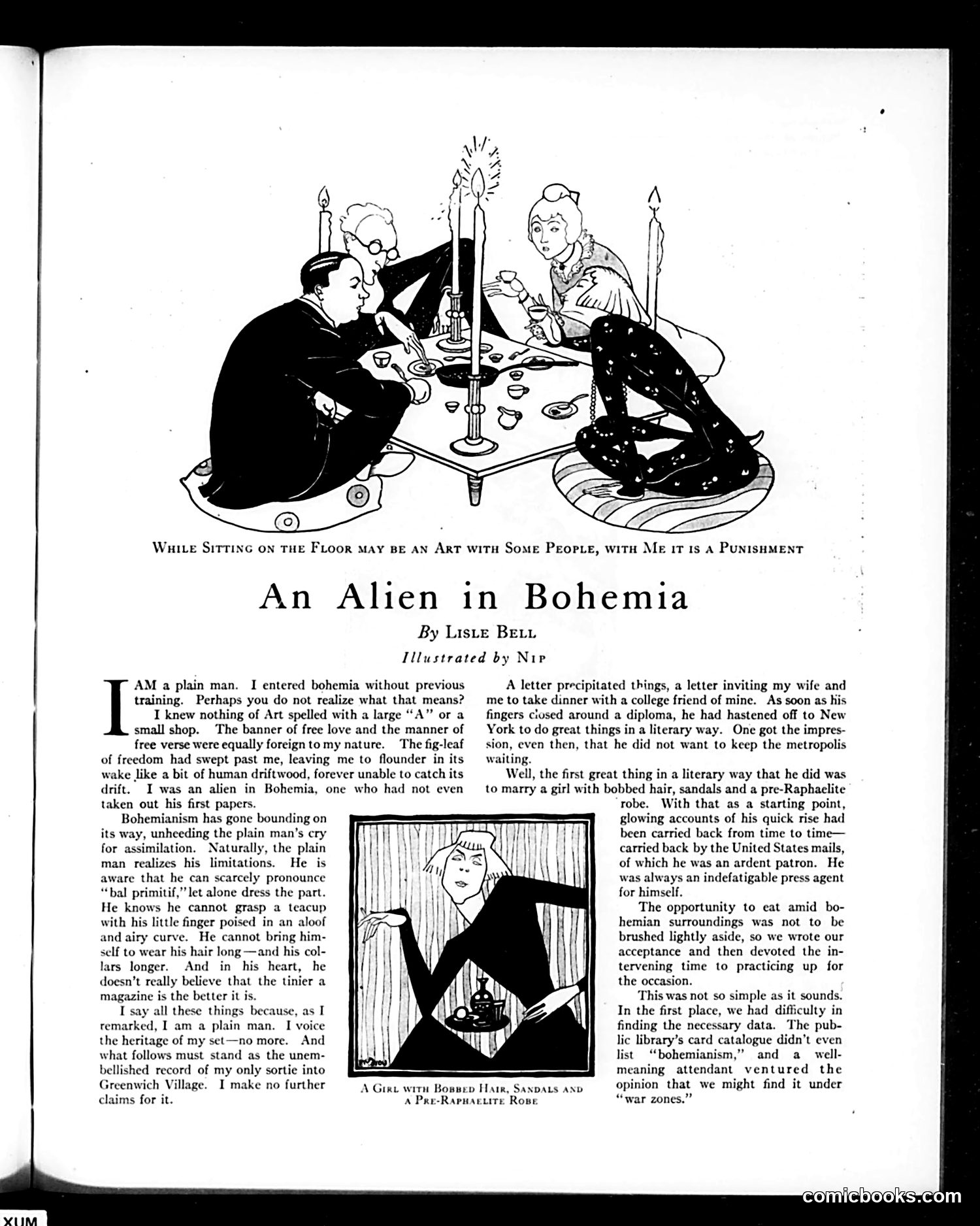
This story satirizes the author's discomfort with 1920s bohemian culture in New York's Greenwich Village. The narrator is a conventional "plain man" who lacks understanding of modernist artistic movements, free love ideology, and bohemian fashion (bobbed hair, sandals, pre-Raphaelite robes). The satire targets both the bohemians themselves—presented as pretentious, affected, and self-promotional—and the plain man's bewilderment at their world. The joke that the library catalogs bohemianism under "war zones" suggests bohemian lifestyles seem as alien and threatening to mainstream society as warfare. The accompanying illustration shows bohemian dinner customs (floor-sitting, candlelit informality) that horrify the conventional narrator. The piece mocks the collision between traditional middle-class values and the avant-garde artistic scene that defined 1920s New York.
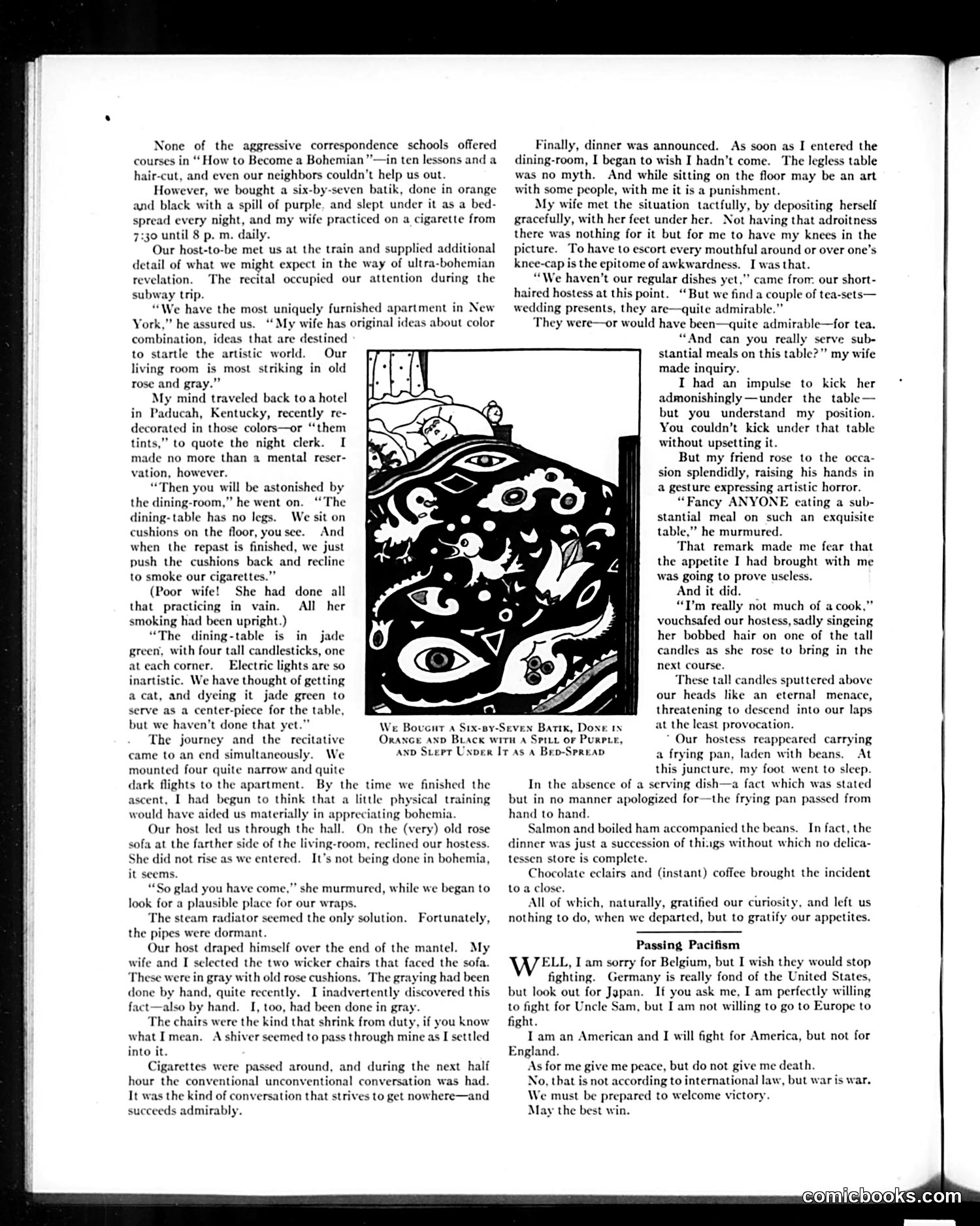
This is a humorous essay mocking **pretentious bohemian affectation** in early 20th-century New York. The narrator and his wife attempt to appear "bohemian" by purchasing a batik bedspread and practicing cigarette-smoking, then visit ultra-bohemian hosts in Manhattan. The satire targets: 1. **Bohemian pretense**: The hosts' self-conscious "artistic" choices—old rose and gray décor, legless dining tables, candlelight instead of electric lights, a jade-colored table with a dyed cat planned as centerpiece—are presented as ridiculous affectations rather than genuine creativity. 2. **Performative unconventionality**: The "conventional unconventional conversation" that "strives to get nowhere" mocks how bohemians perform non-conformity through artificial rituals. 3. **Discomfort masquerading as sophistication**: The physical awkwardness of floor-sitting and the hosts' studied indifference (the hostess doesn't rise to greet guests because "it's not being done in bohemia") are presented as absurd. The accompanying illustration shows an ornate, chaotic batik design—the visual embodiment of affected bohemian taste.
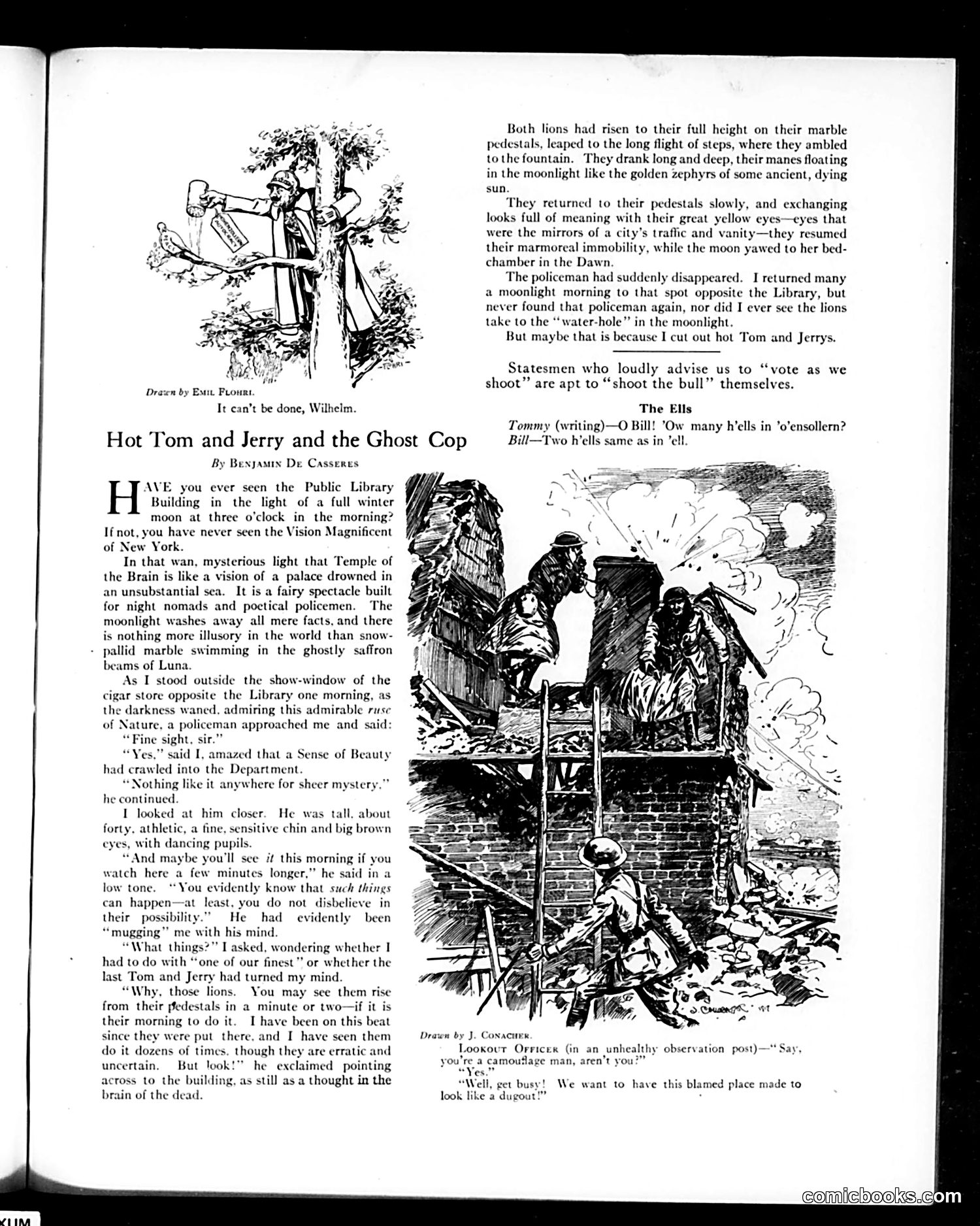
This page contains a whimsical short story illustrated by Emil Floethe titled "Hot Tom and Jerry and the Ghost Cop" by Benjamin De Casseres. The main narrative is a romantic fantasy about the New York Public Library's marble lions coming to life on winter moonlit nights. A mysterious policeman (the "ghost cop") tells the narrator he's witnessed this phenomenon repeatedly. When the narrator watches, the lions indeed descend from their pedestals, drink at the fountain, and return—then the policeman vanishes. The story suggests either magic or the narrator's imagination. Below the main story are two brief humorous items: a political jab at statesmen advocating "vote as we shoot" (likely WWI-era commentary), and a joke about "h'ells in 'o'ensollern" (German Kaiser Wilhelm II's name, mocking soldiers' accents while discussing military trenches). The page is primarily literary entertainment rather than political satire, though wartime references appear peripherally.
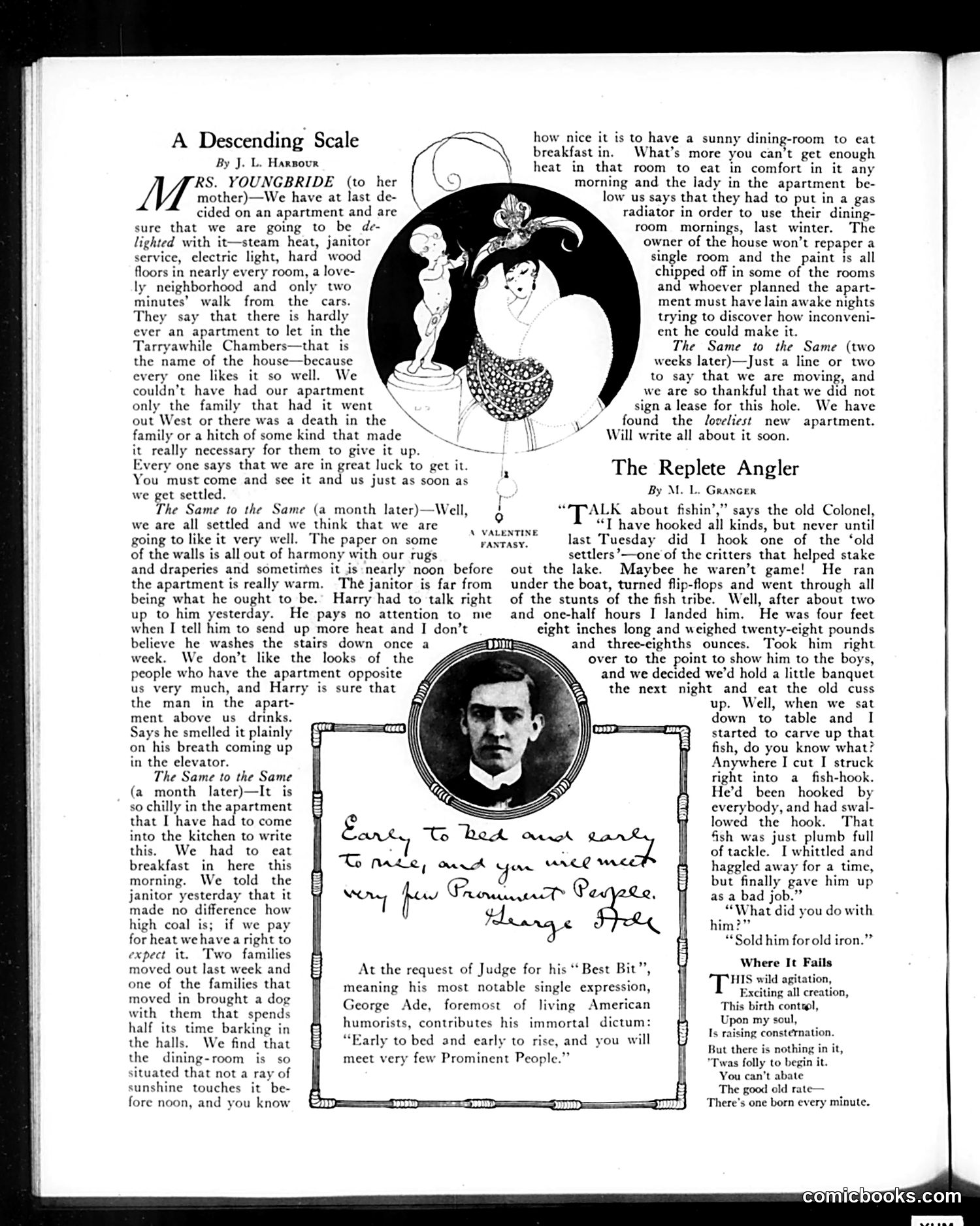
**"A Descending Scale"** satirizes newlywed apartment hunters' rapidly deteriorating expectations. Mrs. Youngbride's initial enthusiasm about her "Tarryawhile Chambers" apartment—steam heat, electric light, hardwood floors—collapses within weeks as she discovers reality: poor heating, peeling wallpaper, an neglectful janitor, unsavory neighbors, and a sunless dining room. By the final letter (two weeks later), she's abandoning the lease entirely for another apartment. The satire mocks both the couple's naïveté about rental properties and the deceptive marketing practices of landlords. The "descending scale" refers to her expectations plummeting from euphoria to disappointment to disgust. **"The Replete Angler"** features an old Colonel bragging about fishing, with an attributed quote from humorist George Ade about early rising. The angler tale appears to be humorous exaggeration typical of fishing stories. Both pieces reflect early 20th-century urban apartment-hunting frustrations and leisure-class humor.
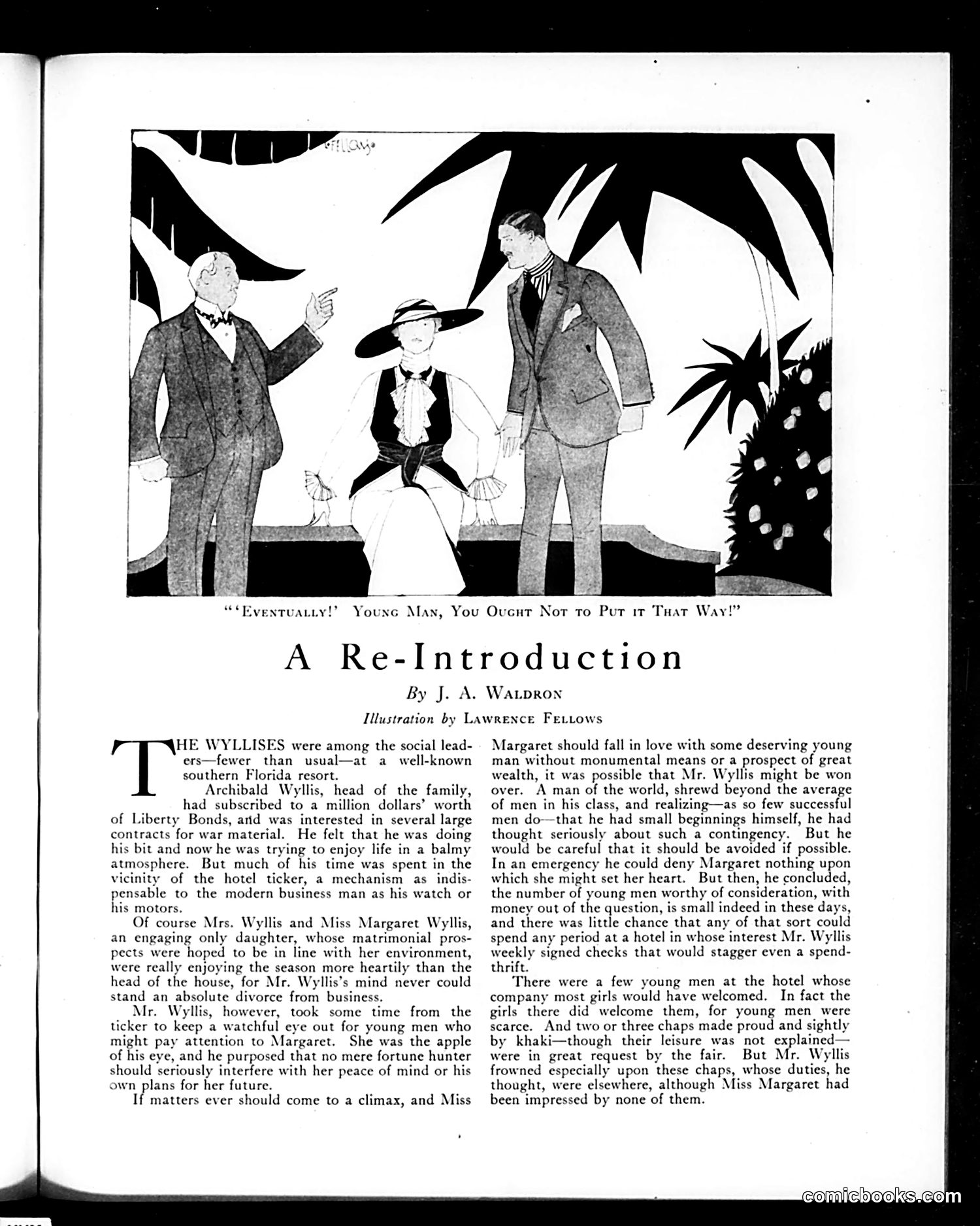
This is a short story opening (not primarily satirical), set during World War I at a Florida resort. The illustration shows three men in suits discussing a young woman seated between two of them—the caption suggests disagreement about courtship propriety. The narrative concerns Archibald Wyllis, a wealthy businessman who's bought Liberty Bonds (government war bonds) and holds war contracts, yet spends leisure time at a luxury hotel watching stock tickers. His concern is protecting his daughter Margaret from fortune hunters. The story's tension involves her potentially falling for an unsuitable suitor—particularly troubling to Wyllis are young men in military khaki uniforms (suggesting soldiers on leave), whom he views suspiciously as shirking war duties elsewhere. The piece explores class anxieties of the era: wealthy fathers' protective instincts, the status of military service, and whether love without money is acceptable among the leisure class.
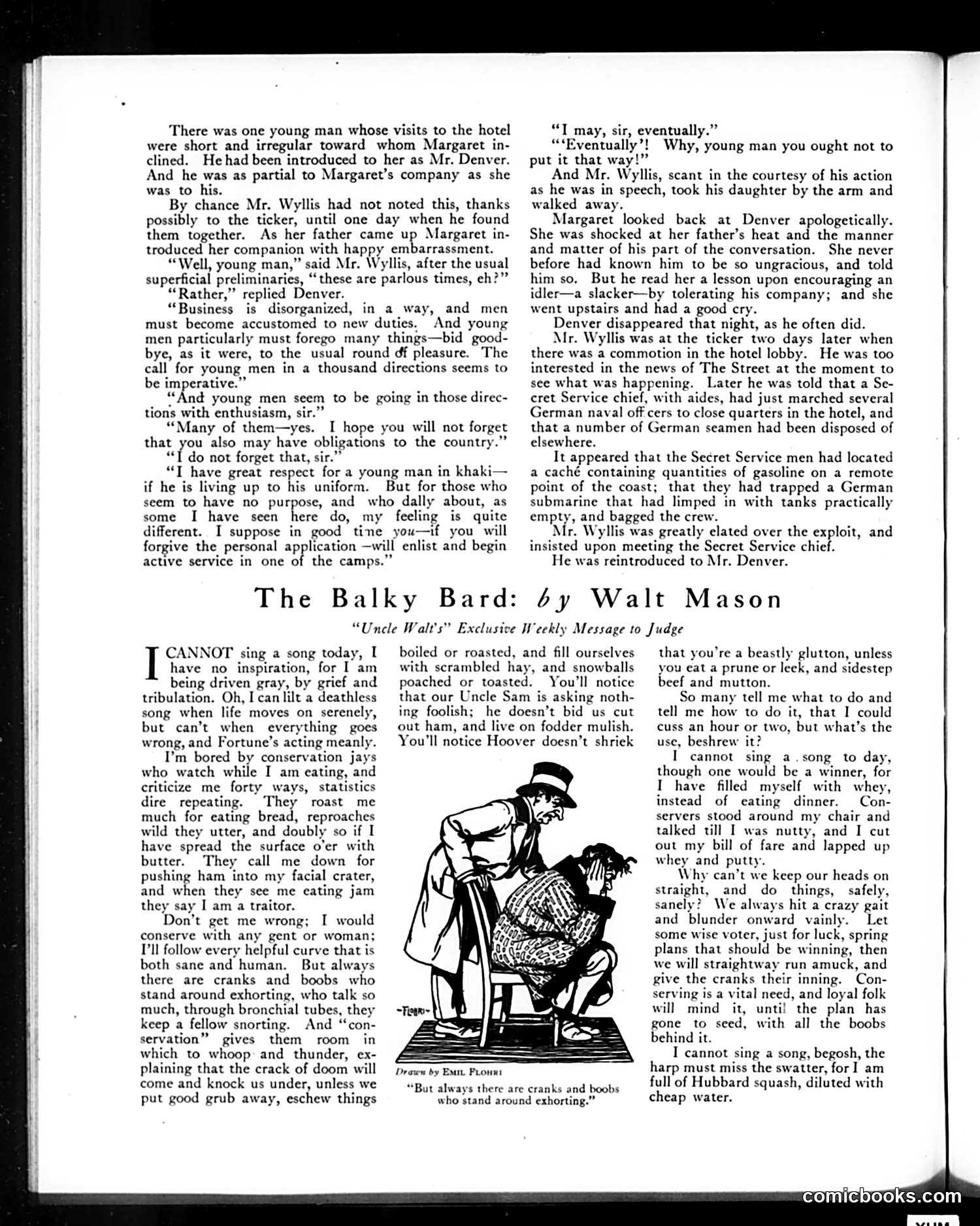
This page contains two distinct pieces from *Judge* magazine: **The main narrative** (top) is a WWI-era story about Mr. Wyllis, a businessman, who pressures a young man named Denver to enlist in military service, dismissing him as a "slacker" for his noncommittal response. Wyllis is harsh and dismissive. The twist: Denver is actually a Secret Service agent who has just successfully captured German naval officers and saboteurs operating from the American coast. Wyllis is humiliated when reintroduced to his daughter's suitor—now revealed as a patriotic hero doing covert war work. **The satire:** The piece mocks civilians who judge others' patriotism based on visible military uniform, while missing actual wartime contributions. It criticizes hasty moral judgment of young men's choices during national emergency. **"The Balky Bard"** (bottom) is Walt Mason's humorous column complaining he cannot write cheerfully during wartime rationing and national stress—a lighter commentary on civilian morale during WWI.
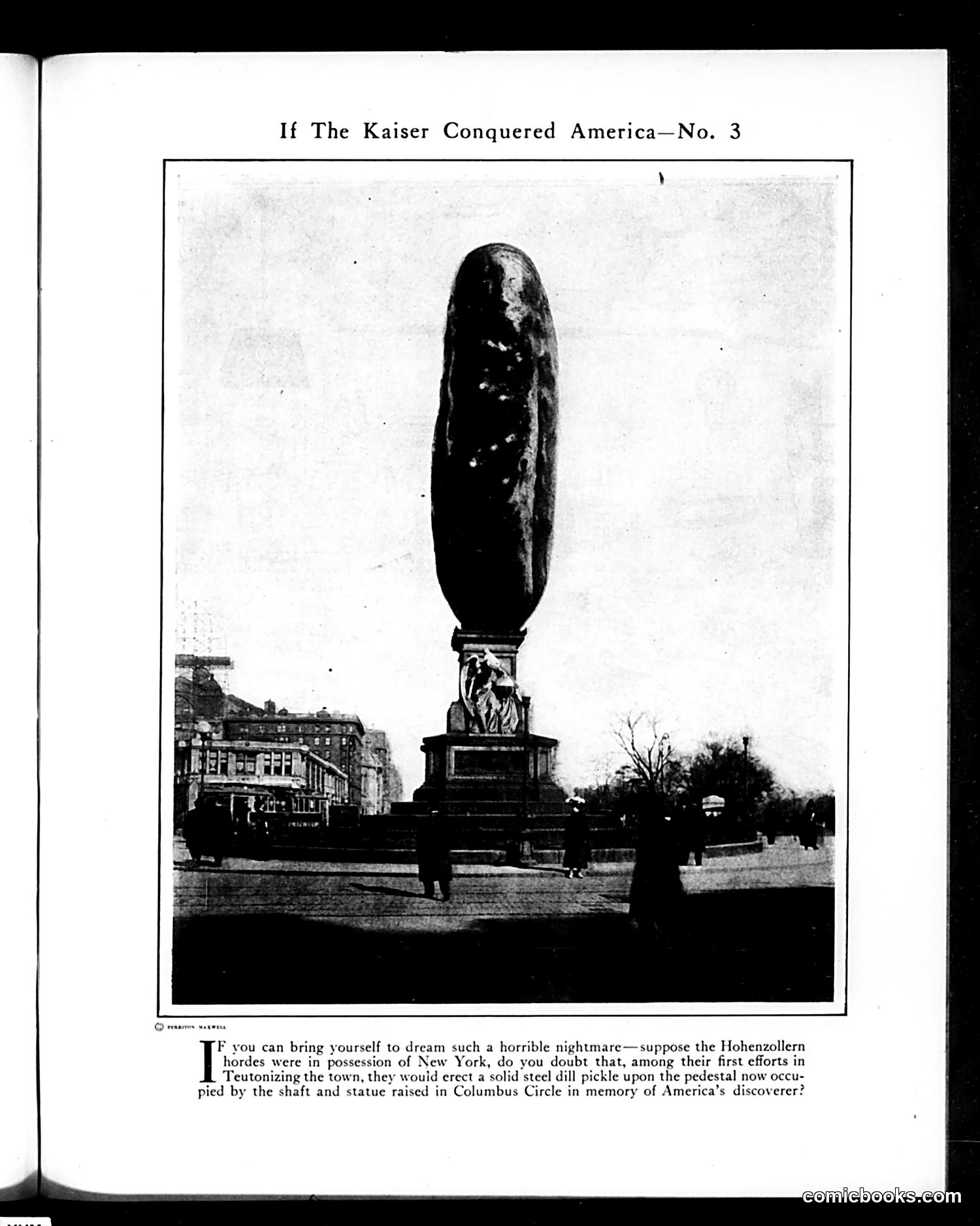
This satirical cartoon imagines German occupation of New York during World War I. The image shows a giant steel pickle monument replacing Columbus's statue in Columbus Circle—a deliberate absurdist mockery suggesting Germans would erase American heritage and impose ridiculous, degrading cultural symbols. The "Hohenzollern hordes" reference is the German imperial dynasty. The "dill pickle" joke likely plays on anti-German ethnic stereotypes (Germans associated with pickled foods). The satire warns that Kaiser Wilhelm II's conquest would destroy American monuments and identity, replacing noble symbols with crude, humiliating ones. This represents wartime propaganda from Judge magazine's pro-Allied stance, using grotesque humor to express anxiety about potential German invasion and cultural domination.
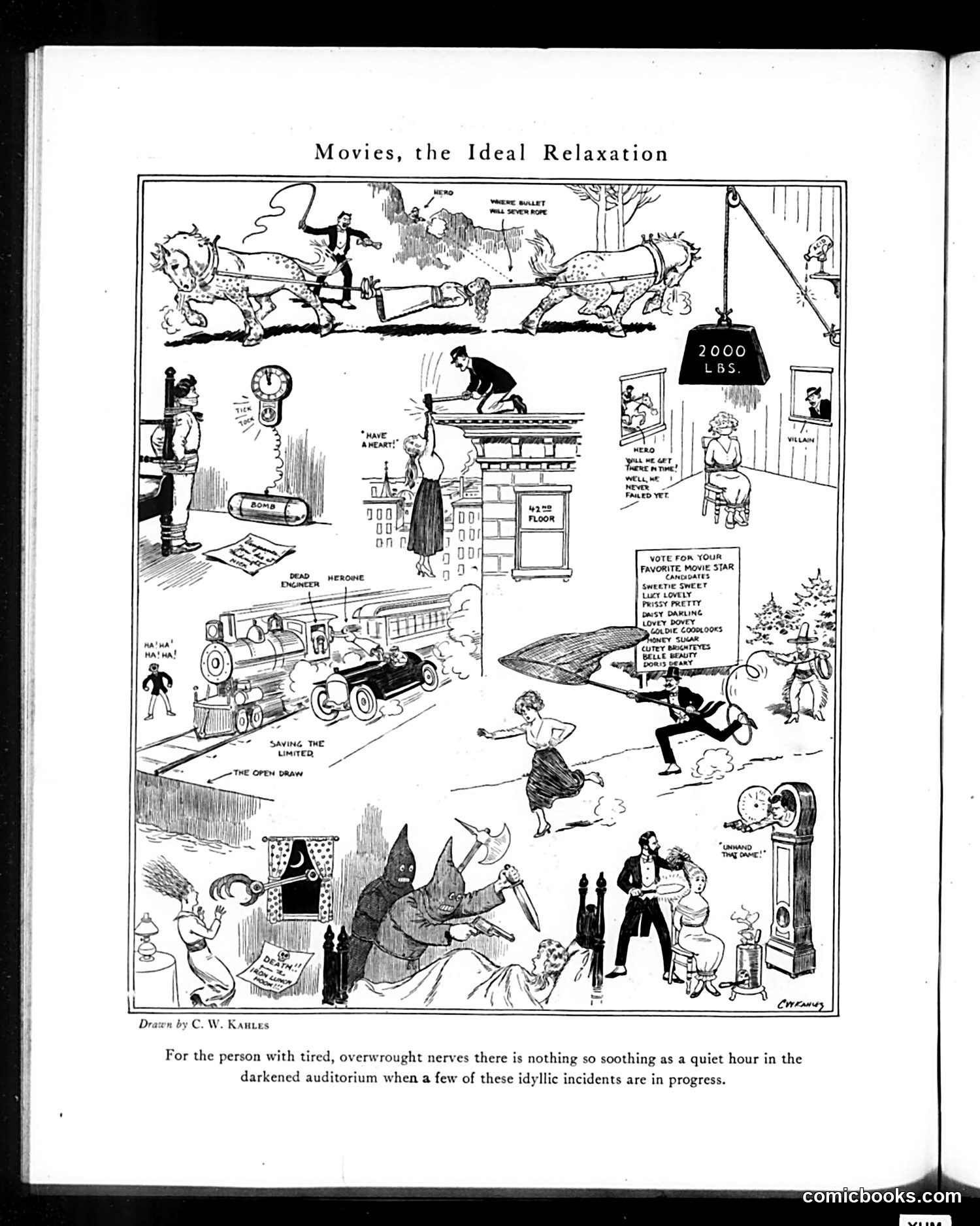
This satirical cartoon by C.W. Kahles mocks the claim that movies provide peaceful relaxation. The image is a chaotic collage of violent, dangerous, and absurd film scenarios—explosions, runaway trains, 2000-pound weights, sword fights, car crashes, and a woman being attacked by demons. The caption's irony is the entire point: it claims movies soothe "tired, overwrought nerves" through "idyllic incidents," but the visual evidence shows the opposite. The cartoon satirizes both early cinema's reliance on sensational action and violence, and audiences' apparently masochistic desire to pay for such stressful entertainment while claiming it's "relaxing." The voting box for "favorite movie star candidates" appears to reference contemporary fan culture around early film celebrities.
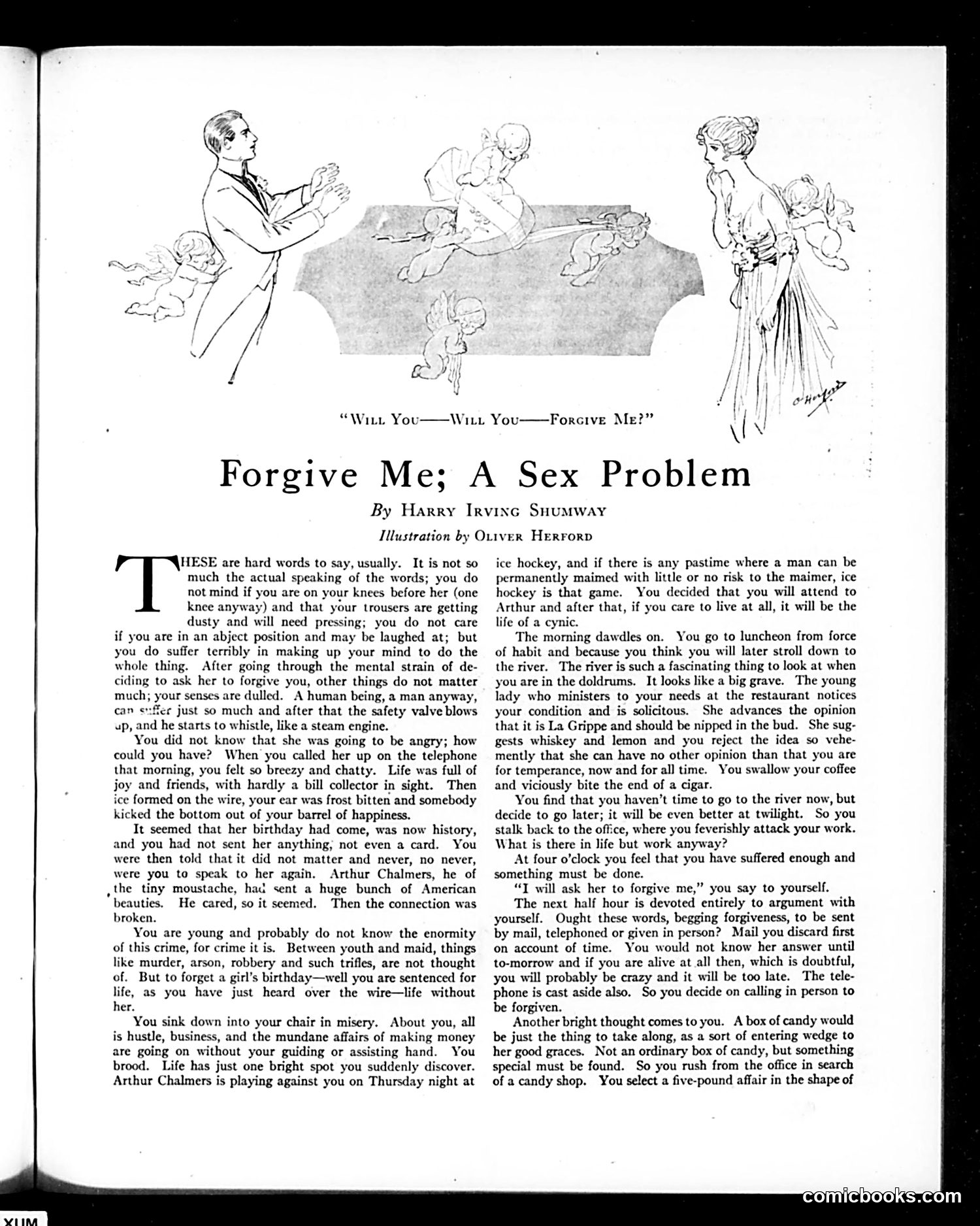
This is a humorous short story (not a political cartoon) by Harry Irving Shumway, illustrated by Oliver Herford. It depicts a young man's anguish after forgetting his girlfriend's birthday. The narrative satirizes male anxiety and emotional incompetence in romantic relationships. The protagonist spirals into despair—contemplating the river as a "grave," fantasizing about maiming his rival Arthur Chalmers at ice hockey, and agonizing endlessly over how to apologize (mail, phone, or in person?). The satire targets masculine emotional dysfunction: he cannot simply apologize straightforwardly, instead suffering dramatic internal torment while his work suffers. The piece gently mocks both the triviality of forgetting a birthday and the disproportionate masculine crisis it triggers—capturing early 20th-century attitudes about men's emotional ineptitude in courtship and domestic matters.
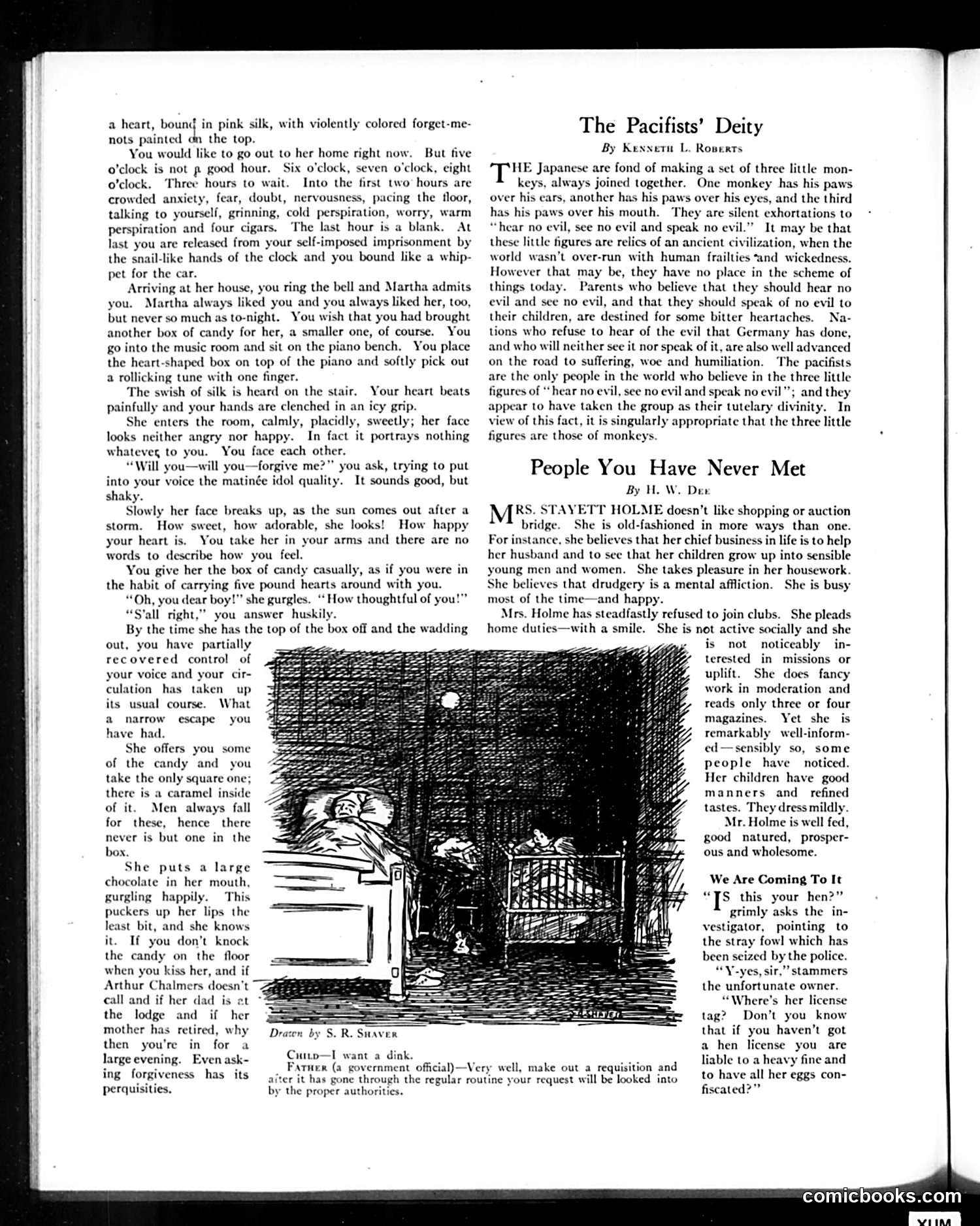
This page contains two distinct articles with illustrations: **"The Pacifists' Deity"** by Kenneth L. Roberts critiques pacifism through the "three monkeys" metaphor (hear no evil, see no evil, speak no evil). Roberts argues that nations and parents who refuse to acknowledge wrongdoing—specifically referencing Germany's conduct (likely WWI-era)—are willfully blind and will suffer consequences. The piece mocks pacifists for ignoring observable evil rather than confronting it. **"People You Have Never Met"** by H.W. Dex describes Mrs. Stavett Holme, a domestically-focused woman who avoids clubs and public life, preferring housework and child-rearing. The tone is gently satirical about her limited interests. **The cartoon** (drawn by S.R. Shaver) depicts a bureaucratic exchange: a child requesting "a dink" (drink), and an official requiring a formal requisition to be processed through "regular routine." It satirizes government red tape and inefficiency. These pieces reflect early 20th-century tensions between pacifism and interventionism, and bureaucratic absurdity.
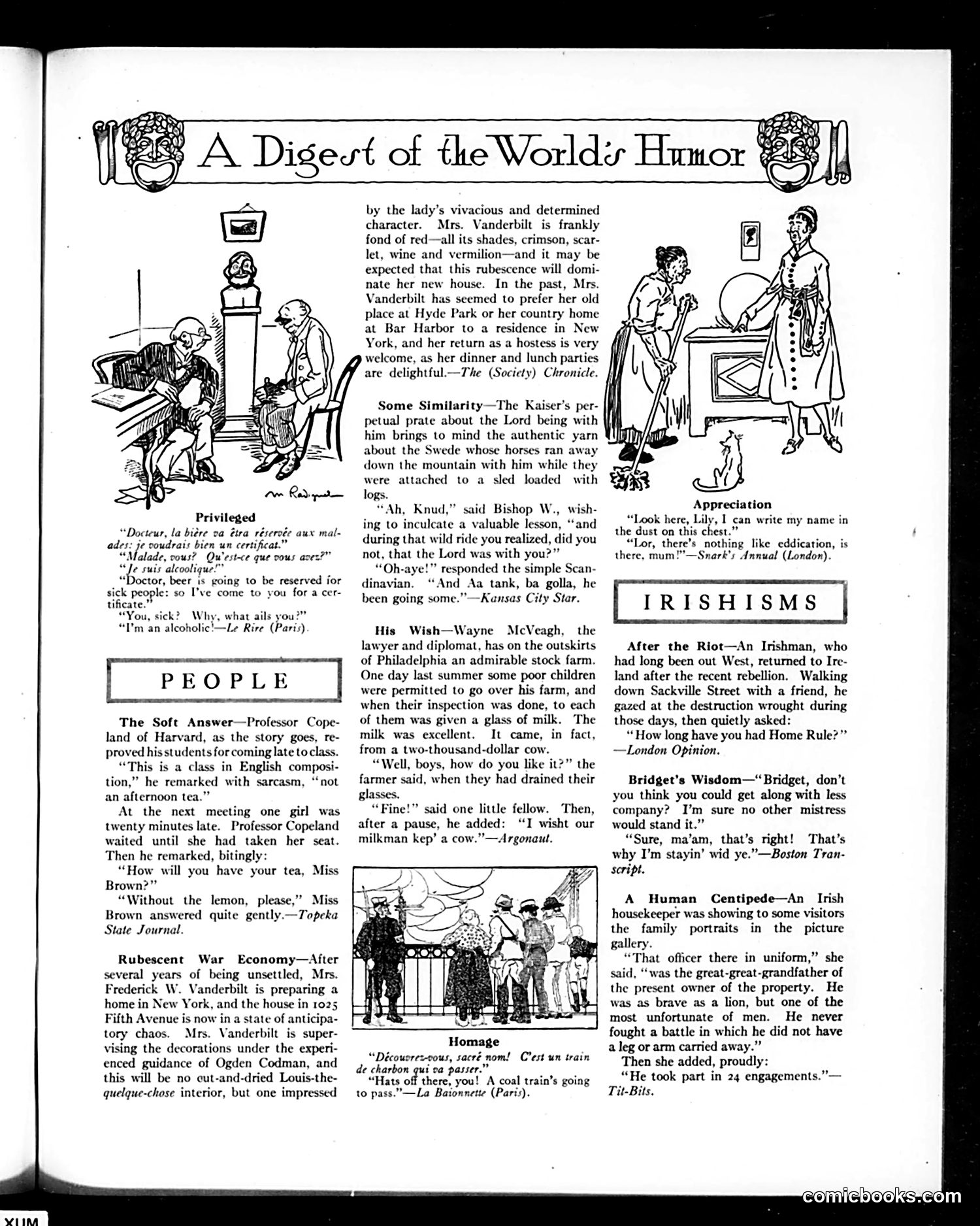
This page from *Judge* magazine contains several short humorous anecdotes and jokes typical of early 20th-century American satire: **"Privileged"** mocks wartime beer rationing (likely WWI-era) through a French joke: a man claims to be an alcoholic to get a medical exemption from beer restrictions. **"The Soft Answer"** is a Harvard anecdote where a late student outsmarts a sarcastic professor by turning his "afternoon tea" insult back on him. **"Rubescent War Economy"** reports on Mrs. Frederick W. Vanderbilt decorating her New York mansion, noting her preference for red colors—a society page item rather than satire. **"Some Similarity"** contrasts the Kaiser's religious rhetoric with a Swedish folk tale about a man thanking God during a runaway sled accident, suggesting hypocrisy. **"Irishisms"** includes two ethnic jokes: an Irishman's confusion about "Home Rule" duration, and an Irish maid's witty retention by her employer through superior company-keeping—playing on period Irish-American stereotypes. The page mixes international reprints with American social commentary.
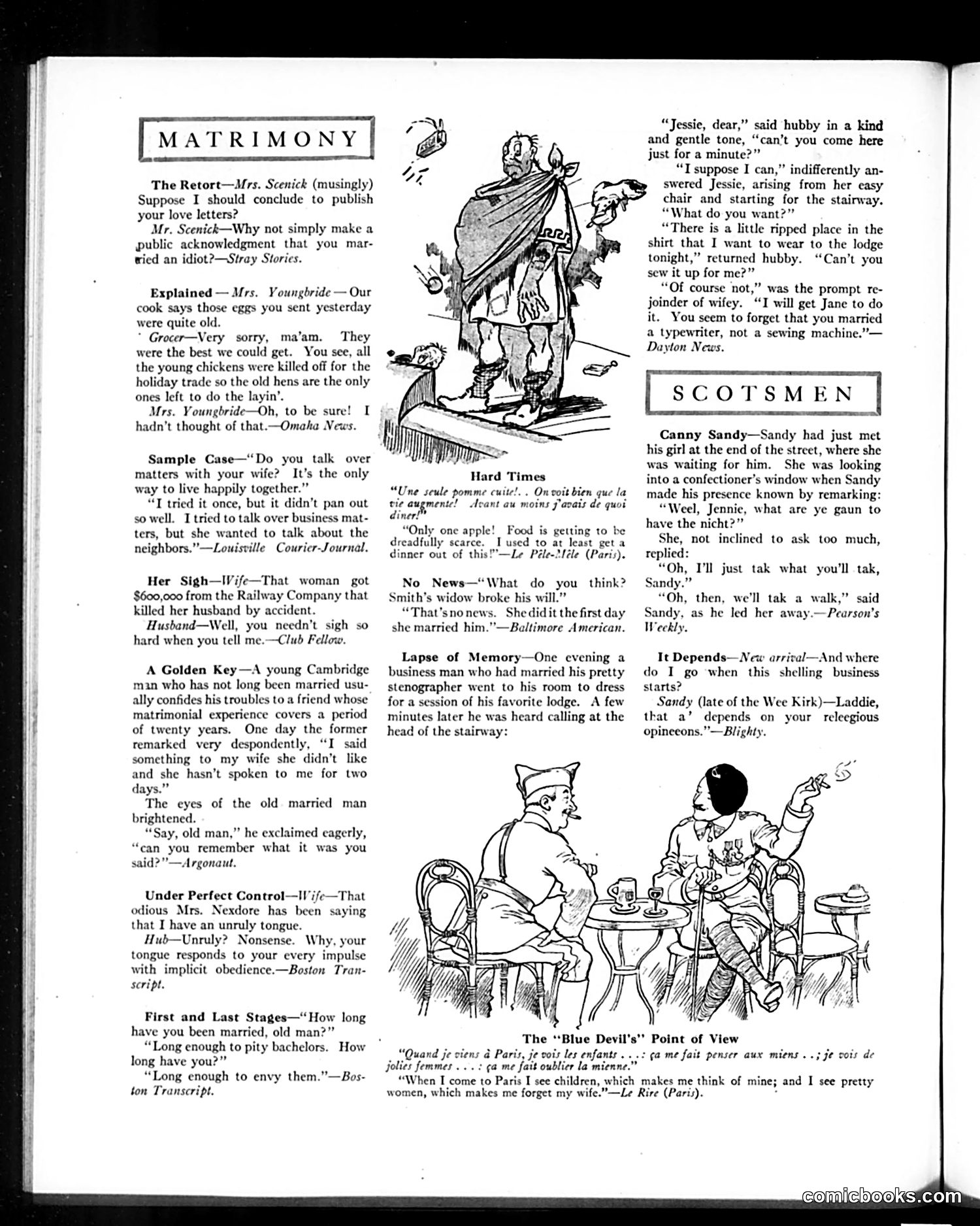
This page contains a collection of brief humorous anecdotes satirizing marriage dynamics and marital discord. The recurring theme is the tension between husbands and wives—wives are portrayed as sharp-tongued, mercenary, and resistant to domestic duties, while husbands are depicted as bumbling, henpecked, or foolish. Key satirical points include: - **"Lapse of Memory"**: A stenographer wife refuses to sew, insisting her husband "married a typewriter, not a sewing machine"—mocking the conflict between modern working women and traditional domestic expectations. - **"Scotsmen" section**: Presents ethnic humor about thrifty Scottish men; "Canny Sandy" avoids spending money by suggesting a walk instead of treats. - **Marriage regrets**: Multiple jokes suggest men prefer bachelorhood or silent wives to actual conversation. The satire reflects early 1900s anxieties about changing gender roles as women entered the workforce, while mocking both sexes' marital complaints.
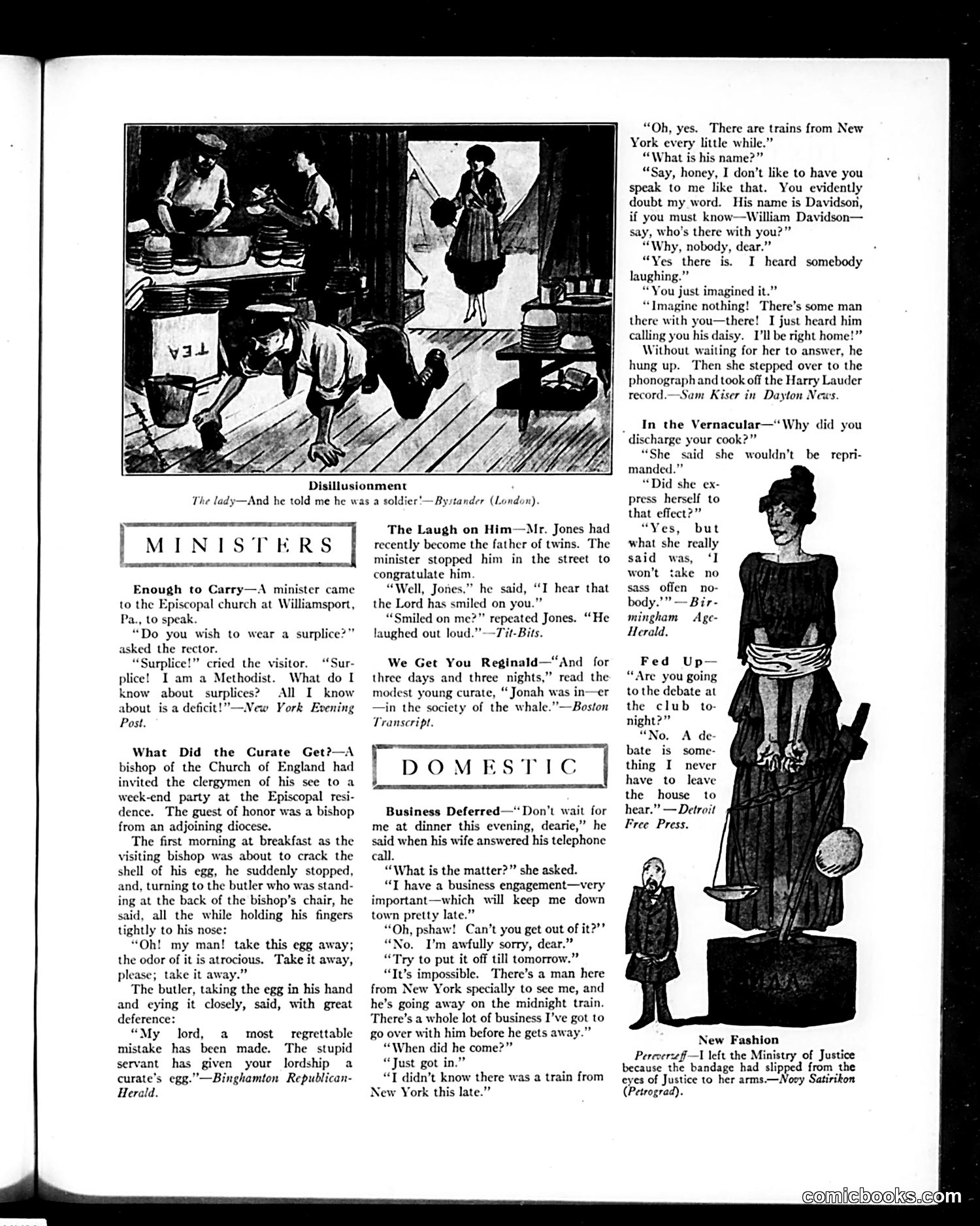
This page collects brief humorous anecdotes satirizing clergy and domestic life, typical of early 20th-century Judge magazine. **Key satirical targets:** The "MINISTERS" section mocks clergymen's impracticality and outdated concerns. One joke ridicules a Methodist minister unfamiliar with ecclesiastical vestments, knowing only about "deficits"—likely referencing financial struggles of churches or denominations. The "curate's egg" joke plays on a famous Victorian phrase suggesting something partly bad; here it's a literal rotten egg. **Domestic humor** appears in "We Get You Reginald," where a wife catches her husband in an obvious lie about meeting a business associate by recognizing a phonograph playing Harry Lauder records in the background—she's presumably heard the "daisy" flirtation through the phone. **Social commentary** includes "New Fashion," a Russian cartoon about Justice's blindfold slipping to her arms—implying corrupt application of law rather than impartial justice, likely referencing instability in Petrograd (pre-Soviet Russia). The satire targets institutional hypocrisy, male infidelity, and governance corruption—evergreen subjects made specific through period-appropriate details.
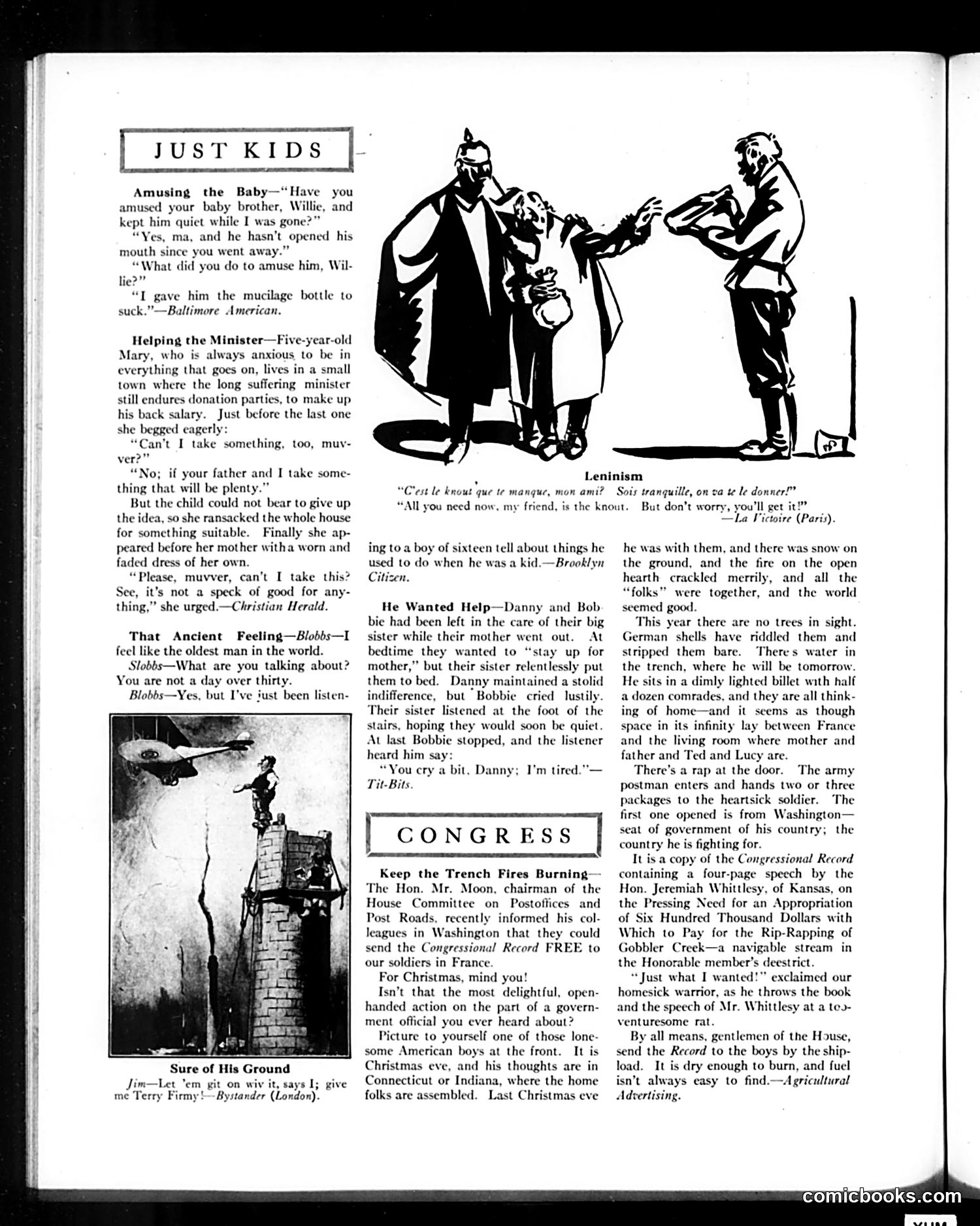
This Judge magazine page contains satirical humor pieces and a pointed political critique. **"Just Kids"** section: Light anecdotes about children's logic and behavior—a boy keeping his baby brother quiet with glue, a girl wanting to donate her worn dress to help the minister. **"Leninism" cartoon** (top right): Shows a figure labeled as representing Leninism telling someone they need "the knout" (a whip)—mocking Soviet brutality under Lenin. The satire suggests Leninism relies on violent coercion. **"Congress" section**: Bitterly sarcastic critique of Representative Moon offering to send Congressional Records free to soldiers in France for Christmas. The text contrasts a homesick soldier's desperate hopes for meaningful care with receiving instead a bureaucrat's lengthy speeches—useless comfort. The satire condemns government waste and hollow gestures toward troops while real wartime hardship persists. The underlying point: political officials offer self-serving publicity rather than genuine soldier welfare during World War I.
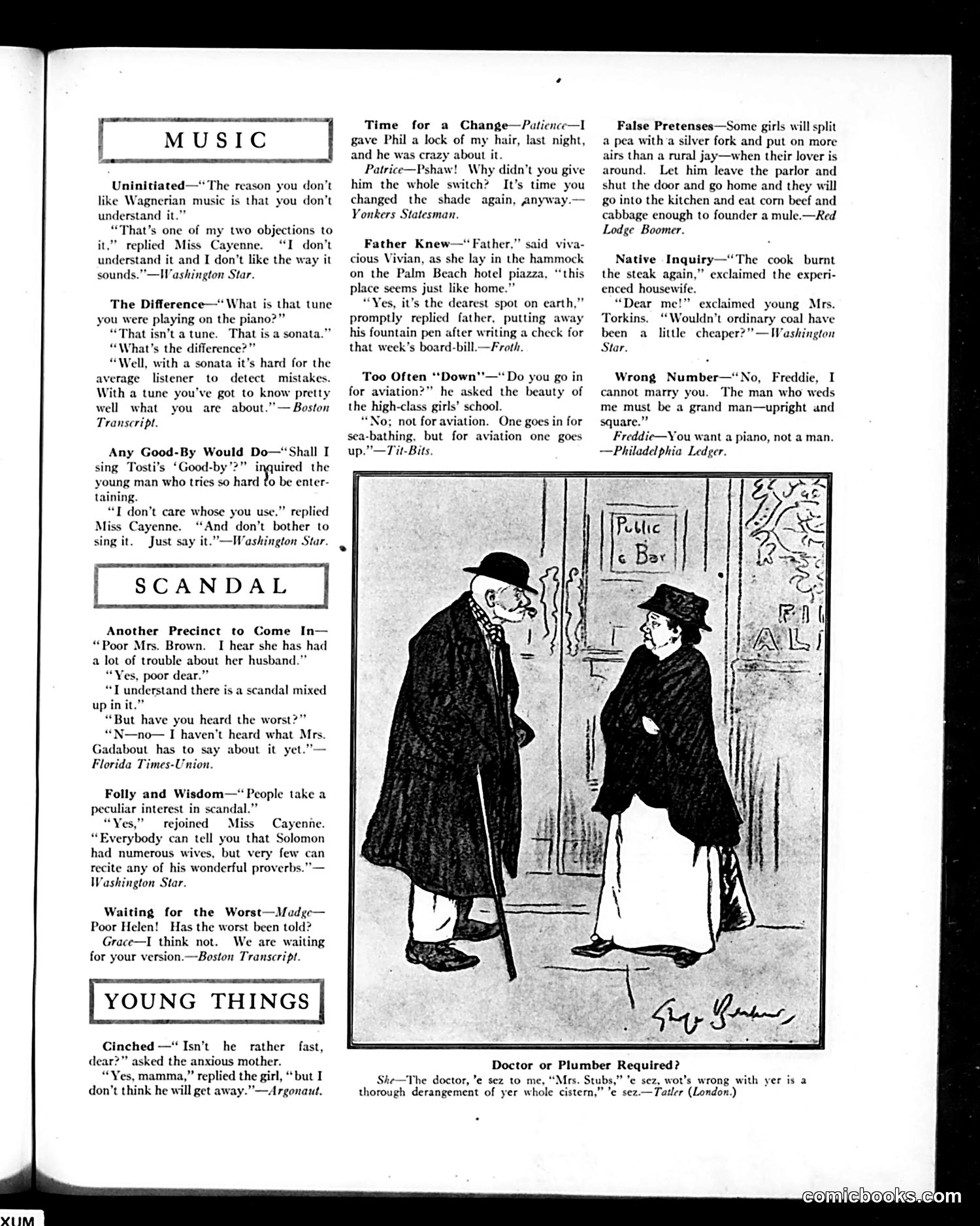
This page from Judge magazine contains humor columns and a single cartoon mocking early 20th-century social pretenses and gender dynamics. The cartoon depicts two working-class Londoners (indicated by dialect in the caption) outside what appears to be a pub. The woman reports her doctor diagnosed her with a "thorough derangement of yer whole cistern"—a deliberately crude malapropism for "system." The joke plays on class differences: the woman's misuse of medical terminology (confusing "system" with "cistern," a water tank) exposes her lack of education while attempting to speak "properly" about her health. The cartoon ridicules both the pretension of adopting formal medical language and working-class speech patterns. The text columns—"Music," "Scandal," and "Young Things"—contain brief humorous anecdotes mocking contemporary social attitudes: snobbish music appreciation, gossip culture, and women's materialism and affectation around romantic relationships. These reflect Judge's satirical focus on American social hypocrisy and class pretension.
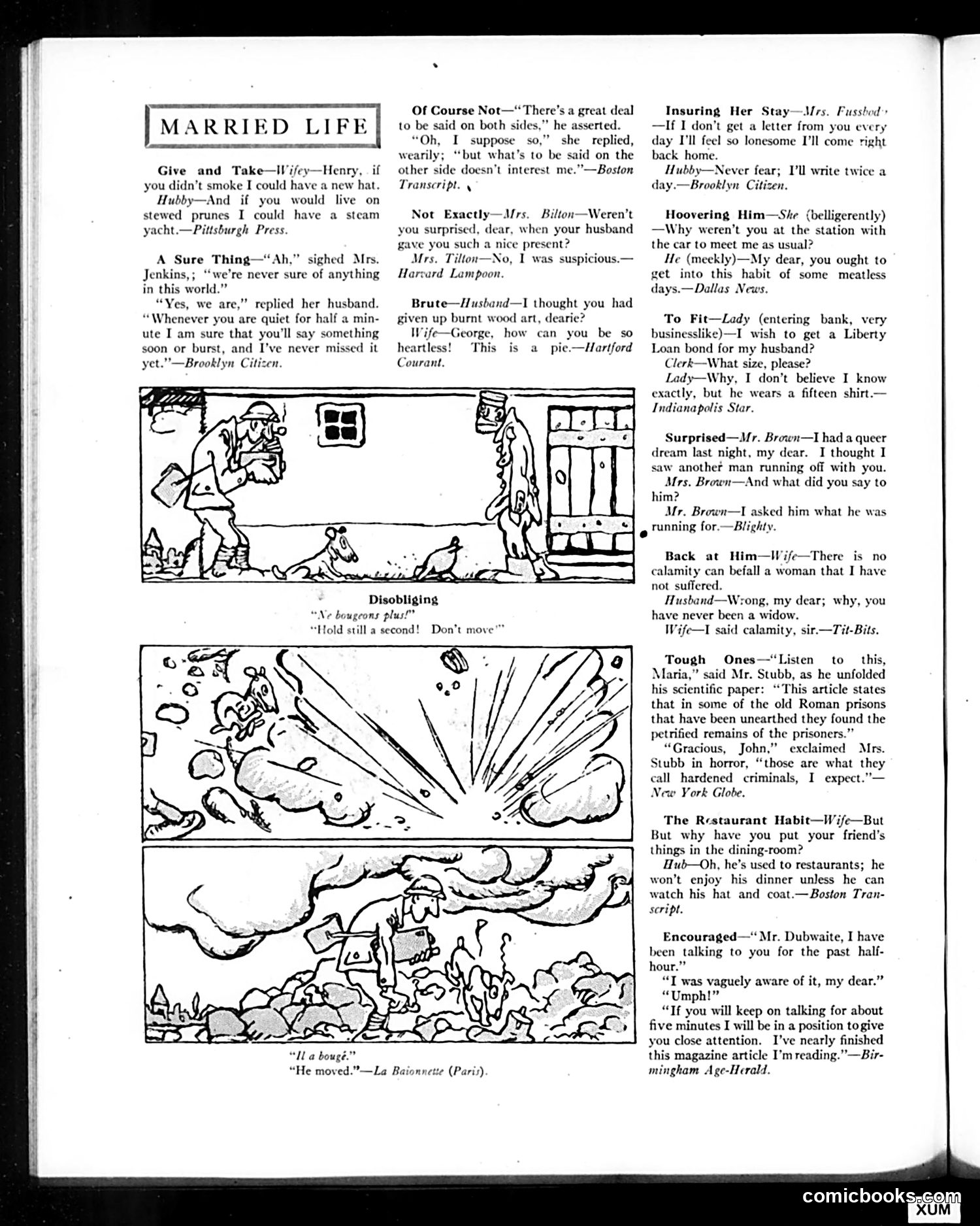
This page from *Judge* magazine presents a collection of short, witty one-liners satirizing married couples' domestic conflicts. The humor relies on exaggerated gender stereotypes common in early 20th-century comedy. Key themes include: **Financial tensions**: Wives wanting new hats/luxuries while husbands resist spending; husbands fantasizing about expensive purchases (steam yachts). **Communication failures**: Husbands ignoring wives' talking; wives suspicious of husbands' gifts or behavior. **WWI-era references**: "Meatless days" and "Liberty Loan bonds" allude to wartime rationing and financing efforts, suggesting this is WWI-era material. **Gender role mockery**: Men portrayed as inattentive/dismissive; women as talkative/suspicious. The "Brute" joke mocks a husband's insensitivity to his wife's hobbies. The three cartoons (labeled "Disobliging" and "He moved") appear to show physical comedy, though details are unclear in reproduction. The satire targets conventional marriage dynamics through exaggeration and role reversal humor typical of period humor magazines.
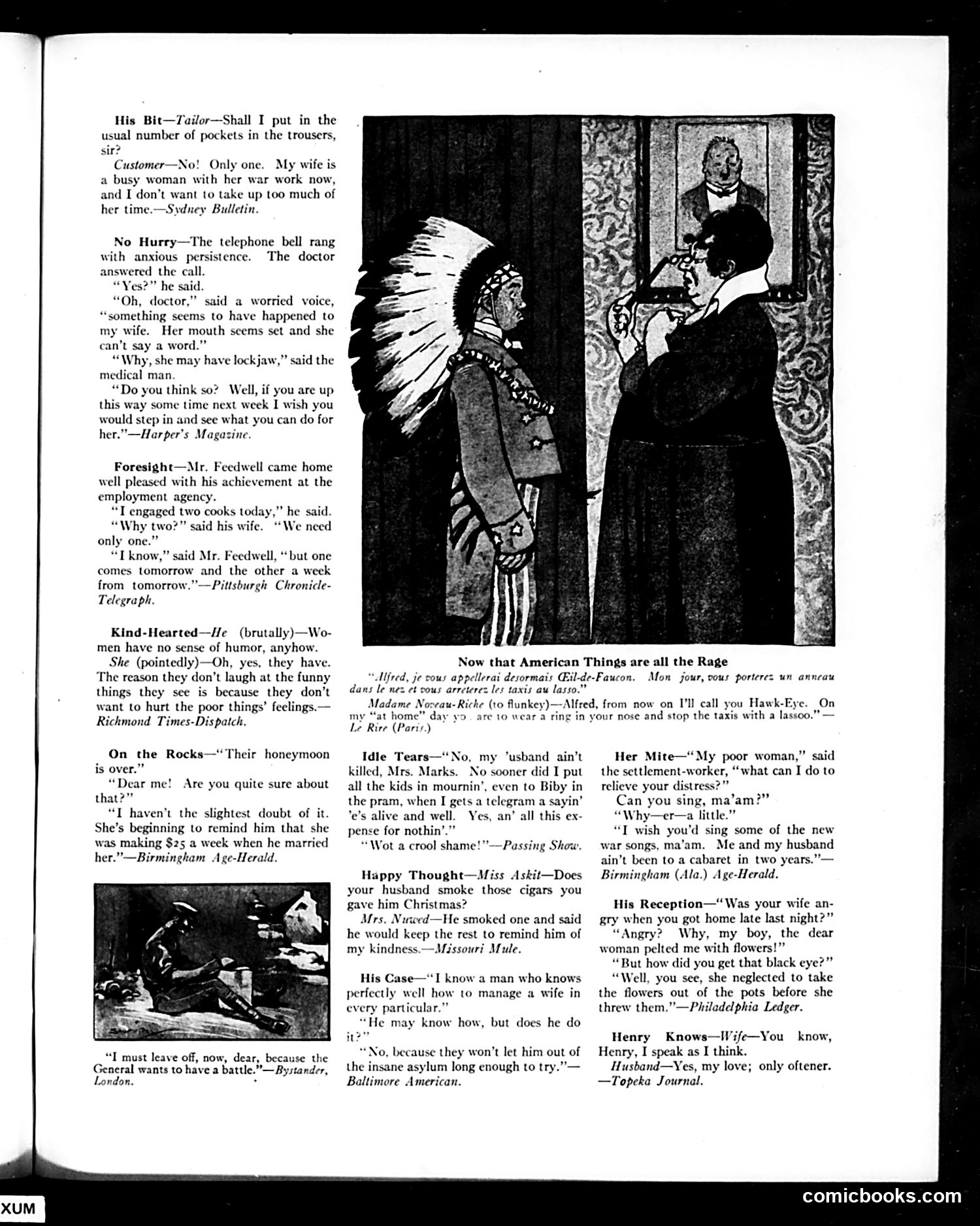
This page collects brief humorous anecdotes satirizing early-20th-century domestic life and gender relations, likely WWI-era based on references to "war work." **Main themes:** The jokes target wives' perceived control over husbands' finances and behavior. "His Bit" mocks a husband limiting trouser pockets to prevent his busy wife from using them. "On the Rocks" suggests newlyweds fight over the wife's lost income ($25/week). "His Case" implies wives are so controlling that only asylum inmates could escape them. **The upper cartoon** shows a Parisian socialite adopting "American" affectations—calling her husband "Hawk-Eye" and lassoing taxis—mocking both American cultural imperialism and wealthy Europeans' fascination with American trends. **Gendered humor** pervades throughout: women lack humor sense, nag about money, and use "war work" as excuses. The settlement-worker anecdote reduces poor women to entertainment sources. These jokes reflect contemporary anxieties about women's increasing independence and wartime employment, presenting wives' autonomy as emasculating and absurd.
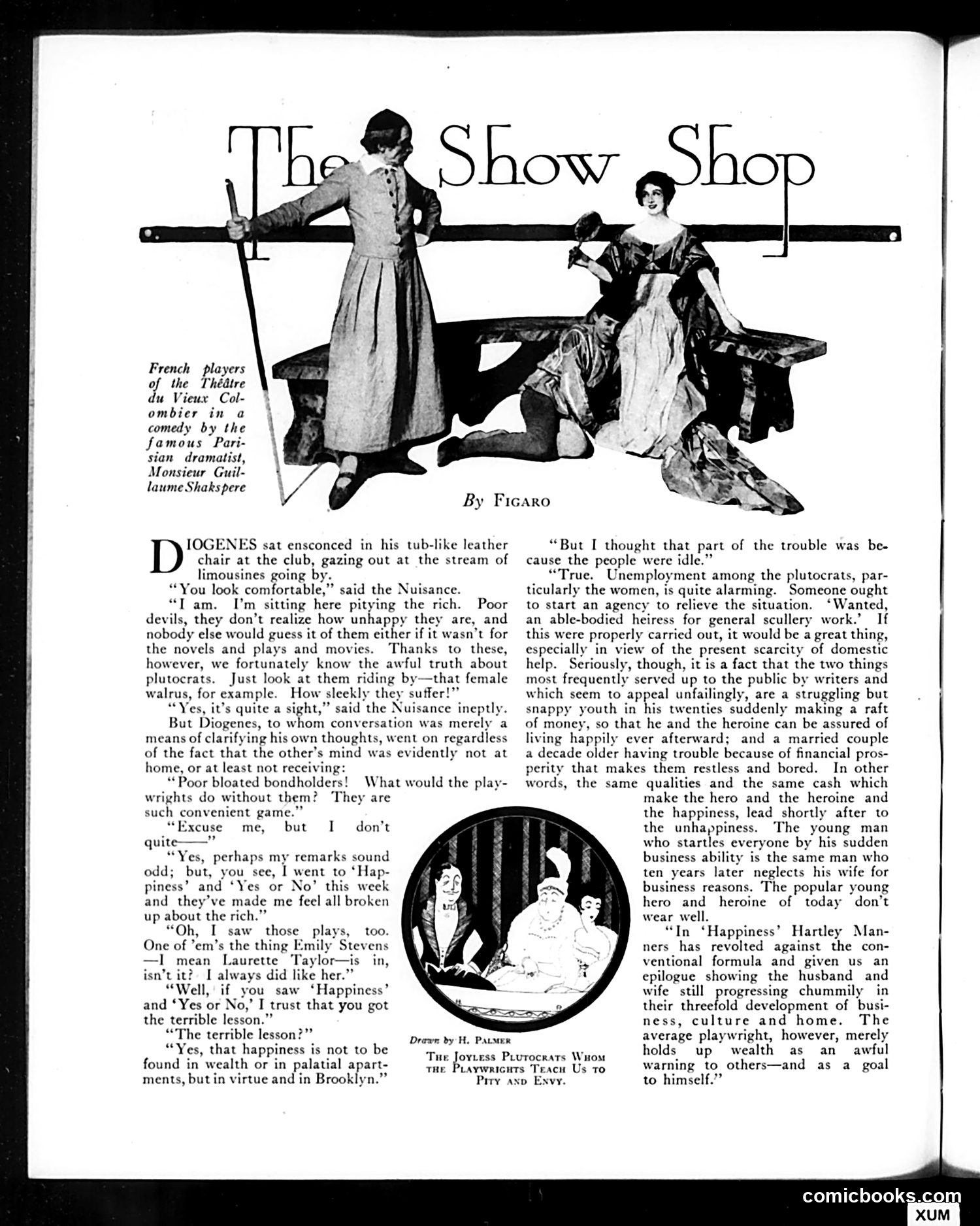
This page satirizes contemporary American playwrights (circa 1910s-20s) for their simplistic moralizing about money. The dialogue features two club members discussing recent plays like "Happiness" and "Yes or No," which the narrator claims teach that true happiness comes from virtue and Brooklyn—not wealth. The satire targets playwrights' lazy formula: wealthy characters are portrayed as miserable, while struggling youth who suddenly acquire money find happiness. The critic points out this is contradictory—the same ambition that creates success later causes neglect and unhappiness. The header notes the page discusses a French theatrical production by Monsieur "Guillaume Shakspere" (a playful misspelling suggesting even classical dramatists engage in such themes). The cartoons showing theatrical scenes illustrate these morality plays about the rich. The underlying joke: playwrights use wealth as convenient "game" to preach virtue while secretly desiring that very wealth themselves.
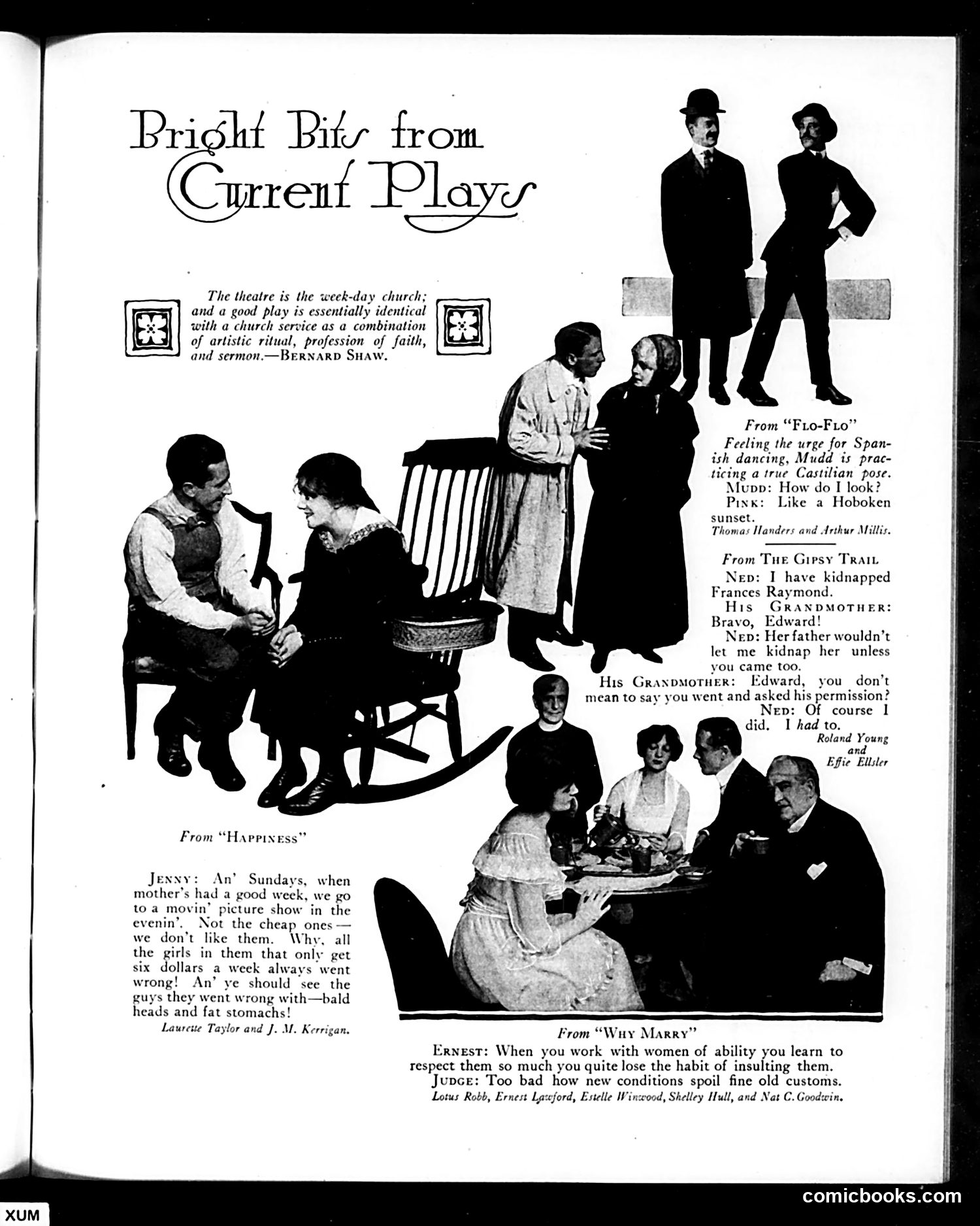
This page excerpts humorous dialogue from popular Broadway productions. The cartoons illustrate theatrical wit about gender relations and class. "Flo-Flo" mocks a character's awkward attempt at Spanish dancing. "The Gipsy Train" uses absurdist humor: a young man kidnaps a woman but first obtains her father's permission—inverting romantic convention into bureaucratic propriety. "Happiness" contains working-class social commentary: a poor girl notes that actresses earning only six dollars weekly "went wrong," suggesting economic desperation drove women to immorality. "Why Marry" offers the most pointed satire: a judge laments that educated women's competence has forced men to abandon their traditional habit of insulting women. The joke critiques both male chauvinism and rapid social change, suggesting that women's advancement into professional respectability has disrupted old patriarchal customs—presented as loss rather than progress.
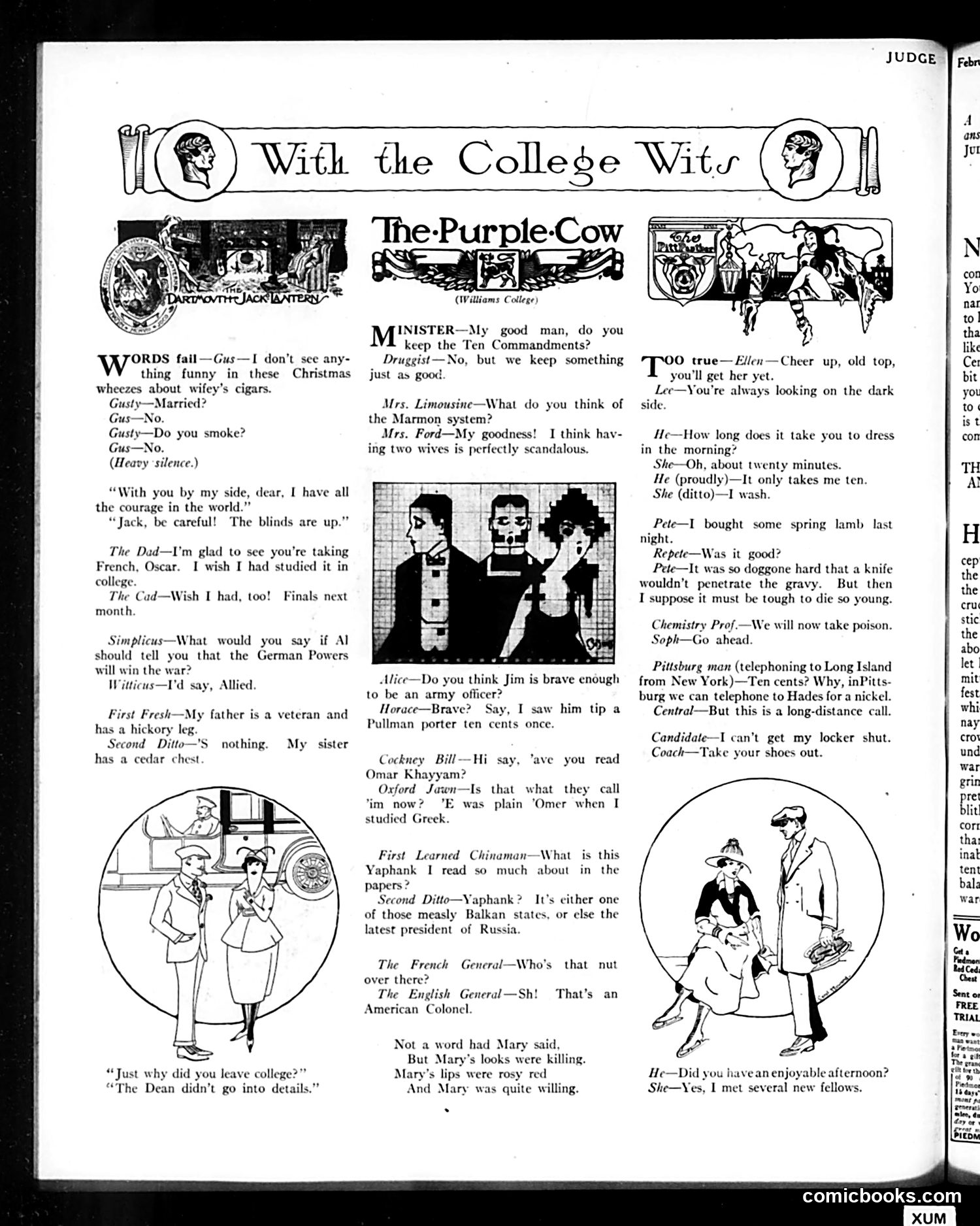
This page collects brief satirical jokes targeting early 20th-century college life and contemporary social issues. Key themes include: **College humor**: Jokes about French studies, finals, and leaving college play on intellectual pretensions. **Gender and romance**: Multiple jokes mock courtship awkwardness and female behavior—women are depicted as shallow or materialistic ("Mary's looks were killing"). **Social commentary**: A minister joke mocks religious hypocrisy. The "Marmon system" joke confuses a car brand with polygamy, satirizing wealthy women's ignorance. References to "German Powers" and "Balkan states" reflect WWI-era anxieties. **Class satire**: The "Mrs. Limousine" versus "Mrs. Ford" contrast ridicules wealthy women; Pullman porter and telephone operator jokes target working-class figures. **Period references**: Yaphank (likely Camp Upton, a WWI training facility) and Omar Khayyam allusions date this content. The overall tone reflects 1910s-era magazine humor—often condescending toward women, immigrants, and working people.
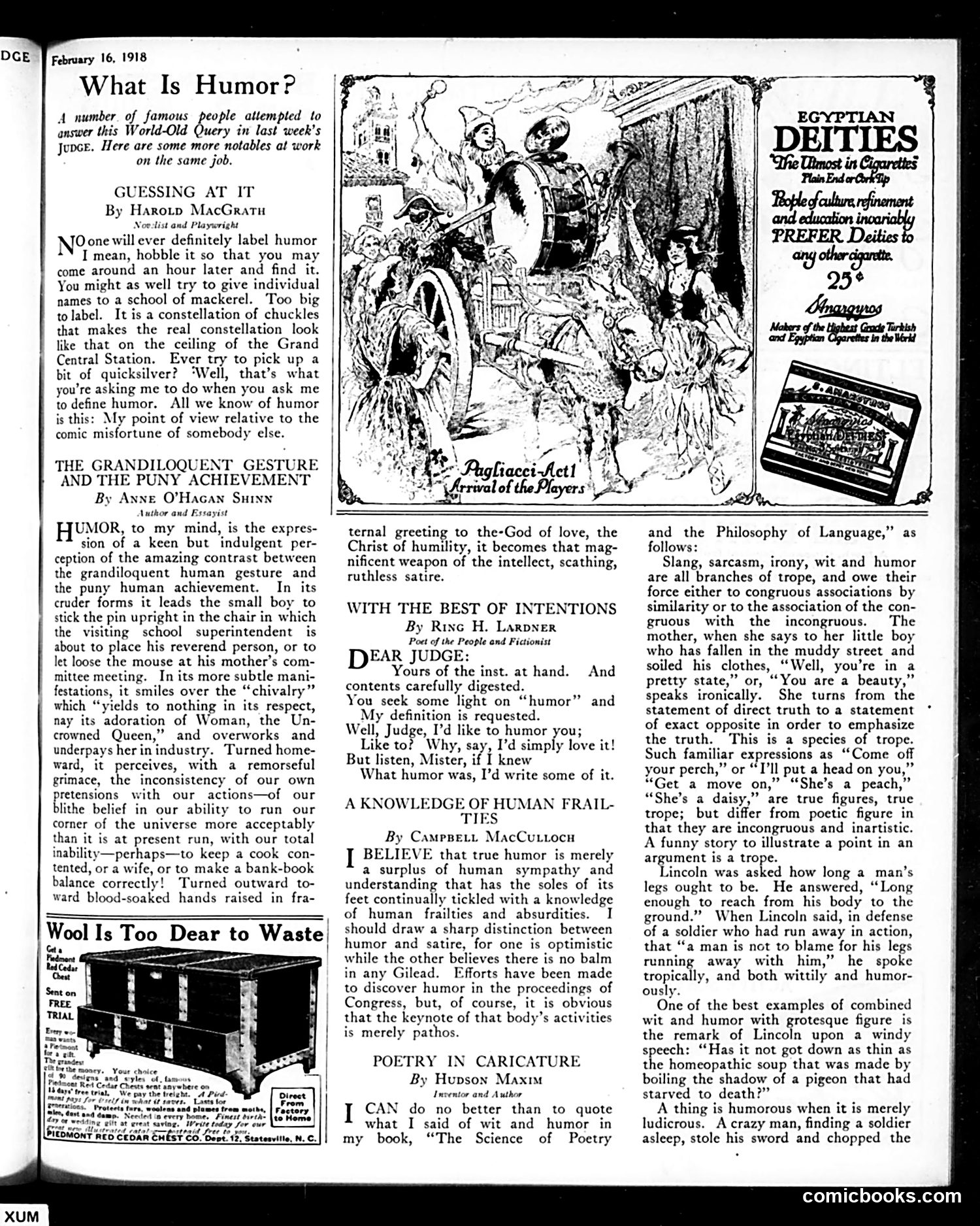
This page is a **meta-humorous feature** where the magazine asks prominent writers and humorists to define "humor" itself—a self-referential joke about the difficulty of defining something everyone recognizes. The **cartoon** (labeled "Piafacci Act! Arrival of the Players") depicts commedia dell'arte performers arriving by car, satirizing how theatrical traditions clash with modern technology. The contrast between old-fashioned theatrical spectacle and the automobile suggests dated forms of entertainment struggling in contemporary society. The **definitions** from Harold MacGrath, Anne O'Hagan Shinn, Ring Lardner, and Hudson Maxim variously describe humor as indefinable, as perception of contrast between grand human pretensions and petty achievements, and as rooted in sympathy for human frailties. Notably, **Lardner's witty non-answer**—"If I knew what humor was, I'd write some of it"—perfectly exemplifies the evasiveness the feature satirizes. The **overall point**: humor resists definition. The feature itself **is** the joke.
This is primarily a **theater review column** ("Broadway and Thereabouts") listing New York productions, not a political cartoon page. The main content catalogs current plays with brief, sardonic descriptions—for example, mocking "Blind Youth" for being melodramatic, or noting that "Business Before Pleasure" makes its vampire "the star of a big film" (more practical than the competing show). The page includes ads for stage productions and consumer goods typical of the era. At the bottom left is a brief humorous anecdote about prohibition and women's rights, suggesting these were contemporary political debates. The cartoon illustration at top left appears decorative rather than satirical—showing a woman's face in an ornate oval frame, likely promoting entertainment generally. **No specific political satire is evident**—this is entertainment journalism from the 1920s era.
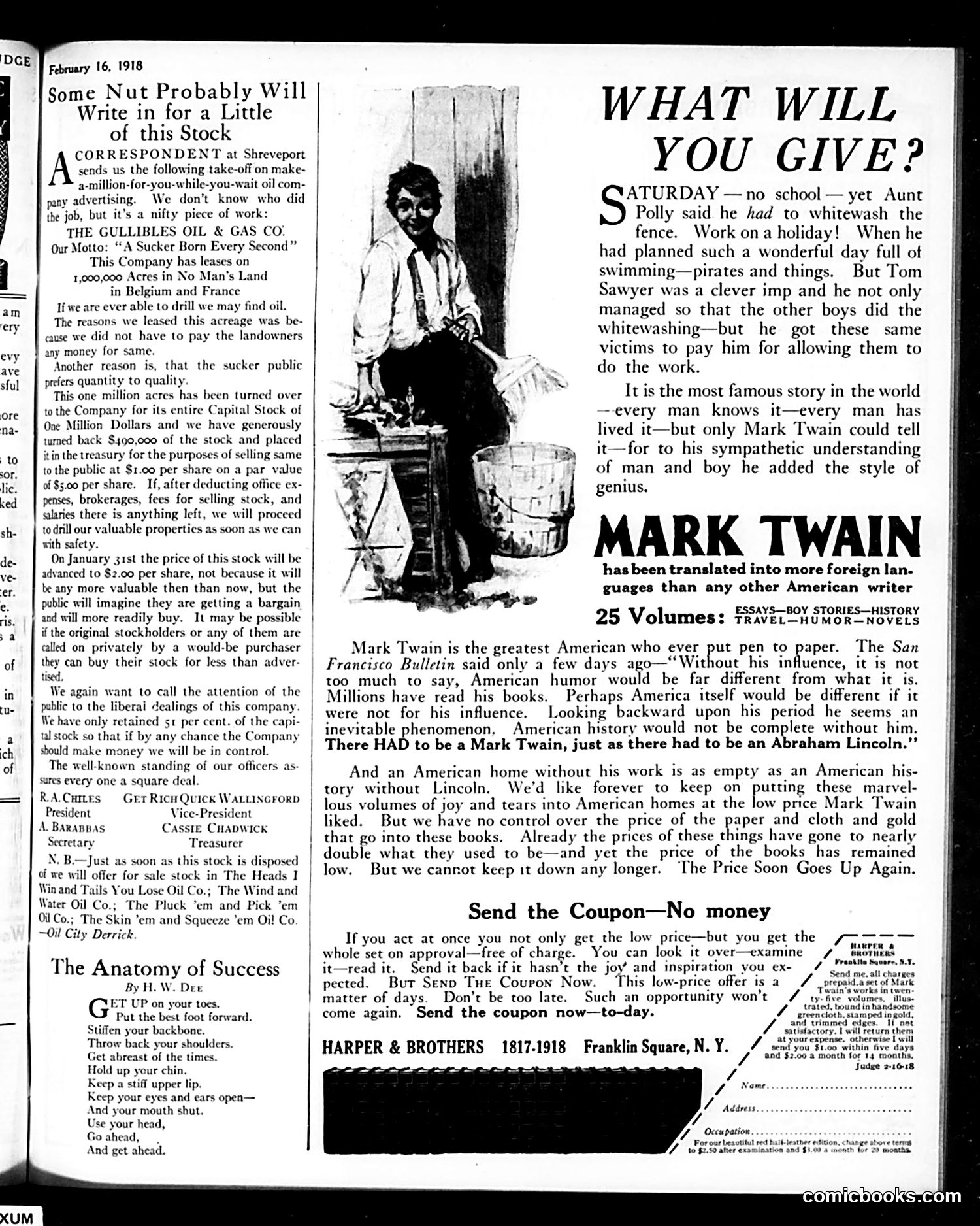
This page contains two unrelated pieces: **Top Left: Oil Stock Satire** A mock advertisement for "The Gullibles Oil & Gas Co." satirizes fraudulent oil investment schemes common in the era. The company claims leases on worthless land in occupied Belgium/France, admits it may never drill, and explicitly states it's designed to fleece "the sucker public." Officers sport obviously fake names (N.B. Barabbas, Cassie Chadwick—likely references to biblical and historical con artists). The joke targets wartime profiteering and the gullibility of American investors. **Right: Mark Twain Advertisement** Harper & Brothers advertises a 25-volume Twain collection, emphasizing his unparalleled influence on American literature and humor. The text celebrates his genius for understanding human nature, using his famous Tom Sawyer fence-whitewashing scene as an example. This is straightforward marketing, not satire. The page juxtaposes cynical commentary on American greed with celebration of American literary achievement.
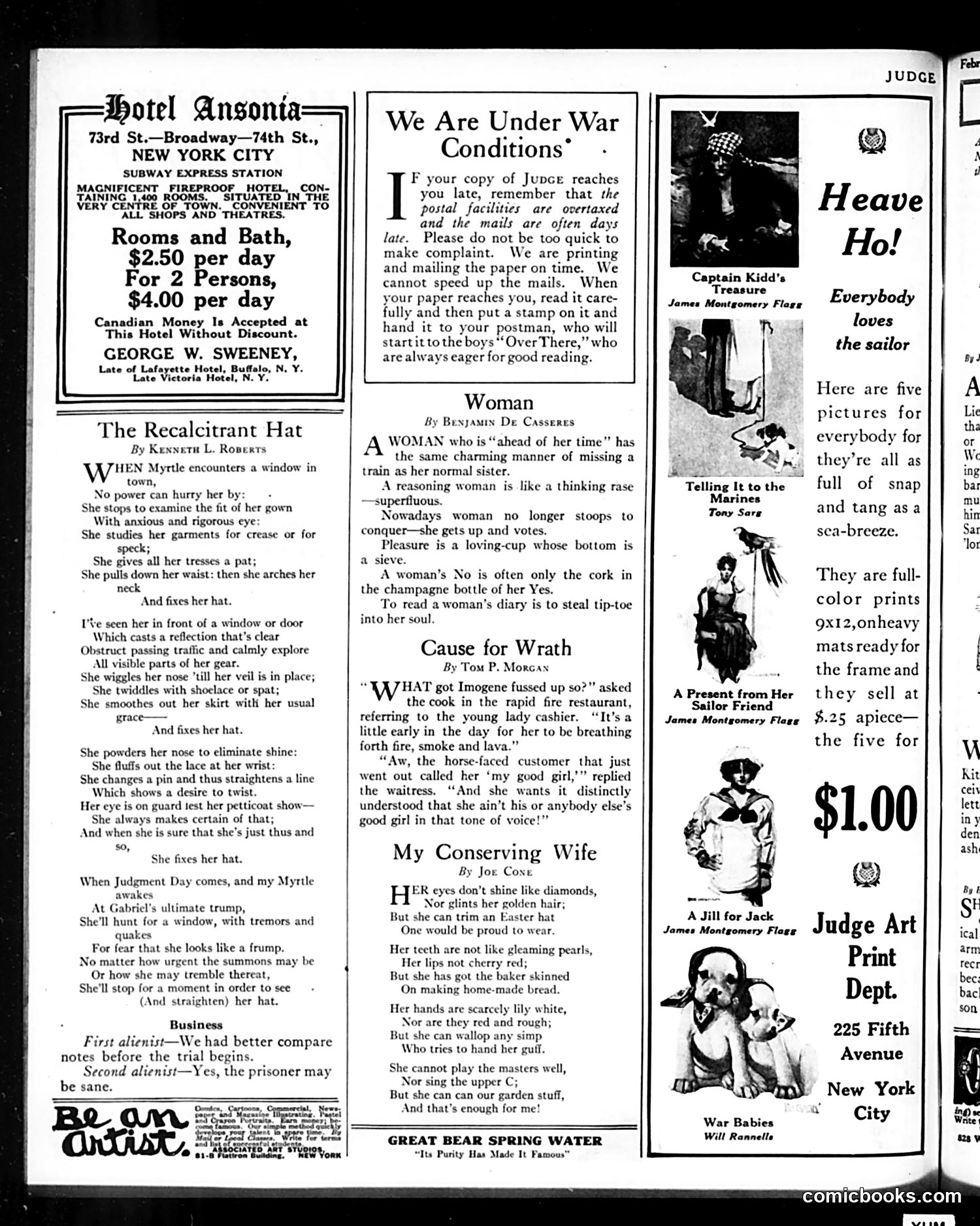
This is primarily a **advertisements and light humor** page from Judge during World War I (evident from "We Are Under War Conditions" header and references to "the boys 'Over There'"). The page contains several humorous poems about women: - **"The Recalcitrant Hat"** satirizes a particular female type—the vain, fastidious woman obsessed with adjusting her appearance, constantly fixing her hat. The satire mocks her vanity and deliberate slowness. - **"Woman"** by Benjamin De Casseres offers cynical observations about modern women—they're becoming independent ("gets up and votes"), unreasonable, emotionally contradictory ("woman's No is often only the cork in the champagne bottle"). - **"My Conserving Wife"** celebrates a domestic, modest woman who doesn't demand luxuries during wartime—a patriotic contrast to the frivolous types above. The **underlying social tension**: Judge is caught between mocking "new women" gaining independence while simultaneously praising women who support the war effort through sacrifice and restraint. The ads for sailor-themed prints reinforce patriotic messaging.
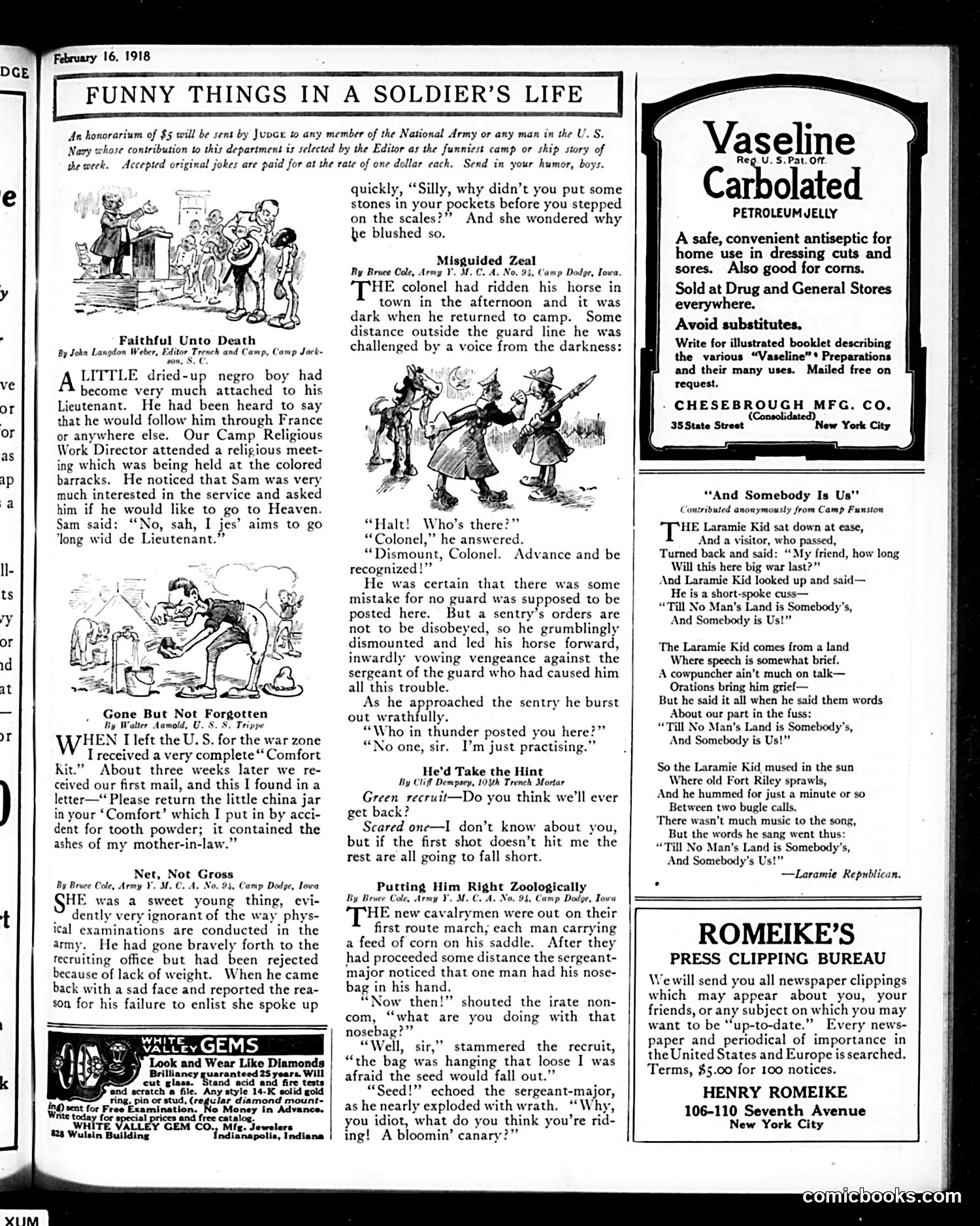
This page collects humorous anecdotes submitted by WWI soldiers and sailors, with a $5 prize offered for the funniest contributions. The jokes satirize military life and recruit inexperience: **"Faithful Unto Death"**: A Black soldier (termed with period racial language) says he'd follow his officer anywhere—even to Heaven—but wouldn't go to Heaven without him. The humor relies on depicting devoted but supposedly simple-minded service. **"Gone But Not Forgotten"**: A soldier's mother-in-law's ashes were accidentally packed in his comfort kit and returned by mail—dark humor about unwanted relatives. **"Misguided Zeal"**: A nervous new sentry challenges even his commanding officer, demonstrating over-zealous adherence to orders. **"Putting Him Right Zoologically"**: A recruit absurdly carries his horse's feed-bag in his own hands rather than on the saddle, confusing military equipment with livestock gear. The cartoons depict typical military blunders and social awkwardness. These are workplace humor for soldiers in WWI, emphasizing inexperience and comic misunderstandings rather than satirizing broader social issues.
This page is primarily **advertising and promotion** for *Judge* magazine during World War I (circa 1918). The left side promotes *Judge* as one of three most popular periodicals among soldiers, encouraging readers to mail copies to troops "over there." The main article, "The Real Thing" by Albert E. Hoyt, satirizes **elite social clubs canceling annual dinners** during wartime to appear patriotic and avoid waste. Hoyt's satire cuts both ways: he mocks the clubs for pretending this is a sacrifice (claiming nobody genuinely enjoys these dinners anyway—they attend out of obligation) while also criticizing their hypocrisy (in peacetime, they'd spend lavishly on charity balls). The piece reflects **WWI-era concerns about civilian sacrifice and morale**, particularly the tension between maintaining normal social life and demonstrating commitment to the war effort. The satire suggests that canceling expensive banquets is performative patriotism rather than genuine sacrifice. No specific figures or caricatures appear—this is commentary on social institutions and attitudes rather than political figures.
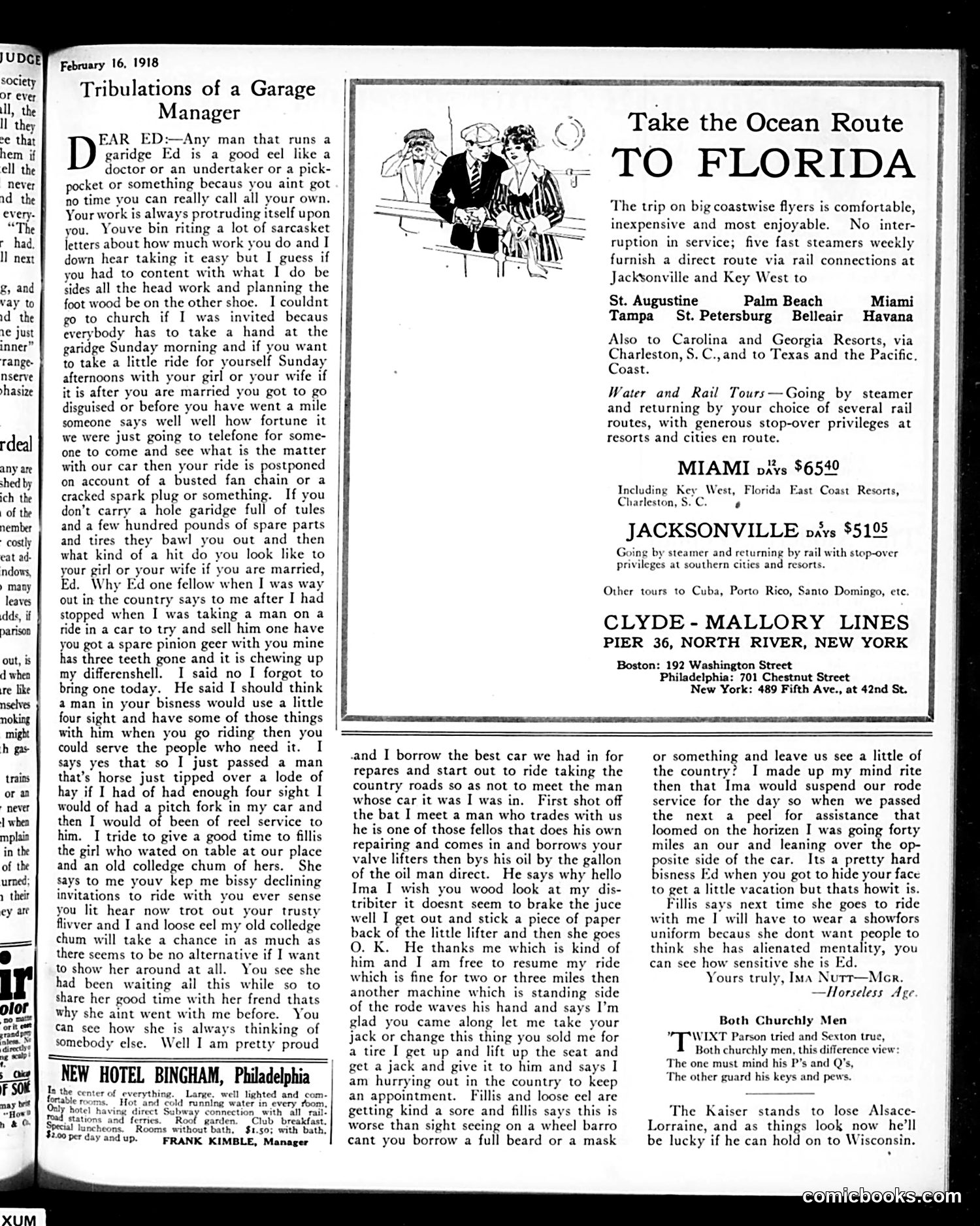
This is a humorous advice column, not a political cartoon. An unnamed garage manager writes to "Dear Ed" complaining about the endless demands of running an automobile repair shop during World War I (1918). The satire targets the garage owner's lack of personal time: he's constantly interrupted by customers with breakdowns, can't attend church or take leisure drives without being summoned for repairs, and must maintain an impossibly large inventory of spare parts. The writer humorously catalogs absurd customer expectations—one demanded he carry a spare pinion gear while another implied he should've had a pitchfork for a horse accident. The piece mocks both the public's growing car dependency and customers' unreasonable entitlements toward service providers. The misspellings ("garidge," "diferenshell") suggest rural working-class dialect, adding to the comedic effect. This reflects early-20th-century anxieties about automobiles disrupting social life.
This page satirizes press coverage of women's suffrage activism. The main article mocks a newspaper report about Representative Jeannette Rankin (the first woman in Congress, though not named here) that described her outfit and hairstyle in detail while ignoring the appearance of her male colleagues. The satire's point: The press applies a sexist double standard, treating the female legislator as a fashion specimen rather than a serious political figure. The author argues that if women's suffrage represents genuine equality ("abolishing the double standard"), then press coverage should either describe all politicians' appearances equally or describe none. The second section ironically praises New York men for being "happier" now that women listen to politicians' lectures rather than buttonholing them with suffrage arguments—suggesting men prefer women as passive audiences rather than active advocates. The overall message: Women's political participation is still being trivialized and constrained by gendered expectations about appearance and behavior.
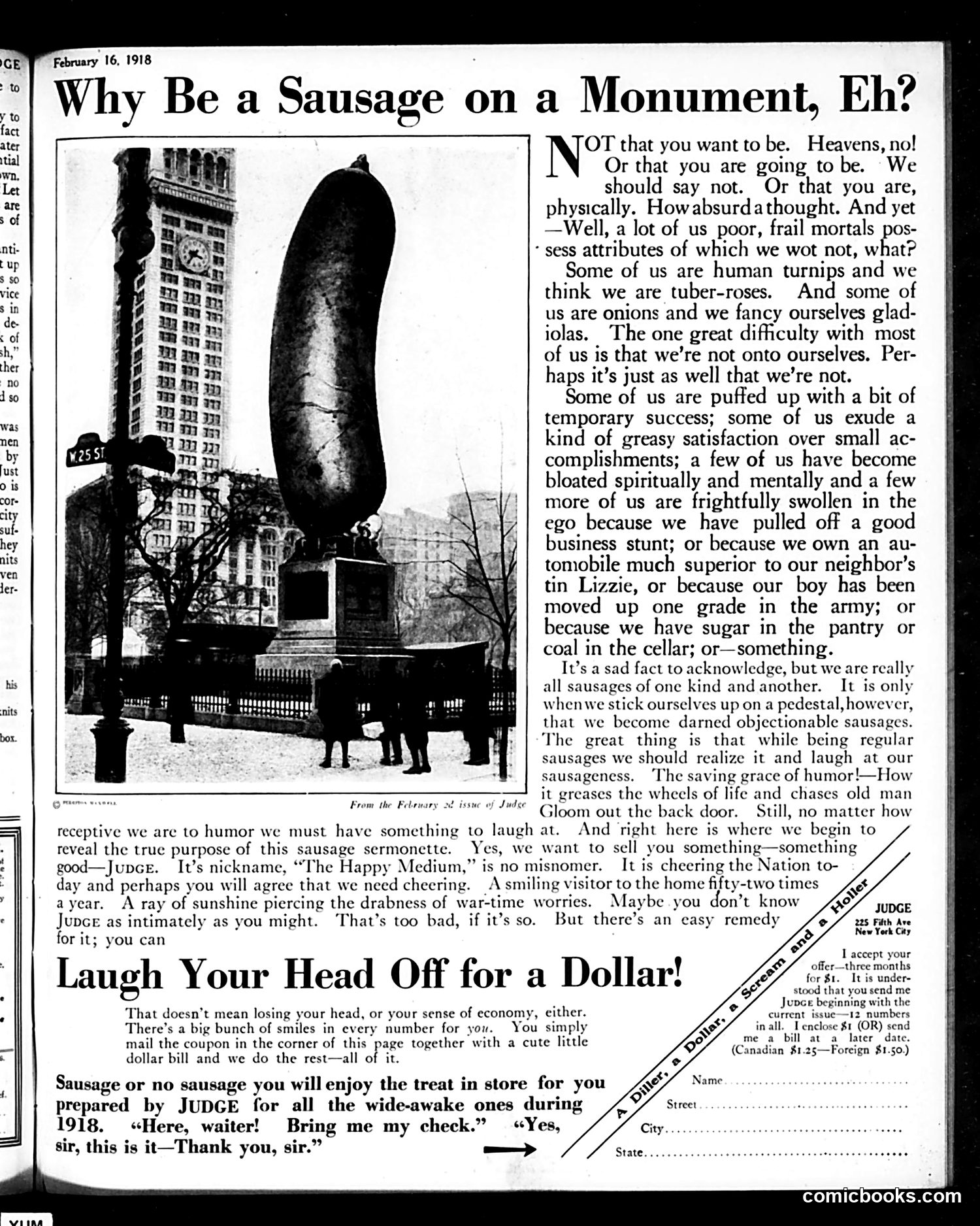
This page promotes **Judge magazine** (a humor publication) through an extended metaphor: ordinary people are "sausages"—common, sometimes self-deluded, prone to petty pride over minor achievements (owning a car, a child's school promotion, pantry supplies). The large photograph shows an actual **giant sausage monument** in an American city, likely erected as a promotional stunt or public art installation. This visual absurdity anchors the satire: the text asks why anyone would monumentalize something as ridiculous as a sausage—yet humans do similarly absurd things by inflating their own importance. Published during **World War I** (note references to wartime worries), the piece argues that humor—specifically Judge magazine—provides psychological relief. The advertisement positions Judge as "The Happy Medium," offering yearly cheer through laughter. The coupon at bottom sells annual subscriptions for $1, targeting readers seeking wartime distraction through satire and humor.
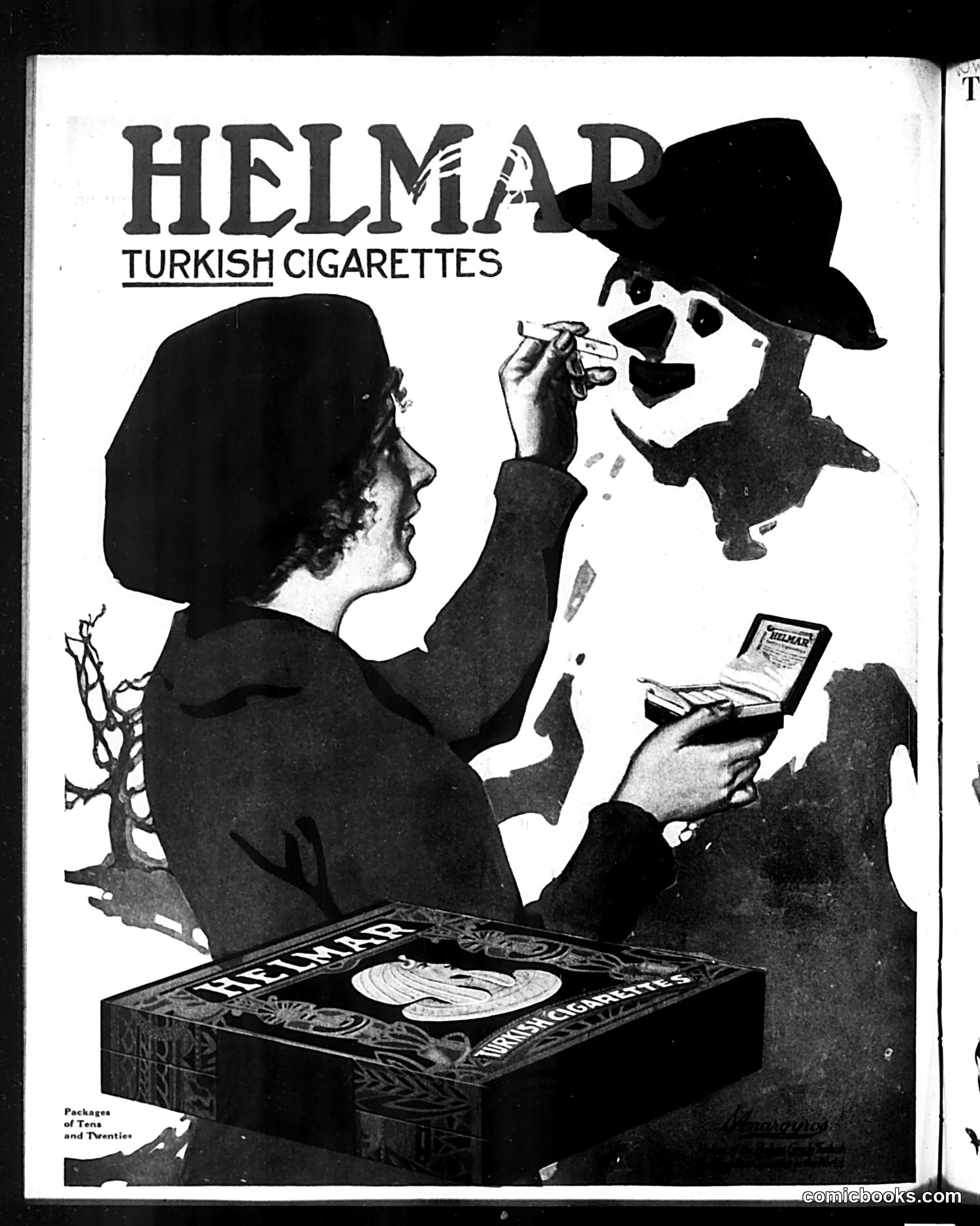
This is a cigarette advertisement rather than political satire. It depicts a woman in 1920s attire examining a package of Helmar Turkish Cigarettes while a stylized male figure (appearing exaggerated or mask-like) presents the product to her. The man holds a cigarette, and the woman appears to be inspecting the packaging. The ad plays on early 20th-century marketing that associated Turkish cigarettes with sophistication and exotic appeal. The theatrical presentation and the woman's engaged interest suggest the advertisement aims to attract female consumers—notable for the era, as women's cigarette smoking was still relatively novel and somewhat transgressive socially. The small text reference to "Packages of Tens and Twenties" indicates product packaging sizes available for purchase.