
Judge, 1918-02-16 · page 15 of 36
Judge — February 16, 1918 — page 15: what you’re looking at
What you’re looking at
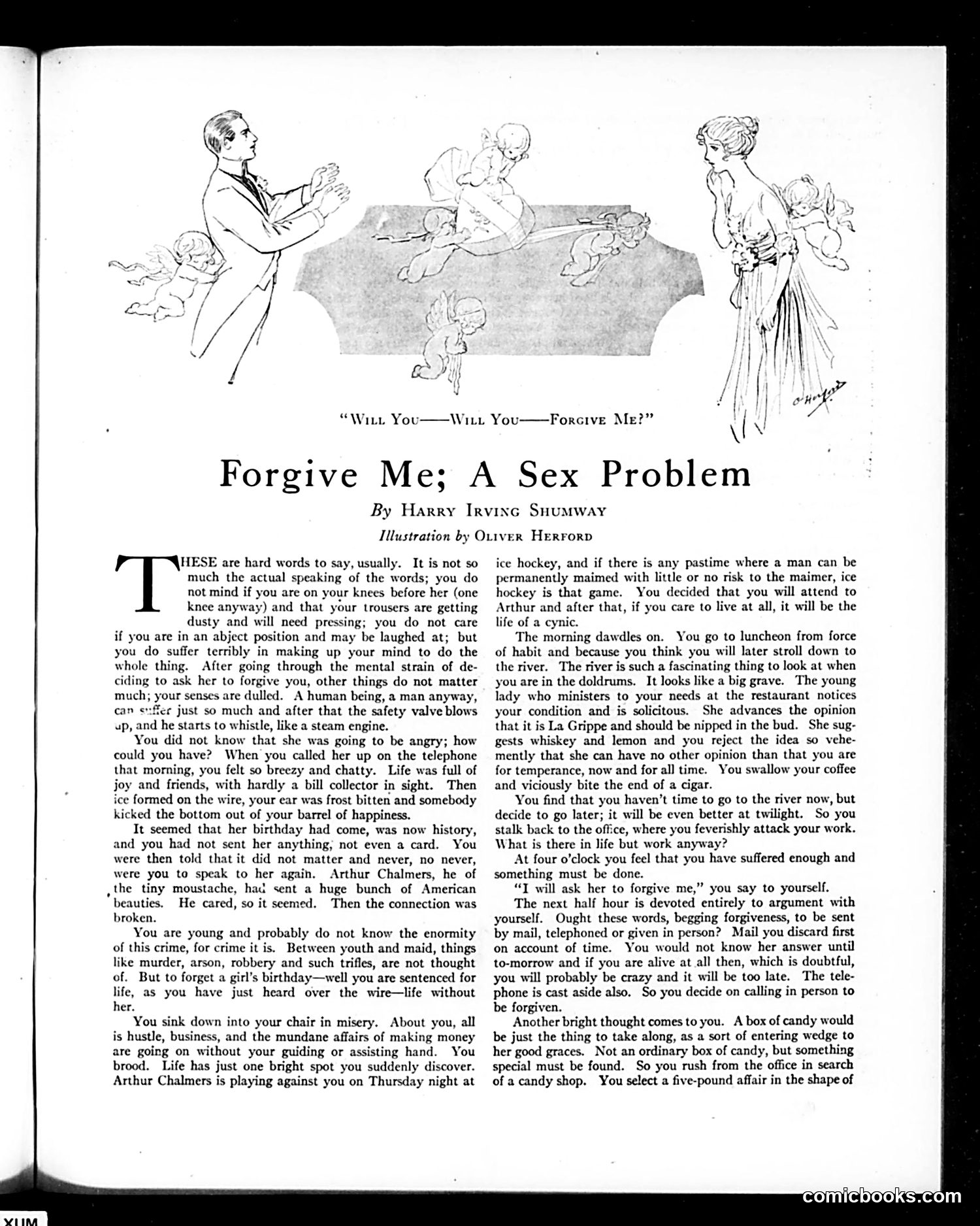
This is a humorous short story (not a political cartoon) by Harry Irving Shumway, illustrated by Oliver Herford. It depicts a young man's anguish after forgetting his girlfriend's birthday. The narrative satirizes male anxiety and emotional incompetence in romantic relationships. The protagonist spirals into despair—contemplating the river as a "grave," fantasizing about maiming his rival Arthur Chalmers at ice hockey, and agonizing endlessly over how to apologize (mail, phone, or in person?). The satire targets masculine emotional dysfunction: he cannot simply apologize straightforwardly, instead suffering dramatic internal torment while his work suffers. The piece gently mocks both the triviality of forgetting a birthday and the disproportionate masculine crisis it triggers—capturing early 20th-century attitudes about men's emotional ineptitude in courtship and domestic matters.
📄 Transcribed text from this page (OCR, searchable)
Machine-transcribed from the original scan — historical spelling and the odd misread are preserved.
“Witt You Witt You——Forcive Mer?” Forgive Me; A Sex Problem By Harry Irvinc Suumway Illustration by Oriver HeRFoRD HESE are hard words to say, usually. It is not so much the actual speaking of the words; you do not mind if you are on your knees before her (one knee anyway) and that your trousers are getting dusty and will need pressing; you do not care if you are in an abject position and may be laughed at; but you do suffer terribly in making up your mind to do the whole thing. After going through the mental strain of de- ciding to ask her to forgive you, other things do not matter much; your senses are dulled. A human being, a man anyway, can e:ffe¢ just so much and after that the safety valve blows up, and he starts to whistle, like a steam engine. You did not know that she was going to be angry; how could you have? When you called her up on the telephone that morning, you felt so breezy and chatty. Life was full of joy and friends, with hardly a bill collector in sight. Then ice formed on the wire, your ear was frost bitten and somebody kicked the bottom out of your barrel of happiness. It seemed that her birthday had come, was now history, and you had not sent her anything; not even a card. You were then told that it did not matter and never, no never, were you to speak to her again. Arthur Chalmers, he of ,the tiny moustache, had sent a huge bunch of American beauties. He cared, so it seemed. Then the connection was broken. You are young and probably do not know the enormity of this crime, for crime it is. Between youth and maid, things like murder, arson, robbery and such trifles, are not thought of. But to forget a girl’s birthday—well you are sentenced for life, as you have just heard over the wire—life without her. You sink down into your chair in misery. About you, all is hustle, business, and the mundane affairs of making money are going on without your guiding or assisting hand. You brood. Life has just one bright spot you suddenly discover. Arthur Chalmers is playing against you on Thursday night at ice hockey, and if there is any pastime where a man can be permanently maimed with little or no risk to the maimer, ice hockey is that game. You decided that you will attend to Arthur and after that, if you care to live at all, it will be the life of a cynic. The morning dawdles on. You go to luncheon from force of habit and because you think you will later stroll down to the river. The river is such a fascinating thing to look at when you are in the doldrums. It looks like a big grave. The young lady who ministers to your needs at the restaurant notices your condition and is solicitous. She advances the opinion that it is La Grippe and should be nipped in the bud. She sug- gests whiskey and lemon and you reject the idea so vehe- mently that she can have no other opinion than that you are for temperance, now and for all time. You swallow your coffee and viciously bite the end of a cigar. You find that you haven’t time to go to the river now, but decide to go later; it will be even better at twilight. So you stalk back to the office, where you feverishly attack your work. What is there in life but work anyway? At four o’clock you feel that you have suffered enough and something must be done. “I will ask her to forgive me,” you say to yourself. The next half hour is devoted entirely to argument with yourself. Ought these words, begging forgiveness, to be sent by mail, telephoned or given in person? Mail you discard first on account of time. You would not know her answer until to-morrow and if you are alive at all then, which is doubtful, you will probably be crazy and it will be too late. The tele- phone is cast aside also, So you decide on calling in person to be forgiven. Another bright thought comes to you. A box of candy would be just the thing to take along, as a sort of entering wedge to her good graces. Not an ordinary box of candy, but something special must be found. So you rush from the office in search of acandy shop. You select a five-pound affair in the shape of