
Judge, 1918-02-16 · page 18 of 36
Judge — February 16, 1918 — page 18: what you’re looking at
What you’re looking at
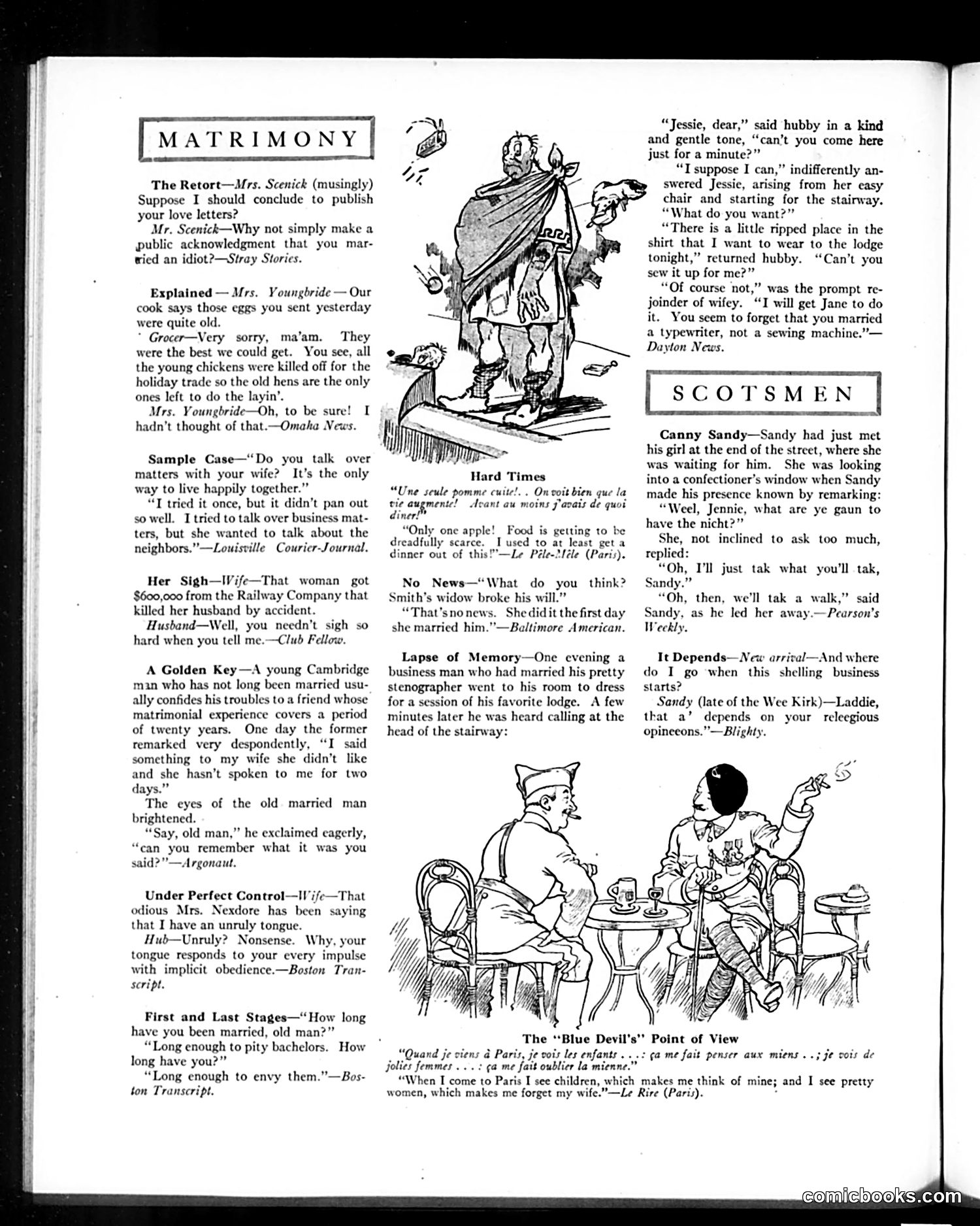
This page contains a collection of brief humorous anecdotes satirizing marriage dynamics and marital discord. The recurring theme is the tension between husbands and wives—wives are portrayed as sharp-tongued, mercenary, and resistant to domestic duties, while husbands are depicted as bumbling, henpecked, or foolish. Key satirical points include: - **"Lapse of Memory"**: A stenographer wife refuses to sew, insisting her husband "married a typewriter, not a sewing machine"—mocking the conflict between modern working women and traditional domestic expectations. - **"Scotsmen" section**: Presents ethnic humor about thrifty Scottish men; "Canny Sandy" avoids spending money by suggesting a walk instead of treats. - **Marriage regrets**: Multiple jokes suggest men prefer bachelorhood or silent wives to actual conversation. The satire reflects early 1900s anxieties about changing gender roles as women entered the workforce, while mocking both sexes' marital complaints.
📄 Transcribed text from this page (OCR, searchable)
Machine-transcribed from the original scan — historical spelling and the odd misread are preserved.
[MATRIMONY | The Retort—Mrs. Scenick (musingly) Suppose I should conclude to publish your love letters? Mr. Scenick—Why not simply make a public acknowledgment that you mar- wied an idiot?—Stray Stories. Explained — Mrs. Youngbride — Our cook says those eggs you sent yesterday were quite old. * Grocer—Very sorry, ma’am. They were the best we could get. You see, all the young chickens were killed off for the holiday trade so the old hens are the only ones left to do the layin’. Mrs. Youngbride—Oh, to be sure! I hadn’t thought of that.—Omaha News. Sample Case—“Do you talk over matters with your wife? It’s the only way to live happily together.” “T tried it once, but it didn’t pan out so well. I tried to talk over business mat- ters, but she wanted to talk about the neighbors.” —Louisville Courier-Journal. Her Sigh—IVife—That woman got $600,000 from the Railway Company that killed her husband by accident. Husband—Well, you needn't sigh so hard when you tell me.—Club Fellow. A Golden Key—A young Cambridge man who has not long been married usu- ally confides his troubles to a friend whose matrimonial experience covers a period of twenty years. One day the former remarked very despondently, “I said something to my wife she didn’t like and she hasn’t spoken to me for two days.” The eyes brightened. “Say, old man,” he exclaimed cagerly, “can you remember what it was you said?” —Argonaut. of the old married man Under Perfect Control—II'ife—That odious Mrs. Nexdore has been saying that I have an unruly tongue. Hub—Unruly? Nonsense. Why, your tongue responds to your every impulse with implicit obedience.—Boston Tran- script. First and Last Stages—“How long have you been married, old man?” “Long enough to pity bachelors. How long have you?” “Long enough to envy them.”—Bos- ton Transcript. cy 7 4 - 4 t Hard Times “Une seule pomme cuite!. . On voit bien que la tie augmente! Avant au moins acais de quoi diner!” “Only one apple! Food is getting to be dreadfully scarce. I used to at least get a dinner out of this!"—Le Péle-2éle (Paris). No News—“What do you think? Smith’s widow broke his will.” “That’snonews. Shedidit the first day she married him.”"—Baltimore American. Lapse of Memory—One evening a business man who had married his pretty stenographer went to his room to dress for a session of his favorite lodge. A few minutes later he was heard calling at the head of the stairway: “Jessie, dear,” said hubby in a kind and gentle tone, “can’t you come here just for a minute?” “T suppose I can,” indifferently an- swered Jessie, arising from her easy chair and starting for the stairway. “What do you want?” “There is a little ripped place in the shirt that I want to wear to the lodge tonight,” returned hubby. “Can’t you sew it up for me?” “Of course not,” was the prompt re- joinder of wifey. “I will get Jane to do it. You seem to forget that you married a typewriter, not a sewing machine.”— Dayton News. | SCOTSMEN Canny Sandy—Sandy had just met his girl at the end of the street, where she was waiting for him. She was looking into a confectioner’s window when Sandy made his presence known by remarking: “Weel, Jennic, what are ye gaun to have the nicht?” She, not inclined to ask too much, ” , I'll just tak what you'll tak, “Oh, then, we'll tak a walk,” said Sandy, as he led her away.—Pearson’s Weekly. It Depends—New arrival—And where do I go when this shelling business starts? Sandy (late of the Wee Kirk)—Laddie, that a’ depends on your releegious opineeons.”"—Blighty. The “Blue Devil's” Point of View | “Quand ji jolies femmes ....: ¢a me fait oublier la mienne.” “When I come to Paris I see children, which women, which makes me forget my wi a Paris, je vois les enfants... 1 ¢a me fait penser aux miens..; Je vois de makes me think of mine; and I see pretty —Le Rire (Paris).