
Judge, 1918-02-16 · page 32 of 36
Judge — February 16, 1918 — page 32: what you’re looking at
What you’re looking at
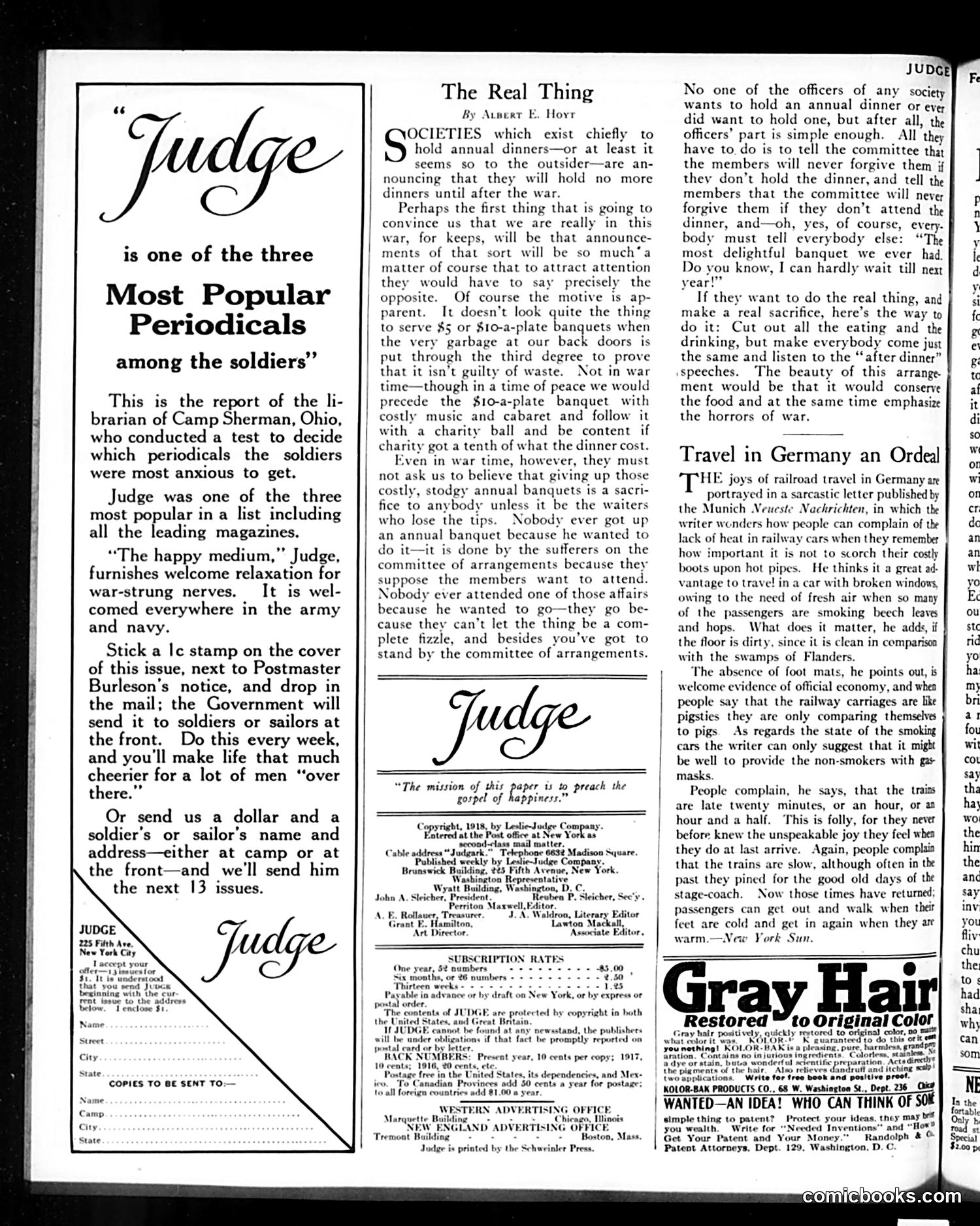
This page is primarily **advertising and promotion** for *Judge* magazine during World War I (circa 1918). The left side promotes *Judge* as one of three most popular periodicals among soldiers, encouraging readers to mail copies to troops "over there." The main article, "The Real Thing" by Albert E. Hoyt, satirizes **elite social clubs canceling annual dinners** during wartime to appear patriotic and avoid waste. Hoyt's satire cuts both ways: he mocks the clubs for pretending this is a sacrifice (claiming nobody genuinely enjoys these dinners anyway—they attend out of obligation) while also criticizing their hypocrisy (in peacetime, they'd spend lavishly on charity balls). The piece reflects **WWI-era concerns about civilian sacrifice and morale**, particularly the tension between maintaining normal social life and demonstrating commitment to the war effort. The satire suggests that canceling expensive banquets is performative patriotism rather than genuine sacrifice. No specific figures or caricatures appear—this is commentary on social institutions and attitudes rather than political figures.
📄 Transcribed text from this page (OCR, searchable)
Machine-transcribed from the original scan — historical spelling and the odd misread are preserved.
is one of the three Most Popular Periodicals among the soldiers” This is the report of the li- brarian of Camp Sherman, Ohio, who conducted a test to decide which periodicals the soldiers were most anxious to get. Judge was one of the three most popular in a list including all the leading magazines. “The happy medium,” Judge, furnishes welcome relaxation for war-strung nerves. It is wel- comed everywhere in the army and navy. Stick a Ic stamp on the cover of this issue, next to Postmaster Burleson’s notice, and drop in the mail; the Government will send it to soldiers or sailors at the front. Do this every week, and you'll make life that much cheerier for a lot of men “over there.” Or send us a dollar and a soldier’s or sailor’s name and address—either at camp or at the front—and we'll send him the next 13 issues. JUDGE 223 Filth Av. New York G that you send JuocE beginning with the cur rent lasue to the address below. Tenclose $1 Name Street City State COPIES TO BE SENT TO.— Name Camp City State The Real Thing By Avsert E. Hoyr OCIETIES which exist chiefly to hold annual dinners—or at least it seems so to the outsider—are an- nouncing that they will hold no more dinners until after the war. Perhaps the first thing that is going to convince us that we are really in’ this war, for keeps, will be that announce- ments of that sort will be so much’a matter of course that to attract attention they would have to say precisely the opposite. Of course the motive is ap- parent. It doesn’t look quite the thing to serve $5 or $10-a-plate banquets when the very garbage at our back doors is put through the third degree to prove that it isn’t guilty of waste. Not in war time—though in a time of peace we would precede the $10-a-plate banquet with costly music and cabaret and follow it with a charity ball and be content if charity got a tenth of what the dinner cost. Even in war time, however, they must not ask us to believe that giving up tho: costly, stodgy annual banquets is a sacri fice to anybody unless it be the waiters who lose the tips. Nobody ever got up an annual banquet because he wanted to do it—it is done by the sufferers on the committee of arrangements because they suppose the members want to attend. Nobody ever attended one of those affairs because he wanted to go—they go be- cause they can’t let the thing be a com- plete fizzle, and besides you’ve got to stand by the committee of arrangements. “The mission of this paper is to preach the gospel of happiness.” Copyright, 1918, by LestieJudge Com Patered atthe Post © fice at New Yor rnd mail mat Cable addres “Judeark Teiethooe 065% Madison Square. Published weekly by LesicJudge Company. Bronswick Bi bail ing, 225 Fifth Avenue, New ‘Yor! rk. ington Representative Wyatt Building, Weciogton, D.C. John A. Sleicher, President Reuben P. Sleicher, Sec'y. Perriton Maxwell, Editor. A. E, Rollauer, Treasurer. "J. X. Waldron, Literary Editor Grant E. Hamilton, lawton Mackal Ari Director Associate Editor. SUBSCRIPTION RATES One year, 58 numbers Six months, or 26 nu pibisteen weeks - found at any’ newsstand, the publ under obligations if that fact he prompily report « by letter 31 rited States, its dependencies, and M inces add 30 cents a year for postage: Tremont Building Boston, Mass. Judge is printed by the Schweinler Press. JUDG) No one of the officers of any society wants to hold an annual dinner or ever did want to hold one, but after all, the officers’ part is simple enough. All “they have to do is to tell the committee that the members will never forgive them if they don’t hold the dinner, and tell the members that the committee will never forgive them if they don’t attend the dinner, and—oh, yes, of course, every. body must tell everybody else: “The most delightful banquet we ever had. Do you know, I can hardly wait till next year!” If they want to do the real thing, and make a real sacrifice, here’s the way to do it: Cut out all the eating and the drinking, but make everybody come just the same and listen to the “after dinner” speeches. The beauty of this arrange ment would be that it would conserve the food and at the same time emphasize the horrors of war. Travel in Germany an Ordeal HE joys of railroad travel in Germany are portrayed in a sarcastic letter published by the Munich este Nachrichten, in which the writer wonders how people can complain of the lack of heat in railway cars when they remember how important it is n scorch their costly boots upon hot pipes. hinks it a great ad- vantage to trave! in a car with broken windows, owing to the need of fresh air when so many of the passengers are smoking beech leaves and hops. What does it matter, he adds, if the floor is dirty, since it is clean in comparison with the swamps of Flanders. The absence of foot mats, he points out, is welcome evidence of official economy, and whea people say that the railway carriages are like pigsties they are only comparing themselves to pigs. As regards the state of the smoking cars the writer can only suggest that it might be well to provide the non-smokers with gas masks. People complain, he says, that the traiss are late twenty minutes, or an hour, or a hour and a half. This is folly, for they never before knew the unspeakable joy they feel whes they do at last arrive. Again, people complaia that the trains are slow, although often in the past they pined for the good old days of the stage-coach. Now those times have returned; passengers can get out and walk when their feet are cold and get in again when they are warm.—New York Sun. Gray Hair Restored y, Original C alr aulchly reytored t0 or eee eT des ure, harmless, gra0d Pe fo, eearniess 8! re R-BAK PRODUCTS CO.. 68 W. Washi oa St, Dept 236 ig WANTED—AN IDEA! WHO CAN THINK OF SO ‘simple thing to patent? Protect your ideas you wealth. Write for “Needed Inventions” and “ “Hox? Get Your Patent and Your Money.” Randolph & © Patent Attorneys, Dept. 129. Washington, D. C.