
Judge, 1918-02-16 · page 12 of 36
Judge — February 16, 1918 — page 12: what you’re looking at
What you’re looking at
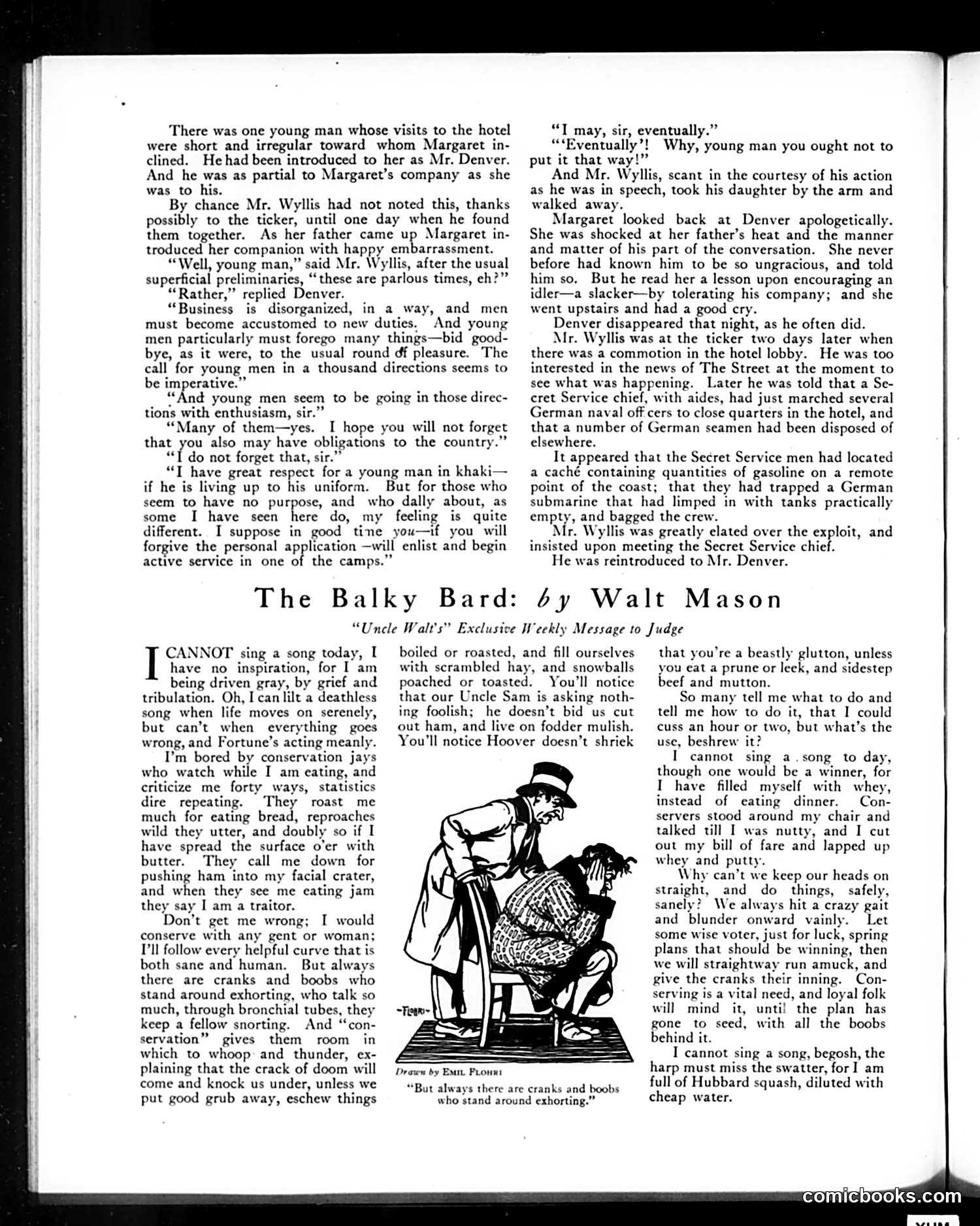
This page contains two distinct pieces from *Judge* magazine: **The main narrative** (top) is a WWI-era story about Mr. Wyllis, a businessman, who pressures a young man named Denver to enlist in military service, dismissing him as a "slacker" for his noncommittal response. Wyllis is harsh and dismissive. The twist: Denver is actually a Secret Service agent who has just successfully captured German naval officers and saboteurs operating from the American coast. Wyllis is humiliated when reintroduced to his daughter's suitor—now revealed as a patriotic hero doing covert war work. **The satire:** The piece mocks civilians who judge others' patriotism based on visible military uniform, while missing actual wartime contributions. It criticizes hasty moral judgment of young men's choices during national emergency. **"The Balky Bard"** (bottom) is Walt Mason's humorous column complaining he cannot write cheerfully during wartime rationing and national stress—a lighter commentary on civilian morale during WWI.
📄 Transcribed text from this page (OCR, searchable)
Machine-transcribed from the original scan — historical spelling and the odd misread are preserved.
There was one young man whose visits to the hotel were short and irregular toward whom Margaret in- clined. Hehad been introduced to her as Mr. Denver. And he was as partial to Margaret’s company as she was to his. By chance Mr. Wyllis had not noted this, thanks possibly to the ticker, until one day when he found them together. As her father came up Margaret in- troduced her companion with happy embarrassment. “Well, young man,” said Mr. Wyllis, after the usual superficial preliminaries, “these are parlous times, eh?” “Rather,” replied Denver. “Business is disorganized, in a way, and men must become accustomed to new duties, And young men particularly must forego many things—bid good- bye, as it were, to the usual round df pleasure. The call for young men in a thousand directions seems to be imperative.” “And young men seem to be going in those direc- tions with enthusiasm, sir.” “Many of them—yes. I hope you will not forget that you also may have obligations to the country.” “T do not forget that, sir.”” “T have great respect for a young man in khaki— if he is living up to his uniform. But for those who seem to have no purpose, and who dally about, as some I have seen here do, my feeling is quite different. I suppose in good tine you—if you will forgive the personal application —will enlist and begin active service in one of the camps.” “T may, sir, eventually.” “*Eventually’! Why, young man you ought not to put it that way!” And Mr. Wyllis, scant in the courtesy of his action as he was in speech, took his daughter by the arm and walked away. Margaret looked back at Denver apologetically. She was shocked at her father’s heat and the manner and matter of his part of the conversation. She never before had known him to be so ungracious, and told him so. But he read her a lesson upon encouraging an idler—a slacker—by tolerating his company; and she went upstairs and had a good cry. Denver disappeared that night, as he often did. Mr. Wyllis was at the ticker two days later when there was a commotion in the hotel lobby. He was too interested in the news of The Street at the moment to see what was happening. Later he was told that a Se- cret Service chief, with aides, had just marched several German naval off cers to close quarters in the hotel, and that a number of German seamen had been disposed of elsewhere. It appeared that the Secret Service men had located a caché containing quantities of gasoline on a remote point of the coast; that they had trapped a German submarine that had limped in with tanks practically empty, and bagged the crew. Mr. Wyllis was greatly elated over the exploit, and insisted upon meeting the Secret Service chief. He was reintroduced to Mr. Denver. The Balky Bard: 6y Walt Mason “Uncle Walt's” Exclusive Weekly Message to Judge CANNOT sing a song today, I have no inspiration, for I am being driven gray, by grief and tribulation. Oh, I can lilt a deathless song when life moves on serenely, but can’t when everything goes boiled or roasted, and fill ourselves with scrambled hay, and snowballs poached or toasted. You'll notice that our Uncle Sam is asking noth- ing foolish; he doesn’t bid us cut out ham, and live on fodder mulish. You'll notice Hoover doesn’t shriek that you're a beastly glutton, unless you eat a prune or leek, and sidestep beef and mutton. So many tell me what to do and tell me how to do it, that I could cuss an hour or two, but what’s the use, beshrew it? wrong, and Fortune’s acting meanly. I’m bored by conservation jays who watch while I am eating, and criticize me forty ways, statistics dire repeating. They roast me much for eating bread, reproaches wild they utter, and doubly so if I have spread the surface o'er with butter. They call me down for pushing ham into my facial crater, and when they see me eating jam they say I am a traitor. Don’t get me wrong; I would conserve with any gent or woman; I'll follow every helpful curve that is both sane and human. But always there are cranks and boobs who stand around exhorting, who talk so much, through bronchial tubes, they keep a fellow snorting. And “‘con- servation” gives them room in which to whoop and thunder, ex- plaining that the crack of doom will come and knock us under, unless we put good grub away, eschew things Drawn by Emm Prourt “But always there are cranks and boobs who stand around exhorting.” I cannot sing a.song to day, though one would be a winner, for I have filled myself with whey, instead of eating dinner. Con- servers stood around my chair and talked till I was nutty, and I cut out my bill of fare and lapped up whey and putty. Why can’t we keep our heads on and do things, safely, sanely? We always hit a crazy gait and blunder onward vainly. Let some wise voter, just for luck, spring plans that should be winning, then we will straightway run amuck, and give the cranks their inning. Con- serving is a vital need, and loyal folk will mind it, until the plan has gone to seed, with all the boobs behind it. I cannot sing a song, begosh, the harp must miss the swatter, for] am full of Hubbard squash, diluted with cheap water. straigh