
Judge, 1918-02-16 · page 11 of 36
Judge — February 16, 1918 — page 11: what you’re looking at
What you’re looking at
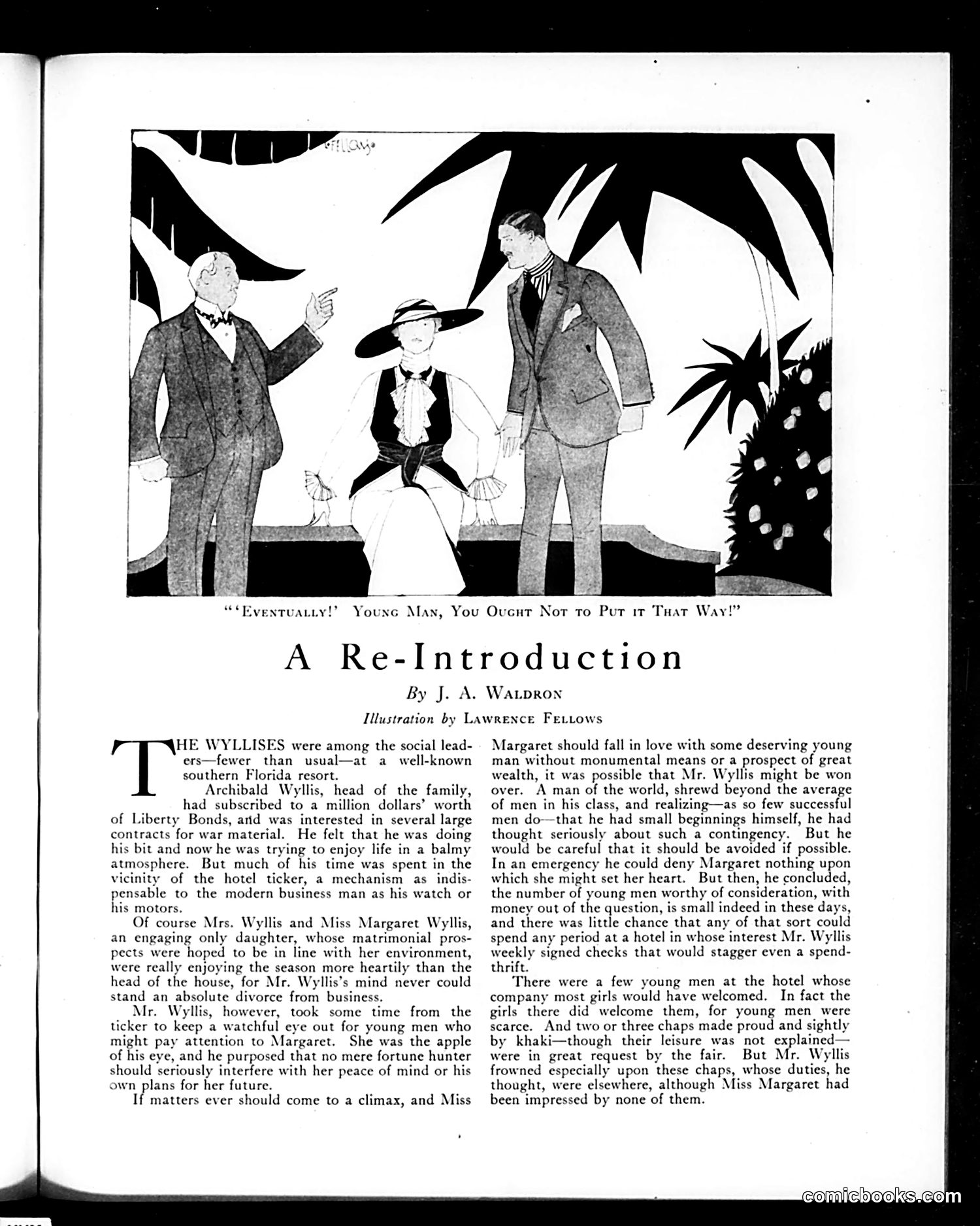
This is a short story opening (not primarily satirical), set during World War I at a Florida resort. The illustration shows three men in suits discussing a young woman seated between two of them—the caption suggests disagreement about courtship propriety. The narrative concerns Archibald Wyllis, a wealthy businessman who's bought Liberty Bonds (government war bonds) and holds war contracts, yet spends leisure time at a luxury hotel watching stock tickers. His concern is protecting his daughter Margaret from fortune hunters. The story's tension involves her potentially falling for an unsuitable suitor—particularly troubling to Wyllis are young men in military khaki uniforms (suggesting soldiers on leave), whom he views suspiciously as shirking war duties elsewhere. The piece explores class anxieties of the era: wealthy fathers' protective instincts, the status of military service, and whether love without money is acceptable among the leisure class.
📄 Transcribed text from this page (OCR, searchable)
Machine-transcribed from the original scan — historical spelling and the odd misread are preserved.
“OP VENTUALLY!” Younc Man, You Oucut Nort to Put it Tuat Way!” A Re-Introduction By J. A. WaLpron Illustration by Lawrence Fettows HE WYLLISES were among the social lead- ers—fewer than usual—at a_ well-known southern Florida resort. Archibald Wyllis, head of the family, had subscribed to a million dollars’ worth of Liberty Bonds, arid was interested in several large contracts for war material. He felt that he was doing his bit and now he was trying to enjoy life in a balmy atmosphere. But much of his time was spent in the vicinity of the hotel ticker, a mechanism as indis- pensable to the modern business man as his watch or his motors. Of course Mrs. Wyllis and Miss Margaret Wyllis, an engaging only daughter, whose matrimonial pros- pects were hoped to be in line with her environment, were really enjoying the season more heartily than the head of the house, for Mr. Wyllis’s mind never could stand an absolute divorce from business. Mr. Wyllis, however, took some time from the ticker to keep a watchful eye out for young men who might pay attention to Margaret. She was the apple of his eye, and he purposed that no mere fortune hunter should seriously interfere with her peace of mind or his own plans for her future. If matters ever should come to a climax, and Miss Margaret should fall in love with some deserving young man without monumental means or a prospect of great wealth, it was possible that Mr. Wyllis might be won over. A man of the world, shrewd beyond the average of men in his class, and realizing—as so few successful men do—that he had small beginnings himself, he had thought seriously about such a contingency. But he would be careful that it should be avoided if possible. In an emergency he could deny Margaret nothing upon which she might set her heart. But then, he concluded, the number of young men worthy of consideration, with money out of the question, is small indeed in these days, and there was little chance that any of that sort could spend any period at a hotel in whose interest Mr. Wyllis weekly signed checks that would stagger even a spend- thrift. There were a few young men at the hotel whose company most girls would have welcomed. In fact the girls there did welcome them, for young men were scarce. And two or three chaps made proud and sightly by khaki—though their leisure was not explained— were in great request by the fair. But Mr. Wyllis frowned especially upon these chaps, whose duties, he thought, were elsewhere, although Miss Margaret had been impressed by none of them.