
Judge, 1918-02-16 · page 17 of 36
Judge — February 16, 1918 — page 17: what you’re looking at
What you’re looking at
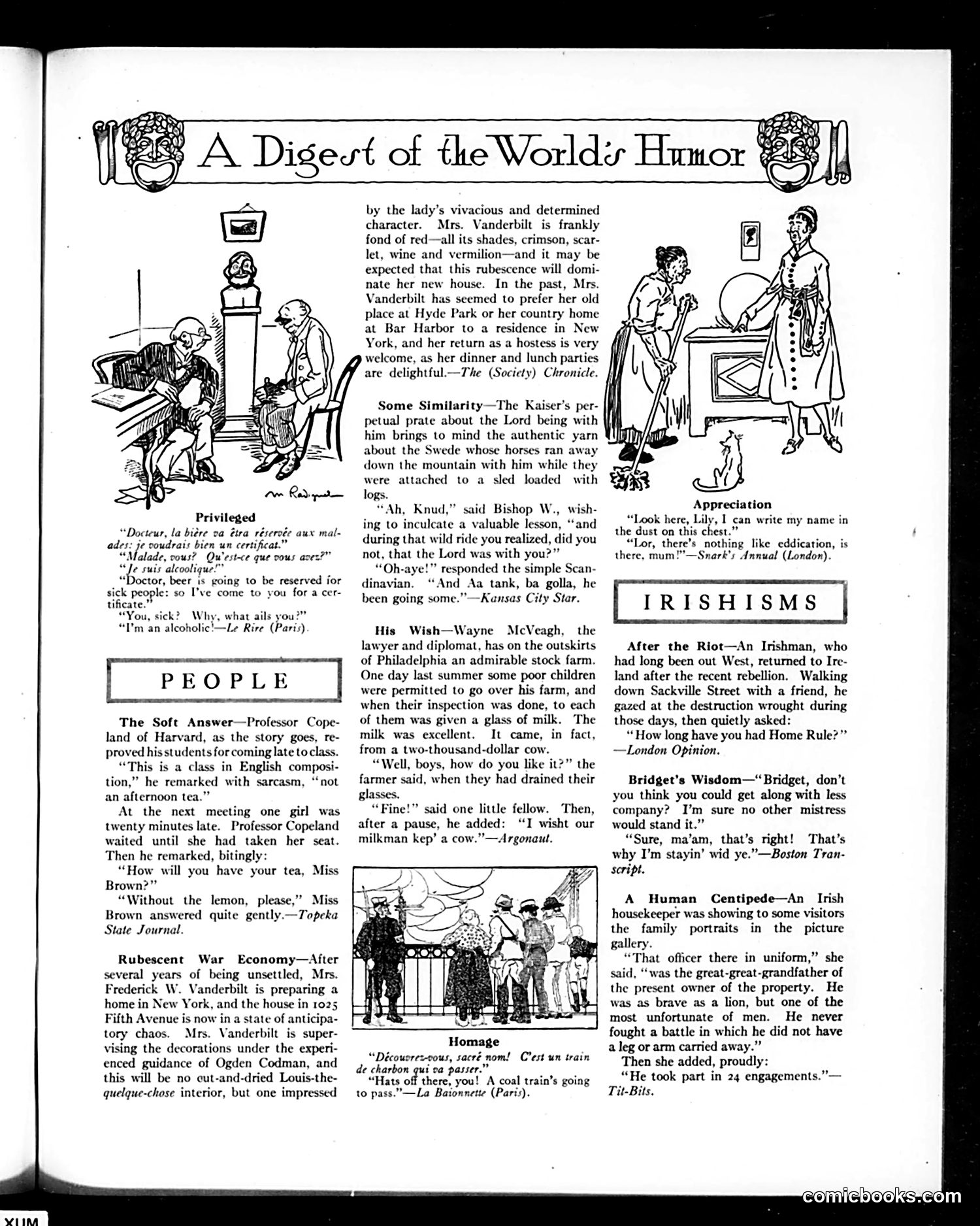
This page from *Judge* magazine contains several short humorous anecdotes and jokes typical of early 20th-century American satire: **"Privileged"** mocks wartime beer rationing (likely WWI-era) through a French joke: a man claims to be an alcoholic to get a medical exemption from beer restrictions. **"The Soft Answer"** is a Harvard anecdote where a late student outsmarts a sarcastic professor by turning his "afternoon tea" insult back on him. **"Rubescent War Economy"** reports on Mrs. Frederick W. Vanderbilt decorating her New York mansion, noting her preference for red colors—a society page item rather than satire. **"Some Similarity"** contrasts the Kaiser's religious rhetoric with a Swedish folk tale about a man thanking God during a runaway sled accident, suggesting hypocrisy. **"Irishisms"** includes two ethnic jokes: an Irishman's confusion about "Home Rule" duration, and an Irish maid's witty retention by her employer through superior company-keeping—playing on period Irish-American stereotypes. The page mixes international reprints with American social commentary.
📄 Transcribed text from this page (OCR, searchable)
Machine-transcribed from the original scan — historical spelling and the odd misread are preserved.
Privileged “Docteur, la biére va étra réservée aux mal- ades: je voudrais bien un certificas.” “Malade, cows? Qu'est-ce que vous a: “Je suis alcoolique!” “Doctor, beer is going to be reserved for sick people: so I've come to you for a cer- tificate.” “You, sick? Why, what ails you?” “I'm an alcoholic! —Le Rire (Paris) The Soft Answer—Professor Cope- land of Harvard, as the story goes, re- proved his students for coming late to class. “This is a class in English composi- tion,” he remarked with sarcasm, “not an afternoon tea.”” At the next meeting one girl was twenty minutes late. Professor Copeland waited until she had taken her seat. Then he remarked, bitingly: “How will you have your tea, Miss ithout the lemon, please,” Miss Brown answered quite gently.—Topeka State Journal. Rubescent War Economy—After several years of being unsettled, Mrs. Frederick W. Vanderbilt is preparing a home in N York, and the house in 1025, Fifth Avenue is now in a state of anticipa- tory chaos. Mrs. Vanderbilt is super- vising the decorations under the experi- enced guidance of Ogden Codman, and this will be no cut-and-dried Louis-the- quelque-chose interior, but one impressed by the lady’s vivacious and determined character. Mrs. Vanderbilt is frankly fond of red—all its shades, crimson, scar- let, wine and vermilion—and it may be expected that this rubescence will domi- nate her new house. In the past, Mrs. Vanderbilt has seemed to prefer her old place at Hyde Park or her country home at Bar Harbor to a residence in New York, and her return as a hostess is very 4p welcome, as her dinner and lunch parties are delightful.—The (Society) Chronice. Some Similarity—The Kaiser’s per- petual prate about the Lord being with him brings to mind the authentic yarn about the Swede whose horses ran away down the mountain with him while they were attached to a sled loaded with EAS logs. “Ah, Knud,” said Bishop W., wish- ing to inculcate a valuable lesson, “and during that wild ride you realized, did you not, that the Lord was with you?” “Oh responded the simple Scan- dinavian. “And Aa tank, ba golla, he been going some.” —Kansas City Star. His Wish—Wayne McVeagh, the lawyer and diplomat, has on the outskirts of Philadelphia an admirable stock farm. One day last summer some poor children were permitted to go over his farm, and when their inspection was done, to each of them was given a glass of milk. The milk was excellent. It came, in fact, from a two-thousand-dollar cow “Well, boys, how do you like it?” the farmer said, when they had drained their gla: # ie!” said one little fellow. Then, after a pause, he added: ‘I wisht our milkman kep’ a cow.” —Argonaut. Homage “Décousrez-cous, sacré nom! C'est un train de charbon get pa passer.” . “Hats off there, you! A coal train’s going to pass.”—La Baionnette (Paris). Appreciation “Look here, Lily, 1 can write my name in the dust on this chest.” “Lor, there’s nothing like eddication, is there, mum!”—Snark's Annual (London). | IRISHISMS | After the Riot—An Irishman, who had long been out West, returned to Ire- land after the recent rebellion. Walking down Sackville Street with a friend, he gazed at the destruction wrought during those days, then quietly asked: “How long have you had Home Rule?” —London Opinion. Bridget’s Wisdom—“ Bridget, don’t you think you could get along with less company? I’m sure no other mistress would stand it.” “Sure, ma’am, that’s right! That’s why I’m stayin’ wid ye.”—Boston Tran- script. A Human Centipede—An_ Irish housekeeper was showing to some visitors the family portraits in the picture gallery. “That officer there in uniform,” she said, “was the great-great-grandfather of the present owner of the property. He was as brave as a lion, but one of the most unfortunate of men. He never fought a battle in which he did not have a leg or arm carried away.” Then she added, proudly: “He took part in 24 engagements.”— Tit-Bits.