
Judge, 1918-02-16 · page 27 of 36
Judge — February 16, 1918 — page 27: what you’re looking at
What you’re looking at
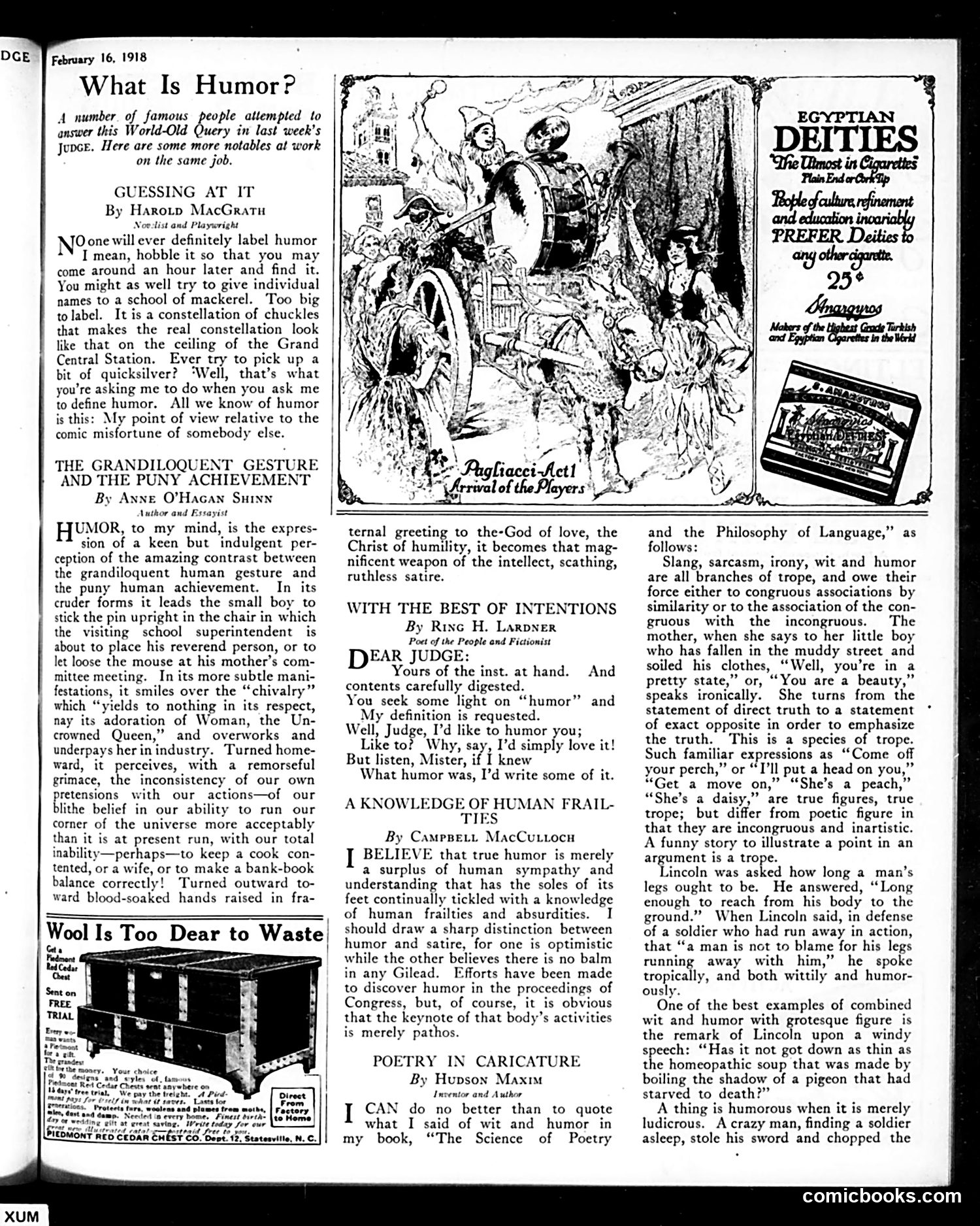
This page is a **meta-humorous feature** where the magazine asks prominent writers and humorists to define "humor" itself—a self-referential joke about the difficulty of defining something everyone recognizes. The **cartoon** (labeled "Piafacci Act! Arrival of the Players") depicts commedia dell'arte performers arriving by car, satirizing how theatrical traditions clash with modern technology. The contrast between old-fashioned theatrical spectacle and the automobile suggests dated forms of entertainment struggling in contemporary society. The **definitions** from Harold MacGrath, Anne O'Hagan Shinn, Ring Lardner, and Hudson Maxim variously describe humor as indefinable, as perception of contrast between grand human pretensions and petty achievements, and as rooted in sympathy for human frailties. Notably, **Lardner's witty non-answer**—"If I knew what humor was, I'd write some of it"—perfectly exemplifies the evasiveness the feature satirizes. The **overall point**: humor resists definition. The feature itself **is** the joke.
📄 Transcribed text from this page (OCR, searchable)
Machine-transcribed from the original scan — historical spelling and the odd misread are preserved.
February 16, 1918 What Is Humor? A number. of famous people attempted to answer this World-Old Query in last week’s Juvce. Here are some more notables at work on the same job. GUESSING AT IT By Harotp MacGratu Novelist and Playwright N°. one will ever definitely label humor I mean, hobble it so that you may come around an hour later and find it. You might as well try to give individual names to a school of mackerel. Too big tolabel. It is a constellation of chuckles that makes the real constellation look like that on the ceiling of the Grand Central Station. Ever try to pick up a bit of quicksilver? ‘Well, that’s what you’re asking me to do when you ask me to define humor. All we know of humor is this: My point of view relative to the comic misfortune of somebody else. THE GRANDILOQUENT GESTURE AND THE PUNY ACHIEVEMENT By Anne O’Hacan Suinn Author and Essayist HeMOR, to my mind, is the expres- sion of a keen but indulgent per- ception of the amazing contrast between the grandiloquent human gesture and the puny human achievement. In its cruder forms it leads the small boy to stick the pin upright in the chair in which the visiting school superintendent is about to place his reverend person, or to let loose the mouse at his mother’s com- mittee meeting. In its more subtle mani- « festations, it smiles over the “chivalry” which “yields to nothing in its respect, nay its adoration of Woman, the Un- crowned Queen,” and overworks and underpays her in industry. Turned home- ward, it perceives, with a remorseful grimace, the inconsistency of our own pretensions with our actions—of our blithe belief in our ability to run our corner of the universe more acceptably than it is at present run, with our total inability—perhaps—to keep a cook con- tented, or a wife, or to make a bank-book balance correctly! Turned outward to- ward blood-soaked hands raised in fra- crery Wire tate in EnEST CO. Devt. 12, Statenvitle, N.C. \ 1 Bs. Puafiaesi Act! , (frvatol the Players ternal greeting to the-God of love, the Christ of humility, it becomes that mag- nificent weapon of the intellect, scathing, ruthless satire. WITH THE BEST OF INTENTIONS By Rinc H. Larpner Poet of the People and Fictionist DEAR JUDGE: Yours of the inst. at hand. contents carefully digested. You seek some light on “humor” and My definition is requested. Well, Judge, I’d like to humor you; Like to? Why, say, I’d simply love it! But listen, Mister, if I knew What humor was, I’d write some of it. And A KNOWLEDGE OF HUMAN FRAIL- TIES By Camppett MacCutiocu I BELIEVE that true humor is merely a surplus of human sympathy and understanding that has the soles of its feet continually tickled with a knowledge of human frailties and absurdities. I should draw a sharp distinction between humor and satire, for one is optimistic while the other believes there is no balm in any Gilead. Efforts have been made to discover humor in the proceedings of Congress, but, of course, it is obvious that the keynote of that body’s activities is merely pathos. POETRY IN CARICATURE By Hupson Maxm Inventor and Author I CAN do no better than to quote what I said of wit and humor in my book, “The Science of Poetry and the Philosophy of Language,” as follows: Slang, sarcasm, irony, wit and humor are all branches of trope, and owe their force either to congruous associations by similarity or to the association of the con- gruous with the incongruous. The mother, when she says to her little boy who has fallen in the muddy street and soiled his clothes, “Well, you’re in a pretty state,” or, “You are a beauty,” speaks ironically. She turns from the statement of direct truth to a statement of exact opposite in order to emphasize the truth. This is a species of trope. Such familiar expressions as “Come off your perch,” or “I’ll put a head on you,” “Get a move on,” “She’s a peach,” “She’s a daisy,” are true figures, true trope; but differ from poetic figure in that they are incongruous and inartistic. A funny story to illustrate a point in an argument is a trope. Lincoln was asked how long a man’s legs ought to be. He answered, “Long enough to reach from his body to the ground.” When Lincoln said, in defense of a soldier who had run away in action, that “a man is not to blame for his legs running away with him,” he spoke tropically, and both wittily and humor- ously. One of the best examples of combined wit and humor with grotesque figure is the remark of Lincoln upon a windy speech: “Has it not got down as thin as the homeopathic soup that was made by boiling the shadow of a pigeon that had starved to death?” A thing is humorous when it is merely ludicrous. A crazy man, finding a soldier asleep, stole his sword and chopped the comicbooks.com