
Judge, 1918-02-16 · page 16 of 36
Judge — February 16, 1918 — page 16: what you’re looking at
What you’re looking at
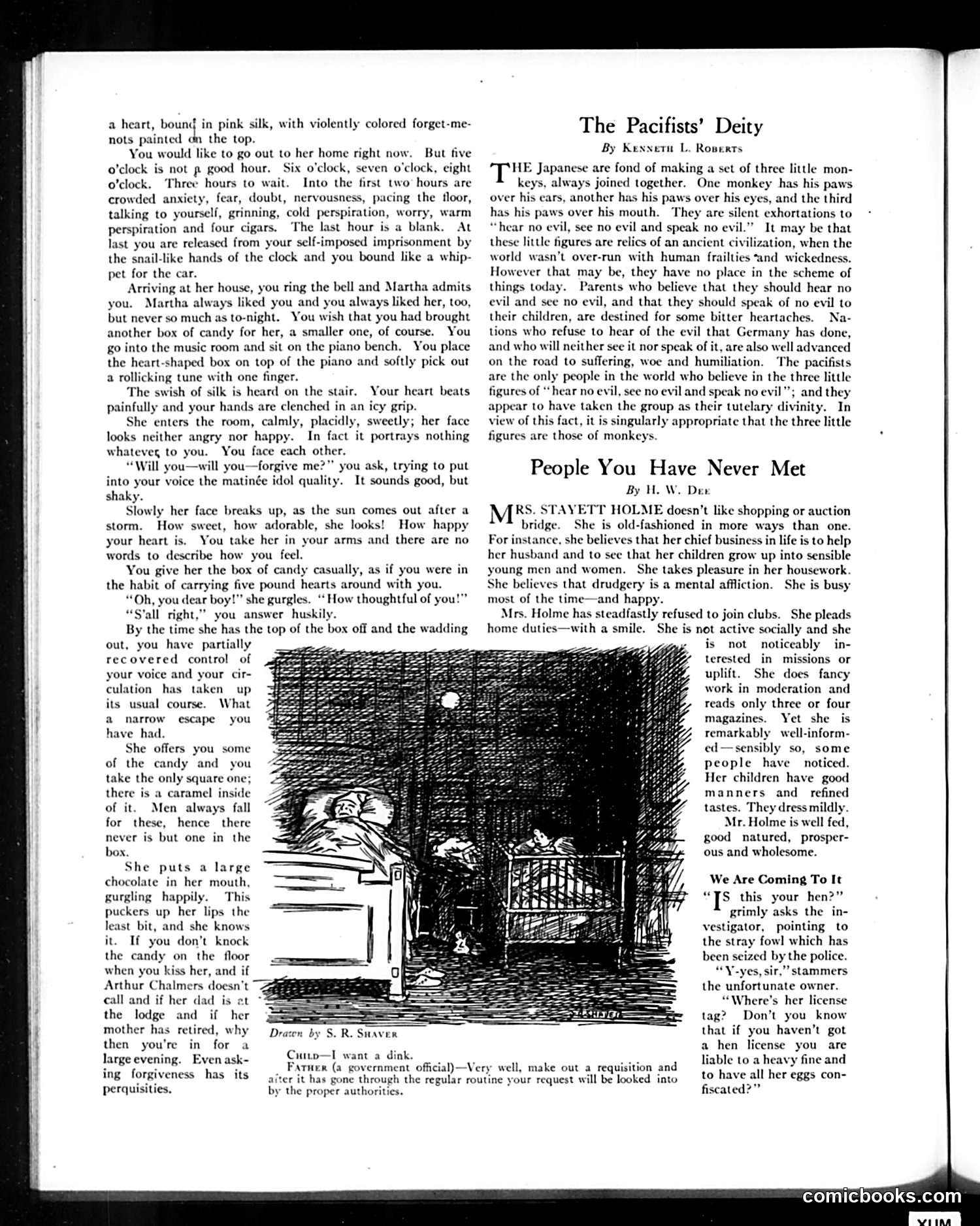
This page contains two distinct articles with illustrations: **"The Pacifists' Deity"** by Kenneth L. Roberts critiques pacifism through the "three monkeys" metaphor (hear no evil, see no evil, speak no evil). Roberts argues that nations and parents who refuse to acknowledge wrongdoing—specifically referencing Germany's conduct (likely WWI-era)—are willfully blind and will suffer consequences. The piece mocks pacifists for ignoring observable evil rather than confronting it. **"People You Have Never Met"** by H.W. Dex describes Mrs. Stavett Holme, a domestically-focused woman who avoids clubs and public life, preferring housework and child-rearing. The tone is gently satirical about her limited interests. **The cartoon** (drawn by S.R. Shaver) depicts a bureaucratic exchange: a child requesting "a dink" (drink), and an official requiring a formal requisition to be processed through "regular routine." It satirizes government red tape and inefficiency. These pieces reflect early 20th-century tensions between pacifism and interventionism, and bureaucratic absurdity.
📄 Transcribed text from this page (OCR, searchable)
Machine-transcribed from the original scan — historical spelling and the odd misread are preserved.
a heart, bound in pink silk, with violently colored forget-me- nots painted dn the top. You would like to go out to her home right now. But five o'clock is not p good hour. Six o'clock, seven o'clock, eight o'clock. Three hours to wait. Into the first two hours are crowded anxiety, fear, doubt, nervousness, pacing the floor, talking to yourself, grinning, cold perspiration, worry, warm perspiration and four cigars, The last hour is a blank. At last you are released from your self-imposed imprisonment by the snail-like hands of the clock and you bound like a whip- pet for the car. Arriving at her house, you ring the bell and Martha admits you. Martha always liked you and you always liked her, too, but never so much as to-night. You wish that you had brought another box of candy for her, a smaller one, of course. You go into the music room and sit on the piano bench. You place the heart-shaped box on top of the piano and softly pick out a rollicking tune with one finger. The swish of silk is heard on the stair. Your heart beats painfully and your hands are clenched in an icy grip. She enters the room, calmly, placidly, sweetly; her face looks neither angry nor happy. In fact it portrays nothing whatever to you. You face each other. “Will you—will you—forgive me?” you ask, trying to put into your voice the matinée idol quality. It sounds good, but shaky. Slowly her face breaks up, as the sun comes out after a How sweet, how adorable, she looks! How happy You take her in your arms and there are no storm. your heart is. words to describe how you feel. You gi the habit of carrying five pound hearts ¢ her the box of candy casually, as if you were in round with you. ar boy!" she gurgles. “ How thoughtful of you!” you answer hus! ve By the time she has the top of the ‘box off and the wadding out, you have partially recovered control of your voice and your cir- culation has taken up its usual course. What @ narrow escape you have had. She offers you some of the candy and you take the only square one; there is a caramel inside of it. Men always fall for these, hence there never is but one in the box. She puts a large chocolate in her mouth, gurgling happily. This puckers up her lips the least bit, and she knows it. If you don’t knock the candy on the floor when you kiss her, and if Arthur Chalmers doesn’t call and if her dad is et the lodge and if her mother has retired, why then you're in for a large evening. Even ask- ing forgiveness has its perquisities. Draven by S. R. Suaver Cuttp—I want a dink. aiter it has gone throt by the proper authorities. arnenr (a government official)—Very well, make out a requisition and zh the regular routine your request will be looked into The Pacifists’ Deity By Kexneru L. Roserts e fond of making a set of three little mon- joined together. One mon has his paws over his ears, another has his paws over his eyes, and the third has his paws over his mouth. They are silent exhortations to “hear no evil, see no evil and speak noe It may be that these little figures are relics of an anci ization, when the world wasn’t over-run with human frailties “and wickedness. However that may be, they have no place in the scheme of things tod. Parents who believe that they should hear no evil and see no evil, and that they should speak of no evil to their children, are destined for some bitter heartaches. Na- tions who refuse to hear of the evil that Germany has done, and who will neither see it nor speak of it, are also well advanced on the road to suffering, woe and humiliation. The pacifists are the only people in the world who believe in the three little figures of “hear no evil, see no evil and speak no evil”; and they appear to have taken the group as their tutelary divinity. In view of this fact, it is singularly appropriate that the three little figures are those of monkeys. People You Have Never Met By H.W. Dee RS. STAYETT HOLME doesn’t like shopping or auction bridge. She is old-fashioned in more ways than one. For instance, she believes that her chief business in life is to help her husband and to see that her children grow up into sensible young men and women. She takes pleasure in her housework. She believes that drudgery is a mental affliction. She is busy most of the time—and happy. Mrs. Holme has steadfastly refused to join clubs. She pleads home duties—with a smile. She is not active socially and she , is not noticeably in- terested in missions or uplift. She does fancy work in moderation and reads only three or four magazin Yet she is remarkably well-inform- ed—sensibly so, some people have noticed. Her children have good manners and_ refined tastes. They dress mildly. Mr. Holme is well fed, good natured, prosper- ous and wholesome. We Are Coming To It S this your hen?” grimly asks the in- vestigator, pointing to the stray fowl which has ed by the police. the unfortunate owner. “Where's her license tag? Don’t you know that if you haven’t got a hen license you are liable to a heavy fine and to have all her eggs con- fiscated?” comicbooks.com