
Judge, 1918-02-16 · page 24 of 36
Judge — February 16, 1918 — page 24: what you’re looking at
What you’re looking at
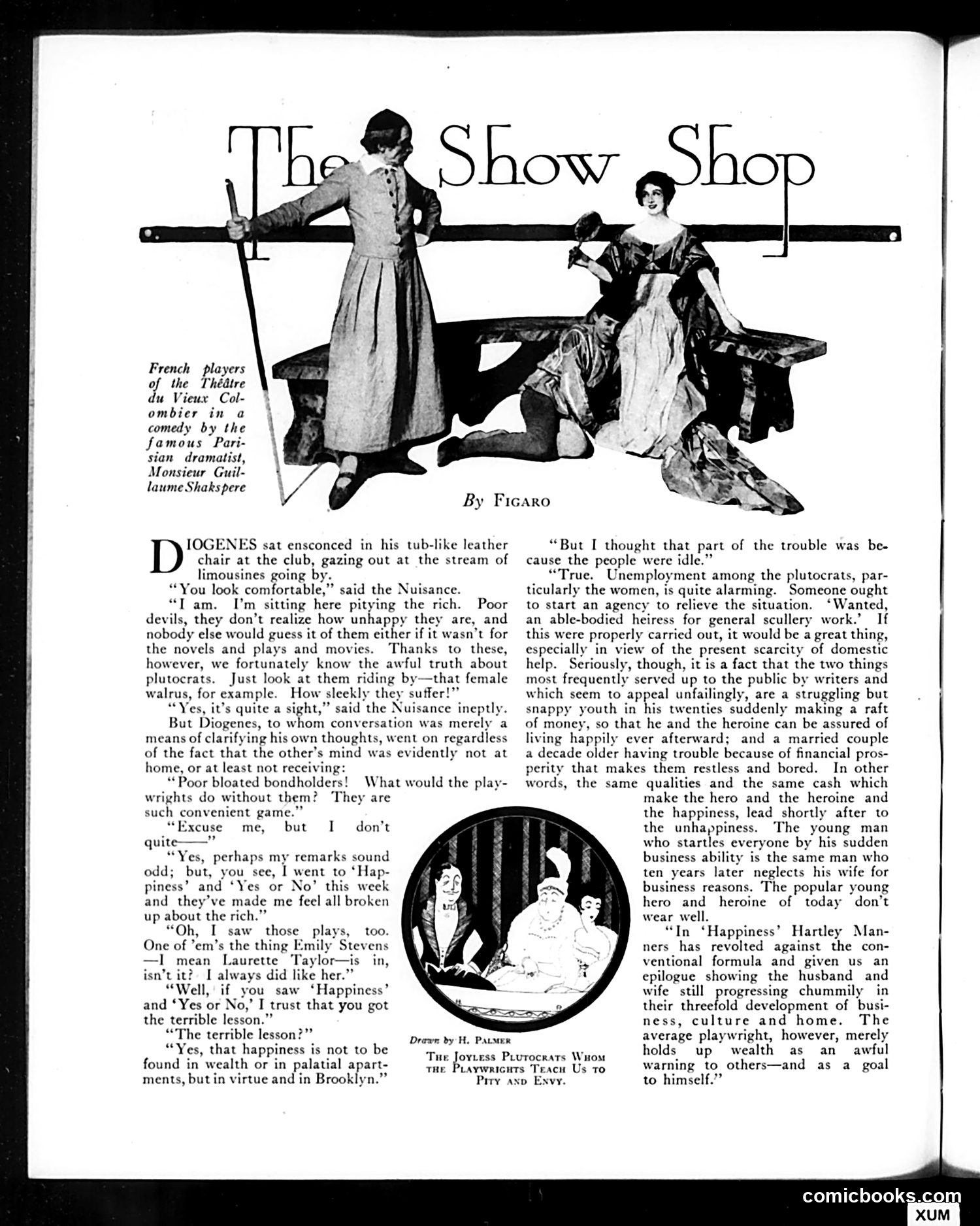
This page satirizes contemporary American playwrights (circa 1910s-20s) for their simplistic moralizing about money. The dialogue features two club members discussing recent plays like "Happiness" and "Yes or No," which the narrator claims teach that true happiness comes from virtue and Brooklyn—not wealth. The satire targets playwrights' lazy formula: wealthy characters are portrayed as miserable, while struggling youth who suddenly acquire money find happiness. The critic points out this is contradictory—the same ambition that creates success later causes neglect and unhappiness. The header notes the page discusses a French theatrical production by Monsieur "Guillaume Shakspere" (a playful misspelling suggesting even classical dramatists engage in such themes). The cartoons showing theatrical scenes illustrate these morality plays about the rich. The underlying joke: playwrights use wealth as convenient "game" to preach virtue while secretly desiring that very wealth themselves.
📄 Transcribed text from this page (OCR, searchable)
Machine-transcribed from the original scan — historical spelling and the odd misread are preserved.
French players of the Thédtre du Vieux Col- ombier in a comedy by the famous Pari- sian dramatist, Monsieur Guil- laume Shaks pere By Ficaro IOGENES sat ensconced in his tub-like leather D chair at the club, gazing out at the stream of limousines going by. “You look comfortable,” said the Nuisance. “Tam. I’m sitting here pitying the rich. Poor devils, they don’t realize how unhappy they are, and nobody else would guess it of them either if it wasn’t for the novels and plays and movies. Thanks to these, however, we fortunately know the awful truth about plutocrats. Just look at them riding by—that female walrus, for example. How sleekly they suffer!” “Yes, it’s quite a sight,” said the Nuisance ineptly. But Diogenes, to whom conversation was merely a means of clarifying his own thoughts, went on regardless of the fact that the other’s mind was evidently not at home, or at least not receiving: “Poor bloated bondholders! What would the play- wrights do without them? They are such convenient game.” excuse me, but I don’t quite- “Yes, perhaps my remarks sound odd; but, you see, I went to ‘Hap- piness’ and ‘Yes or No’ this week and they’ve made me feel all broken up about the rich.” “Oh, I saw those pla too. One of ’em’s the thing Emily Stevens —I mean Laurette Taylor—is in, isn’t it? I always did like her.” “Well, if you saw ‘Happiness’ and ‘Yes or No,’ I trust that you got the terrible lesson.” “The terrible lesson?” “Yes, that happiness is not to be found in wealth or in palatial apart- THE ments, but in virtue and in Brooklyn.” Drawn by H, Pauwer Tue fovtzss Prurocrats Wom LAYWRIGHTS Js Prry axp Envy. “But I thought that part of the trouble was be- cause the people were idle.” “True. Unemployment among the plutocrats, par- ticularly the women, is quite alarming. Someone ought to start an agency to relieve the situation. ‘Wanted, an able-bodied heiress for general scullery work.’ If this were properly carried out, it would be a great thing, especially in view of the present scarcity of domestic help. Seriously, though, it is a fact that the two things most frequent rved up to the public by writers and which seem to appeal unfailingly, are a struggling but snappy youth in his twenties suddenly making a raft of money, so that he and the heroine can be assured of living happily ever afterward; and a married couple a decade older having trouble because of financial pros- perity that makes them restless and bored. In other , the same qualities and the same cash which make the hero and the heroine and the happiness, lead shortly after to the unhappiness. The young man who startles everyone by his sudden business ability is the same man who ten years later neglects his wife for business reasons. The popular young hero and heroine of today don’t wear well. “In ‘Happiness’ Hartley Man- ners has revolted against the con- ventional formula and given us an epilogue showing the husband and wife still progressing chummily in their threefold development of busi- ness, culture and home. The average playwright, however, merely holds up wealth as an awful warning to others—and as a goal racn Us To 1 > to himself. comicbooks.com