
Judge, 1918-02-16 · page 3 of 36
Judge — February 16, 1918 — page 3: what you’re looking at
What you’re looking at
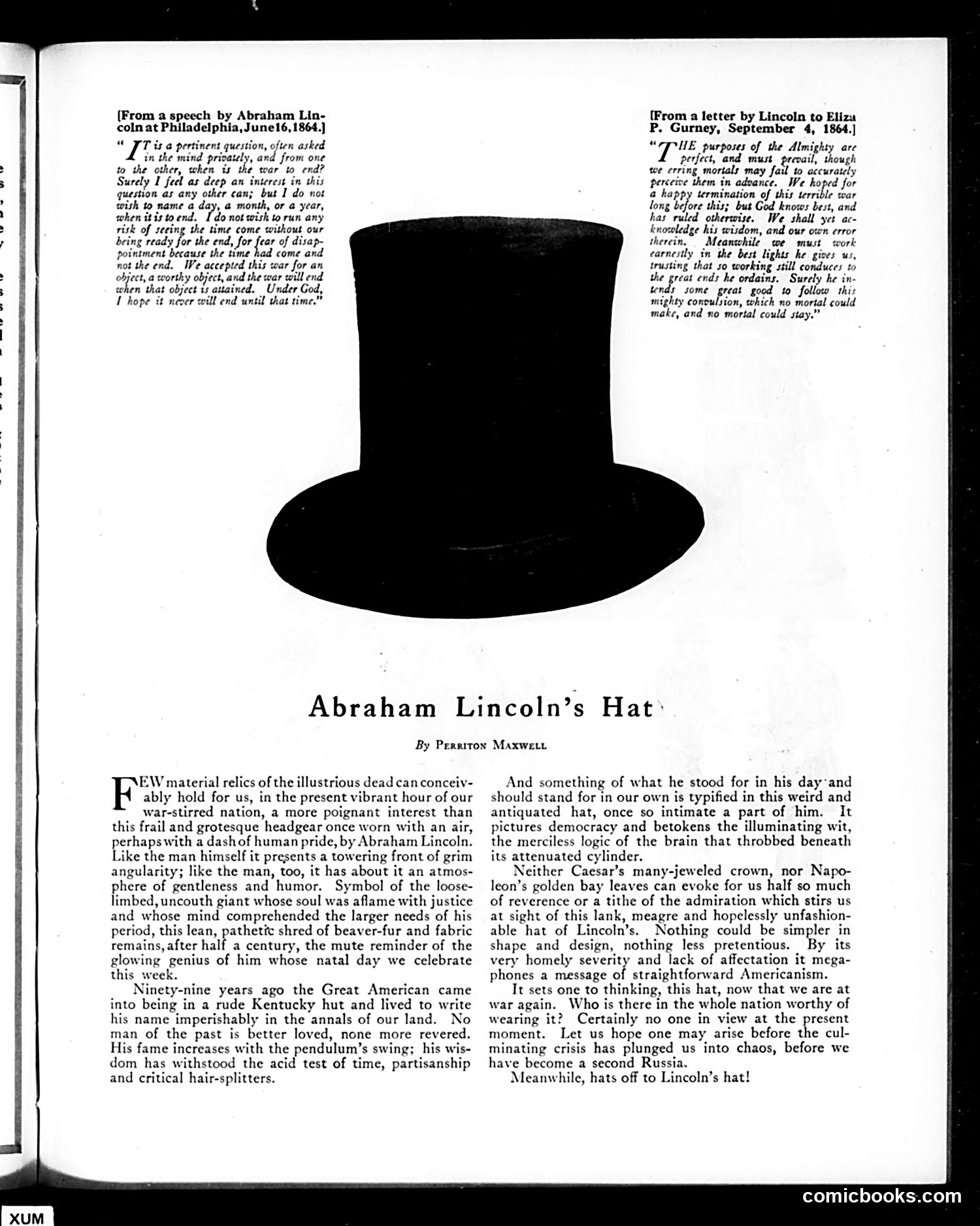
This page from *Judge* magazine features an article by Perriton Maxwell about Abraham Lincoln's tall stovepipe hat, presented as a historical relic worthy of reverence. The text celebrates Lincoln as an American icon whose "wisdom has withstood the acid test of time" and whose legacy grows stronger with decades. The article frames the hat symbolically—as representing Lincoln's character: "simplicity," "homely severity," and "lack of affectation." The author contrasts it favorably with grandiose symbols like Caesar's crown or Napoleon's laurels, suggesting American democracy values humble authenticity over ornate power. The piece appears written during a period of national crisis (possibly WWI era, given references to "chaos"), using Lincoln's enduring memory to inspire contemporary Americans facing turbulent times.
📄 Transcribed text from this page (OCR, searchable)
Machine-transcribed from the original scan — historical spelling and the odd misread are preserved.
Pe he >. TA STINT (From a speech by Abraham Lin- coln at Philadelphia, June 16,1864.) “ TT is a pertinent question, often asked in the mind privately, and from one to the other, when ts the war to end? Surely I feel as deep an interest in this question as any other can; but I do not wish to name a day, @ month, or a year, when itistoend. [do not wish to run any risk of seeing the time come without our being ready for the end, for fear of disap- pointment because the time had come and not the end. We accepted this war for an object, a worthy object, and the war will end when that object 1s attained. Under God, I hope it never will end until that time.” {From a letter by Lincoln to Eliza P. Gurney, September 4, 1864.) “THE purposes of the Almighty are perfect, and must prevail, though we erring mortals may fail to accurately perceive them in adoance. We hoped for @ happy termination of this terrible war long before this; bus God knows best, and has ruled otherwise. We shall yet ac- knowledge his wisdom, and our own error therein. Meanwhile we must work earnestly in the best lights he gives us, trusting that so working still conduces to the great ends he ordains. Surely he in- tends some great good to follow this conoulsion, which no mortal could and no mortal could stay.” Abraham Lincoln’s Hat: By Peaniton Maxwett ably hold for us, in the present vibrant hour of our war-stirred nation, a more poignant interest than this frail and grotesque headgear once worn with an air, perhaps with a dashof human pride, by Abraham Lincoln. Like the man himself it presents a towering front of grim angularity; like the man, too, it has about it an atmos- phere of gentleness and humor. Symbol of the loose- limbed, uncouth giant whose soul was aflame with justice and whose mind comprehended the larger needs of his period, this lean, pathetic shred of beaver-fur and fabric remains, after half a century, the mute reminder of the glowing genius of him whose natal day we celebrate this week. Ninety-nine years ago the Great American came into being in a rude Kentucky hut and lived to write his name imperishably in the annals of our land. No man of the past is better loved, none more revered. His fame increases with the pendulum’s swing; his wis- dom has withstood the acid test of time, partisanship and critical hair-splitters. | NEW material relics of the illustrious dead can conceiv- And something of what he stood for in his day’and should stand for in our own is typified in this weird and antiquated hat, once so intimate a part of him. It pictures democracy and betokens the illuminating wit, the merciless logic of the brain that throbbed beneath its attenuated cylinder. Neither Caesar’s many-jeweled crown, nor Napo- leon’s golden bay leaves can evoke for us half so much of reverence or a tithe of the admiration which stirs us at sight of this lank, meagre and hopelessly unfashion- able hat of Lincoln’s. Nothing could be simpler in shape and design, nothing less pretentious. By its very homely severity and lack of affectation it mega- phones a message of straightforward Americanism. It sets one to thinking, this hat, now that we are at war again. Who is there in the whole nation worthy of wearing it? Certainly no one in view at the present moment. Let us hope one may arise before the cul- minating crisis has plunged us into chaos, before we have become a second Russia. Meanwhile, hats off to Lincoln’s hat! comicbooks.com